
- What Is an NRI PAN Card?
- What Is a Normal PAN Card for Resident Indians?
- NRI PAN Card vs Normal PAN Card: Key Differences Explained
- Advantages of Having a PAN Card in India
- Why Is an NRI PAN Card Important for NRIs?
- NRI PAN Card vs Normal PAN Card: Application Process
- Documents Required for NRI PAN Card and Normal PAN Card
- Final Thoughts on NRI PAN Card vs Normal PAN Card
Talking about an NRI PAN card and a regular PAN card is essentially the same thing, but viewed from different angles. Aregularl PAN card is meant for resident Indians living in the country. For them, the PAN card serves as a passport for managing finances and is used for almost everything, from buying a mobile connection to paying taxes in India.
Now let’s talk about the other aspect - the NRI PAN card used by Indians living overseas. NRIs may be running a business or working abroad, but they still need to stay connected to the Indian financial system, especially if they earn income in India. So, when we talk about the difference between an NRI PAN card and a regular PAN card, we are essentially discussing the same document viewed from different residential perspectives. Confused? Not to worry, this guide will clear all your doubts and help you understand the exact difference between an NRI PAN card and a regular PAN card.
- The NRI PAN card is for Indian citizens staying overseas. It streamlines their connection to India's financial system, specifically for tax purposes.
- The regular PAN card is for Indian residents and is essential for managing domestic financial activities and tax obligations.
- Both PAN card types have the same format and validity. Both cards remain valid for life without renewal.
- An NRI can apply online or through authorized services abroad. At the same time, Indian residents can use the official Income Tax Department channels.
- Both an NRI and a regular PAN card are essential for legal compliance regarding taxes and financial transactions.
- NRI PAN cards are used for property transactions, such as opening NRE/NRO accounts or making investments in India.
What Is an NRI PAN Card?
An NRI PAN card is a tax identity issued to individuals who are not residing in India but are Indian citizens. It is for non-resident Indians who, for various reasons such as education, job opportunities, or residence, are spread across the world. Additionally, PIOs (People of Indian Origin), OCI (Overseas Citizen of India), foreign nationals, and international companies not registered in India can also apply for an NRI PAN card. Apart from the status difference, in terms of validity and structure, the PAN (Permanent Account Number) remains the same, like the regular PAN card in India.
It is issued to NRIs who wish to conduct financial transactions and participate in investment activities in India. This involves managing bank accounts in India, purchasing property, investing in mutual funds and the stock market, or doing any transaction that needs a tax account number in India. Despite physical absence, a PAN card helps NRIs remain in the financial and tax loop in India. Apart from this, this card is considered a valid ID proof in India and allows NRIs comply with the country's tax rules. While the format and design of the NRI PAN Card are the same as a regular PAN card, it is linked to the non-resident status of the cardholder for specific uses.
What Is a Normal PAN Card for Resident Indians?
A regular PAN card is issued to Indian residents living within the country. A PAN card is a personal identification number that enables the tax-related activities and financial transactions of Indian residents to be traced on a single thread. This includes banking transactions, salary, buying assets and property, or any activity that involves monetary transactions taxable under Indian law. Through regular PAN cards, the Indian government tracks the financial activities of Indian residents and ensures they fulfill their tax obligations.
NRI PAN Card vs Normal PAN Card: Key Differences Explained
Based on different factors, here is a quick comparison between an NRI PAN Card and a Normal PAN Card:
| Criteria | NRI PAN Card | Normal PAN Card |
|---|---|---|
| Eligibility Criteria | NRI PAN card is designed for Indian citizens living outside India for business, employment, and other purposes, as well as for foreign nationals and international companies. | A typical PAN is issued to Indian citizens who live in the country. |
| Application Process | NRIs can apply for a PAN card either online or through authorized companies overseas. | Indian residents can apply for a PAN card directly on the official Income Tax Department website or in person at a designated center. |
| Residential Status | An NRI PAN card is issued to individuals living outside India. | A regular PAN card is issued to Indian residents living within the country. |
| Taxation Rules | NRIs are subject to different tax regulations, such as the Double Taxation Agreement (DTAA) and the Foreign Account Tax Compliance Act (FATCA), which determine their tax liabilities based on their resident country and income earned in India. | Indian residents are subject to standard tax regulations. |
| Types of Transactions | NRI PAN cards are generallyhelpfull for specific transactions, including buying property, opening bank accounts, making investments, and doing financial transactions in IndiaRegular | PAN cards are generally used for several financial activities in India, such as taking a bank loan, opening a bank account, and more. |
| Repartition of Funds | NRI PAN cards facilitate compliance with India's tax laws for NRIs during the repatriation of funds. | Not used for funds repartition. |
| Validity | NRI PAN cards are valid for a lifetime and do not require reissuance or renewal. | Comes with lifetime validity and does not need renewal or reissuance. |
| Documents Required | ID, address, and date of birth proof, passport, abroad address proof, and proof of NRI status. | Require ID, address, and date of birth proof. |
| Tax Benefits | Under specific circumstances, NRIs can avail of several tax benefits, such as exemption from certain incomes. | Offer standard tax benefits to Indian residents. |
| Bank Account Operations | Using an NRI PAN card, NRIs can open NRE (Non-resident External) and NRO (Non-resident Ordinary) accounts in India. | It can be used to open standard bank accounts in India. |
Advantages of Having a PAN Card in India
Here are the following benefits of having a PAN card by your side:
- Tax Management: A PAN card is used as a unique identifier for tracking financial records and tax filings.
- Simplified Transactions: It is one of the vital documents for investing in the stock market, conducting property deals, and engaging in mutual fund transactions.
- Identity Verification: A PAN card is globally recognized as a reliable identity proof across several services.
Why Is an NRI PAN Card Important for NRIs?
Apart from the benefits mentioned above, an NRI PAN card offers several additional perks. These are as follows:
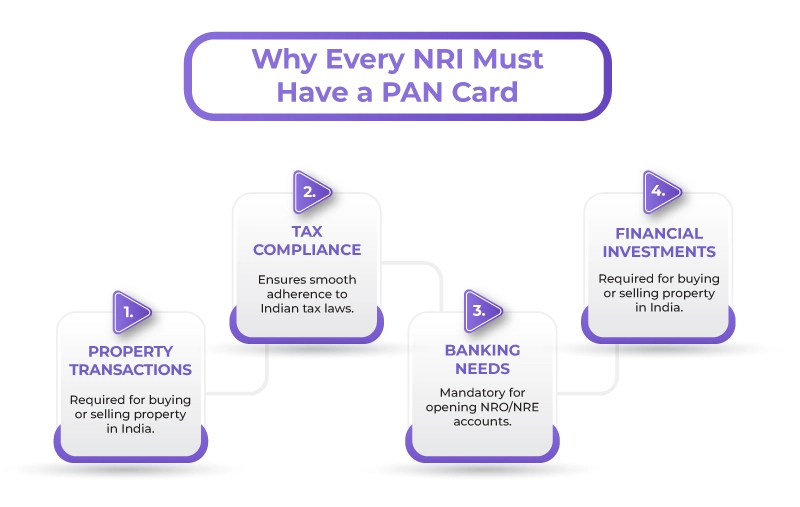
- Property Management: An NRI must have a PAN card to purchase or sell property in India. It is one of the essential documents required for a smooth, legal property transaction.
- Compliance with Tax Laws: An NRI PAN card helps NRIs comply with India's tax regulations on income earned in India. It is essential for NRIs, as it allows them to maintain their legal standing and tax implications with financial institutions in India.
- Ease in Banking Operations: To open an NRO account and an NRE Account in Indian banks, NRIs need a PAN card. It is one of the vital documents required while opening a bank account in India. To manage income in India and overseas, NRIs need to open these accounts.
- Facilitation of Financial Investments: With a PAN card in hand, NRIs can easily invest in mutual funds, the Indian stock markets, and other financial instruments. These investments further help offer better returns to NRIs than other markets.
NRI PAN Card vs Normal PAN Card: Application Process
The application process for both NRIs and Indian residents is straightforward and can be completed from anywhere in the world. Moving on, let's look at the NRI's application process.
PAN Card Application Process for NRIs
As an NRI, to apply for a PAN card, you need to follow the steps mentioned:
- To apply for a PAN card, visit the official TIN-NSDL website.
- Fill out Form 49A with the correct information and upload all the requested documents.
- Additionally, attach digital copies of address proof, identification proof, DOB proof, and a recent passport-size photograph.
- Cross-check all the mentioned information and the attached documents before paying the PAN card fee.
- Once you make the payment, you will receive an acknowledgment receipt. It also helps you track the status of your PAN application.
PAN Card Application Process for Resident Indians
There are two ways for Indian residents to apply for a PAN card: online and offline. Moving ahead, let's go into more detail about them.
Online PAN Card Application Process
- Visit the official NSDL website to apply for a PAN card in India.
- As part of the verification process, please mention your Aadhaar card number.
- Carefully complete the online PAN application form and upload the required documents.
- Once you have cross-checked all the details using any of the available online payment options, pay the PAN card fee.
- After payment confirmation, you will receive a 15-digit acknowledgment number. Further through it, you can easily track your application status.
Offline PAN Card Application Process
- To apply offline, Indian residents must first download the application form from the NSDL website.
- Then, fill out the form with the correct information and attach the requested documents.
- After that, along with the demand draft or cheque, dispatch the filled form and attach the documents to the specified PAN service center. You can find a list of nearby PAN card centres on the official website.
- Within 15-20 days of submitting your application, you will receive your PAN card.
Apply, update, or correct your NRI PAN card with ease.
Documents Required for NRI PAN Card and Normal PAN Card
In India, having a PAN card requires submitting several documents to establish your address, identity, and age, making the application process more manageable. Although the documents remain the same for both Indian residents and NRIs, some of them differ. Moving on, let's review the documents both parties need to submit.
Documents Required for a Normal PAN Card (Resident Indians)
Here is the list of documents required when applying for a regular PAN card:
- Identity Proof: Any of the mentioned documents
- Passport copy
- Voter ID card copy
- Aadhaar card copy
- Driving license copy
- Pensioner card copy
- Address Proof: Any of the stated documents
- Driving license copy
- Passport copy (if address is mentioned)
- Domicile certificate granted by the government
- Recent utility bill (landline, electricity, gas, and more)
- Bank account statement or bank passbook
- Date of Birth Proof: Any of the following documents
- Copy of birth certificate
- Copy of passport
- Matriculation certificate copy
- Photographs: Two recent passport-size colored photographs
Note: Ensure that your name and date of birth are consistent across all submitted documents. For Indian residents, Aadhaar is mandatory for linking with PAN, unless exempted under special provisions.
Documents Required for NRI PAN Card
To acquire an NRI PAN card, linking to the financial system of India, NRIs need to submit the following documents:
- ID Proof: Copy of Passport
- Overseas Address Proof: Any of the mentioned documents
- NRE bank account statement in India
- Overseas driving license
- Bank accountant statement copy in the current resident country
- An ID card issued by the government indicating the residence or nationality status
- Copy of residence permit in the residence country, attested by the Indian Consulate/Embassy/ High Commission
- Proof of NRI Status: PIO or OCI card, if applicable
- Photographs: Two recent passport-size colored photographs
Note: All NRI documents must be self-attested and, in many cases, also attested by the Indian Embassy/Consulate or a notary public in the resident's country.
| Document Type | Regular PAN Card (Indian Residents) | NRI PAN Card (Non-Resident Indians) |
|---|---|---|
| ID Proof | Any one of: • Aadhaar Card • Voter ID • Passport • Driving License • Pensioner Card |
• Passport (mandatory) |
| Address Proof | Any one of: • Driving License • Passport (with address) • Domicile Certificate • Utility Bill (electricity, gas, landline, etc.) • Bank Statement or Passbook |
Any one of: • NRE Bank Statement (India) • Overseas Driving License • Foreign Bank Statement (current residence country) • Residence/Nationality card (issued by local govt.) • Residence Permit (attested by the Indian Embassy/Consulate) |
| Date of Birth Proof | Any one of: • Birth Certificate • Passport • 10th/Matriculation Certificate |
Any one of: • Birth Certificate • Passport |
| Proof of NRI Status | ❌ Not Required | ✔️ Required: • PIO or OCI Card • Visa or Residence Permit (if not PIO/OCI) |
| Photograph | Two recent passport-size color photographs | Two recent passport-size color photographs |
| Document Attestation | Self-attested copies | Self-attested + Embassy/Notary attested (as required) |
Final Thoughts on NRI PAN Card vs Normal PAN Card
Whether you are an NRI looking to invest in your home country or an Indian resident managing finances in India, having a correct PAN card simplifies your legal tax obligations and financial transactions within the country. To provide you with a clear idea, the above guide outlines the key difference between an NRI PAN card & regular PAN card, and how they simplify things for an individual. In support of your journey, Savetaxs helps you with correctly filing your ITR in India and solves any tax-related queries. If you have any questions about your tax liability or are facing issues with filing your ITR, please connect with us. We have a team of professionals who can assist you and guide you through the entire process smoothly.

Shubham Jain is the Founder of SaveTaxs and has extensive experience in Indian and NRI taxation. He advises individuals, NRIs, and businesses on tax filing, tax planning, capital gains, DTAA benefits, fund repatriation, and compliance matters. He regularly writes about taxation and related financial topics. His focus is on making complex tax concepts easy to understand. Through his articles, he helps taxpayers stay informed, avoid common mistakes, and stay compliant with Indian tax laws. See Full Bio
Expert CA-led ITR filing

- What Is an NRI PAN Card?
- What Is a Normal PAN Card for Resident Indians?
- NRI PAN Card vs Normal PAN Card: Key Differences Explained
- Advantages of Having a PAN Card in India
- Why Is an NRI PAN Card Important for NRIs?
- NRI PAN Card vs Normal PAN Card: Application Process
- Documents Required for NRI PAN Card and Normal PAN Card
- Final Thoughts on NRI PAN Card vs Normal PAN Card
Frequently Asked Questions
No, the PAN card does not show NRI status on it. It only shows PAN number, name, date of birth, father's name, photograph, and signature of the individual.
For an NRI PAN card, the government charges a fee of INR 1011. It includes PAN application fee and dispatch charges, i.e., Rs. 857 and 18% GST to people with an address outside India. Additionally, a PAN card delivered to an Indian address costs Rs 107, including GST.
To convert your normal PAN card to an NRI PAN card, visit the official TIN NSDL website. Using your credentials, log in to the website. Once you log in to the portal, go to the edit profile option from the dashboard, click on the edit option, and update your resident status as 'non-resident.' It is how you can simply change your status on the PAN card.
According to the Indian Aadhaar Card Act, an NRI doesn't need to obtain an Aadhaar card unless they live in India for 182 days or more in 1 year. However, if the NRIs already have the card, then linking with their PAN card is a must, and not linking can result in an inoperative PAN.
Yes, an NRI is eligible to apply for a PAN card if he/she are involved in financial activities in India. Whether they are earning rental income, investing in stock markets or mutual funds, or opening an NRO savings account and NRE account, having a PAN card eases the financial transactions and tax compliance in India.