
Are you a US-based NRI investing in India? If yes, having your PFIC tax explained for Indian investment is vital to avoid the IRS penalties and audit risk. A Passive Foreign Investment Company (PFIC) is a foreign corporation that earns minimum 75% of its income from passive sources or holds at least 50% of its assets for generating passive income. Considering this, US-based NRIs investing in Indian financial products such as mutual funds, ETFs, and other investments unknowingly trigger PFIC rules. It further leads to tax consequences.
Confused? To help you out, this blog explains what the PFIC tax is and how it attracts Indian investments. So read on and gather all the information.
- The IRS classifies an entity as a PFIC if 75% or more of its income is passive or 50% or more of its assets generate passive income.
- To classify whether an Indian investment comes under PFIC or not, the IRS applies two tests annually, i.e., the passive income test and the passive asset test.
- Indian mutual funds are considered as PFICs as they are non-US pooled investment vehicles, earn passive income, and are structured as companies or trusts.
- Generally, you must file IRS Form 8621 for each PFIC investment you own, subject to the filing requirements and exceptions prescribed by the IRS. In many cases, filing is required even if you do not sell the investment or receive any distribution during the year.
- You can avoid PFIC taxes by buying individual stocks of Indian companies and US-domiciled funds.
What is a PFIC Under US Tax Laws?
According to Section 1297 of the US Internal Revenue Code, a PFIC is any foreign corporation that meets either the 75% passive income test or the 50% passive asset test. In simple words, these are just investment vehicles registered outside the US. Considering this, NRIs with a financial connection to India should know that this classification affects major tax implications.
Passive Income Test
If 75% or more of the corporation's gross income is derived from passive sources, it is classified as passive income. It includes
- Rent and royalties
- Dividends and interest
- Capital gains from securities trading
- Annuity payments
- Income from commodities and currency transactions
Asset Test
If at least 50% of the average value of the foreign corporation's assets during the taxable year produce, or are held to produce, passive income, it satisfies the passive asset test. Considering this, different corporations use different asset valuation methods to calculate PFIC. For instance:
- Publicly traded corporations use fair market value
- Controlled foreign corporations use adjusted basis
- Other foreign corporations can use any of these two methods
To be classified as PFIC, a foreign entity needs to fulfill only one of these tests. Considering this, most investment vehicles like ETFs, mutual funds, and unit trusts easily satisfy both the tests. Additionally, if you are a U.S. taxpayer and hold these investments through an NRO account, demat account, or an Indian broker, the PFIC rules may apply to you.
This was all about PFIC under US tax laws. Moving ahead, let's know why Indian mutual funds are treated as PFICs.
Why are Indian Mutual Funds Treated as PFICs?
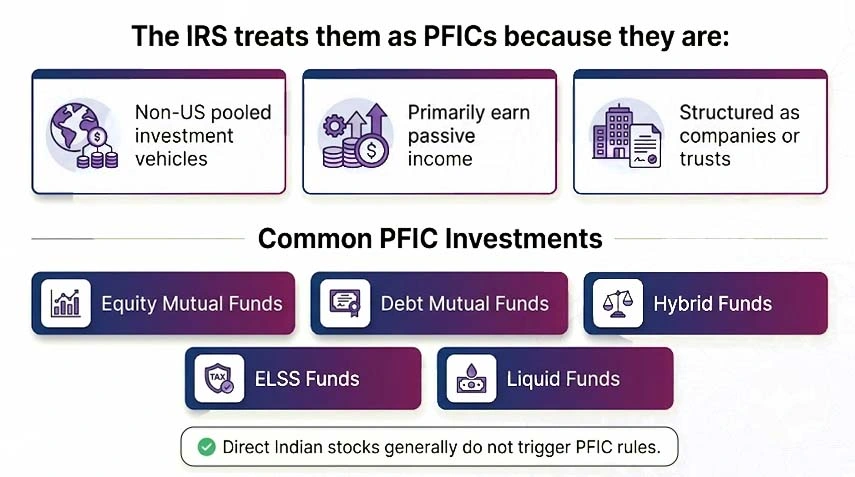
Indian mutual funds are treated as PFICs by the IRS because they are:
- Non-US pooled investment vehicle
- Primarily earn passive income
- They are generally structured as companies or trusts and are not U.S.-regulated investment funds.
Further, as an outcome of it, almost all Indian mutual funds are stated as PFICs, including:
- Equity mutual funds
- Debt mutual funds
- Hybrid funds
- ELSS funds
- Liquid funds
Direct investments in Indian stocks do not trigger the US PFIC rules. It creates a chance to avoid PFIC difficulty by directly investing in individual Indian stocks instead of mutual funds. Generally, the type of account does not change the PFIC classification. If you are a U.S. taxpayer, PFIC rules may apply regardless of whether the investment is held through an NRO account, demat account, or another eligible investment account.
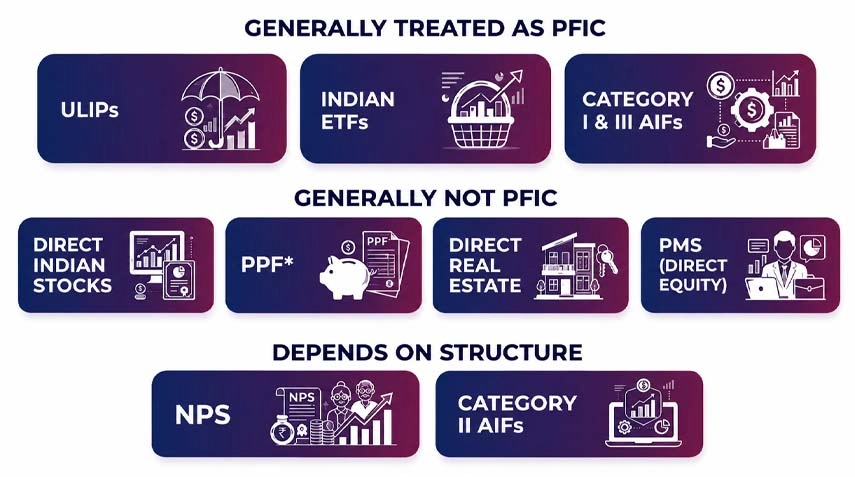
Moreover, let's know how other popular Indian investments are treated under PFIC rules.
- ULIPs: Unit Linked Insurance Plans with both investment and insurance parts come under PFICs.
- AIFs: Alternative Investment Funds, specifically Category 1 and 3, are counted as PFICs.
- ETFs: As per IRS guidelines, all Indian exchange-traded funds come under PFICs.
- PPF: Public Provident Fund is generally not stated as PFIC as it is a government scheme, not a foreign corporation. However, this investment has separate FBAR and FATCA reporting requirements.
- NPS: National Pension Scheme of PFIC classification is a grey area. It depends on how the scheme is structured and which underlying funds are selected.
Category 2 AIFs might avoid classification under PFIC if they distribute all income and capital gains to unit holders. Additionally, direct investments in real estate, bonds, or Portfolio Management Services that follow direct equity investments are also not counted as PFIC.
So, here is why Indian mutual funds are treated as PFIC. Moving further, let's know the PFIC tax explained for Indian investments for NRIs in the US.
With Savetaxs, experience accurate, stress-free, and fast tax filing without an issue.
PFIC Tax Rules for NRIs in the US
There are three different tax methods that are imposed on the Indian mutual funds held by US-based NRIs. Each tax method has its own implications and reporting needs.
Default Methods: Excess Distribution Rules
This taxation method applies automatically if you do not choose any other option. It is generally the most costly option for long-term investors.
- How It Works: When you sell PFIC shares or receive a distribution, the IRS treats the part of the capital gain as "excess distribution." Additionally, allocates the gains across all years you owned the investment. Here, on each year's allocated portion, you pay ordinary income tax rates plus an interest charge for the theoretical deferral benefit.
- Tax Rate: The ordinary PFIC tax rates can be up to 37% plus interest charges. This tax burden can take your returns with tax rates that might go above 50%.
- When It Makes Sense: This is a default tax option that is imposed when you do not choose a tax method.
Mark-to-Market (MTM) Election
This tax method is available for only PFICs traded on eligible exchanges.
- How It Works: MTM elections mean your PFIC shares are treated as if you sold them every December 31. Considering this, you pay tax on gains every year, even if you do not sell anything. Additionally, you can claim capital gain losses against the gains if you reported them before.
- Tax Rate: Ordinary PFIC rates up to 37% without any interest charges.
- Requirements: The following are the requirements of the MTM Election:
- PFIC should be traded on a qualified exchange.
- Can be made in any financial year you held the PFIC
- The election is made on IRS Form 8621 and filed along with your U.S. income tax return.
- When It Makes Sense: This tax method is applicable when you own public traded PFIC and expect annual gains. This tax method is best for investments you plan to hold for a long term in nations where there are low local taxes.
Qualified Electing Fund (QEF) Election
It is the most favorable tax method. This tax method lets you treat your Indian investments like US mutual funds.
- How It Works: Under this taxation method, you report your proportional share of the ordinary earnings of PFIC and net capital gain annually. Considering this, ordinary earnings are taxed at general rates, but capital gains from these investments qualify for preferential long-term gain rates.
- Tax Rate: Ordinary income tax rates on earnings, preferential rates of 0-20% on capital gains.
- Critical Requirements: The following are the critical requirements of this tax method:
- The PFIC must provide a PFIC Annual Information Statement containing the information required to make a QEF election.
- Should make a tax election in the first year you held the PFIC
- If you missed the tax deadline, you need IRS approval to make a late election (Form 8621, along with a "protective" statement)
- When It Makes Sense: This taxation method has a reduced long-term tax burden with capital gains treatment.
This was all about PFIC tax rules for NRIs in the USA holding Indian mutual funds. Further, for most NRIs, MTM is the most viable tax option as Indian mutual funds do not provide the required statements. Now, moving forward, let's better understand the PFIC tax explained for Indian investment with an example.
PFIC Tax Rules Explained for US-based NRIs with an Example
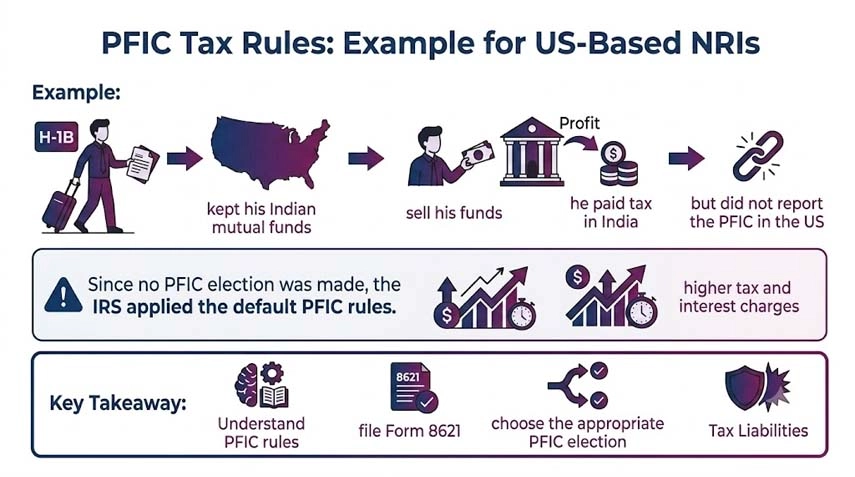
For instance, in 2019, with an H-1B visa, Mr. A moved to the US and became a tax resident there. However, before leaving India, he invested INR 15,00,000 in three different mutual fund schemes. It includes an equity fund, a liquid fund, and a balanced fund. Further, in 2024, with a profit of INR 7,00,000 (about $8500), he sold his Indian mutual funds for INR 22,00,000. On his Indian tax return, he reported this income as capital gain and paid the required taxes.
However, he was not aware that he was also liable to pay PFIC tax in the US. Since he was unaware of the tax obligation, he didn't make any special tax elections. Considering this, the default tax rule applies to him. As per that, his $8500 capital gain is allocated across all the years when he held the investments, and each year's portion would be taxed at a higher tax rate for that year, plus interest charges. Here, his US tax on the capital gain exceeded $4200- much higher than the 15% long-term capital gains tax that he expected.
If Mr. A knows about the US PFIC tax rules, and had made an MTM election when he became a US tax resident in 2019. Additionally, file the necessary Form 8621, his tax situation would be different.
So from the above example, you must understand why it is important for US-based NRI to know about PFIC tax rules and choose the right taxation method. Moving ahead, let's know the PFIC reporting requirements for NRI under US tax laws.
PFIC Reporting Requirements
Form 8621 is the main reporting tool for all your PFIC holdings. Considering this, for each PFIC you own directly or indirectly, you need to file a separate Form. Additionally, your annual tax return should also include Form 8621. Further, you need to file this form when you:
- Receive distribution from a PFIC
- Make a QEF or MTM election
- Receive capital gain on disposition of PFIC shares
- Own PFICs with a combined value of more than $25,000 (single) or $50,000 (married filing jointly)
You need to mention the following information in the Form 8621:
- Name and EIN (if available) of the PFIC
- Beginning and ending shares or value
- Sales or dispositions during the year
- Distributions you get during the year
- Election type and calculations
Other Forms: FBAR and FATCA (Form 8938)
Beyond Form 8621, your PFIC investment might need additional reporting. These are as follows:
- FBAR (FinCEN Form 114): You need to fill out this form when your foreign financial accounts total is more than $10,000 at any time during the financial year.
- Form 8938 (FATCA): This form is required when specified foreign financial assets are more than $50,000 on the last day of the tax year or $75,000 at any point during the financial year.
Each form has a unique threshold, deadlines, and filing locations.
Penalties for Non-Compliance
Form 8621 does not impose any direct monetary penalties, but missing the filing creates serious issues. The IRS can indefinitely examine your entire tax return. Additionally, it also imposes the Excess Distribution method by default without proper tax filing. Apart from this, FBAR violations may attract significant civil penalties, which are adjusted periodically for inflation. The applicable penalty depends on whether the violation is non-willful or willful.
This was all about the PFIC requirement for NRIs living in the US. Moving further, let's know how NRIs can reduce PFIC compliance issues.
How NRIs Can Reduce PFIC Compliance Issues?
NRIs can minimize the PFIC compliance issues in the following ways:
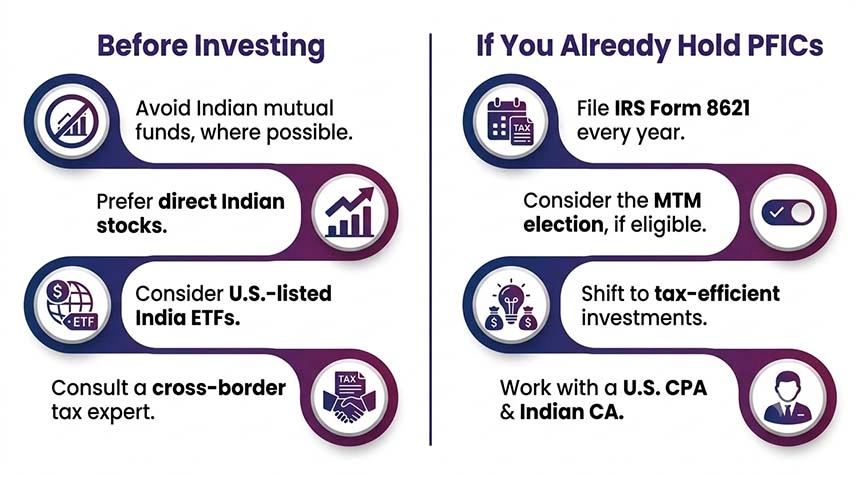
Before Investing in Indian Mutual Funds
If you are a US tax resident planning to invest in India, consider the mentioned points:
- Avoid investing in Indian mutual funds where possible, as under PFIC tax rules, these are taxable for US residents.
- Consider investing directly in Indian stocks through a U.S.-compliant broker, as individual stocks do not come under PFICs.
- Explore US-listed India ETFs, such as those investments listed on NASDAQ or NYSE. These invest in Indian markets, which do not count as PFICs as they are US corporations.
- Take the help of a US CPA with cross-border tax and investment expertise before making any Indian investment.
If You Already Hold PFIC Investments
In case you already hold PFIC investments, consider the following points:
- As early as possible, make the MTM election on IRS Form 8621, ideally in the first year you became a U.S. tax resident or acquired the PFIC.
- File Form 8621 for every investment, every year, even if there are no transactions.
- Consider exiting Indian mutual fund positions gradually and reinvesting through tax-efficient structures.
- Work with a US CPA and an Indian CA together for PFIC tax planning and coordination across the tax systems of both countries.
So, this is how NRIs can reduce their PFIC compliance issues in the US.
At Savetaxs, we provide expert tax consultation to NRIs living in the US and reduce their tax obligations.
Final Thoughts
Lastly, for NRIs in the US with Indian mutual fund investments, ignoring the PFIC tax rules can create issues. To ensure compliance, file Form 8621 and select the correct tax method early. Mistakes in PFIC compliance can lead to hefty costs in interest, taxes, and penalties. So, understanding the PFIC tax explained for Indians is important for effectively navigating these challenges.
Further, if you are looking for professional guidance for managing your US and Indian taxes, connect with Savetaxs. We have a team of financial experts with years of experience in cross-border taxation. They can guide you in tax planning, filing your returns, and maximizing your tax refunds.

Hatim Dudhiyawala is a Certified Public Accountant (CPA) with SaveTaxs and specializes in Indian and NRI taxation. He advises individuals, NRIs, and businesses on income tax filing, capital gains taxation, DTAA benefits, fund repatriation, and tax compliance. With experience in cross-border tax matters, Hatim helps taxpayers understand complex regulations and make informed decisions. Through his articles, he shares practical insights to help readers stay compliant and manage their tax obligations with confidence. See Full Bio
Expert CA-led ITR filing

Frequently Asked Questions
With respect to the Internal Revenue Service, Form 8621 is used by U.S. taxpayers to report their shares in passive foreign investment companies.
The PFIC tax is a highly disciplinary US tax regime applied to investments made in Passive Foreign Investment Companies, such as foreign-based mutual funds or FTFs.
As high as 40%.
If you hold shares of PFIC, you may not have to file Form 8621 with the IRS each year for each PFIC investment.
By now, there is no such direct monetary penalty associated with failing to file for 8621.