NRI Income Tax Compliance
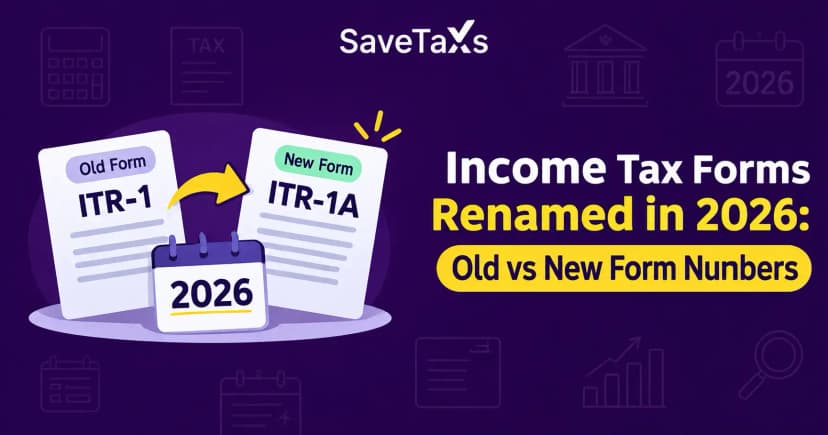
Income Tax Forms Renamed in 2026: Old vs New Form NumbersIncome Tax Forms Renamed in 2026: Old vs New Form Numbers
Written by Vipul Jain

_1767003468.png&w=3840&q=75)
NRI stands for Non-Resident Indian. The term is commonly used for an Indian citizen living outside India, but its exact legal meaning depends on the rule being applied.
For tax purposes, your residential status is determined under the applicable income-tax provisions. FEMA uses a different framework for foreign-exchange and banking matters. Your citizenship, OCI status and country of residence do not by themselves determine your tax status.
NRI stands for Non-Resident Indian.
NRI is a commonly used term; tax law specifically determines whether an individual is resident, non-resident or RNOR for a particular tax year.
Indian tax residential status depends mainly on your stay in India and applicable statutory conditions.
FEMA and income-tax rules serve different purposes, so your status under one framework may not answer every banking or tax question.
Indian income such as rent, interest, dividends and gains from Indian assets may remain subject to Indian tax rules.
NRE, NRO and FCNR(B) accounts are banking options available to eligible non-residents under RBI rules.
An OCI card does not automatically determine your Indian tax residence.
If you live abroad, you may also have tax or reporting obligations in your country of residence.
NRI means Non-Resident Indian. In everyday use, the term generally refers to an Indian citizen who lives outside India.
People commonly use NRI when discussing Indians who live abroad for employment, education, business, family relocation or other long-term purposes.
However, simply moving abroad does not answer every legal question.
For example, your Indian tax residential status is determined using the applicable income-tax rules for the relevant tax year. FEMA separately determines whether you are a person resident in India or a person resident outside India for foreign-exchange and related purposes.
This distinction matters because the same person can have different obligations for:
Income-tax filing
Bank accounts
Investments
Remittances
Foreign-exchange transactions
Reporting of income and assets
Therefore, instead of asking only “Am I an NRI?”, it is often more useful to ask “What is my residential status under the specific rule I need to apply?”
NRI status can affect how your Indian income, bank accounts, investments and financial transactions are treated.
If you live outside India but receive income from India, you may still have Indian tax obligations. Examples include:
Rental income from property in India
Interest from Indian bank accounts
Dividends from Indian investments
Capital gains from Indian assets
Business income connected with India
Salary relating to work performed in India
Your country of residence may also have its own tax and reporting rules. If you are resident in another country, you may need to consider its treatment of Indian income and whether a DTAA (Double Taxation Avoidance Agreement) or foreign tax credit rules apply.
The correct result therefore depends on your individual facts rather than simply on the label “NRI.”
For income-tax purposes, an individual is treated as non-resident when they do not satisfy the applicable conditions for being resident in India for the relevant tax year.
For tax years beginning on or after 1 April 2026, residential status is governed by the Income Tax Act, 2025. The Income Tax Department confirms that the basic residence tests continue under the new Act.
For earlier tax years, the corresponding provisions of the Income-tax Act, 1961 continue to apply.
The rules consider factors such as:
Your number of days in India during the relevant tax year
Your stay in India during preceding years where applicable
Whether special provisions apply to you
Whether you fall within the rules for RNOR (Resident but Not Ordinarily Resident)
The exact test can therefore depend on the tax year and your circumstances.
Your physical presence in India is an important part of determining tax residential status.
For example, an individual who spends limited time in India may remain non-resident, while someone who spends a substantial amount of time in India may satisfy the conditions for residence.
The rules also contain special provisions for certain Indian citizens and persons of Indian origin visiting India, as well as Indian citizens leaving India for employment abroad.
Because the applicable provisions depend on the tax year, you should use the rules for the specific year being assessed, rather than relying on a generic “182-day rule” without checking the other conditions.
For example, the Income Tax Department's guidance confirms that the basic residence tests continue to use the 182-day and 60-day-plus-365-day framework, subject to the statutory exceptions and special provisions.
RNOR means Resident but Not Ordinarily Resident.
RNOR is a separate Indian tax residential category. A person who satisfies the conditions for being resident may still qualify as RNOR if the applicable additional conditions are met.
RNOR is different from both:
Resident
Non-resident
The distinction can be important because the tax treatment of foreign income can differ depending on your residential category.
If you have recently returned to India after living abroad, or have significant international income, your residential status should be reviewed for the relevant tax year rather than assumed from your citizenship or previous NRI status.
The Income Tax Act and FEMA serve different purposes.
Income-tax rules determine your residential status for Indian taxation. FEMA regulates foreign-exchange matters and related transactions.
Under income-tax rules, your residential status is determined using statutory tests applicable to the relevant tax year.
Under FEMA, factors such as the purpose for which you leave India and the circumstances of your stay outside India can be relevant to determining whether you are a person resident outside India.
This means your tax status and FEMA status should not automatically be treated as identical.
| Aspect | Income-tax rules | FEMA |
|---|---|---|
| Main purpose | Determine tax residential status | Regulate foreign exchange and related transactions |
| Main consideration | Statutory residential tests | Residence under FEMA and circumstances of stay |
| Relevant authority | Income Tax Department | RBI / FEMA framework |
| Common impact | Taxability and return filing | Banking, investments and remittances |
If you have moved abroad, review the two frameworks separately.
These terms describe different aspects of your relationship with India.
| Term | Meaning |
|---|---|
| NRI | Common term for an Indian citizen living outside India; the precise legal result depends on the rule being applied. |
| Resident | A person who satisfies the applicable Indian tax-residence conditions for the relevant tax year. |
| RNOR | A resident who satisfies the conditions for the “not ordinarily resident” category. |
| OCI | Overseas Citizen of India status held by an eligible foreign citizen of Indian origin; it does not itself determine Indian tax residence. |
No. OCI status and tax residential status are separate concepts.
An OCI cardholder may have Indian-source income and may therefore have Indian tax obligations. Conversely, an Indian citizen can be non-resident for Indian tax purposes without holding an OCI card.
Your tax position should therefore be determined from your residential status and income rather than from your OCI status alone.
Living abroad does not automatically remove Indian tax considerations.
Depending on your circumstances, you may need to review:
Rental income from Indian property
Interest income from Indian accounts
Dividends
Capital gains
Pension income
Business or professional income
Salary connected with services performed in India
Other income arising or received in India
The tax treatment can differ depending on the nature and source of the income and your residential status.
If you have income in more than one country, also consider the tax rules of your country of residence and any applicable DTAA or foreign tax credit provisions.
Moving abroad can require you to review the status of your Indian bank accounts.
The RBI provides for account categories including NRE, NRO and FCNR(B) for eligible non-residents. The appropriate treatment depends on your residential status and circumstances.
If you move abroad, contact your bank and confirm whether your existing resident account needs to be redesignated and which non-resident account structure is appropriate.
Do not use the name of a bank account as a substitute for determining your tax residential status. They are related issues, but they are not the same legal classification.
Consider Rahul, an Indian citizen who moves from Pune to Dubai for employment during a financial year.
He continues to own a property in Pune and receives rental income from it.
The correct approach is not to assume that moving to Dubai automatically answers every question.
Rahul should separately review:
His India stay for the relevant tax year.
The applicable income-tax residential-status provisions.
His FEMA status.
His Indian rental income.
His Indian bank accounts.
The tax and reporting rules of his country of residence.
If his facts satisfy the applicable conditions for non-resident status, he would be treated as non-resident for Indian tax purposes for that year. His Indian-source income would still need to be reviewed under the applicable tax rules.
This illustrates why your residential status should be determined from your actual facts rather than simply from the country where you work.
If you have recently moved outside India, use this checklist:
Record your India stay for the relevant tax year.
Note your departure date and return visits.
Identify all Indian-source income.
Review your Indian bank accounts with your bank.
Gather bank statements, tax documents, property records and investment statements.
Check your tax obligations in your country of residence.
Review whether a DTAA or foreign tax credit may apply.
Determine the appropriate Indian income-tax return based on your status and income.
Review your position again for each relevant tax year.
If your circumstances involve multiple countries, returning to India, substantial Indian income or overlapping tax and FEMA considerations, professional advice can help you apply the relevant rules to your facts.
Residential Status Calculator — Check your residential status using your travel history.
Complete NRI Income Tax Guide — Understand Indian tax rules applicable to NRIs.
NRE vs NRO Account Guide — Understand the differences between NRE and NRO accounts.
DTAA Guide — Learn how tax treaties can affect cross-border taxation.
Returning NRI Tax Guide — Understand tax and financial considerations when returning to India.
NRI stands for Non-Resident Indian, but the term should not be treated as a single legal test for every situation.
Your Indian tax residential status depends on the applicable tax-year rules. FEMA separately addresses residence for foreign-exchange purposes, while OCI status relates to a different legal framework.
If you live outside India, start by checking your India stay, residential status, Indian income and banking position. Then consider the tax and reporting requirements of your country of residence.
For a more accurate assessment, review your position for the specific tax year rather than relying only on your citizenship, overseas address or the number of days you generally spend abroad.
The information in this article is based on the following official sources and regulatory guidance:
Income Tax Department — Non-Resident / Residential Status
Income Tax Department – Non-Resident Guidance
Income Tax Department — Income-tax Act, 2025
Income Tax Department – Income-tax Act, 2025
Reserve Bank of India — Accounts in India for Non-Residents
RBI – Accounts for Residents and Non-Residents
Reserve Bank of India — Foreign Exchange Management Act (FEMA)
RBI – FEMA Resources
Income Tax Department — Form 145 and Related Guidance
Income Tax Department – Form 145 Guidance
Note: Tax, FEMA and banking rules can change. The applicable rule may depend on the relevant tax year and your individual circumstances. Always verify the current provisions before making a tax, banking or remittance decision.
This article is for general informational purposes only and does not constitute tax, legal, financial, or investment advice. Laws, regulations, rates, and procedures may change over time and may vary based on individual circumstances.
While SaveTaxs makes reasonable efforts to keep the information accurate and up to date, readers should verify applicable rules with official authorities or consult a qualified professional before making decisions based on this information.
Shubham Jain is the Founder of SaveTaxs and has extensive experience in Indian and NRI taxation. He advises individuals, NRIs, and businesses on tax filing, tax planning, capital gains, DTAA benefits, fund repatriation, and compliance matters. He regularly writes about taxation and related financial topics. His focus is on making complex tax concepts easy to understand. Through his articles, he helps taxpayers stay informed, avoid common mistakes, and stay compliant with Indian tax laws. See Full Bio

Want to read more? Explore Blogs