




Investment & Financial Planning
NRI Property Sale: How to Calculate Capital Gains TaxNRI Property Sale: How to Calculate Capital Gains Tax
Written by Shubham Jain
_1778569376773.webp&w=3840&q=75)
For many NRIs living in the USA, investing in India is more than a financial decision. It is one of their ways to stay connected with their roots. Additionally, the country remains a high-growth economy, a familiar investment market, and often the place where long-term goals such as legacy planning or retirement are anchored.
For US NRIs, investing in India is completely well-regulated and legal, but comes with the intersection of US tax regulations and Indian foreign exchange laws. In this, the most significant financial regulation that US-based NRIs are affected by is the Foreign Account Tax Compliance Act (FATCA). Understanding the FATCA rules for NRIs with Indian investment is vital, as it helps in avoiding costly mistakes and earning high returns.
To help you out, this blog provides complete information about the FACTA rules for NRIs with Indian investments and how you can simplify them with smart strategies. So read on and clear all your doubts.
The Foreign Account Tax Compliance Act (FATCA) was introduced by the US Congress in 2010 to combat tax evasion and increase transparency regarding offshore financial assets with a total value of more than $50,000. The primary purpose of it is to certify that US taxpayers disclose their foreign accounts and income.
For NRIs with Indian investments living in the US, this plays out through two-way information. The Indian government signed an Inter-Governmental Agreement (IGA) with the USA in 2015 to implement FATCA. Considering this, from NRI investors living in the US, Indian tax officials need FATCA documents.
Further, being an NRI living in the US, when you invest in India, the financial institutions in India require your personal details and income. Additionally, they report that information to the Central Board of Direct Taxes (CBDT) in India. This data under the IGA from CBDT is then forwarded to the Internal Revenue Service (IRS). Additionally, if your total foreign assets are more than the applicable threshold, i.e., $50,000, then you need to report them on Form 8938 as a part of your annual US tax return. Non-compliance results in severe consequences such as suspending mutual fund investments, freezing bank accounts, and blocking NPS accounts.
In simple terms, you can consider that FATCA is not only about the reporting rule for foreign assets but also an investment decision. Every investment you hold in India contains FATCA implications. In this, some are simple while some are complex, and before investing, knowing the difference between these is vital.
This was all about the FATCA rule and why it matters for NRIs investing in India. Moving further, let's know the investments that get complicated under FATCA.
As mentioned above, for NRI investors in India, FATCA has significant implications. It impacts their ability to manage and access several financial products while ensuring compliance with the tax laws of the US. To provide you with an idea, here is the list of Indian investments that get complicated under FATCA.
For US-based NRIs, mutual funds in India are the most problematic investment category, as they come with a specific classification, i.e., Passive Foreign Investment Company (PFIC). Considering this, under US tax laws, whether equity, hybrid, debt, or index, these mutual funds are treated as PFICs. This further results in:
In simple words, you can say that higher tax rates, multiple reporting requirements, and fund house limitations make mutual funds a difficult investment choice for US NRIs.
Non-resident ordinary (NRO) accounts are vital for receiving Indian income, such as pension, rent, and dividends. However, they often come with tax and compliance responsibilities. Considering this, interest earned on the NRO account is taxable in both India (subject to TDS) and in the USA as ordinary income, and under FATCA, you need to report this account.
Additionally, currency conversion (as funds in these accounts are held in INR) and compliance complexity (repatriation limit) add further administrative work for NRIs. However, under the Double Taxation Avoidance Agreement (DTAA) between India and the USA, you can claim a Foreign Tax Credit (FTC) in the USA on the taxes you already paid in India. It helps avoid double taxation of the same income, but the reporting requirements remain the same.
Although NRO accounts are suitable for your operational needs, such as managing Indian expenses and receiving rent, they are not a good option for making heavy investments due to compliance requirements.
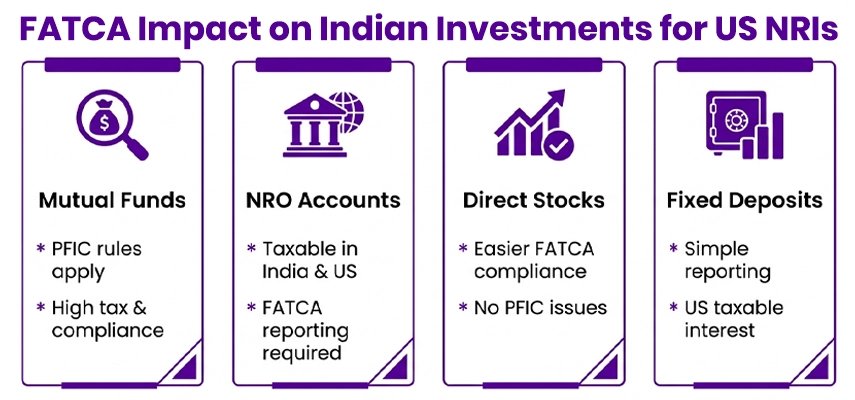
Compared to mutual funds, holding Indian equities directly through a Portfolio Investment Scheme (PIS) and a demat account is more FATCA-friendly. It is because:
Although direct equity exposure to India via PIS and demat is not risk-free, it often needs careful reporting requirements. However, from a FATCA perspective, direct stock investments are far easier investments for US NRIs than mutual funds.
Under FATCA, for US-based NRIs, NRE and NRO fixed deposits (FDs) are one of the simplest investments to hold and report. The account information is mentioned on Form 8938 and FBAR. Additionally, the interest generated from it is stated on Schedule B of your 1040 Form.
However, while NRE FD offers tax-free interest in India but is taxed in the US as ordinary income. Also, NRE FD interest faces higher TDS in India, plus US taxation with available DTAA credit. Considering this, although FDS are a good investment choice for compliance ease and capital preservation, they are not a tax-efficient tool for increasing wealth.
So, this is how Indian investments get affected under FATCA. Moving further, let's better understand with a practical example.
Imagine you are an NRI living in the US. You have invested INR 20,00,000 in mutual funds and INR 15,00,000 in stocks directly through a demat account in India.
Here, both investments are made in the same investment market. However, the investment vehicle completely provides different outcomes.
Moving ahead, let's know the common mistakes that US-based NRIs make while investing in Indian markets.
Common investment mistakes NRIs living in the US make include:
These are some of the mistakes that the US NRI investors made unknowingly while investing in India, and that further trigger the US taxation and reporting. Moving ahead, let's know the smart portfolio strategies to avoid these mistakes.
Here are some of the smart portfolio strategies for NRIs who want to invest in India without impacting the US taxation rules:
Implementing these strategies helps you stay compliant with FATCA rules and provides you with better investment options in India.
With Savetaxs, with the comfort of your home, you can invest in India from anywhere in the world.
Lastly, in India, for US-based NRIs, many investment opportunities are available. In this, FATCA rules for NRIs with Indian investments not only provide a compliance rule, but it is a strategy driver that states what you can invest in, and how they are taxed. With proper understanding, FATCA of cross-border financial planning remains a manageable part.
Furthermore, consulting a tax professional like Savetaxs can help you navigate the complexities of FATCA and ensure adherence to both Indian and US tax laws. We have a team of experts who help you in choosing the right investment that perfectly matches your financial goals. So connect with us and have a safe financial journey in India.
This article is for general informational purposes only and does not constitute tax, legal, financial, or investment advice. Laws, regulations, rates, and procedures may change over time and may vary based on individual circumstances.
While SaveTaxs makes reasonable efforts to keep the information accurate and up to date, readers should verify applicable rules with official authorities or consult a qualified professional before making decisions based on this information.
Vipul Jain is the Co-Founder of SaveTaxs and a tax expert with experience in Indian and NRI taxation. He advises individuals, NRIs, and businesses on tax filing, tax planning, capital gains, DTAA, and compliance matters. He focuses on making complex tax concepts simple and helping taxpayers make informed, compliant decisions. See Full Bio
Want to read more? Explore Blogs

_1781845771869.webp&w=828&q=75)
_1778936280179.webp&w=828&q=75)