


Investment & Financial Planning
NRI Property Sale: How to Calculate Capital Gains TaxNRI Property Sale: How to Calculate Capital Gains Tax
Written by Shubham Jain

_1768221427.webp&w=3840&q=75)
A Portfolio Investment Scheme (PIS) allows NRIs on a repatriation basis to purchase and sell shares of listed Indian companies. Additionally, through an RBI-authorized bank where you have an NRE account, you can obtain a PIS permission letter. To do so, you need to open a PIS account for an NRI and start investing in the secondary market.
Further, to help you out, here is a comprehensive blog to understand PIS, including its types, permission letter, eligibility to get, and more. So read on and gather all the information related to it.
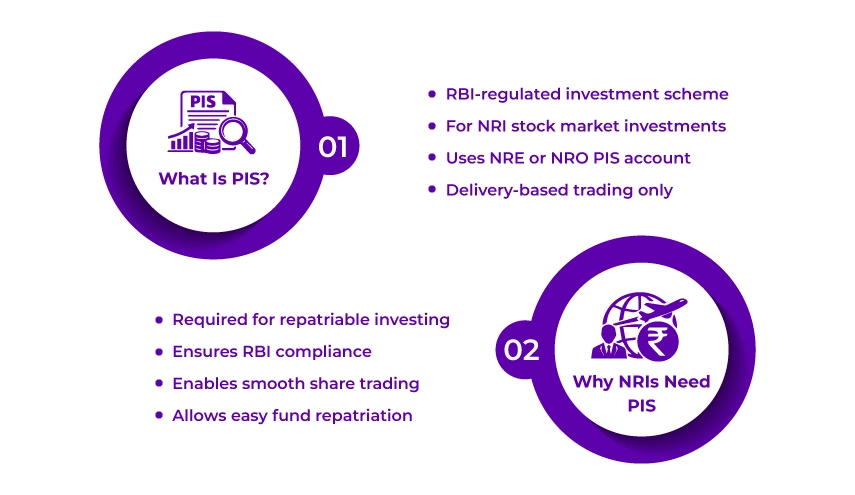
A Portfolio Investment Scheme (PIS) allows NRIs to purchase and sell shares and convertible debentures of Indian companies listed on recognized stock exchanges. As stated under Schedule 3 of the Foreign Exchange Management Act (FEMA) 2000, through a designated bank branch, PIS investment is routed.
To invest in the Indian stock market, in any designated bank, NRIs need to set up a PIS-enabled NRE or NRO account. Additionally, the investment can be made on a repatriation or a non-repatriation basis.
Further, let's know why NRIs need a PIS account.
A PIS account helps NRIs earn good returns on investments in the Indian stock markets. It is the only way NRIs can buy and sell shares of Indian companies and convertible debentures. You can trade freely; however, transactions are restricted to intra-day. Considering this, with a PIS account, NRIs get the following benefits:
This was all about the PIS account and why NRIs need a PIS account. Moving ahead, let's know the different types of PIS accounts for NRIs.
There are two types of PIS accounts for NRIs. These are as follows:
So, with NRE PIS and NRO PIS accounts, NRIs can freely invest in the shares listed on Indian companies. Moving on, let's discuss a PIS permission letter.
With the expert guidance of Savetaxs, achieve a compliant and easy ITR filing as an NRI.
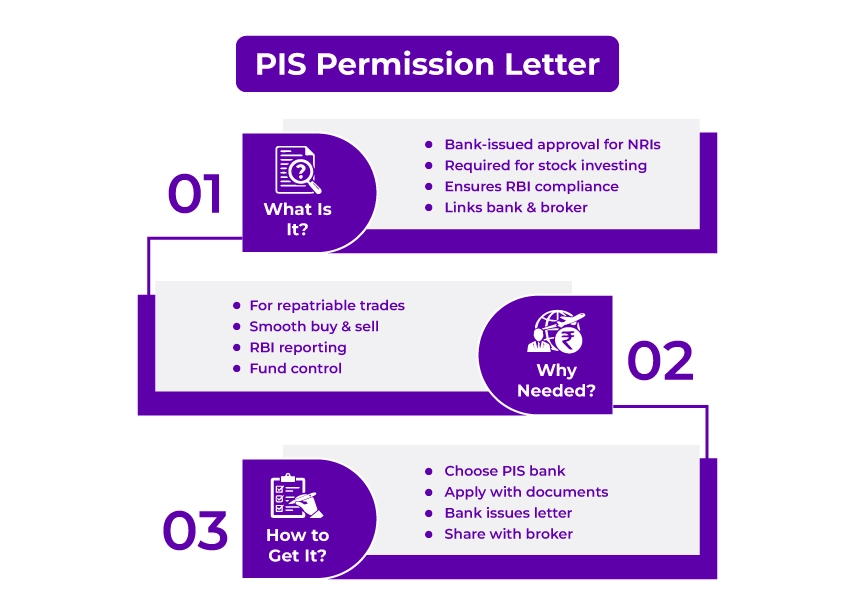
A PIS letter is an official document issued by the RBI on behalf of a bank that authorizes NRIs to invest in the Indian stock market. In simple terms, it is a license that confirms compliance with RBI regulations before an NRI can start trading on the Indian stock market.
It is well known that the Indian stock markets are regulated by the RBI. One part of the regulation is providing a PIS letter to NRIs who want to participate in the Indian stock market. Here is why you need a PIS letter:
This was all about a PIS permission letter and why NRIs need to obtain it. Moving ahead, let's know the eligibility to get this letter.
Generally, an individual is eligible for a PIS letter if:
However, there are some restrictions also. These are as follows:
So, this was the eligibility criteria an individual needs to follow to get a PIS permission letter. Moving further, let's know the documents NRIs require to get a PIS permission letter.
Banks generally ask for the following self-attested documents, depending on where you reside, sometimes with embassy or notarisation attestation:
Further, some banks may also ask you for a KYC form, a recent passport-size photograph, and in-person or video KYC before granting a PIS permission letter. Now, moving ahead, let's know how NRIs can obtain a PIS permission letter.
If you already have an NRE/ NRO account, the process to get a PIS permission letter becomes straightforward. This is how NRIs can obtain it:
So, this is how an NRI can obtain a PIS permission letter. Moving further, now know the difference between the PIS vs the Non-PIS route for NRIs.
The table below showcases the key differences between the PIS vs the Non-PIS route for NRIs.
| Features | PIS Route (NRE/ NRO PIS) | Non-PIS Route (NRO Only) |
|---|---|---|
| Use Bank Account | NRE PIS for fund repatriation/ NRO PIS for non-repatriation of funds. | NRO Savings (no PIS flag) |
| RBI Reporting | Mandatory- it is mandatory for all banks to report secondary-market stock trades | No PIS-specific RBI reporting, only normal NRO compliance |
| Products Allowed | Deliver-based equity and some debt on exchange. | Equity delivery, F&O, IPSs, bonds, mutual funds via NRO. |
| Repatriation | NRE PIS is fully repatriable, whereas NRO PIS is subject to NRO rules. | NRO: Repatriation of funds is allowed up to limits with tax clearance. |
| Costs | The cost is higher due to PIS reporting and transaction charges from the bank. | The cost is lower as there are no PIS reporting fees, and easy settlement. |
| Best for | This is best for NRE equity investors focused on repatriable holdings. | This is best for F&O, active traders, and broader investing from NRO funds. |
This was all about the PIS route and the non-PIS route for NRIs. Moving ahead, let's know the tax structure of PIS for NRIs.
Across PIS and non-PIS routes, there are identical tax rates. However, for NRIs, PIS simplifies RBI reporting, TDS deduction, and audit trails. Further, here are the PIS tax benefits that NRIs get:
Further, to provide you with a clear idea, here is a simple comparison of PIS and non-PIS tax structures.
| Aspect | PIS Route | Non-PIS Route |
|---|---|---|
| TDS Handling | TDS is auto-deducted by the bank per trade | It is less consistent as the broker handles the TDS. |
| RBI Reporting | Mandatory and automatic | None |
| ITR Compliance | Form 16A + bank statements | Manual gain computation needed |
| Best for | Long-term equity investors | F&O/ itraday traders |
Therefore, the tax angle also highlights the importance of the PIS structure for NRIs.
Lastly, a PIS account for NRIs is a robust option for long-term, compliant equity investments in India. Under the RBI guidelines, it provides a clear path for structured reporting and repatriation. Additionally, a PIS permission letter is more than an official document. It permits NRIs to invest in the stock market of India.
Once you know about the PIS process and gather all the required documents, as an NRI, you can start your investing journey. Further, when in doubt, connect with Savetaxs. Our financial experts will provide you with the necessary investment guidance and assistance.
This article is for general informational purposes only and does not constitute tax, legal, financial, or investment advice. Laws, regulations, rates, and procedures may change over time and may vary based on individual circumstances.
While SaveTaxs makes reasonable efforts to keep the information accurate and up to date, readers should verify applicable rules with official authorities or consult a qualified professional before making decisions based on this information.
Vipul Jain is the Co-Founder of SaveTaxs and a tax expert with experience in Indian and NRI taxation. He advises individuals, NRIs, and businesses on tax filing, tax planning, capital gains, DTAA, and compliance matters. He focuses on making complex tax concepts simple and helping taxpayers make informed, compliant decisions. See Full Bio

Want to read more? Explore Blogs
_1781845771869.webp&w=828&q=75)
_1778936280179.webp&w=828&q=75)