


_1785327342628.webp&w=828&q=75)
NRI Banking Services
What Should NRIs Know Before Choosing an NRI Account?What Should NRIs Know Before Choosing an NRI Account?
Written by Shubham Jain

You need a demat account to hold and trade securities in electronic form. Although investors along the way chose to freeze their demat accounts to safeguard their long-term holdings or prevent unauthorized or illegitimate transactions.
However, understanding the risks of freezing and unfreezing a demat account is essential, as it helps investors better control their investments.
In this log, we will specifically understand the process of freezing and unfreezing a demat account, including the reasons an NRI may choose to freeze it.
Freezing a demat account means restricting some or all transactions without closing the account. Additionally, depending on the type of freeze you have requested, you can stop the debit of securities, block specific ISINs (International Securities Identification Numbers), or restrict operations across the entire demat account.
It is the account holder's responsibility to specify whether the freeze applies to all securities or only certain ones.
There are various reasons why an investor may freeze their demat account. A few of them are mentioned below.
| Type Of Freeze | Description Of The Freeze |
|---|---|
| Full Freeze | Here, you freeze all transactions on the demat account, including buying, selling, and transferring securities. |
| Debit Freeze | This type of freeze prevents your securities from being debited, meaning they cannot be sold or transferred. But it still allows the credit part, meaning receiving the securities. |
| Specific security freeze | In this type of freeze in an NRI Demat Account, only the selected stocks or shares are frozen, leaving the rest unchanged. |
| ISIN-based freeze | This type of freeze freezes the securities based on ISIN, meaning International Securities Identification Number. |
The following are general steps you must follow to freeze your Demat account.
To freeze your demat account, contact your deposit participant via their branch or customer care, or log in to your broker's online portal (e.g., Zerodha, Kotak, Angel One).
Fill in the demat account freeze request form accurately. Specify whether you want a full freeze, specific security freeze, or debit freeze, the duration of the freeze, and so on.
The DP will then run an identity verification check.
Once the request is successfully verified, the DP will submit the freeze demat account instruction to the depository, which is CDSL or NSDL.
Once your account is successfully applied, you will receive an acknowledgement with respect to freezing the NRI demat account.
Please ensure to check the exact process of the DP, as the steps may vary.
However, for NRIs, freezing an NRI demat account has additional regulatory considerations. As NRI transactions in India are governed by FEMA, the Demat account is typically linked to an NRE or NRO bank account.
Freezing of a demat account for NRIs is usually applied when:
NRIs can also voluntarily freeze their Demat accounts to avoid any accidental non-compliant transactions, especially during relocation and documentation.
NRIs must coordinate with their respective DPs and brokers to minimize any delays.
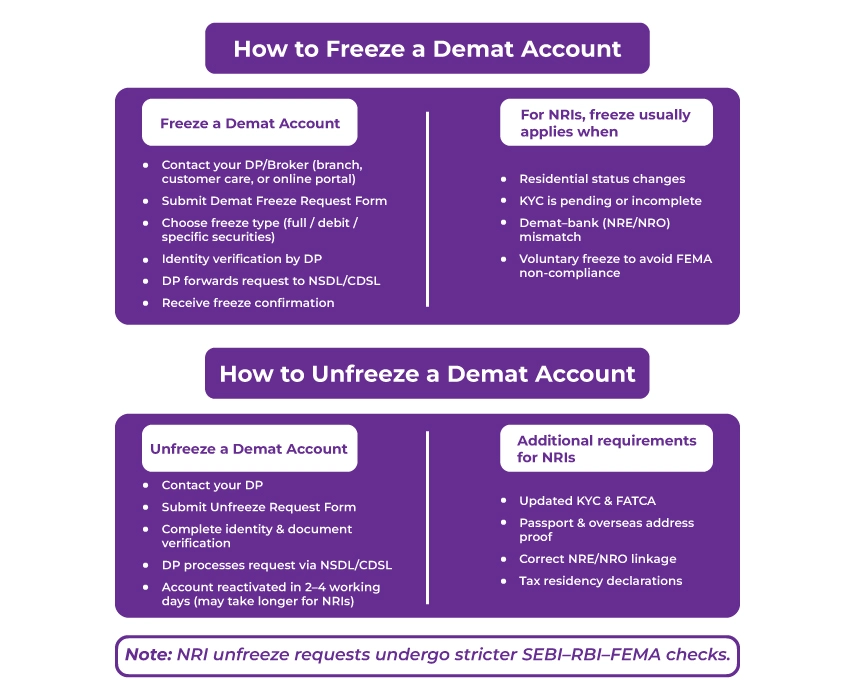
To reactivate frozen account or to unfreeze NRI demat account, follow these steps.
Contact your DP and inform them about your request to unfreeze your demat account or the specific securities, as you prefer.
Fill out the demat account unfreeze request form and specify whether you want a full or partial unfreeze.
For this step, your DP might ask you for specific documents or require certain verification steps for security purposes.
The DP will then process the request through the depository.
Once the request is processed successfully and the account is active again, you will be notified. Processing the request can take 2 to 4 business days.
However, NRIs, please ensure that unfreezing of the demat account in your case involves more scrutiny than for a resident Indian. The DP will ensure that, before the unfreeze request is processed, all earlier transactions comply with the guidelines set by SEBI, RBI, & FEMA.
Addtioanly NRIs will be asked to provide:
After these checks are completed successfully, the DP will proceed with the unfreeze request. However, for an NRI, this request may take a long time to process.
The following are some of the key considerations that you must know:
The process of freezing and unfreezing a demat account is a low-key, useful technique that adds an extra layer of security around your investment portfolio. By following the right steps, any investor can protect their assets from unauthorized access and transactions, ensuring a secure trading environment.
Furthermore, if you need professional assistance with freezing or unfreezing your account, Savetaxs is here to help. We have been helping NRIs from 20+ countries manage their investment portfolios across borders.
Our investment experts ensure that your portfolio is managed to meet your financial goals, analyze your financial situation, recommend the right securities, monitor performance, adjust strategies by diversifying your investments, manage risk, and more.
Connect with us as we serve our clients 24/7 across all time zones.
This article is for general informational purposes only and does not constitute tax, legal, financial, or investment advice. Laws, regulations, rates, and procedures may change over time and may vary based on individual circumstances.
While SaveTaxs makes reasonable efforts to keep the information accurate and up to date, readers should verify applicable rules with official authorities or consult a qualified professional before making decisions based on this information.
Vipul Jain is the Co-Founder of SaveTaxs and a tax expert with experience in Indian and NRI taxation. He advises individuals, NRIs, and businesses on tax filing, tax planning, capital gains, DTAA, and compliance matters. He focuses on making complex tax concepts simple and helping taxpayers make informed, compliant decisions. See Full Bio

Want to read more? Explore Blogs


_1784120197435.webp&w=828&q=75)