



Business Setup
Difference Between a LLP and a Partnership FirmDifference Between a LLP and a Partnership Firm
Written by Vipul Jain
_1774093903131.webp&w=3840&q=75)
The Memorandum of Association (MOA) serves as the constitutional document of a company. This legal document outlines the company's foundation, incorporation details, operational scope, and internal structure. In simple terms, the MOA defines the company’s relationship with the outside world, specifies the activities it is allowed to undertake, and states the objectives for which the company is formed.
The MOA sets the legal boundary for a company’s actions. A company cannot carry out activities beyond the powers mentioned in its Memorandum of Association. Any action outside these powers may be treated as ultra vires, meaning legally invalid.
In this blog, we will cover all essential aspects of the Memorandum of Association (MOA), including its meaning, objectives, format, clauses, benefits, alteration process, and more.
The full form of MOA is “Memorandum of Association”. It is a legal document drafted during the incorporation and registration of a company. The MOA defines the company’s authority, scope of operations, objectives, and relationship with external parties.
Since it is prepared at the initial stage of company formation, the MOA acts as the company’s charter document. It lays down the framework within which the company must operate and ensures that its activities remain aligned with its stated objectives.
The MOA is also an important document for shareholders, creditors, investors, and regulatory authorities because it clearly outlines the company’s powers and limitations.
The format of the Memorandum of Association is prescribed under Section 4(6) of the Companies Act, 2013. According to the Act, the format of an MOA is specified under Tables A to E of Schedule I. Companies must adopt the appropriate format based on their business structure.
The formats are classified as follows:
Table A: Applicable to companies limited by shares.
Table B: Applicable to companies limited by guarantee without share capital.
Table C: Applicable to companies limited by guarantee with share capital.
Table D: Applicable to unlimited companies without share capital.
Table E: Applicable to unlimited companies with share capital.
The MOA must be properly numbered, divided into paragraphs, printed, and signed by the subscribers to the company.
The Memorandum of Association serves multiple legal and operational purposes within a company. Some of its key objectives include:
Under Section 3 of the Companies Act, 2013, a company can be incorporated only after the required number of subscribers sign the MOA:
Seven or more members for a public company
Two or more members for a private company
One member for a One Person Company (OPC)
The MOA specifies the range of activities a company can undertake. This ensures that the company operates only within its legally permitted scope.
The MOA acts as one of the primary documents establishing the legal identity of the company at the time of incorporation.
The MOA defines the rights, liabilities, and obligations of shareholders, helping maintain transparency and corporate accountability.
The document restricts the company from engaging in activities outside its stated objectives, thereby safeguarding stakeholders and investors.
The MOA includes the state in which the company’s registered office is situated. This helps determine the jurisdiction of the Registrar of Companies (ROC).
The MOA states the authorized share capital of the company and the types of shares it can issue, such as equity shares or preference shares.
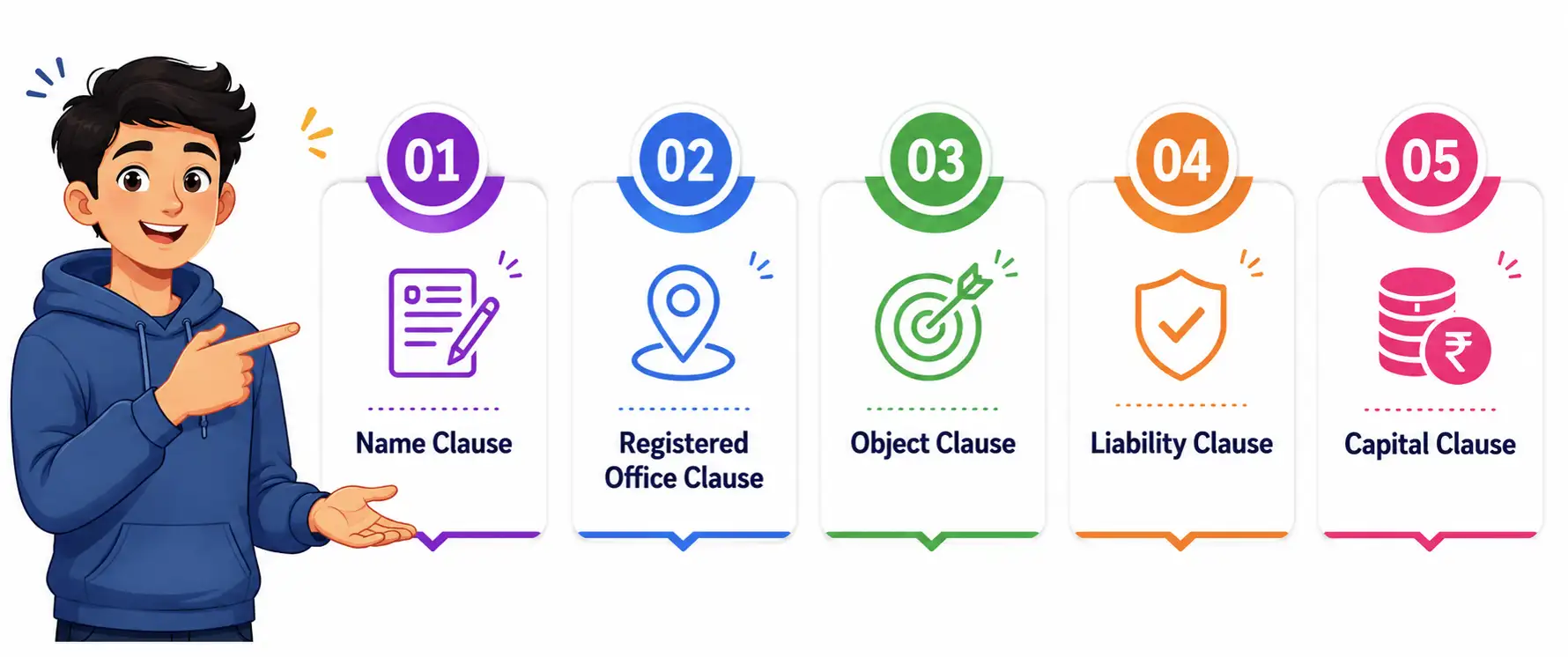
The Memorandum of Association generally contains the following five clauses:
Name Clause
Registered Office Clause
Object Clause
Liability Clause
Capital Clause
The Name Clause specifies the legal name of the company. The name must comply with the provisions of the Companies Act and should not be identical or deceptively similar to an existing company name.
For example:
Private companies must use the term “Private Limited”.
Public companies must use the term “Limited”.
Section 8 companies may use words such as:
Foundation
Association
Federation
Council
Chamber
Forum
This clause specifies the state in which the company’s registered office is located. The registered office serves as the official address for receiving legal notices, communications, and government correspondence.
The company must inform the ROC about its exact registered office address within the prescribed period after incorporation.
The Object Clause is one of the most important parts of the MOA. It defines the purpose for which the company is incorporated and the activities it can legally undertake.
Typically, the object clause includes:
Main objectives
Incidental or ancillary objectives
Other permitted business activities
A carefully drafted object clause is important because companies cannot legally engage in activities outside the scope mentioned in this clause.
The Liability Clause defines the extent of liability of the company’s members.
In a company limited by shares, liability is restricted to the unpaid amount on shares held by members.
In a company limited by guarantee, liability is restricted to the guaranteed amount agreed upon by members.
In unlimited companies, members may have unlimited liability.
This clause becomes particularly important during winding up or settlement of company debts.
The Capital Clause specifies the company’s authorized share capital and its division into shares of a fixed value.
It also states the type of securities the company is authorized to issue, including:
Equity shares
Preference shares
Debentures
This clause provides clarity regarding the company’s capital structure and fundraising capacity.
The following are some major benefits of the MOA:
The MOA helps establish the company as a separate legal entity distinct from its owners and shareholders.
It ensures that the company operates within the legal framework prescribed under the Companies Act, 2013.
The MOA creates transparency regarding the company’s powers, objectives, and liabilities, which helps protect shareholders, creditors, and investors.
The MOA acts as a guiding framework for directors and management while making strategic and operational decisions.
Since the MOA clearly defines the company’s scope of activities, it helps prevent misuse of corporate powers.
If there is any change in the company’s structure or objectives, the MOA must be amended accordingly.
The following changes generally require alteration of the MOA:
Change in company name
Change in registered office
Change in business objectives
Change in member liability
Change in authorized capital
Change in capital structure
The Board of Directors must approve the proposed alteration.
Shareholder approval must be obtained through a general meeting.
A special resolution approving the alteration must be passed and filed with the Registrar of Companies within the prescribed timeline.
The ROC reviews the application and approves the alteration after verifying compliance requirements.
The following persons or entities can subscribe to the Memorandum of Association:
Individuals
Foreign citizens
Minors through natural guardians
Companies registered under the Companies Act
Foreign companies
Limited Liability Partnerships (LLPs)
Registered societies
Bodies corporate established under Central or State legislation
The Memorandum of Association (MOA) is far more than a procedural legal document. It serves as the foundation upon which a company is incorporated and operated. From defining business objectives and capital structure to outlining member liability and operational boundaries, the MOA plays a critical role in corporate governance and compliance.
A properly drafted MOA helps companies avoid legal disputes, maintain regulatory compliance, and build transparency with shareholders and investors.
For NRIs and foreign entrepreneurs planning to establish a business in India, understanding the role and structure of the MOA is especially important during the company incorporation process. Professional guidance can help ensure the document is drafted correctly and aligned with long-term business objectives.
This article is for general informational purposes only and does not constitute tax, legal, financial, or investment advice. Laws, regulations, rates, and procedures may change over time and may vary based on individual circumstances.
While SaveTaxs makes reasonable efforts to keep the information accurate and up to date, readers should verify applicable rules with official authorities or consult a qualified professional before making decisions based on this information.
Vipul Jain is the Co-Founder of SaveTaxs and a tax expert with experience in Indian and NRI taxation. He advises individuals, NRIs, and businesses on tax filing, tax planning, capital gains, DTAA, and compliance matters. He focuses on making complex tax concepts simple and helping taxpayers make informed, compliant decisions. See Full Bio

Want to read more? Explore Blogs

_1780491123033.webp&w=828&q=75)
_1778757638178.webp&w=828&q=75)