



Business Setup
Difference Between a LLP and a Partnership FirmDifference Between a LLP and a Partnership Firm
Written by Vipul Jain
_1773142480787_1773146465792.webp&w=3840&q=75)
First, if you are an NRI planning to start or invest in an Indian business, you have probably already looked at Private Limited Company registration as a structured option. However, generic incorporation guides often overlook NRI-specific requirements such as overseas documents, resident directors, FEMA/FDI rules, and remote execution. In this guide, we explain how private limited company registration for NRIs works, including eligibility, documents, MCA incorporation, costs, remote registration, and key compliance considerations.
NRIs can establish or invest in an Indian Private Limited Company, subject to the Companies Act, FEMA, FDI rules, and applicable sector-specific requirements.
An NRI shareholder and an NRI director are separate considerations, and the requirements for each should be evaluated independently.
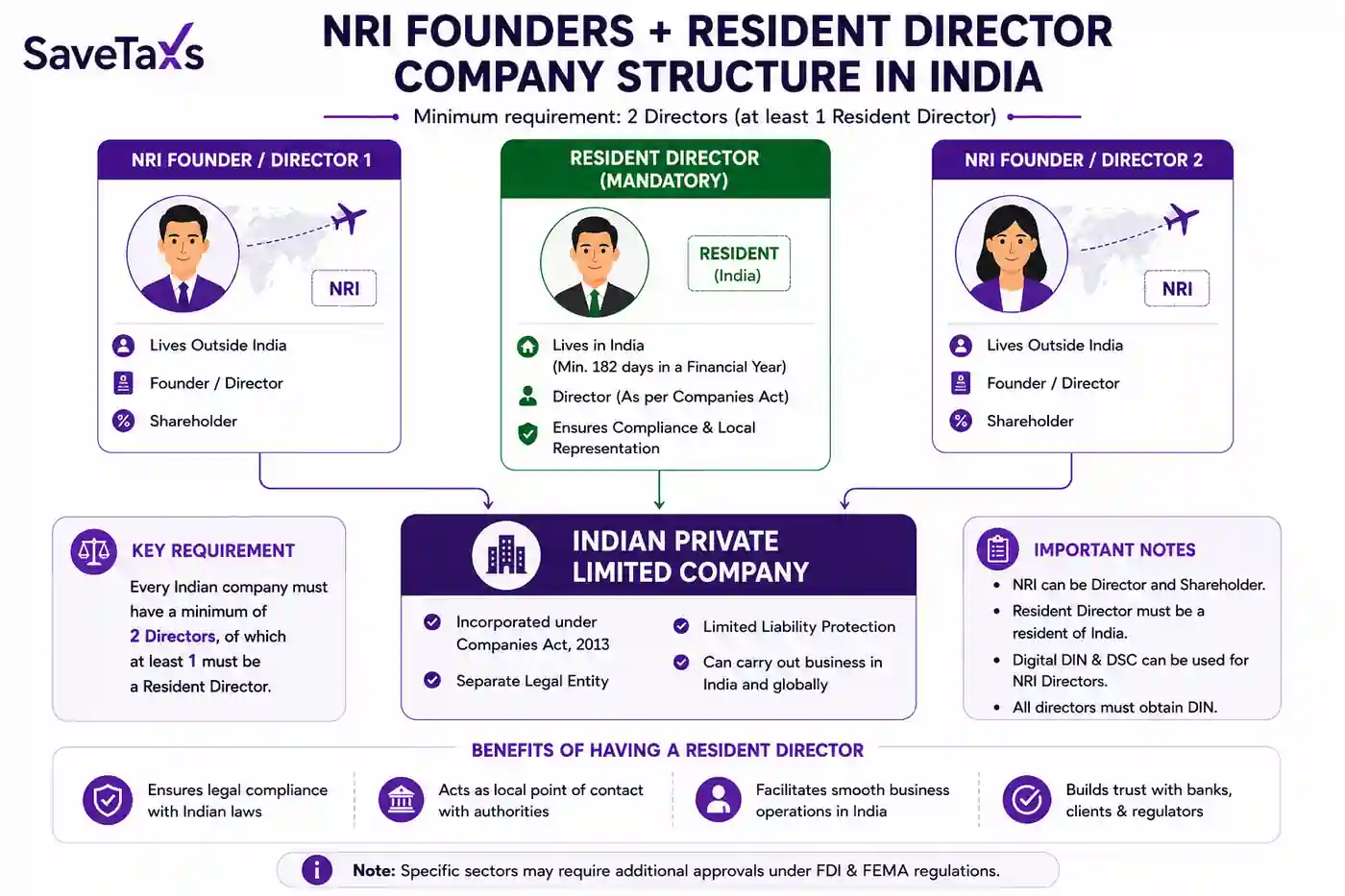
A Private Limited Company requires at least two members and two directors, with at least one director satisfying India's resident-director requirement.
NRI incorporation can often be coordinated remotely, but documents issued outside India may require notarization, apostille, consular attestation, or other authentication depending on the jurisdiction.
The MCA incorporation process uses SPICe+ and linked forms for incorporation and associated registrations such as DIN, PAN, and TAN.
NRI investment can trigger FEMA/FDI considerations, particularly where shares are acquired on a repatriation basis or the business operates in a regulated sector.
Registration costs vary because MCA fees, stamp duty, DSC, documentation, authentication, and professional fees can all affect the final amount.
Private Limited Company registration for NRIs is the process of incorporating an Indian private company where one or more shareholders or directors are NRIs, subject to Indian corporate and foreign-exchange regulations. An NRI is generally a person resident outside India who is a citizen of India, while an OCI is a separate category under FEMA regulations.
First, a Private Limited Company is a separate legal entity from its shareholders. For example, if an NRI living in the United States incorporates an Indian technology company, the company itself owns its business assets and enters into contracts independently of the shareholder.
Moreover, the Companies Act, 2013 governs the corporate incorporation framework, while the Ministry of Corporate Affairs administers incorporation through the MCA portal and Registrar of Companies. The MCA's SPICe+ framework supports incorporation and several linked registrations through an integrated process.
At the same time, NRI founders should not treat company incorporation and foreign investment compliance as the same issue. MCA determines whether the company can be incorporated under company law, while FEMA and related RBI rules can govern how non-residents invest in or transfer Indian securities.
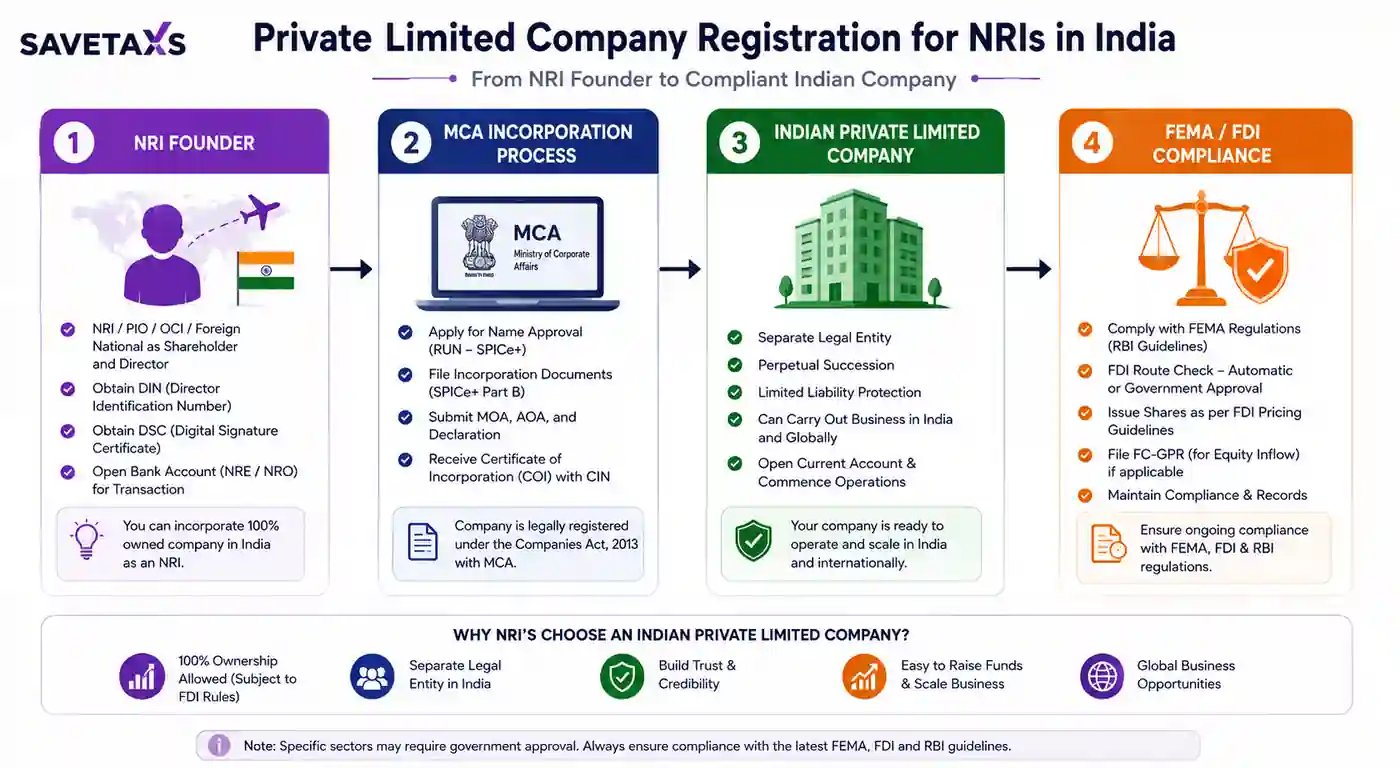
Private Limited Company registration matters to NRI founders because it creates a formal Indian business entity that can operate independently while providing limited liability and a structured ownership framework. For example, an NRI entrepreneur can establish an Indian subsidiary or operating company instead of conducting all Indian business activities personally.
First, limited liability separates the company's obligations from the shareholders' personal assets, subject to applicable law and exceptions. This structure can be useful when an NRI wants to build an Indian business with employees, contracts, customers, vendors, and future investors.
Moreover, a Private Limited Company can provide a defined shareholding structure, which makes it easier to document ownership among founders or investors. For example, two founders can subscribe to shares in agreed proportions while the company's constitutional documents establish its governance framework.
At the same time, the structure can support future fundraising through equity investment, subject to applicable company law and foreign-investment regulations. An NRI should therefore evaluate the proposed ownership and funding structure before incorporation rather than treating registration as a purely administrative exercise.
Yes, an NRI can generally establish or invest in an Indian Private Limited Company, subject to the Companies Act and applicable FEMA/FDI regulations. The exact requirements depend on the NRI's status, proposed shareholding, business activity, source of funds, and whether the investment is intended to be repatriable.
First, a Private Limited Company generally requires at least two members and at least two directors, while the Companies Act permits up to 200 members for a private company. The MCA's current SPICe+ instructions specify a minimum of two directors for a private company other than a producer company.
Moreover, an NRI can potentially be a shareholder and can also serve as a director if the applicable director requirements are satisfied. However, the company must comply with the resident-director requirement, so having only non-resident directors is not sufficient.
At the same time, share ownership does not automatically determine director eligibility. An NRI may own shares without being a director, while an NRI director must satisfy the requirements applicable to directors of Indian companies.

Yes, a Private Limited Company must comply with the requirement to have at least one director who satisfies the statutory resident-director condition. This is why an NRI-only proposed board needs to be evaluated carefully before filing incorporation documents.
For example, if two NRIs living in the United States are proposed as directors, the company must still ensure that its board satisfies the applicable resident-director requirement. The NRI founders may therefore need an eligible resident director as part of the proposed structure.
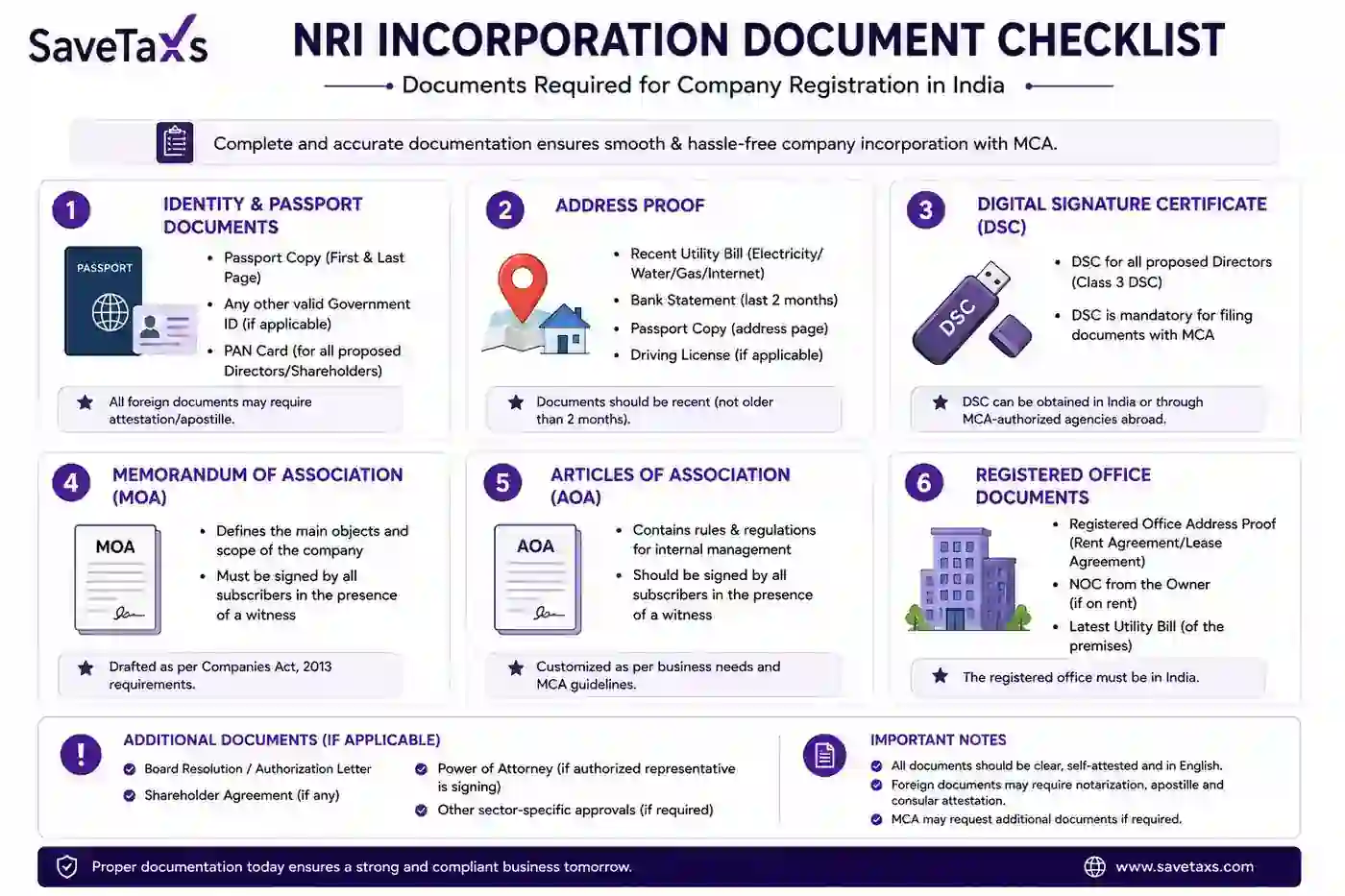
NRI company registration typically requires identity and address documents, incorporation documents, digital signatures, and additional authentication or attestation for documents issued outside India where applicable. The exact document set can vary according to the NRI's country of residence, citizenship, role in the company, and proposed ownership structure.
First, NRI directors and shareholders should generally prepare valid identity and address documentation, such as:
Passport.
Overseas residential address proof.
Recent bank statement or utility bill, where applicable.
Photograph.
PAN or relevant tax identification details where required.
Digital Signature Certificate for proposed directors who need to sign electronic filings.
Moreover, documents issued outside India may require notarization, apostille, or consular attestation, depending on the country and applicable MCA requirements. MCA guidance has specifically addressed authentication of documents for foreign subscribers and incorporated entities.
For example, an NRI residing in the United States may need to have certain incorporation documents authenticated according to the applicable process before they can be accepted for Indian incorporation.
At the same time, the Indian company's registered office requires its own documentation. Depending on the premises, this can include proof of address, ownership or occupancy documentation, and a no-objection certificate from the property owner.
| Requirement | Typical purpose | NRI-specific consideration |
|---|---|---|
| Passport | Identity verification | Usually important for overseas applicants |
| Overseas address proof | Residential address verification | Should meet applicable validity requirements |
| PAN / tax information | Tax and incorporation records | Requirements vary by applicant and filing |
| DSC | Electronic signing | Required for applicable digital filings |
| Registered-office proof | Establishes Indian registered office | Must relate to the proposed Indian address |
| NOC from owner | Permission to use premises | Relevant where premises are not owned by the company |
| MOA | Defines company objects and scope | Must reflect intended business activities |
| AOA | Establishes internal governance rules | Should align with proposed ownership structure |
For more practical preparation, see the NRI legal checklist for starting a business in India.
The Private Limited Company registration process for NRIs involves preparing the proposed structure, obtaining required digital signatures, submitting incorporation information through MCA's SPICe+ framework, and completing the linked incorporation filings. The process becomes more complex when overseas documents require authentication or when foreign investment rules apply.
First, follow these practical steps.
First, determine the proposed shareholders, directors, shareholding percentages, business activity, and Indian registered office before preparing the application. For example, an NRI founder may own 90% of the shares while another shareholder owns 10%, provided the structure complies with applicable law.
Next, choose a company name that complies with applicable naming requirements and does not conflict with existing company names or trademarks. MCA's SPICe+ Part A is used for name reservation when submitted separately, and the incorporation process also captures the proposed company information.
[Insert image: Show the MCA SPICe+ name reservation workflow | Alt text: "Check company name for Private Limited Company registration in India"]
Then, proposed directors and other relevant signatories obtain the required Digital Signature Certificates (DSCs) so electronic incorporation documents can be signed and submitted.
For an NRI living abroad, DSC coordination should be planned early because identity verification and issuance procedures can involve additional steps compared with an Indian resident applicant.
Next, prepare the Memorandum of Association (MOA) and Articles of Association (AOA). The MOA establishes the company's objects and scope, while the AOA governs internal management and shareholder-related matters.
For example, if an NRI is establishing an Indian software company, the objects should accurately reflect the proposed business activities rather than using an unrelated generic description.
Then, submit the incorporation application through the MCA's SPICe+ framework along with applicable linked forms and supporting documents. SPICe+ Part B covers incorporation and can also facilitate services such as DIN allotment, PAN, and TAN.
The MCA's instructions also state that DIN allotment can be processed through SPICe+ for eligible proposed directors who do not already have a DIN.
Finally, once the application is approved, the company receives its Certificate of Incorporation, establishing the company as a registered Indian entity. The incorporation process can also provide PAN and TAN through the integrated framework.
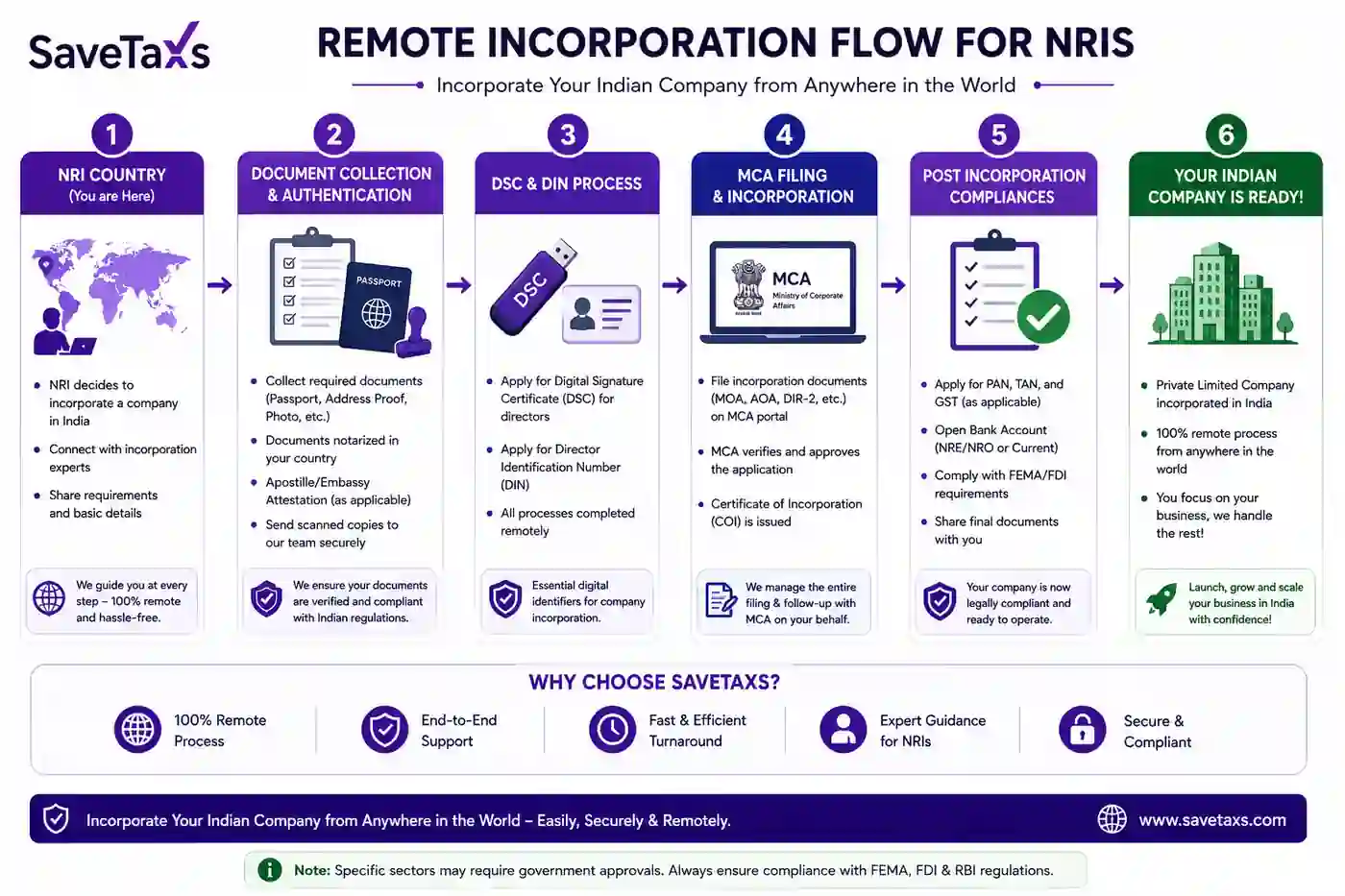
An NRI can often manage the Indian company incorporation process remotely, although specific documentation and authentication requirements depend on the NRI's country of residence and the company's proposed structure. Remote coordination can reduce the need for the founder to travel to India solely for incorporation.
First, the NRI can generally coordinate document preparation, DSC processing, incorporation forms, professional review, and MCA submissions from overseas when the applicable procedures permit it.
For example, an NRI based in Canada may provide passport and overseas address documentation, complete required authentication, sign electronic documents, and coordinate the Indian registered office without making multiple trips to India.
Moreover, remote incorporation does not mean that every requirement disappears. An Indian registered office is still required, and overseas documents must satisfy the applicable authentication rules.
At the same time, banking and post-incorporation procedures may involve additional verification. The practical workflow should therefore be planned around both MCA incorporation and the company's subsequent operational requirements.
FEMA and FDI rules determine how a person resident outside India can invest in an Indian company and what conditions apply to that investment. The relevant rules can depend on whether the investor is an NRI or OCI, whether the investment is on a repatriation or non-repatriation basis, the business sector, and the applicable entry route.
First, RBI regulations recognize specific investment routes for NRIs and OCIs. RBI guidance states that NRI or OCI investment in Indian company equity instruments on a non-repatriation basis is permitted under the relevant schedule and conditions.
Moreover, under the applicable non-repatriation framework, consideration can generally be paid through permitted banking channels or eligible NRE, FCNR(B), or NRO account funds, subject to the applicable regulations.
For example, an NRI funding an Indian company from an eligible NRO account should not assume that the investment will automatically have the same repatriation treatment as an investment made through a repatriable route.
At the same time, sector-specific restrictions matter. An NRI investing in a technology business may face a different regulatory analysis from an investor entering a sector subject to ownership restrictions, licensing requirements, or government approval.
Therefore, before transferring capital, review the proposed business activity, investor status, ownership percentage, source and mode of funds, pricing requirements, reporting obligations, and repatriation objective with an appropriate FEMA professional.
For broader background, you can also review our guide on NRI company registration in India.
The cost of Private Limited Company registration for an NRI is not a single fixed amount because government charges, stamp duty, DSC, documentation, authentication, and professional fees can all affect the final cost. Any advertised starting price should therefore be distinguished from the complete incorporation cost.
First, MCA and state-related charges can vary according to factors such as the company's proposed capital and the state in which the registered office is located. Stamp duty is particularly relevant because it is state-dependent.
Moreover, an NRI may incur additional expenses that an Indian resident applicant does not face, including document notarization, apostille or consular authentication, courier charges, and overseas document processing.
For example, two NRI founders with identical company structures could have different total incorporation costs if they reside in different countries and therefore face different document-authentication requirements.
At the same time, professional service fees vary according to the provider and the scope of work. A transparent quotation should clearly identify government fees, DSC charges, professional fees, authentication expenses, and optional services.
For more context, read our guide on Company registration cost in India.
Post-incorporation compliance is the ongoing legal and administrative work required after a Private Limited Company is registered. Incorporation is only the beginning; the company must continue meeting applicable Companies Act, tax, accounting, FEMA, and other regulatory obligations.
First, the company should complete its initial corporate actions, including opening the company's bank account, depositing subscribed capital where applicable, issuing share certificates, and maintaining statutory records.
Moreover, the company must meet applicable board-meeting, financial statement, annual return, auditor, and income-tax filing requirements. The exact filing obligations depend on the company's circumstances and current law.
At the same time, an NRI-owned company may need additional attention to foreign investment reporting, share transfers, repatriation, and FEMA compliance when transactions involve non-residents.
For example, an Indian company receiving additional equity from an overseas shareholder should evaluate the applicable foreign-investment reporting and pricing requirements rather than treating the transaction as an ordinary domestic capital contribution.
Common NRI incorporation mistakes include using incorrectly authenticated overseas documents, overlooking the resident-director requirement, choosing an unsuitable business structure, and transferring investment funds without reviewing FEMA requirements. Preventing these issues before filing is usually easier than correcting them afterward.
First, avoid assuming that all foreign-issued documents are automatically accepted. Authentication requirements can vary depending on where the documents were issued and the applicant's circumstances.
Second, avoid treating an NRI shareholder and NRI director as interchangeable roles. The company must satisfy its director requirements even when the proposed shareholders are eligible to hold shares.
Third, avoid transferring capital before determining the applicable FEMA investment route and repatriation treatment. RBI regulations distinguish between investment on repatriation and non-repatriation bases.
Fourth, avoid selecting business objects without checking whether the proposed activity is regulated. A sector may have additional licensing, ownership, FDI, or approval requirements.
Finally, avoid relying on old incorporation articles for current fees, forms, tax rates, or regulatory requirements. MCA and RBI requirements can change, so current official guidance should be checked before filing.
MCA's SPICe+ system is the primary government filing framework for new company incorporation, making it the most important platform to understand before beginning the process. SPICe+ integrates incorporation with several associated services, including DIN allotment and mandatory PAN/TAN issuance.
First, use the official MCA portal to review current incorporation instructions and filing requirements before submitting documents. The MCA SPICe+ incorporation instructions are particularly useful when checking form requirements.
Moreover, use RBI's current FEMA material when reviewing non-resident investment questions. RBI's framework confirms that investment by persons resident outside India is subject to applicable entry routes, sectoral caps or investment limits, and associated conditions.
At the same time, a professional incorporation service can be useful when the founder is overseas and needs help coordinating documents, registered-office requirements, MCA filings, and NRI-specific compliance considerations.
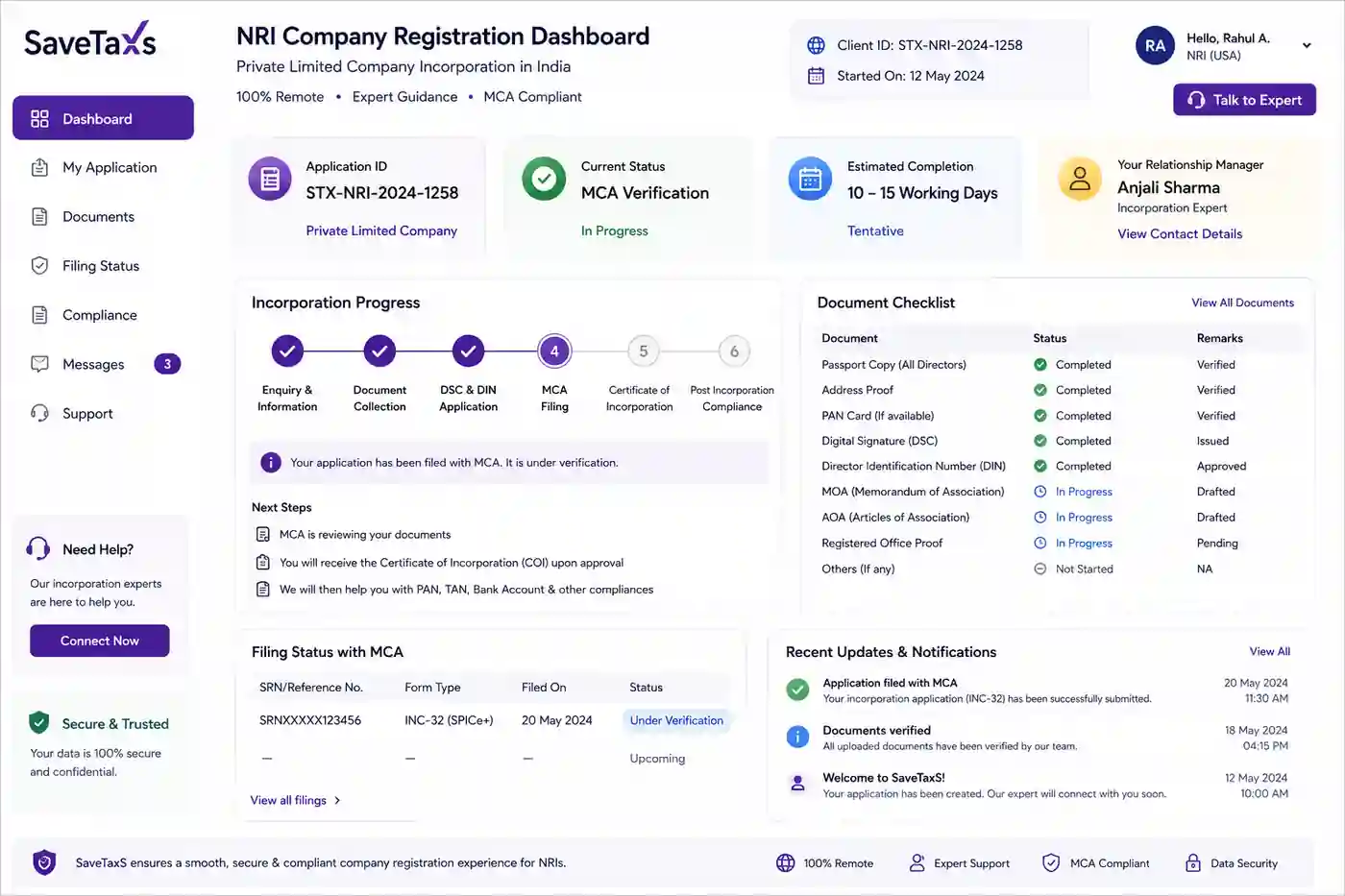
The best next step is to determine the proposed ownership, directors, business activity, funding source, and Indian registered office before preparing incorporation documents. This preliminary assessment can identify MCA, FEMA, FDI, and documentation issues before they delay the filing.
First, prepare this basic information:
Decide the shareholders and shareholding percentages.
Identify the proposed directors, including the person who will satisfy the resident-director requirement.
Confirm the company's proposed business activity.
Choose and verify the proposed company name.
Arrange the Indian registered office and supporting documents.
Prepare NRI identity and overseas address documents.
Determine whether overseas documents require notarization, apostille, or consular authentication.
Review the FEMA/FDI position before transferring investment funds.
Obtain applicable DSCs and prepare the incorporation filings.
Complete post-incorporation banking, capital, statutory, tax, and foreign-investment compliance.
Moreover, if you are still comparing business structures, our guide on Types of companies NRIs can open in India can help you evaluate the available options before committing to incorporation.
At the same time, if you already know that a Private Limited Company is appropriate, you can use Company registration for NRIs to review the broader NRI incorporation process.
A Private Limited Company is a practical structure for many NRIs who want to establish, own, or invest in an Indian business, but the registration process involves more than simply filing an MCA application. NRI company incorporation requires coordinated attention to corporate law, overseas documentation, resident-director requirements, and applicable FEMA/FDI rules.
First, determine your proposed shareholders, directors, business activity, registered office, and funding route. Then, prepare the required documents, complete the SPICe+ incorporation process, and review post-incorporation compliance requirements.
Moreover, do not rely on generic company-registration information when your structure involves non-resident investment. The correct process depends on your individual circumstances, so current MCA and RBI requirements should be verified before filing or transferring funds.
If you are ready to establish an Indian company while living overseas, an NRI-focused professional can help coordinate the incorporation process and identify documentation or FEMA considerations before they become obstacles.
This article is for general informational purposes only and does not constitute tax, legal, financial, or investment advice. Laws, regulations, rates, and procedures may change over time and may vary based on individual circumstances.
While SaveTaxs makes reasonable efforts to keep the information accurate and up to date, readers should verify applicable rules with official authorities or consult a qualified professional before making decisions based on this information.
Vipul Jain is the Co-Founder of SaveTaxs and a tax expert with experience in Indian and NRI taxation. He advises individuals, NRIs, and businesses on tax filing, tax planning, capital gains, DTAA, and compliance matters. He focuses on making complex tax concepts simple and helping taxpayers make informed, compliant decisions. See Full Bio

Want to read more? Explore Blogs

_1780491123033.webp&w=828&q=75)
_1778757638178.webp&w=828&q=75)