


Investment & Financial Planning
FCNR Deposit Interest Rates in 2026FCNR Deposit Interest Rates in 2026
Written by Vipul Jain


If you are an NRI selling property in India, you have probably already considered the sale price and the tax deducted from your payment. However, the sale price, capital gain, TDS, and final tax liability are different amounts. In this guide, you will learn how to calculate capital gains tax step by step, understand the current LTCG treatment, account for TDS under Section 195, and identify possible exemptions.
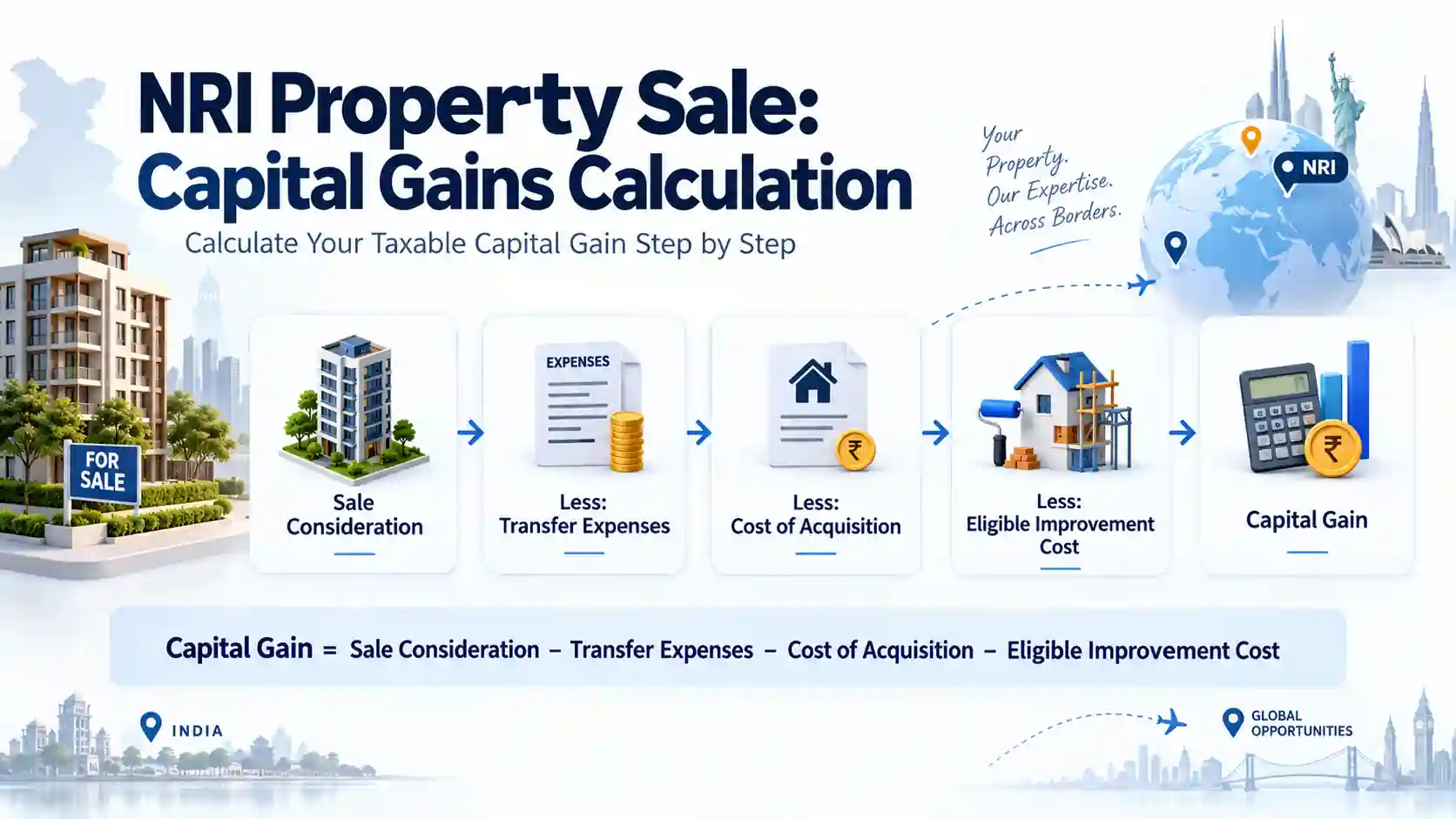
Capital gain is generally calculated after accounting for the relevant sale consideration, eligible transfer expenses, acquisition cost, and qualifying improvement costs.
Property held for more than 24 months is generally treated as a long-term capital asset for immovable-property capital-gains purposes.
The current LTCG rate for relevant transfers on or after 23 July 2024 is 12.5%, and current Income Tax Department guidance states that indexation is not available to non-residents for these transfers.
TDS and final capital-gains tax are not automatically the same amount because TDS is a mechanism for collecting tax during the transaction.
Section 195 applies when an NRI sells Indian immovable property, rather than the resident-seller TDS provisions under Section 194-IA.
Section 54 may provide an exemption when a qualifying long-term residential house is sold and the statutory conditions for purchasing or constructing another residential house are satisfied.
The transfer date matters, particularly because capital-gains rules changed for transfers occurring on or after 23 July 2024.
Capital gains tax is the tax that may apply to the profit arising from the transfer of a capital asset, such as property located in India. For an NRI, the calculation generally starts with the relevant sale consideration and accounts for eligible transfer expenses, acquisition cost, and qualifying improvement costs.
Moreover, the amount you receive from the buyer is not automatically your taxable capital gain. For example, if you sell a property for ₹1.2 crore after purchasing it for ₹50 lakh, the ₹70 lakh difference is only a starting point because eligible expenses and applicable tax provisions also affect the calculation.
For an NRI selling immovable property in India, the capital gain is generally calculated by determining the relevant sale consideration and deducting eligible transfer expenses and the applicable cost of acquisition and improvement.
A simplified calculation is:
Capital Gain = Sale Consideration − Transfer Expenses − Cost of Acquisition − Eligible Cost of Improvement
The final taxable amount may then be reduced by an applicable exemption, where the statutory conditions are satisfied.
Capital gains tax matters because the tax payable is based on the taxable gain rather than simply the gross amount received from the buyer. Understanding the calculation before completing the transaction can help you estimate your liability and identify documentation or exemptions that may affect the result.
First, the holding period determines whether the property is generally treated as short-term or long-term. For immovable property, a holding period of more than 24 months generally qualifies the asset as long-term.
Second, the date of transfer can change the applicable tax treatment. For relevant transfers on or after 23 July 2024, the current Income Tax Department guidance states that the LTCG rate is 12.5% and indexation is not available to non-residents.
Finally, TDS under Section 195 must be considered separately from the final tax calculation. The buyer is required to deduct tax when purchasing immovable property from a non-resident seller, subject to the applicable provisions.
Capital gains tax on an NRI property sale can be calculated by following a sequence of steps that identifies the holding period, sale consideration, eligible expenses, acquisition cost, improvement costs, applicable tax rate, and available exemptions.
The holding period determines the classification of the property for capital-gains purposes. An immovable property held for more than 24 months is generally treated as a long-term capital asset, while property held for 24 months or less is generally short-term.
For example, if an NRI purchased a house in April 2021 and sells it in September 2026, the property has been held for more than 24 months and would generally qualify as long-term.
This classification matters because the applicable tax treatment differs between short-term and long-term gains.
The sale consideration is the amount relevant to calculating the gain from the property transfer. Start with the consideration specified for the transaction and then determine whether any other valuation or transfer rules affect the calculation.
For example, if the agreed sale price is ₹1.20 crore, begin the calculation with ₹1.20 crore before deducting eligible expenses.
The exact computation can become more complex where the stamp-duty value or other statutory valuation provisions affect the transaction. Therefore, do not assume that the amount written in the sale agreement is always the only figure relevant for tax purposes.
Transfer expenses are costs incurred wholly and exclusively in connection with transferring the property. Examples can include eligible brokerage or certain legal expenses directly connected with the sale.
For example, if an NRI pays ₹2 lakh in eligible brokerage and transfer-related expenses on a ₹1.20 crore sale, those qualifying expenses can affect the capital-gain computation.
Keep invoices, receipts, agreements, and payment records because documentation helps establish that an expense is genuinely connected with the transfer.
The cost of acquisition is the eligible cost associated with acquiring the property. Your purchase agreement, payment records, and other supporting documents can help establish the original acquisition cost.
For example, if the property was purchased for ₹50 lakh, the relevant acquisition cost starts with ₹50 lakh, subject to the applicable tax rules and the property's specific history.
Inherited property requires additional care because the computation can depend on the circumstances of acquisition and the previous owner's cost. Do not automatically use the amount paid by the previous owner without checking the applicable rules.
Eligible improvement costs can affect the capital-gain calculation when they meet the applicable requirements. Examples may include qualifying capital expenditure that improves the property rather than routine repairs or maintenance.
For example, assume ₹5 lakh was spent on qualifying improvements supported by proper documentation. That amount may form part of the relevant cost calculation, subject to the applicable provisions.
Keep improvement invoices and payment evidence, particularly for older properties where the sale may occur many years after the expenditure.
The applicable tax treatment depends on the nature of the gain and the transfer date. For relevant transfers of immovable property by a non-resident on or after 23 July 2024, the Income Tax Department states that long-term gains are subject to a 12.5% TDS rate under Section 195 and that indexation is not available to non-residents.
| Calculation factor | Current treatment to check |
|---|---|
| Holding period | More than 24 months generally means long-term |
| Transfer date | Particularly important for transfers on/after 23 July 2024 |
| LTCG rate | 12.5% for the relevant current long-term property gains |
| Indexation for NRI | Not available for relevant transfers on/after 23 July 2024 |
| Buyer-side TDS | Section 195 applies to payments to an NRI |
| Exemptions | Available only when statutory conditions are satisfied |
For transfers of relevant immovable property on or after 23 July 2024, current Income Tax Department guidance states that non-residents do not receive indexation and the applicable LTCG rate is 12.5%.
TDS is tax deducted at source by the buyer and is separate from the final income-tax computation. When an NRI sells immovable property in India, the buyer is required to deduct tax under Section 195, rather than the resident-seller property TDS provisions under Section 194-IA.
For current transactions, the Income Tax Department's Section 195 guidance lists a 12.5% rate for relevant long-term capital gains on transfers on or after 23 July 2024, while short-term gains have different applicable rates. Surcharge and Health and Education Cess may also apply.
Importantly, TDS should not automatically be treated as the NRI seller's final tax liability. The final liability is determined through the applicable income-tax computation, with eligible TDS credit taken into account.
A practical example makes the calculation easier to understand. Assume an NRI purchased a property for ₹50 lakh, spent ₹5 lakh on eligible improvements, paid ₹2 lakh in eligible transfer expenses, and later sold the property for ₹1.20 crore.
First, calculate the gain using the simplified framework:
| Particulars | Amount |
|---|---|
| Sale consideration | ₹1,20,00,000 |
| Less: Eligible transfer expenses | ₹2,00,000 |
| Less: Cost of acquisition | ₹50,00,000 |
| Less: Eligible improvement cost | ₹5,00,000 |
| Capital gain | ₹63,00,000 |
Therefore, the illustrative capital gain is ₹63 lakh before considering any applicable exemption and the final tax computation.
Next, assume the property was held for more than 24 months and the transfer occurred after 23 July 2024. The gain would generally be treated as long-term, and the applicable current LTCG rate for the relevant category is 12.5%.
A simple illustration of tax at 12.5% on ₹63 lakh is ₹7.875 lakh before applicable surcharge, cess, exemptions, and other individual tax considerations.
This example is intentionally simplified. It is not a substitute for an individual tax computation, particularly where the property is inherited, jointly owned, acquired before specific legislative changes, or affected by valuation rules.

Section 54 can provide an exemption from qualifying long-term capital gains when an individual or HUF transfers a qualifying residential house and satisfies the prescribed conditions for purchasing or constructing another residential house.
For example, a qualifying taxpayer may purchase another residential house within one year before or two years after the transfer, or construct a residential house within three years after the transfer, subject to the statutory requirements.
The exemption is subject to limits and conditions. The Income Tax Department states that, from Assessment Year 2024-25, where the cost of the new asset exceeds ₹10 crore, the excess is ignored for calculating the Section 54 exemption.
Other capital-gains exemptions may also be relevant depending on the type of property and circumstances. However, an NRI should verify eligibility before assuming that reinvesting sale proceeds automatically eliminates the tax.
The right documents make the capital-gains calculation easier to verify and defend. Before calculating the tax, collect the following:
Original purchase agreement or deed
Sale agreement and final sale deed
Proof of purchase payments
Documents supporting eligible improvement costs
Brokerage and transfer-expense invoices
Property valuation documents, where relevant
Inheritance, gift, or succession documents, if applicable
TDS certificates and tax-credit records
Documents supporting any exemption claim
For inherited property, also collect documents showing how and when the property was inherited and the relevant previous-owner information.

The next step is to reconcile the capital-gain calculation with the TDS deducted during the transaction. An NRI should compare the final tax liability with the available TDS credit rather than assuming that the buyer's deduction is the final tax amount.
First, verify the TDS amount and ensure the tax credit is correctly reflected in the relevant tax records. Second, determine whether an exemption is available. Third, include the property transaction correctly in the applicable income-tax return.
Moreover, consider professional review if the property is inherited, jointly owned, gifted, acquired many years ago, or involves a substantial capital gain. Such transactions can involve additional rules that a simplified calculation does not capture.
If you also need to consider cross-border tax consequences, review the applicable treaty position separately rather than assuming that Indian capital-gains tax is the only relevant consideration.
A reliable NRI property-sale calculation should combine a document-based calculation sheet with official tax guidance. A spreadsheet can help you enter the purchase price, improvement costs, transfer expenses, sale consideration, capital gain, applicable tax rate, TDS, and exemption separately.
You can also verify tax provisions through official Income Tax Department resources rather than relying solely on calculators or third-party summaries. This is particularly important because capital-gains and TDS rules can change through Finance Acts and subsequent guidance.
The most useful practical approach is to calculate the gain first, determine the applicable tax treatment second, and reconcile TDS third. This sequence prevents the common mistake of treating the amount deducted by the buyer as the final tax liability.
Before completing an NRI property sale, use this checklist:
Confirm your residential status for the relevant tax year.
Confirm the property's holding period and whether the gain is short-term or long-term.
Confirm the transfer date, particularly if the transaction is around a tax-law change.
Calculate the relevant sale consideration.
Identify eligible transfer expenses.
Verify the cost of acquisition and improvement costs.
Check whether indexation applies to your specific transaction.
Calculate the applicable capital-gains tax.
Check Section 54 or another potentially applicable exemption.
Reconcile Section 195 TDS with the final tax liability.
Retain all supporting documents.
File the applicable income-tax return and claim eligible TDS credit.
Calculating capital gains tax on an NRI property sale becomes easier when you separate the transaction into sale consideration, eligible expenses, acquisition cost, improvement cost, capital gain, tax treatment, exemptions, and TDS. For relevant transfers on or after 23 July 2024, current Income Tax Department guidance provides a 12.5% LTCG rate and does not provide indexation to non-residents.
Most importantly, TDS under Section 195 is not automatically the same as your final capital-gains tax liability. By gathering the right documents, applying the rules for the relevant transfer date, checking available exemptions, and reconciling TDS with your final tax computation, you can approach the sale with a much clearer picture of your Indian tax obligations.
This article is for general informational purposes only and does not constitute tax, legal, financial, or investment advice. Laws, regulations, rates, and procedures may change over time and may vary based on individual circumstances.
While SaveTaxs makes reasonable efforts to keep the information accurate and up to date, readers should verify applicable rules with official authorities or consult a qualified professional before making decisions based on this information.
Shubham Jain is the Founder of SaveTaxs and has extensive experience in Indian and NRI taxation. He advises individuals, NRIs, and businesses on tax filing, tax planning, capital gains, DTAA benefits, fund repatriation, and compliance matters. He regularly writes about taxation and related financial topics. His focus is on making complex tax concepts easy to understand. Through his articles, he helps taxpayers stay informed, avoid common mistakes, and stay compliant with Indian tax laws. See Full Bio
Want to read more? Explore Blogs
_1781845771869.webp&w=828&q=75)
_1778936280179.webp&w=828&q=75)
_1778936089630.webp&w=828&q=75)