



Business Setup
Difference Between a LLP and a Partnership FirmDifference Between a LLP and a Partnership Firm
Written by Vipul Jain
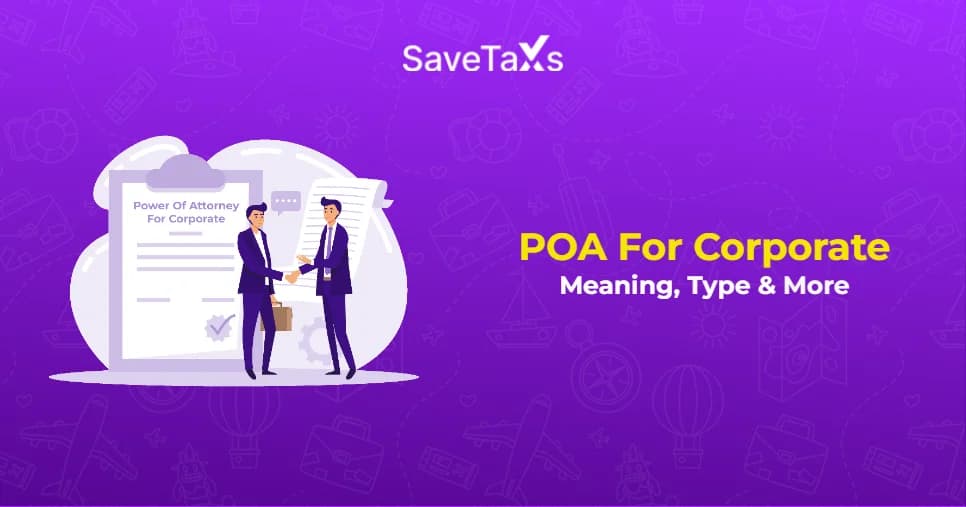
A power of attorney is a key mechanism where an authorized person acts legally on behalf of another person. In companies, delegation of authority is inevitable when authorized signatories or directors cannot be present to handle every legal or operational task in person. That's when the power of attorney for companies comes into the picture.
However, understanding the power of attorney meaning is important for company directors, representatives, or owners, as an inaccurate delegation can lead to a compliance issue. In this blog, we will discuss what a Power of Attorney for companies is, its types, the differences between corporate and personal POAs, how to set up a POA, and more.
The POA full form is Power Of Attorney.
A company POA (power of attorney) is also known as Corporate Power of Attorney. A POA is a legal document that grants a company or business the authority to authorize an entity or individual to act on its behalf. The authority covers everything from handling legal matters to making key management decisions, managing finances, signing contracts, and more.
In a company:
Ensure that, unlike a personal POA, a corporate POA complies with internal approval requirements, company law, and authorized signature rules.
Companies issue a POA to ensure seamless business operations without requiring the company's directors to be present in person for every task.
General reasons for a company to issue a POA include:
An accurately drafted POA allows businesses to operate efficiently while maintaining legal accountability.
Based on the task's duration and scope, a power of attorney is classified into different types.
The general power of attorney grants the attorney-in-fact broad authority to perform various acts and tasks on behalf of the principal. In corporations and businesses, this type of POA is usually restrictive, and if used, it is drafted carefully to avoid misuse.
Best For: When the director, business owner, or executive is temporarily unavailable and the company needs someone to manage key business responsibilities.
This type of power of attorney grants the attorney-in-fact the authority to perform a specific task, such as representing the company in court or signing a particular agreement. In corporate matters, this is the most commonly used POA.
For Example
This type of power of attorney is valid only for a fixed period of time or until a specific purpose is complete.
Best Use For: Delegating a specific and temporary authority, such as handling a specific real estate sale or executing an agreement during the absence of the directors.
In India, a POA must comply with applicable laws to be legally valid.
The following are the key requirements:
Both the personal and the corporate power of attorney grant the authority to act on behalf of the principal. However, both types of attorneys serve different purposes.
A personal power of attorney is issued by an individual when they aren't available in person to manage their personal affairs, such as signing documents, making medical decisions, handling finances, and managing property. The grantor often grants the power of attorney to a trusted family member, friend, or professional firm.
This type of power of attorney is specifically for businesses, allowing them to delegate authority to employees, external representatives, or executives. This includes making business decisions for the company when primary decisions are unavailable, signing contracts, managing the company's financial transactions, and so on.
A corporate power of attorney is governed by the by laws of the corporation and requires the board's approval to grant it to someone.
The following table demonstrates the difference between the personal and corporate POA
| Feature | Company POA | Personal POA |
|---|---|---|
| Grantor (principal) | The Company (through the board resolution) | An Individual |
| Purpose | Ensuring seamless business operations, signing contracts, and managing operational efficiency. | Managing personal affairs such as finances, health, legal affairs, assets, and more. |
| Duration | Active while authorized; can be revoked. | Can be durable, meaning lasting through incapacity, or non-durable. |
| Authority | Authorized by the board/directors. | Authorized by an individual. |
The POA does not last for life unless specified otherwise.
However, the POA may end due to:
In companies, the revocation of an attorney's power occurs through a formal board decision.
The following is an easy, step-by-step approach to drafting a POA for a company.
Before you begin drafting the POA, it is important to outline the powers that are being granted.
While drafting the POA, ensure it meets legal requirements and includes all essential details.
When a corporate POA takes effect, it should comply with the company's internal decision-making process and the governance rules. Hence:
To ensure the POA is legally enforceable, it must undergo the official verification process.
Once the POA is finalized, the business must ensure that all relevant parties are informed and that the POA is stored securely.
Key Considerations
Savetaxs provides clear advice and expert support for your Indian business journey.
For a business, a power of attorney (PoA) has proven a valuable tool, making it easier to delegate authority and keep operations running seamlessly even when the primary decision-makers are unavailable. However, as they say, with great power comes great responsibility; similarly, if a POA is not drafted accurately, it can lead to legal trouble and financial losses.
Henceforth, the company must be clear about the powers it is gaining and those it is not granting. Additionally, the company must have a robust plan to update or revoke the POA as needed.
As an NRI business owner, if you are planning to draft a POA and seeking professional guidance, Savetaxs is the name to trust. Our experts provide end-to-end consultation on drafting the POA, ensuring the documentation is accurate, the POA is executed properly, and the POA is legally stamped. The experts will ensure that the Power of Attorney draft aligns with your business requirements just right.
Connect with us as we serve our clients 24/7 across all time zones.
This article is for general informational purposes only and does not constitute tax, legal, financial, or investment advice. Laws, regulations, rates, and procedures may change over time and may vary based on individual circumstances.
While SaveTaxs makes reasonable efforts to keep the information accurate and up to date, readers should verify applicable rules with official authorities or consult a qualified professional before making decisions based on this information.
Vipul Jain is the Co-Founder of SaveTaxs and a tax expert with experience in Indian and NRI taxation. He advises individuals, NRIs, and businesses on tax filing, tax planning, capital gains, DTAA, and compliance matters. He focuses on making complex tax concepts simple and helping taxpayers make informed, compliant decisions. See Full Bio
Want to read more? Explore Blogs
_1780491123033.webp&w=828&q=75)
_1778757638178.webp&w=828&q=75)