



Business Setup
Difference Between a LLP and a Partnership FirmDifference Between a LLP and a Partnership Firm
Written by Vipul Jain
_1776861904907.webp&w=3840&q=75)
The startup ecosystem in India is rapidly evolving and securing global investments. For NRIs, being a part of an Indian startup is not only about emotions but also an investment opportunity. Considering this, there are several Startup India benefits for NRI entrepreneurs. It includes providing a conducive environment for startups, encouraging innovation, offering access to government tenders, offering tax exemptions, and more. However, to secure these benefits, they need to stick to the correct investment route. Additionally, follow the regulations set by the Foreign Direct Investment (FDI) policy, the Foreign Exchange Management Act (FEMA), and the Reserve Bank of India (RBI).
Further, understanding NRI Indian startup investment, legal compliance, and equity structure helps prevent future risks. Want to know about this in detail? Read the blog and get your answers.
Key Takeaways
The Startup India Scheme was launched by the Indian government on January 16, 2016. It was first announced by the Honorable Prime Minister, Mr. Narendra Modi, during his speech on August 15, 2015. This scheme is spearheaded by the Department for Promotion of Industry and Internal Trade (DPIIT). It focuses on three areas, i.e., Simplification, Handholding, and Collaboration.
The scheme was introduced to nurture entrepreneurs, develop a robust ecosystem for innovation, and create large-scale employment. Additionally, it provides benefits such as simplified compliance, tax exemptions, funding support, and access to government tenders for registered startups.
However, Startup India is not granted to founders; it is provided to entities. It is vital for resident and NRI entrepreneurs to know. In simple terms, as an individual, you cannot register under Startup India, but your company can.
Considering this, according to DPIIT guidelines, private limited companies under the Companies Act, 2013, limited liability partnerships (LLPs), and registered partnership firms are included in Startup India. This means that before applying for DPIIT recognition, an NRI should form a legal business entity in India.
This was all about Startup India for NRI entrepreneurs. Moving ahead, let's know the eligibility criteria for NRIs under this scheme.
To take the Startup India benefits, NRIs first need to fulfill the eligibility criteria. This is as follows:
These are the key eligibility criteria for the Startup India scheme that NRIs need to consider to avail of its benefits. Moving forward, let's look at the key benefits of this scheme for NRIs.
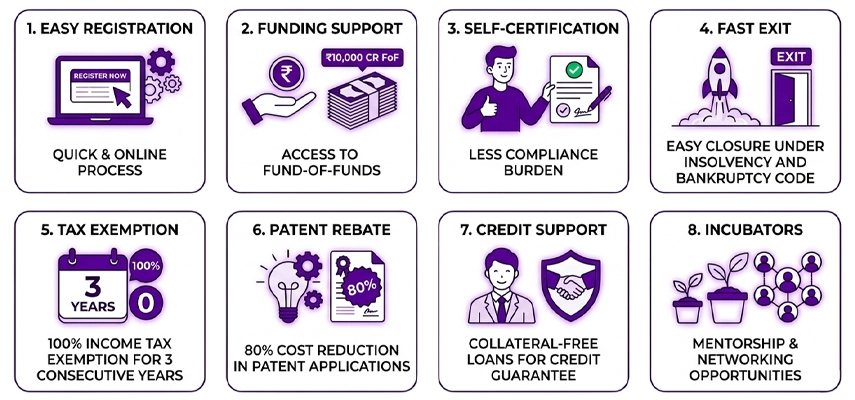
The Startup India benefits are extensive and designed to offer startups with vital resources to succeed and grow. Here are some of the key benefits of Startup India innovation for NRI entrepreneurs:
With minimal documentation, you can register your startup through the Startup India portal. The registration process is designed to be hassle-free and quick. It allows entrepreneurs, rather than bureaucratic process concentrate on their business. This easy process of business registration is one of the key benefits of this scheme, as it reduces both effort and time.
For any startup to succeed, it is vital to have access to funds. Through a Fund of Funds (FoF) program, this scheme facilitates access to funding. The program allocates INR 10,000 crores to help startups via registered Alternative Investment Funds (AIFs). This financial assistance helps startups secure investments vital to their operations.
With certain environmental regulations and labor laws, a startup can self-certify compliance. It reduces the inspection requirement for up to five years. The self-certification process eases the compliance requirements. It helps entrepreneurs, rather than regulatory difficulties, focus on their business activities.
In case you want to wind up your startup, the scheme provides an easy bankruptcy process. If necessary, it allows eligible startups to close down through a fast-track process, typically completed within 90–180 days under IBC. This fast exit mechanism offers NRIs peace of mind, knowing that if things do not work as planned, they have a clear path.
One of the most vital Startup India benefits for NRI entrepreneurs is the provision of tax exemptions. Businesses recognized under this scheme for three consecutive years out of ten years of their incorporation can claim 100% tax exemption on profits. It allows entrepreneurs to reinvest their earnings into growth initiatives. Additionally, make it easy to scale operations without getting burdened by tax obligations.
For startups that are working towards innovation, intellectual property protection is vital. Under this scheme, entrepreneurs can get 80% rebate on patent costs. It further reduces their financial burden linked with protecting their intellectual property. Apart from this, the facilitation fees for a patent application are covered by the Indian government. It encourages entrepreneurs to effectively secure their innovations.
To improve creditworthiness, the Indian government has introduced a Credit Guarantee Fund. It offers guarantees for loans taken by entrepreneurs from banks. This step helps mitigate risks associated with lending. Additionally, make it easy for startups to secure investment capital with no collateral requirements.
Startups can connect with government-recognized incubators that provide resources, guidance, and networking options. These play an essential role in nurturing entrepreneurs by prgovernment-recognisedoviding mentorship from professionals. Also, give access to valuable industry contacts.
These are the key Startup India benefits for entrepreneurs in India. Moving forward, let's know about the registration process.
Here is how NRI entrepreneurs register for the Startup India scheme:
Before applying to the Startup India scheme, you need to register your business as a limited liability partnership (LLP), private limited company, or registered partnership. For entity registration, you need to follow the standard process, which involves filling out an application form.
Visit the official Startup India website and register your company as a startup under the Startup India scheme of the government. For this, you need to fill out the form on the website. Additionally, you should complete all the fields and upload all the requested documents.
After creating a profile on the website, the company must first obtain recognition from the DPIIT. It allows businesses to take advantage of benefits such as access to intellectual property services, among other things.
Upload all the documents in PDF format. With the form, you need to upload the required documents such as incorporation certificate and business details.
Considering this, here are the documents that you need to provide:
Certificate of Incorporation or Registration
Company description in brief
PAN details of the company (if applicable)
Additionally, you should upload your LLP certificate and the business certificate of incorporation, or the registration certificate, of the partner company.
In India, startups can apply for tax exemption for three consecutive years. However, to qualify for tax privileges, the Inter-Ministerial Board (IMB) should validate your business. DPIIT recognition is required, but startups must obtain separate approval from IMB to claim tax benefits.
The conditions for self-certification are mentioned below:
After submitting the registration, you will get immediate recognition. Once the administration has reviewed all your uploaded documents, you will receive a certificate of incorporation or registration.
This is how NRI entrepreneurs can register their businesses in the Startup India scheme. You can also take professional assistance to ease the registration process. Moving ahead, let's outline the legal and compliance requirements NRIs must follow when registering for this scheme.
For NRI entrepreneurs who want to register their business under the Startup India scheme, there are some legal and compliance requirements to follow. These are as follows:
Under the Foreign Exchange Management Act (FEMA), NRIs are allowed to invest 100%FDI (foreign direct investment) in an Indian startup in most sectors through the automatic route. This means they do not need to take prior permission from the government for investment. However, to invest in sectors like media, telecom, and defence, they need prior approval from the government.
Apart from this, FEMA also governed how NRIs can invest the funds. It includes reporting requirements, pricing guidelines, and equity structure.
The Reserve Bank of India (RBI) regulates the flow of foreign funds in India. Considering this, NRIs through the designated Indian bank accounts route their investments. These are as follows:
Further, it is mandatory to report the foreign investments to the RBI. Non-compliance with it can result in unnecessary penalties.
Apart from FEMA and the RBI guidelines, NRIs also need to follow standard business regulations in India. It includes:
Moreover, ensuring compliance from the beginning helps in avoiding legal complications in the future.
Connect with Savetaxs and get smart guidance for your business ventures in India.
Lastly, the Startup India Scheme is an important initiative by the Indian government to nurture entrepreneurship in the country. This scheme is also available for NRIs and foreign entrepreneurs and offers several advantages. The numerous Startup India benefits for NRI entrepreneurs include an easy registration process, tax exemptions, support for innovation, and funding options.
Do you also want to make the most startup India benefits for your business? Savetaxs helps you secure recognition, enjoy compliance with ease, and claim tax exemptions. So connect with us and let our experts handle all the things on your behalf.
This article is for general informational purposes only and does not constitute tax, legal, financial, or investment advice. Laws, regulations, rates, and procedures may change over time and may vary based on individual circumstances.
While SaveTaxs makes reasonable efforts to keep the information accurate and up to date, readers should verify applicable rules with official authorities or consult a qualified professional before making decisions based on this information.
Vipul Jain is the Co-Founder of SaveTaxs and a tax expert with experience in Indian and NRI taxation. He advises individuals, NRIs, and businesses on tax filing, tax planning, capital gains, DTAA, and compliance matters. He focuses on making complex tax concepts simple and helping taxpayers make informed, compliant decisions. See Full Bio
Want to read more? Explore Blogs
_1780491123033.webp&w=828&q=75)
_1778757638178.webp&w=828&q=75)