Directors play a key role in a company. They make strategic decisions, represent the business in the world, and guide operations. However, sometimes things do not work as planned. Due to inactivity, misbehavior, or disagreement, a director is dismissed by the shareholders. Considering this, the process to remove a director from the company is regulated by the Companies Act, 2013. It has to be cautiously undertaken to follow the procedure and the law.
Want to know more about the removal process of the director from the company in detail? The blog contains all the information that you should know about the process, from director types, reasons, legal provisions, and more. So read on and gather all the information.
Key Takeaways
- Under section 169 of the Companies Act, 2013, shareholders have the right to remove a director before the end of their agreement or the company's articles.
- At least 14 days before initiating the meeting to remove the director, a special notice should be sent to the company.
- The director has a legal right to be heard and to represent themselves at the general meeting.
- You need to file Form DIR-12 to remove a director within 30 days of the resolution. It formalizes the removal.
- A removed director cannot be reappointed to the same position again in the company.
Understanding Director Removal Under Company Law
Section 169 of the Companies Act 2013 provides a power to the company to remove a director before the expiry of his term by passing an ordinary resolution. Members who want to remove the director at least 14 days before the meeting need to provide a special notice to the company at which the removal resolution is conducted.
After passing the resolution, the company should fill out Form DIR-12 with the Ministry of Corporate Affairs for the removal of the director.
This was all about the director's removal under the company law. Moving ahead, let's know the grounds to remove a director from the company.
Grounds to Remove a Director from the Company
Varying from company to company, here are some of the grounds upon which a director can be removed from their position:
- Negligent of Duties: Directors owe legal duties to their shareholders and the company. It includes loyalty, duties of care, and good faith. If a director does not fulfill his/her duties, the company may take legal action for their removal.
- Mismanagement or Misconduct: Directors can also be removed from their position if he/she is found engaged in mismanagement or misconduct that harms the company. This includes embezzlement, fraudulent activities, or gross negligence in fulfilling their duties.
- Conflict of Interest: Directors should work in the best interest of their shareholders and the company. Additionally, should avoid their personal conflicts of interest. In case the personal interest of the director conflicts with the interest of the company, they may be removed.
- Loss of Confidence: Directors can also be removed by the shareholders on the grounds of losing confidence or inability to effectively conduct their duties. Further, this loss of confidence results from ethical lapses, poor performance, or other factors. It is because it determines the effectiveness and credibility of the director.
- Violation of Laws or Regulations: If a director is found non-compliant with the laws and regulations of the operations of the company, they can be removed. This includes violating various laws of the company, such as labor laws, environmental regulations, commercial laws, and company law.
These are some of the key reasons to remove a director from the company. Moving forward, let's know the types of directors who can be removed from their positions.
Types of Directors Who Can Be Removed
Here are the different types of directors who can be removed from their position:
- Executive Director
- Managing Director
- Nominee Director
- Whole-Time Director
- Non-Executive Director
- Additional Director
Further, a director appointed by the Tribunal or under proportional representation under section 169 of the Companies Act, 2013, cannot be removed.
This was all about the different types of directors who can be removed from a company. Moving further, let's know the process to remove a director from the company.
Procedure to Remove a Director from the Company
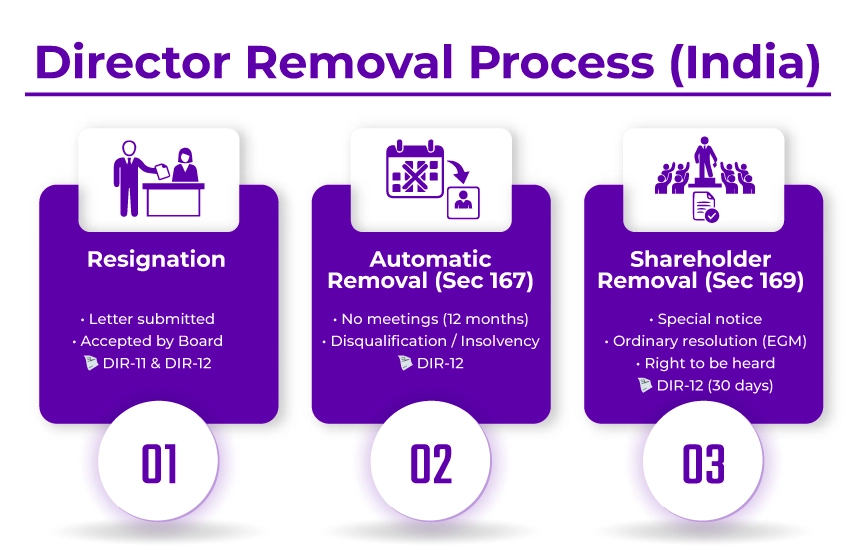
The process to remove a director from the company can be done in three different ways. These are as follows:
Resignation by the Director (Voluntary Removal)
When the director of the company voluntarily tendered his/her resignation.
- A director submits a resignation letter from their position.
- In the minutes of the meeting, the resignation of the director is accepted and recorded by the company.
- Form DIR-11, by the director, and Form DIR-12, by the company, are filled out with the ROC (Registrar of Companies).
Automatic Vacation of Office (Under Section 167)
Under this, the director automatically vacated the company in case of:
- Absence from all board meetings for 12 months.
- Failure to disclose interest in contracts.
- Disqualification under Section 164
- Being declared insolvent
- To update the ROC, the company fills out Form DIR-12
- Conviction and sentence of more than six months
Director Removal by Shareholders Under Section 169
When shareholders under section 169 decided to remove a director from their position:
- Board Meeting: To approve the removal notice, a meeting is conducted by the Board.
- Extraordinary General Meeting (EGM): To remove a director from the company, shareholders pass an ordinary resolution.
- Right to Representation: Before voting, the director has a right to defend his/her case.
- Filing with ROC: Within 30 days of the resolution, the company needs to file Form DIR-12 to remove a director from their position.
Further, once the ROC updates the records of the company, the name of the director is officially removed from the MCA database. Additionally, the process remains the same to remove an NRI director from the company in India.
These are the three methods for removing a director from a company. Moving ahead, let's know the compulsory criteria that you need to follow for director removal.
Checklist for Removal of Director
To remove a director from a company, you need to fulfill the following mandatory requirements:
- Issuance of Special Notice: Under section 115H of the Companies Act, 2013, a special notice should be issued. The written notice should follow the statutory procedure. Additionally, notify the shareholders and members of the company about the removal.
- Notice Period to Director: The special notice to the respective directors should be dispatched at least 14 days before the passed resolution. It provides the director with sufficient time to respond to the removal.
- Right to be Heard: It is obligatory to provide the opportunity to the concerned directors to represent their case. Considering this, the representations should be done in written form. To ensure transparency, with the notice, a copy of the representation should be included.
- General Meeting and Voting: At the general meeting, the resolution for the removal of a director is put to a vote. Members and shareholders of the company can determine the outcome with voting rights. Considering this, the provision of section 169 ensures that the voting process is done fairly and in the interest of the company.
- Filing for Form DIR-12 with ROC: File Form DIR-12 to remove a director with the ROC to record the dismissal of the director. Documents may include a copy of the special notice, resignation letter of the director, the board resolution, and direct identification number (DIN).
- Restrictions on Reappointment: The removed director cannot reappoint to the same position in the company. Provisions associated with it are also mentioned in the Companies Act 2006.
- Filing of Form MGT-14: In cases where the removal of a director includes changes to the share capital or articles of the company, you need to fill out Form MGT-14 with the ROC. Additionally, include an explanatory statement along with the form to clarify the reasons for removing the director.
- Appointment of a New Director: Depending on the model articles of the company and the shareholders' agreement, the board may need to appoint a new director or additional directors.
- Consideration of Minority Shareholders: When removing a director from their position, ensure that the minority shareholders are not affected unfairly by this decision. Considering this, following the Principle of Proportional Representation can help in safeguarding their interests.
- Filing Requirements with Companies House: If applicable, particularly for a private limited company, certain statutory filings may be required with Companies House. This includes copies of special notices and draft minutes submission.
This is the checklist you need to follow when removing a director from their position in the company. Moving forward, now, let's look at the consequences of non-compliance in the removal of directors.
Consequences of Non-Compliance in Removal of Directors
Consequences of non-compliance with the stated legal procedure to remove the director include:
- Void or invalid removal of the director.
- Increased cases of shareholder disputes and litigation.
- Delay in operational and statutory decisions.
- Fine payments to the officers and the firm in default.
- Governance issues and reputational damage of the company.
These are some of the consequences the company may face when non-compliant in the removal of a director from a company.
Not Sure About NRI Business Regulatory Framework?
For smooth business operations in India, Savetaxs provides expert consultancy to NRIs.
Final Thoughts
Lastly, from the above blog, it is clear that to remove a director from a company, you need to follow legal procedures stated in the Companies Act, 2013, or relevant local regulations. Additionally, it is an important decision that demands strict compliance and careful consideration of the legal processes. Considering this, whether it includes a board resolution, ordinary resolution, or court order, the process should be transparent, fair, and align with the best interests of the company.
Further, at Savetaxs, we assist NRIs in navigating the director removal process in India. From legal consultation to director removal, our end-to-end service covers every step. We ensure a stress-free experience tailored to your business needs.



_1775566690480.webp&w=3840&q=75)
_1780491123033.webp&w=828&q=75)
_1778757638178.webp&w=828&q=75)