UAE NRI Taxation
How UAE NRIs Can Build a Retirement Corpus for IndiaHow UAE NRIs Can Build a Retirement Corpus for India
Written by Shubham Jain
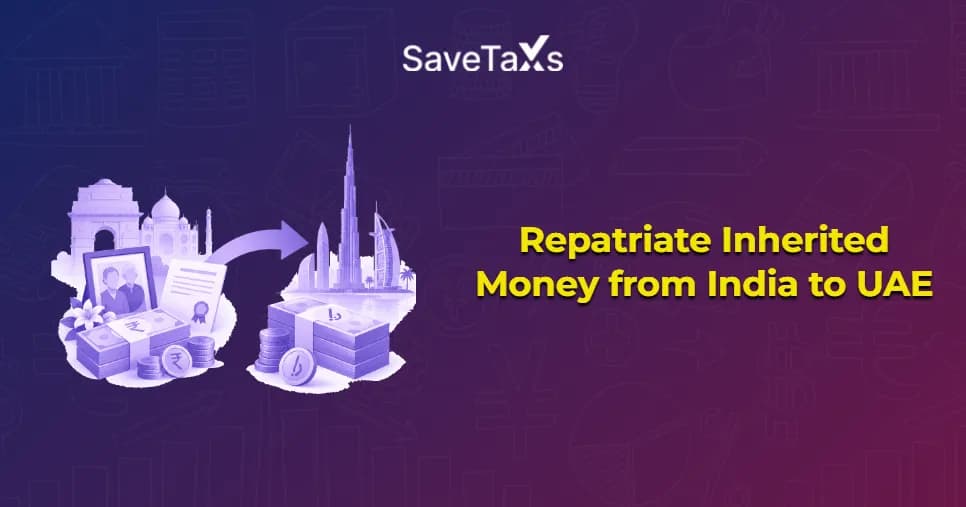
An NRI can legally repatriate inherited funds from India to the UAE under RBI and FEMA guidelines. Eligible inherited assets or their sale proceeds may generally be repatriated up to USD 1 million per financial year, subject to applicable conditions and documentation. However, to do so, you must provide documents proving your legal entitlement, such as a will or succession certificate.
Additionally, before you move the money abroad, you must comply with any applicable tax requirements. This means that although there is no tax on inheritance itself, any income or capital gains arising from it may be taxed.
If you want to know more about repatriating inherited money in detail, keep reading the blog.
According to the Reserve Bank of India, NRIs can repatriate inherited money to the UAE. However, the following conditions must be met:
The inheritor must be a bona fide NRI at the time of repatriation.
The inherited assets must be legally acquired and fall within the categories permitted under applicable FEMA rules.
Prove your relationship with the deceased and legal entitlement by submitting valid documents.
Now, once your eligibility is confirmed, you can repatriate inherited money. However, banks require valid proof of inheritance before transferring the funds. So, an NRI can prove legal entitlement to an inheritance by submitting a will.
But what if there is no valid will? To get the answer to this question, let's next understand how an NRI can prove their legal ownership of an inheritance.
File your taxes accurately with confidence and precision at Savetaxs.
An NRI can prove their legal entitlement to an inheritance by submitting a valid will. Further, in the absence of a will, you can provide a legal heir certificate or a succession certificate. Here's how it works:
A will explains how the deceased person wanted the estate to be distributed. The person who is appointed to manage the will, known as the executor, must determine the assets, settle eligible liabilities, and distribute the estate. The documents required to claim the assets when there is a valid will may include:
Moreover, when ownership is unclear or disputed, banks, the property authority, or an investment institution may request probate. Probate is basically the court's confirmation of a will. However, you may not need to submit it in every case, and the requirement may depend on the situation. This is what you can do where there is a will. Now, let's look at what happens when there is no will.
In the absence of a will, the estate is distributed under the applicable succession law. This is called intestate succession, meaning inheriting assets without a will. In this situation, you may need the following documents:
Keep in mind that these documents will not serve as identity proof or as evidence of ownership for every property. Additionally, another issue arises when there are multiple legal heirs.
Another situation is when several heirs might inherit the same asset. In this case, you must prove each person's individual share.
Imagine you are one heir of the property and have the original asset documents. But that doesn't mean you have the right to sell or transfer the entire property. Instead, you may have to obtain the participation, consent, or legally valid authorization of the other heirs for the sale or transfer of the entire property, depending on the circumstances.
Additionally, the bank may request:
The NRI will be credited only with the share they can prove and repatriate in that person's name. Documents such as a succession certificate, probate of a will, and property documents are important for claiming the assets. You may also need additional banking or transaction documents, depending on the source and history of the funds.
Once you have all the required documents for your situation, proceed with repatriation. Next, we will explain the steps to repatriate inherited money.
Follow the steps below to repatriate inherited funds from India to the UAE:
If the inherited asset has been sold or the proceeds are held in India, ensure that the funds are received through the appropriate Indian banking channel.
Collect all the important documents, such as a death certificate, inheritance proof (probate/will/succession certificate), your identification papers, and relationship evidence.
Complete the applicable tax-compliance requirements and obtain the relevant tax documentation for the remittance.
Provide a repatriation request to your Indian bank. Also submit an application specifying the amount, destination account, and required documents.
The bank will process the transfer to your overseas account once they verify compliance with RBI and FEMA guidelines.
Note: Form 145 and 146 have now been replaced by Form 145 and Form 146, applicable to remittances made from 1st April 2026. Form 146 is required only where the applicable tax-compliance conditions call for an accountant's certificate.
Here's an important point: you cannot repatriate as much as you want, as FEMA rules have limits. So, an individual can generally repatriate only up to USD 1 million per financial year under the applicable remittance-of-assets facility. Let's understand this USD 1 million facility on repatriating inherited money.
As mentioned above, eligible remittances under the FEMA remittance-of-assets framework are generally covered by the USD 1 million per financial year facility. Here's how it works:
The USD 1 million limit applies per financial year (April to March) and not per transaction or per estate. But what if your inheritance is more than this limit? In that case, you can spread eligible transfers across multiple years.
For example, if your total eligible proceeds exceed the USD 1 million facility, you can move funds in installments. This means you can transfer eligible amounts within the applicable annual limit each financial year until you successfully transfer the entire amount. However, for each installment, you must comply with the applicable Indian tax requirements.
If you still want to transfer amounts above the specified limit in a financial year, you will need prior approval from the RBI. You apply for this approval through your bank, which can take time and might not be approved quickly.
Once you prove ownership and settle the applicable taxes, you can transfer the funds after the bank clears its checks. There's no mandatory lock-in period before you choose to repatriate eligible inherited assets.
Further, although the UAE imposes no personal income tax and India doesn't levy inheritance tax, inheritance itself is not taxable merely because it is received. However, income or capital gains arising from the inherited assets may be taxable depending on what you do with them. Confused? Let's understand this in detail.
While receiving an inheritance is tax-free, secondary taxes may apply later based on what you do with the assets. Here's how the tax applies:
| Situation | Tax Implication |
|---|---|
| When You Receive the Inherited Asset | In India, there is no inheritance tax. It means you will not have to pay tax on money, property, or investments acquired through inheritance merely because they were inherited. |
| Income Earned After Inheritance | After you own the inherited assets, any income they generate may be taxable. This includes rent received from a property, interest earned on a deposit, or dividends acquired from shares. |
| When You Sell the Inherited Asset | You may attract capital gains tax when you sell an inherited asset. The calculation considers the original owner's purchase price and holding period, as applicable. |
In short, when you repatriate money from India to the UAE, don't simply assume that you owe no tax. This is because inheritance itself is not taxable in India, but any income or capital gains generated from the assets may be taxable.
Savetaxs can help you transfer and repatriate your funds smoothly.
If you prove ownership and comply with the applicable tax requirements, repatriating inherited funds from India to the UAE becomes easier. You must stay compliant with the guidelines at each step. Although India doesn't levy inheritance tax and the UAE has no personal income tax, it doesn't make you free from tax obligations entirely. Instead, income tax or capital gains tax may apply based on what you do with the assets later on. Assuming no tax applies can lead to complications later. If you are unsure about the rules, process, or requirements, connect with an expert at Savetaxs.
At Savetaxs, we have a team of experts who can help you gather all the required documents for inheritance and everything connected to the process. Our team can ensure your inheritance repatriation is managed smoothly while ensuring compliance with Indian regulations. Contact us today for expert help with NRE repatriation to the UAE, NRO repatriation to the UAE, and much more.
This article is for general informational purposes only and does not constitute tax, legal, financial, or investment advice. Laws, regulations, rates, and procedures may change over time and may vary based on individual circumstances.
While SaveTaxs makes reasonable efforts to keep the information accurate and up to date, readers should verify applicable rules with official authorities or consult a qualified professional before making decisions based on this information.
Vipul Jain is the Co-Founder of SaveTaxs and a tax expert with experience in Indian and NRI taxation. He advises individuals, NRIs, and businesses on tax filing, tax planning, capital gains, DTAA, and compliance matters. He focuses on making complex tax concepts simple and helping taxpayers make informed, compliant decisions. See Full Bio

Want to read more? Explore Blogs