UAE NRI Taxation
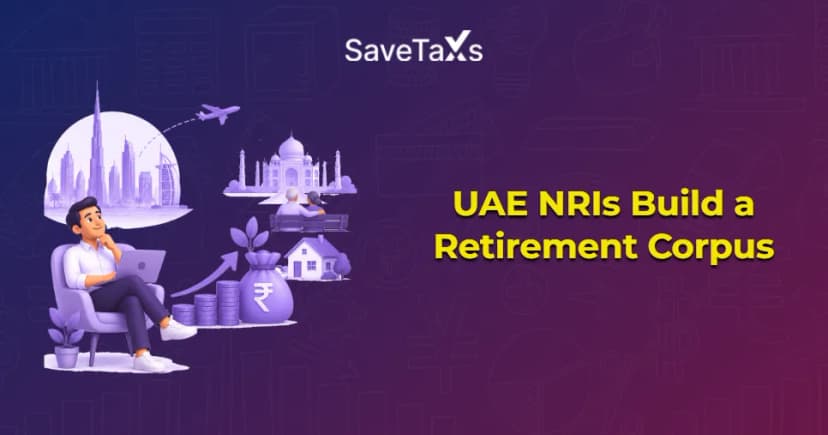
How UAE NRIs Can Build a Retirement Corpus for IndiaHow UAE NRIs Can Build a Retirement Corpus for India
Written by Shubham Jain
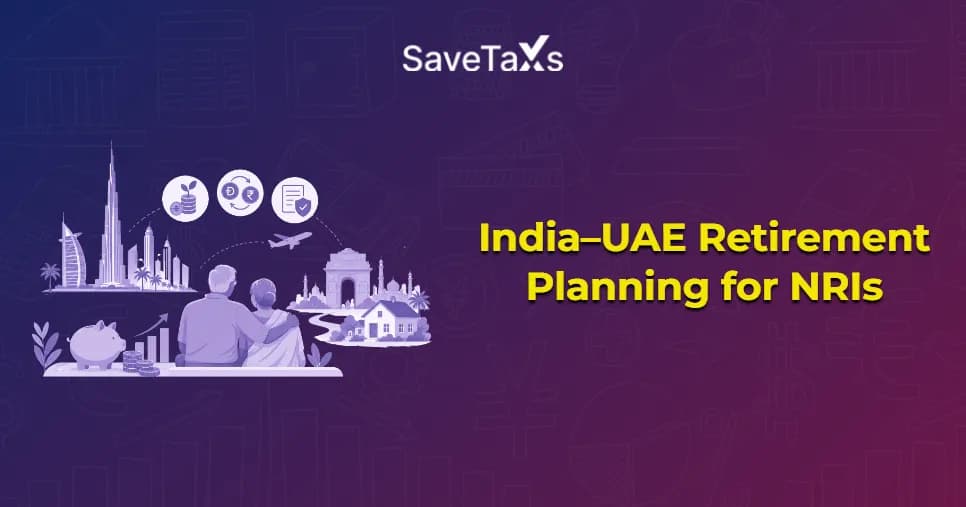
Have you thought about what your life will be like after retirement? Many people don't think about it, and this is where they make a mistake. Retirement planning remains important, and it becomes even more crucial for NRIs living in the UAE. Sounds confusing, right? Proper retirement planning for NRIs in the UAE helps secure their financial future. It helps you live in your desired country, maintain your preferred lifestyle, and stay financially independent even after retirement.
But how does retirement planning work? The simple answer is that it depends on your preferences. Based on this, you decide on the country, lifestyle, expenses, and tax obligations.
Want a detailed overview of it? Read the blog and know how to plan your life after retirement.
The most crucial step in retirement planning for NRIs in the UAE is deciding which country they want to live in after retirement. This can vary from person to person, as everyone has their own preferences and choices. To provide an overview, let's compare the lifestyle both countries offer to people:
| Basis | India | UAE |
|---|---|---|
| Cost of Living | Compared to the UAE, everyday expenses, domestic help, and local medical care in India cost less. | Daily expenses, private healthcare, and housing are costly. |
| Healthcare | Major cities offer excellent healthcare facilities, though the quality and availability of public healthcare services vary widely. | Offers top-quality modern hospitals and advanced medical technology. However, private healthcare facilities can require significant funds. |
| Visa and Legal Stay | Indian citizens do not need a retirement visa to live in India. | People aged 55 and above can apply for a 5-year renewable retirement visa, subject to eligibility requirements. These include at least 15 years of work experience and financial requirements, such as owning property worth AED 1 million and having savings of AED 1 million, or an annual income of at least AED 180,000. In Dubai, the annual fixed income requirement is at least AED 240,000. |
| Lifestyle and Environment | Offers a vibrant culture, but urban areas may face infrastructure challenges, pollution, and traffic congestion. | Offers a clean, safe, and cosmopolitan environment with large Indian communities. However, the weather remains hot for most of the year due to the desert climate. |
| Taxation | Once you become a resident, your tax treatment depends on whether you are ROR or RNOR. An ROR is generally liable to tax on global income in India, while an RNOR has a more limited scope of taxation on foreign income. | The UAE currently imposes 0% personal income tax. |
| Verdict | Choose India if you prefer familiar local food, want to stay connected to your roots, and have a modest retirement fund. | Choose the UAE if you have substantial wealth, want to maintain a luxury lifestyle, and value safety. |
This was just an overview of your life after retirement in India and the UAE. Moving forward, let's determine which country is best for retirement based on your investment and retirement plans.
At Savetaxs, we provide NRIs with personalized guidance based on their tax situation and income in India.
Both countries offer different investment options for NRI retirement planning. These are as follows:
Globally, India continues to grow and evolve. The country offers several investment options to NRIs. Considering this, here are some of the most popular retirement plans for NRIs in India:
Talking about retirement planning for NRIs in the UAE, knowing the available investment options is vital. Unlike India, the UAE does not offer a government pension system to NRIs. So you need to rely on private retirement schemes available in the country. Available options include:
Although the country does not offer a pension scheme for expatriates, it provides end-of-service UAE gratuity. Article 51 of the UAE Labor Law caps the total gratuity at two years' wage. The gratuity is calculated based on the last basic wage, using 21 days for each of the first five years and 30 days for each additional year, subject to the applicable rules.
These are the retirement investment options available for NRIs in both countries. Moving further, let's learn about the tax obligations.
India and the UAE both have their own regulations and tax systems; here is how it works for NRIs.
Returning to India for tax purposes does not make you a resident on the day you arrive there. Considering this, your tax status in India depends on factors such as how many days you live in the country and your residence history. Here is how it works:
The UAE does not impose personal tax on individuals. So you are not obliged to pay tax on your salary and investments there. Considering this, even if you decide to retire in the UAE, you do not need to pay personal income tax here on your Indian investments and capital gains. However, Indian tax may still apply to income from your Indian investments under Indian tax rules.
These are the tax obligations that NRIs face after retirement in India and the UAE. Next, let's look at a few points to consider when planning for retirement in India as an NRI.
If you plan to retire in India after years of living in the UAE, consider the following points:
Once you return to India permanently and your FEMA residential status changes, you need to redesignate your NRI accounts. In simple terms, after moving to India, you need to redesignate your NRO account as a resident account, while your NRE account should be redesignated as a resident account or the funds may be transferred to an RFC account. In addition, before returning, do the following:
You can also hold an FCNR deposit without converting it until its maturity date.
Once you permanently return to India and become an ROR, you generally need to report your applicable foreign assets and income in your ITR. The Income Tax Department of India clearly states the financial interests, overseas bank accounts, property, and other foreign assets you need to disclose.
When returning to India, you may have a UAE pension, retirement savings, Indian investments, and rental income across several accounts. Decide which account you'll use for your Indian expenses and how much you'll keep overseas. Considering this, you can divide your retirement money into three categories:
The first option needs accessibility and stability, while the other two options may remain aside for investment fluctuations, as they have more time.
For a brief overview of investment allocation between India and the UAE, read our blog, "How to Allocate Investments Between India and the UAE."
Your retirement plan is incomplete without your withdrawal strategy. Plan your strategy so you get reliable income without selling long-term assets during market fluctuations. In these circumstances, one practical strategy you can opt for includes:
The amount you keep in each mentioned category depends on age, health, family support, pension, and risk capacity.
Currency fluctuation is another important factor in retirement planning for NRIs in the UAE. This is because exchange rates constantly change, which further affects investment returns. To avoid this, when planning your retirement in India, use INR for Indian expenses and AED for UAE expenses. This reduces frequent conversions and reliance on foreign exchange rates.
These are the key things you should consider when planning for retirement in India as an NRI.
Connect with Savetaxs and choose the country that best matches your preferences and retirement goals.
Lastly, effective retirement planning for NRIs in UAE and India starts with deciding which country to settle in. According to that, NRIs need to plan their retirement strategy. This is because both countries have different taxation systems, rules, and regulations. Remember that the best retirement planning depends not only on your investment portfolio but also on how you use those funds after retirement. Whether you choose India or the UAE, both countries offer different retirement and investment options.
If you are facing issues in retirement planning and need help, connect with Savetaxs. Our team of cross-border experts will help you choose the right country as per your financial goals, lifestyle, and investment strategy.
This article is for general informational purposes only and does not constitute tax, legal, financial, or investment advice. Laws, regulations, rates, and procedures may change over time and may vary based on individual circumstances.
While SaveTaxs makes reasonable efforts to keep the information accurate and up to date, readers should verify applicable rules with official authorities or consult a qualified professional before making decisions based on this information.
Shubham Jain is the Founder of SaveTaxs and has extensive experience in Indian and NRI taxation. He advises individuals, NRIs, and businesses on tax filing, tax planning, capital gains, DTAA benefits, fund repatriation, and compliance matters. He regularly writes about taxation and related financial topics. His focus is on making complex tax concepts easy to understand. Through his articles, he helps taxpayers stay informed, avoid common mistakes, and stay compliant with Indian tax laws. See Full Bio

Want to read more? Explore Blogs