



Business Setup
Difference Between a LLP and a Partnership FirmDifference Between a LLP and a Partnership Firm
Written by Vipul Jain
A FPO stands for Farmer-Producer Organization. It is a type of producer organization (PO) whose members are farmers. A producer organization is an organization of primary producers, such as milk producers, fishermen, farmers, weavers, rural artisans, craftsmen, etc.
As the Indian agricultural sector becomes technology-based, market-oriented, and more organized, NRIs are exploring ways to participate in agriculture, rural supply chains, technology-driven farming, food processing, and related sectors. To do so, one of the most effective business models available is the Farmer-Producer Organization (FPO).
Henceforth, for NRIs with a family-owned agricultural business, local farmer networks, and an agri-business vision in India, an FPO is an ideal entry point for you. Although the FPO registration process is not as simple as any other business registration, it requires proper farmer eligibility, MCA registrations, FEMA/FCI review, legal documentation, and more.
In this guide, we will explore everything NRIs need to know before completing FPO registration.
In the last few years, the government of India has implemented a major policy to streamline the collectivization of farmers and improve farm-to-market efficiency. This is the reason why Farmer-Producer Organizations are encouraged across the country under the Central Sector Scheme for Formation and Promotion of 10,000 FPOs. Here, the eligible FPOs generally received capacity-building assistance, handholding support, access to credit-linked benefits, and equity grant support.
For NRIs, Farmer Producer Organization creates a practical business platform in sectors such as.
Unlike the investment required for passive landholding, the FPO provides NRIs with an opportunity to build and organize a rural enterprise where they can combine local farmers' knowledge with global capital and technology, oversee buyers' access, and manage the system.
With that being said, a Farmer-Producer Organization (FPO) cannot be created merely as an investment shell; it shall remain a genuine producer-member-led organization in both operational and structural aspects.
Savetaxs helps NRIs file their business ITR in India under expert guidance.
Yes, an NRI can legally register an FPO, but not in the ways you assume.
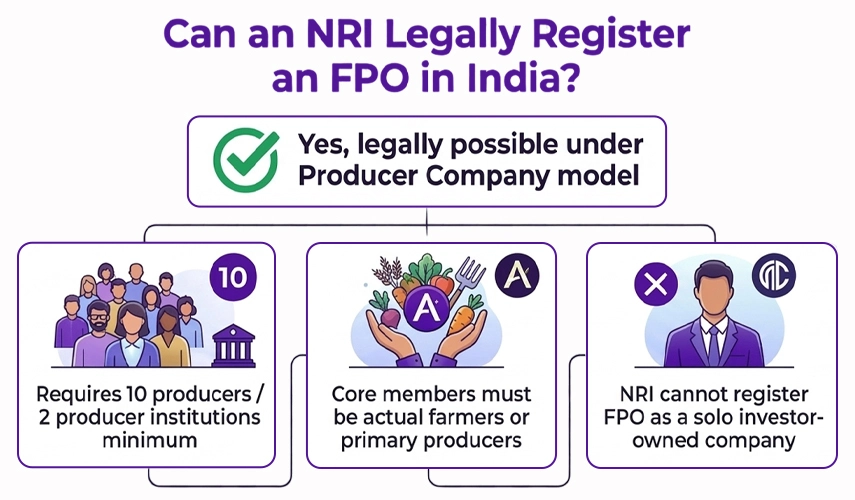
The very first thing that NRIs must understand is that a farmer-producer organization is generally registered in India under the Producer Company model of the Companies Act. This means that FPO is not a typical investor-owned company; it is a specialized company created solely for the benefit of its primary stakeholders.
For the incorporation of an FPO, the producer company generally requires.
These producers must be involved in primary produce activities, such as:
That is where many NRIs misunderstand the entire concept.
As an NRI, you cannot simply register an FPO alone as a foreign investor and then use the same FPO name as a business vehicle. Indian law expects the entity to be producer-driven rather than investor-driven.
So the NRI's role is usually that of
While the core producer membership remains with actual farmers or primary producers.
In practice, the NRI participation works best when the NRI builds the FPO around an existing farmer ecosystem.
This might include
The NRIs then add the business layer, including storage systems, capital planning, processing units, overseas market linkages, branding, compliance systems, and the long-term expansion strategy.
However, as the structure involves the non-resident financial participation in an agriculture-linked entity, FEMA/FDI review becomes important before any capital infusion is finalized.
This is why NRI participation should always be professionally structured at the drafting stage and not after final incorporation.
A Farmer-Producer Organisation is established on one simple principle: producer ownership with democratic control. That means it cannot operate like an ordinary promoter-controlled setup.
A producer company typically requires:
Furthermore, if the farmer-producer organization decides to access government-backed support, such as capacity-building assistance or equity grants, then organic farmer participation, business viability, and the shareholder spread are evaluated beyond the paper incorporation.
So, in simpler terms, getting a Ministry of Corporate Affairs (MCA) certificate of incorporation is not enough; the FPO must also be operationally credible.
The registration process for FPO is conducted on the MCA portal through the producer company incorporation. In a normal case, the entire registration process takes around 20 to 35 working days, depending on how quickly the farmer documents, the drafting formalities, and the director's KYC are completed.
Let us break the process down.
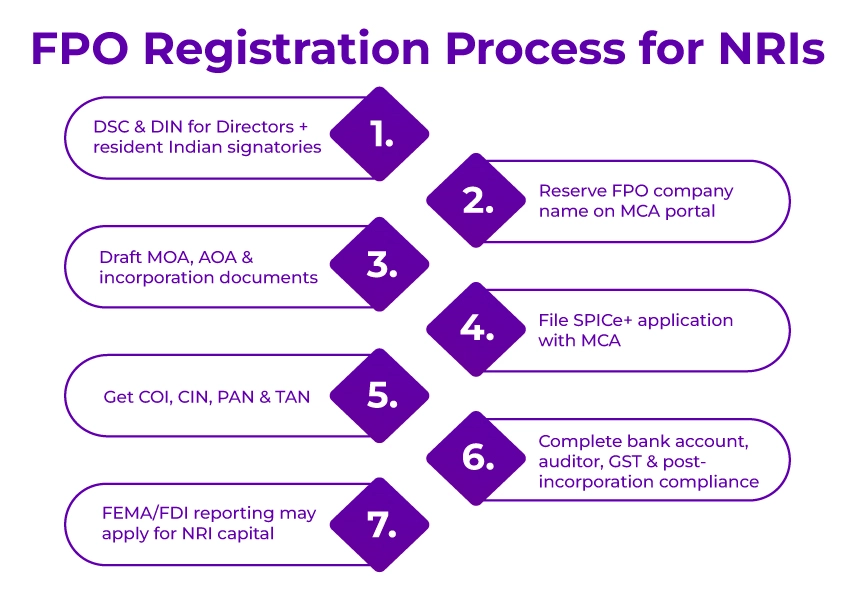
Every proposed director of the organization must obtain a digital signature certificate (DSC) as MCA filings are completed entirely digitally.
Whereas the Director Identification Number (DIN) is provided through the SPICe+ incorporation application itself.
Now that the FPO will need the local operation supervision, NRIs must keep the.
In a Farmer Producer Organization (FPO), when an NRI himself becomes a director, your original address, overseas passport copies, and KYC certificates may be required, depending on the jurisdiction.
Whatever name you are choosing for your FPO, it must ideally reflect the
For example:
The application to register the name is filed through SPICe+ Part A on the MCA portal, and it must meet MCA name availability requirements and legal naming norms.
Alright, this is one of the most overlooked parts of the entire process, when it shouldn't be. Poorly drafted incorporation documents can create long-term funding and governance problems for the company.
These documents will be:
Memorandum of Association (MoA): It outlines the company's end-to-end objectives. Meaning the MoA must clearly define the business objects, such as:
Articles of Association (AoA): The AoA for the organization must be accurately drafted, and it should define the
It is understood that when an NRI is involved, additional drafting on banking permissions, delegated authority, overseas communication powers, and reporting responsibilities is extremely useful.
Over time, once the drafting and documentation are complete, the integrated SPICe+ filing is submitted with:
Once the MCA has verified the filing, the organization receives
After receiving the approved documents, the producer company becomes a legally registered FPO vehicle.
This is the part of the registration process where many incorporations slow down.
Once the FPO registration is completed, the Producer company must immediately complete:
Furthermore, when NRI capital is formally repatriable and subscribed, reporting under FEMA/FDI through the authorized dealer bank may also be applicable, depending on the final structure.
Furthermore, eligible FPOs can explore CBBO support, equity grant assistance, and credit guarantee support under government-backed frameworks.
The following are the challenges that an NRI faces while registering a farmer-producer organization.
If an NRI FPO model is structured correctly, it provides NRIs with something far more than ordinary agricultural land ownership.
It creates:
That aside, the real business value comes not from the land appreciation alone but from the
This is where the FPO becomes a business institution and not just a legal registration.
The FPO registration is a combination of.
This is why NRIs should avoid treating an FPO as just another company registration assignment.
An experienced Farmer-Producer Organization Advisory team helps with
Savetaxs offers 24/7 expert NRI business consultancy support.
Unlike the standard business incorporation, the FPO registration process for NRIs is far more strategic. The entrepreneurial model of an FPO is a producer-led agricultural enterprise model that demands the participation of real farmers, complete planning, legal precision, and practical NRI structuring from day one.
As an NRI, if you are seeking to build an agricultural procurement business, food processing ventures, rural supply chain platforms, or agri export channels, the FPO route can be incredibly strong. However, for it to be effective, it must be registered with the right legal and operational foundation.
For NRIs seeking to establish a business in India, Savetaxs is the name to trust. The experts at Savetaxs help NRIs register their companies in India in compliance with applicable laws.
Connect with us as we serve our clients 24/7 across all time zones.
This article is for general informational purposes only and does not constitute tax, legal, financial, or investment advice. Laws, regulations, rates, and procedures may change over time and may vary based on individual circumstances.
While SaveTaxs makes reasonable efforts to keep the information accurate and up to date, readers should verify applicable rules with official authorities or consult a qualified professional before making decisions based on this information.
Vipul Jain is the Co-Founder of SaveTaxs and a tax expert with experience in Indian and NRI taxation. He advises individuals, NRIs, and businesses on tax filing, tax planning, capital gains, DTAA, and compliance matters. He focuses on making complex tax concepts simple and helping taxpayers make informed, compliant decisions. See Full Bio
Want to read more? Explore Blogs
_1780491123033.webp&w=828&q=75)
_1778757638178.webp&w=828&q=75)