



Business Setup
Difference Between a LLP and a Partnership FirmDifference Between a LLP and a Partnership Firm
Written by Vipul Jain
_1776344270639.webp&w=3840&q=75)
Under the Indian law, the OCI cardholders enjoy the same economic rights as NRIs. These rights include starting a business or professional practice in India, investing in Indian companies, and serving as a shareholder and director of an Indian corporation.
With respect to the Reserve Bank of India and the Ministry of Home Affairs, an OCI cardholder may engage in business activities in India, provided they comply with FEMA and other applicable regulations.
In this blog, we will explore the OCI business setup in India, including the legal procedures, required documents, and more.
For OCI cardholders, setting up a business in India is a streamlined digital process that is governed by the Ministry of Corporate Affairs (MCA). Generally, OCI cardholders prefer to set up a private limited company, as it offers limited liability and is highly respected by investors.
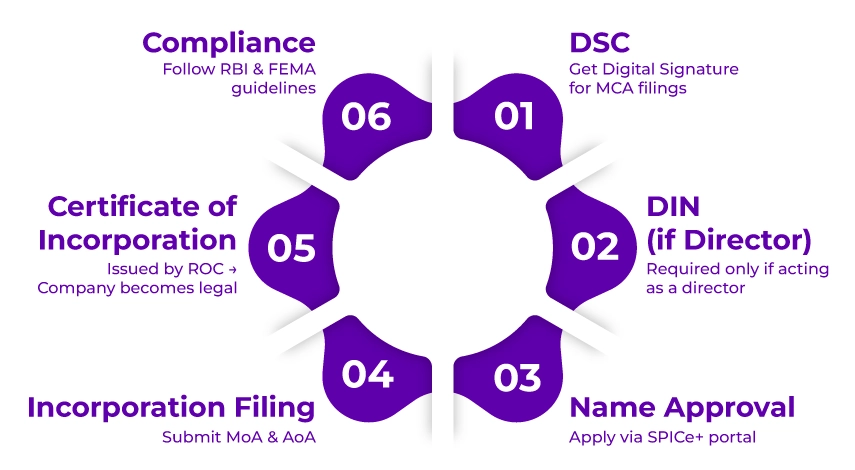
The legal process for setting up a business in India as an OCI cardholder typically begins with obtaining a Digital Signature Certificate (DSC), as filings with the Ministry of Corporate Affairs require digital authentication. If the OCI intends to act as a director, a Director Identification Number (DIN) is required, which is usually applied for during the company incorporation process.
A DIN is a unique number and a non-negotiable requirement for every person intending to serve as a director of an Indian company.
Once you have DSC handy, you must apply for your company name reservation in the next step. To do so, you must do it through the SPICe+ (Simplified Proforma For Incorporating Company Electronically Plus) portal.
After the name is approved by the authorities, you shall file the incorporation documents, including the Articles of Association (AOA) and Memorandum of Association (MoA). The MOA and AOA establish the company's regulatory framework and the goals the company must adhere to.
Upon completing the setup process, the Registrar of Companies issues a certificate of Incorporation, thereby establishing the OCI cardholder's business as a legal entity in India.
It is advisable for an OCI Cardholder seeking to establish a business in India to take a CA's assistance in the legal process for the OCI business setup. A qualified expert can lead you through the entire process seamlessly, ensuring everything is in compliance.
One of the fundamental requirements for a business's proper functioning is accurate documentation. Since you are an OCI cardholder establishing a business in India, your Documents executed outside India must be notarized or apostilled as applicable and may be submitted through an authorized representative in India.
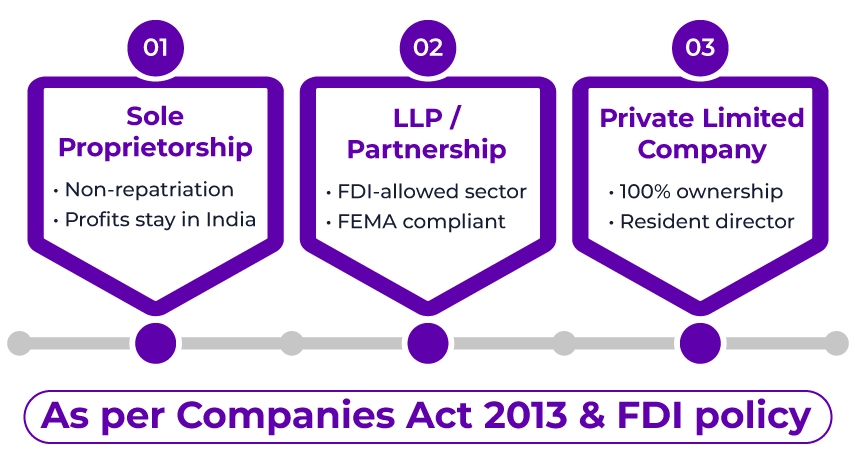
The following are the types of business an OCI cardholder can own in India.
An OCI cardholder can set up a sole proprietorship business in India on a non-repatriation basis. However, as the OCI cardholder business owner in India, you shall comply with
For instance, an OCI cardholder setting up a trading firm in Mumbai that will operate under their own name as a proprietorship.
In association with Indian residency, OCI cardholders can form LLPs and partnership firms, provided:
This type of business structure allows the OCI cardholders to co-own a business with their spouses or even family members in India.
This type of business structure is the most preferred among OCI entrepreneurs. With respect to the Companies Act 2013, an OCI cardholder can.
For instance, OCI entrepreneurs start a consultancy firm in Delhi, appoint an Indian director to the board to satisfy residency requirements, and own 100% equity.
While most business sectors in India permit investment by OCI cardholders, the following sectors remain prohibited.
|
Restricted Sector |
Nature Of Restrictions |
|---|---|
|
Agriculture & Plantation |
An OCI cardholder cannot purchase or own plantation land or agricultural land, unless inherited. |
|
Real Estate (Agricultural) |
An OCI cardholder cannot buy a farmhouse, farmland, or a plantation property. |
|
Defence, Space, and Media |
Subject to FDI caps and government approval. |
|
Lottery, Betting, or Gambling |
Prohibited for OCI and foreign investors. |
As an OCI cardholder business owner in India, you are subject to:
Example On OCI Business Setup In India
The following are three scenarios related to OCI business in India for better understanding.
Assume an OCI cardholder based in Berlin wishes to start a fintech company in Delhi.
An OCI cardholder living in the USA wants to buy farmland in Haryana to set up his agricultural and farming business.
An OCI cardholder from Dubai sets up a sole proprietorship consultancy in Noida on a non-repatriation basis.
SaveTaxs simplifies registration, compliance, and taxation for NRIs and OCI cardholders.
Yes, OCI cardholders can set up a business in India, provided they comply with the Companies Act, FEMA, and FDI policy regulations. The legal procedure for setting up a business in India for an OCI entrepreneur is a streamlined digital process, whether for sole proprietorship, LLP, partnership, or private limited company incorporation.
However, the OCI entrepreneurs must be aware of the restrictions and limitations on agricultural and plantation land ownership, as well as on other regulated industries.
As an OCI cardholder, if you are thinking of setting up a business in India and seeking professional guidance, Savetaxs is the name to trust. Our experts provide end-to-end consultation on managing the company incorporation process via the MCA SPICe+ portal, including assistance with obtaining a DSC (Digital Signature Certificate) and a DIN (Director Identification Number).
The experts will ensure 100% compliance with FDI regulations, FEMA, and RBI guidelines, specifically for automatic route investments. In addition to this documentation support, banking and taxation setup consultation is also provided.
Connect with us as we serve our clients 24/7 across all time zones.
This article is for general informational purposes only and does not constitute tax, legal, financial, or investment advice. Laws, regulations, rates, and procedures may change over time and may vary based on individual circumstances.
While SaveTaxs makes reasonable efforts to keep the information accurate and up to date, readers should verify applicable rules with official authorities or consult a qualified professional before making decisions based on this information.
Vipul Jain is the Co-Founder of SaveTaxs and a tax expert with experience in Indian and NRI taxation. He advises individuals, NRIs, and businesses on tax filing, tax planning, capital gains, DTAA, and compliance matters. He focuses on making complex tax concepts simple and helping taxpayers make informed, compliant decisions. See Full Bio
Want to read more? Explore Blogs
_1780491123033.webp&w=828&q=75)
_1778757638178.webp&w=828&q=75)