Payroll Planning
Salary Structure & CTC Planning for NRI Business OwnersSalary Structure & CTC Planning for NRI Business Owners
Written by Hatim Dudhiyawala

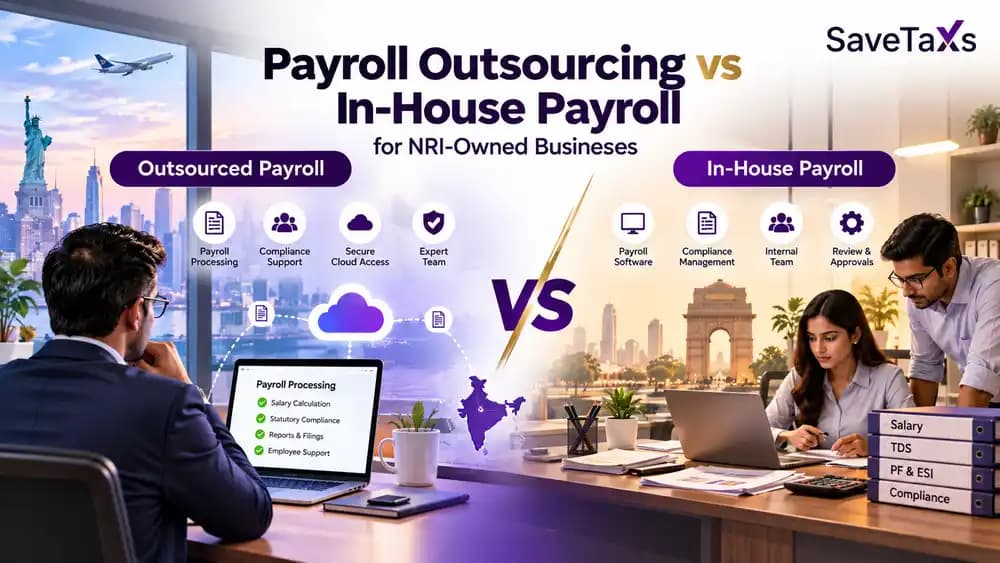
Outsourced payroll reduces administrative work, while in-house payroll gives you more direct control; the right choice depends on your employee count, complexity, internal expertise and availability in India. Managing Indian payroll from another country makes time zones, local supervision, data security and missed compliance actions more difficult to control. This guide compares both models, explains who remains responsible for errors, and shows when outsourcing, in-house payroll or a hybrid arrangement fits your business.
Outsourced payroll means an external Indian provider processes payroll, while in-house payroll means your own employees manage the work inside the business. The difference is who performs the calculations, prepares records and coordinates filings, not who owns the underlying employer obligation.
With outsourced payroll, you send the provider information such as attendance, salary changes, new hires, exits, bonuses and reimbursements. The provider then calculates salary, deductions and contributions, prepares payroll reports, and handles the services listed in your agreement. Some providers also support statutory filings and employee documents.
With in-house payroll, a finance, accounts or human resources employee handles the process using payroll software or spreadsheets. That person collects payroll inputs, checks attendance and leave, calculates deductions, prepares payment instructions and coordinates compliance activity.
The label alone does not tell you whether payroll is safe. An outsourced provider with no review process can create risk. An in-house employee without current knowledge, backup cover or proper access controls can create the same risk.
The first mistake to avoid is treating payroll processing as the same thing as legal accountability. Your agreement should state who prepares each item, who reviews it, who approves payments, who submits filings and who responds to notices.
Remote ownership makes payroll harder because you may not see local employee changes, compliance notices or payment approvals in real time. The problem becomes more serious when the business depends on one India-based person who has no trained backup.
A payroll issue can begin with a small data error. A late update to salary, a missed exit date or an incorrect reimbursement can affect employee pay, deductions and statutory records. If you are in the USA, UK, Canada, Australia, the UAE or another country, the time difference can delay questions and approvals.
Outsourcing gives you a local operating layer for routine payroll work. In-house payroll gives you more control over the process, but you must provide local supervision, backup capacity and current knowledge of Indian requirements.
Your company’s payroll obligations are separate from your personal obligations as an NRI or OCI. Read the guide to NRI tax obligations in India for your personal position, and see how residential status is determined separately. Your country of residence can also have its own rules for your personal income, reporting and management activities; those rules are outside this payroll comparison.
The employer normally remains accountable for giving correct payroll inputs, approving payments, maintaining records and meeting its statutory duties even when a provider performs the administrative work. A written review process matters more than whether the work is called outsourced or in-house.
For salary tax deduction, the Income-tax Act, 1961 covers tax deducted from salary under section 192. Employers report salary deductions through Form 24Q, which is filed quarterly by 31 July, 31 October, 31 January and 31 May of the following year for the first, second, third and fourth quarters, respectively.
In practical terms, the provider might prepare the payroll and return data, but your business still needs a person who checks employee details, salary changes, deductions and payment records before submission. The common mistake is assuming that a vendor contract removes the employer’s responsibility. When the inputs are wrong or an approval is missed, the company can still face correction work, employee complaints and compliance consequences.
In-house payroll gives you more direct control, while outsourced payroll gives you more external capacity and specialist support. Neither model is automatically more accurate; control depends on approvals, segregation of duties, software and review quality.
| Decision factor | Outsourced payroll | In-house payroll |
|---|---|---|
| Daily control | You control inputs and approvals; the provider performs agreed tasks | Your staff control the full process |
| Expertise | Access to external payroll and compliance knowledge | Knowledge stays with your employees |
| Speed of queries | Depends on service levels and time-zone coordination | Immediate access during staff working hours |
| Scalability | Provider capacity can support growth if scope is clear | You add staff, software and controls as complexity grows |
| Confidentiality | Data leaves your internal systems and needs vendor controls | Data stays within the business, subject to staff access controls |
| Continuity | Backup depends on the provider’s team and contract | Backup depends on your own staffing and documentation |
| Error control | Strong when the provider has review checks and you approve outputs | Strong when staff are trained and independently review payroll |
Outsourcing suits a business that wants routine work handled without building a payroll function. In-house payroll suits a business that needs close daily access to payroll data and already has dependable finance staff.
The downside of outsourcing is reduced visibility when the service scope is vague. The downside of in-house payroll is concentration risk: one employee may know the entire process, hold sensitive data and be unavailable when payroll is due.
Your business remains responsible for employer compliance even when an external provider prepares payroll calculations or filing data. The provider is responsible for the services and mistakes assigned under the contract, but that does not automatically remove your company’s statutory exposure.
The main compliance areas include salary TDS, EPF contributions under the Employees’ Provident Funds and Miscellaneous Provisions Act, 1952, ESI contributions under the Employees’ State Insurance Act, 1948, professional tax, gratuity obligations, and state-specific employment requirements. EPFO and ESIC administer important parts of the social-security system, but the correct registration, employee data, payment and filing responsibilities must be allocated clearly.
The guide to TDS on salary explains the employer-side salary deduction process. The guide to EPF and ESI compliance covers those areas separately.
Your contract should identify who prepares returns, who submits them, who funds payments, who retains acknowledgements and who handles notices. It should also state what happens when the provider receives incomplete or late payroll inputs. A provider that promises “compliance” without defining these controls leaves you with an expensive ambiguity.
The owner’s personal income-tax return is a separate matter from company payroll. Once you identify which return applies to your own income and file it from abroad, SaveTaxs can help you file your Indian income-tax return as an NRI.
Compare the full operating cost rather than only the provider’s invoice or the salary of an in-house payroll employee. The correct comparison includes people, technology, supervision, continuity and the cost of fixing errors.
For an outsourced model, list the recurring provider fee, implementation work, extra charges for new employees or special payroll runs, support for multiple locations, filing support, employee queries and notice handling. Also include your own review time and the cost of correcting data that the provider receives late or incorrectly.
For an in-house model, include salary, payroll software, training, compliance updates, secure access, backup staffing, leave cover and management time. Add the cost of independent review because payroll should not be approved by the same person who entered every change.
A cheap arrangement can become expensive when it produces repeated corrections. For example, a missed salary change can affect an employee’s pay, deductions, records and trust in the business. Your comparison should therefore ask what each model costs when the normal process fails, not only what it costs when everything goes smoothly.
Compliance complexity increases when your workforce spans locations, includes different pay structures or requires several registrations. Outsourcing helps with administration, but the business still needs accurate employee data and an internal person who reviews the output.
Salary TDS under section 192 requires correct employee details, taxable salary information and deduction calculations. Form 24Q reporting follows the quarterly schedule stated by the Income Tax Department. Payroll also needs to account for EPF, ESI, professional tax and gratuity requirements where they apply.
The relevant rules can change with the employee’s location, the establishment’s registrations, the business structure and the workforce composition. State labour requirements can also differ. A provider should therefore confirm the states covered, registrations supported and assumptions used in its calculations.
The common mistake is comparing vendors only on salary processing while leaving state-specific compliance outside the contract. Ask whether the provider handles each applicable registration, prepares each required filing, tracks payment evidence and escalates changes in law.
The Goods and Services Tax Act, 2017 also matters to the provider relationship because payroll processing or support services can have GST treatment on the vendor invoice. Ask the provider to show its service scope and tax treatment clearly rather than treating the invoice as a single unexplained amount.
An NRI-owned business should use restricted access, documented approvals and a secure exchange of payroll information whether payroll is outsourced or in-house. Payroll contains salary, identity, bank and tax information, so confidentiality is an operating requirement, not an optional feature.
Under the Digital Personal Data Protection Act, 2023, your business should understand how employee data is collected, used, stored, shared and deleted. Ask who can access raw payroll files, whether the provider uses subcontractors, how access is removed after an employee leaves and how incidents are reported.
Keep salary preparation separate from payment approval where practical. The person who uploads or prepares payroll should not have uncontrolled authority to release funds. Use an approval trail showing changes, reviewer comments, final sign-off and payment confirmation.
Your contract should cover data ownership, permitted use, retention, security controls, breach escalation, confidentiality and return or deletion of data when the relationship ends. In-house payroll still needs these controls because internal employees also create data-security risk.
Choose outsourced payroll when you have limited local finance capacity, straightforward payroll and a provider with clear review and escalation controls. Choose in-house payroll when your business has experienced local finance staff, frequent payroll changes and a strong need for immediate internal control. Choose a hybrid model when you want external processing but want to retain approval, payment control and compliance oversight.
Outsourcing fits a small business that has employees in India but no full-time payroll specialist. It gives the owner a defined operating process and a local point of contact. The owner still needs a local reviewer who confirms inputs and approves the final payroll.
In-house payroll fits a business with an established finance function, documented procedures and enough staff to provide backup. It becomes less attractive when one employee holds all payroll knowledge or when the business is expanding into additional states.
A hybrid model divides the work. The provider calculates payroll, prepares reports and supports filings. Your finance team reviews changes, approves the final payroll, controls bank payments and monitors compliance evidence. This structure is useful when payroll is too complex for a small internal team but too sensitive to hand over without oversight.
Outsourcing is cheaper only when its total service cost is lower than the full cost of internal staffing, software, supervision, leave cover and error correction. A low vendor fee does not make outsourcing cheaper if important tasks remain with an overstretched owner or accountant.
The main downsides are reduced direct control, dependence on the provider, data-sharing risk, communication delays and unclear responsibility for errors. These problems are reduced when the contract defines service scope, deadlines, approvals, review checks, security measures and exit support.
Use employee count, locations, payroll complexity, internal finance capacity and growth plans as the starting decision points. A business with few employees and no payroll specialist usually needs external capacity, while a larger business with a trained finance team may need internal or hybrid control.
Ask yourself:
If you cannot name the person who reviews payroll and the person who approves payment, neither model is ready to operate safely. Assign those roles before signing a provider contract or hiring an internal payroll employee.
Rahul lives in the UAE and owns an Indian company with six India-based employees. He left payroll with an office administrator, has no full-time finance employee, and relies on a local accountant to approve payments. The company runs monthly payroll and has no complex variable-pay structure. Rahul must decide whether to outsource payroll or keep it in-house.
Because the business lacks a dedicated payroll specialist, outsourcing is the stronger operating choice. The provider can prepare payroll and compliance work, while the local accountant reviews the output and approves payments. Keeping payroll with the administrator would leave the company dependent on one person without specialist backup. Rahul should still approve the service scope, review reports remotely and retain access to filing acknowledgements.
Meera lives in Canada and owns an Indian company with 50 employees across two states. The company has variable pay, reimbursements, several monthly payroll inputs and plans to hire rapidly. It has an internal finance manager but limited payroll software capability. Meera must choose between an outsourced provider, an in-house team and a hybrid model.
A hybrid model fits these facts. The provider can handle calculations, state-specific processing and filing support, while the finance manager reviews payroll inputs, approves the final reports and controls payment. A fully in-house model would require additional expertise and stronger software controls. A fully outsourced model would reduce internal work but leave too much control outside the company during rapid growth.
An NRI owner should verify the provider’s exact scope, review process, data controls, service levels and exit arrangements before signing. Price should come after you know what the provider will actually do.
Check whether the agreement covers:
Ask for a sample monthly workflow. You should see when inputs are due, who checks them, when draft payroll is shared, how changes are recorded and when final approval occurs. A provider that cannot explain the workflow clearly is not offering a control system; it is offering task execution without enough visibility.
Start by assigning one owner for payroll inputs, one reviewer and one payment approver. Document the monthly calendar, required employee data, approval route, filing evidence and the process for correcting errors.
Set up secure access and remove access promptly when staff or vendors leave. Reconcile payroll reports to the bank payment, accounting records and statutory payment evidence after every payroll cycle. Keep a central record of filings, acknowledgements, employee changes and review comments.
Review the arrangement after the business adds employees, changes locations or introduces variable pay. Those changes can turn a simple process into one that needs a hybrid structure or a broader provider scope.
Choose outsourced payroll when you need local capacity without building a payroll team, in-house payroll when you already have reliable finance expertise and close control matters most, and a hybrid model when you need both external processing and internal oversight. Before deciding, map every task from payroll input to filing evidence and payment approval. The fact that changes the answer most is whether you have a trained local reviewer who can act when you are abroad.
This article is for general informational purposes only and does not constitute tax, legal, financial, or investment advice. Laws, regulations, rates, and procedures may change over time and may vary based on individual circumstances.
While SaveTaxs makes reasonable efforts to keep the information accurate and up to date, readers should verify applicable rules with official authorities or consult a qualified professional before making decisions based on this information.
Shubham Jain is the Founder of SaveTaxs and has extensive experience in Indian and NRI taxation. He advises individuals, NRIs, and businesses on tax filing, tax planning, capital gains, DTAA benefits, fund repatriation, and compliance matters. He regularly writes about taxation and related financial topics. His focus is on making complex tax concepts easy to understand. Through his articles, he helps taxpayers stay informed, avoid common mistakes, and stay compliant with Indian tax laws. See Full Bio
Want to read more? Explore Blogs