

Payroll Planning
Payroll Outsourcing vs In-House Payroll for NRI-Owned BusinessesPayroll Outsourcing vs In-House Payroll for NRI-Owned Businesses
Written by Shubham Jain


An NRI-owned business follows the Indian payroll rules that apply to its employees and employing entity; NRI ownership does not create a separate payroll system. Getting payroll wrong can lead to incorrect salary deductions, missed labour filings, employee disputes, and problems when money moves across borders. This guide shows how to set up Indian payroll, manage employee and director payments, maintain records, and identify issues that need tax, labour, FEMA, or treaty advice.
Payroll planning means designing a repeatable process for hiring, paying, withholding tax from, and reporting employee compensation in India. It covers worker classification, salary components, employee declarations, TDS, provident fund, employee insurance, professional tax, gratuity, bonus, payslips, filings, and reconciliations.
The process starts before the first employee is paid. You identify the employing entity, work locations, employee categories, registrations, salary structure, payment account, approval process, and payroll records. Each month, you calculate gross pay and deductions, deposit statutory amounts, issue payslips, and reconcile the payroll with the books and bank statement.
The owner’s residence is a separate question. An NRI is an individual whose Indian residential status is determined under Indian tax rules, while the company, LLP, partnership, or other employer has its own Indian compliance responsibilities. Read about NRI residential status under Indian tax law before analysing the owner’s personal position.
An OCI card does not by itself decide whether the holder is resident in India or how the Indian business must run payroll. The holder’s stay, income, role, and the employing entity still matter.
If you hold an OCI card and need help with the Indian tax and compliance side, SaveTaxs can help you review your position.
Structured payroll reduces errors in TDS, statutory deductions, cash-flow planning, employee documentation, and cross-border payments. It also gives the business a clear audit trail showing how each salary figure was calculated.
The common mistake is treating payroll as a bank transfer. Paying an employee the agreed net amount without calculating deductions first can leave the business responsible for unpaid TDS, PF, ESI, professional tax, or other statutory amounts. Correcting the error later can require revised filings, additional payment, and employee communication.
State and professional review matters because professional tax, Shops and Establishments requirements, leave rules, labour registrations, and local filing processes differ by location. Employee coverage can also change with pay, establishment type, worker category, and the applicable law.
First identify the Indian employer, every work location, each worker category, and the registrations triggered by those facts. Ownership by an NRI is not the deciding factor for employee payroll coverage.
Confirm whether the employer is an Indian company, LLP, partnership, branch-related operation, or another establishment. Then map employees, directors, consultants, apprentices, contractors, remote workers, and overseas personnel separately. A consultant described as an employee can create incorrect deductions and employment-law exposure.
For each Indian location, record the state, establishment type, headcount, work address, joining date, salary, and employment category. Use this map to review income-tax withholding, provident fund, employee insurance, professional tax, bonus, gratuity, and local labour registrations.
The first review should answer:
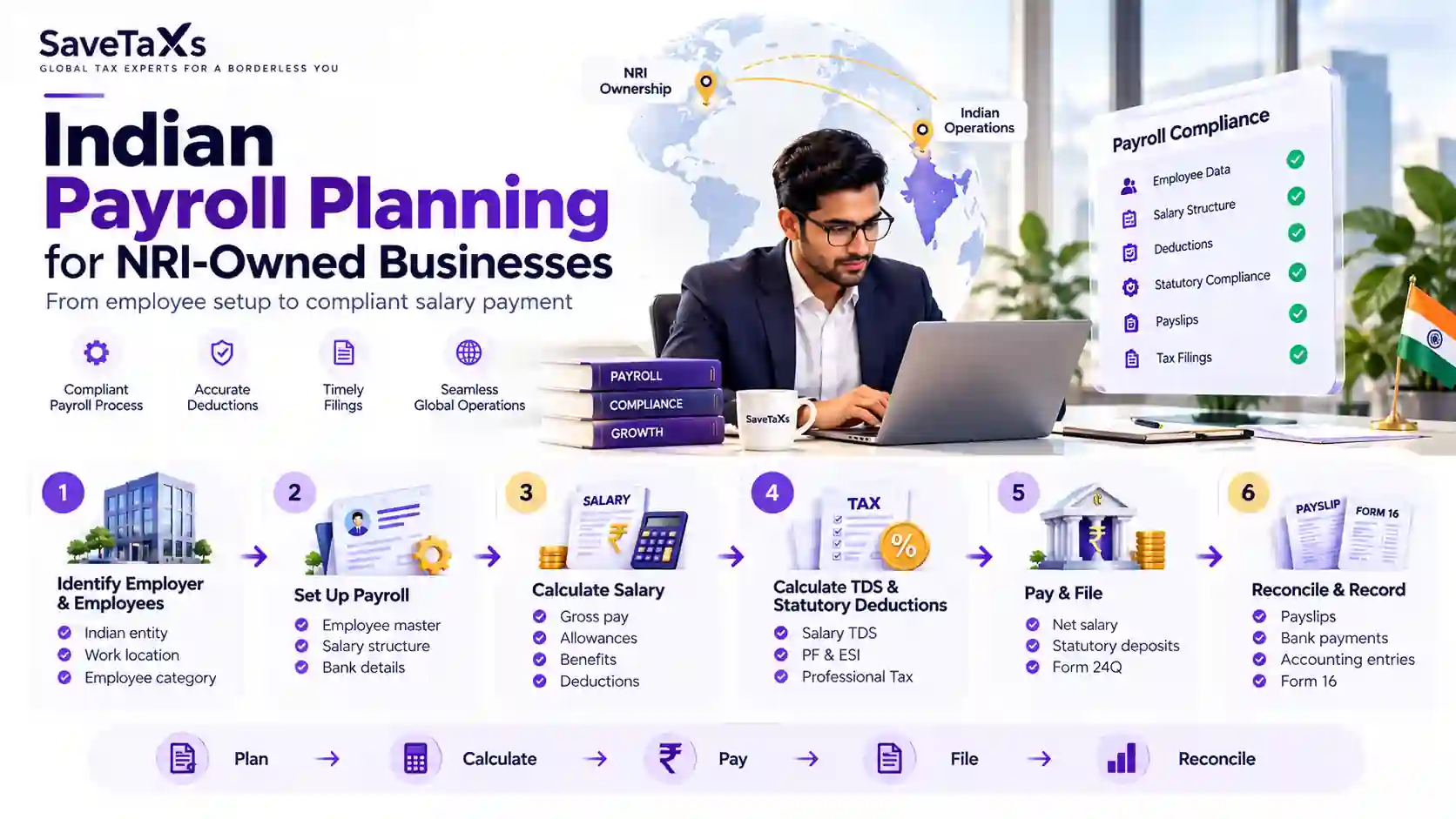
Set up the employer registrations, payroll policy, salary structure, payment controls, and filing calendar before the first salary run. A payroll account alone does not complete the compliance process.
Create an employee master containing identity details, tax information, bank details, joining date, role, location, salary components, tax regime choice, declarations, and statutory identifiers. Limit access to sensitive payroll data and retain approval evidence for changes.
Configure separate payroll codes for basic salary, allowances, bonus, reimbursements, perquisites, employer contributions, deductions, and final settlement amounts. Decide how the business will collect employee declarations and supporting documents for tax calculations.
Assign responsibilities clearly:
A compliant salary structure separates fixed pay, variable pay, reimbursements, benefits, employer contributions, and recoveries. Each component must be classified correctly for payroll, income-tax, and labour-law purposes.
Basic salary, allowances, bonus, commission, perquisites, reimbursements, and employer contributions do not all receive the same treatment. The payroll setup must identify which components form part of taxable salary and which affect statutory coverage or benefit calculations.
Avoid creating artificial components only to reduce deductions. A salary structure that does not match the employment contract, actual work, and payroll records can create problems during an employee claim or compliance review.
Give employees a written compensation statement. Record changes in pay, role, location, working hours, benefits, and deductions through approved payroll changes rather than informal messages.
The employer calculates salary TDS and the statutory deductions that apply to each employee, including PF, ESI, professional tax, and other authorised recoveries. The correct deduction depends on the employee’s pay, category, location, establishment, and the law applicable to that worker.
Salary TDS is calculated from taxable salary after considering the employee’s declarations, eligible items, selected tax regime, and the relevant financial-year rules. The employer deducts the calculated amount from salary and deposits it through the prescribed process.
Provident fund applies where the establishment and employee fall within the statutory coverage rules. The payroll team must identify covered employees, calculate employee and employer contributions using the applicable wage base, deposit the amounts, and maintain the employee account details.
Employee State Insurance, or ESI, applies where the establishment and employee meet the coverage conditions. It provides a statutory social-security framework for covered workers. The employer calculates both shares, deducts the employee share, adds the employer share, and deposits the total through the prescribed system.
Professional tax is a state-level levy where applicable. The rate, salary bands, registration, deduction, and payment process differ by state. Do not copy a professional-tax setup from one state into another.
A common mistake is applying one deduction to every employee. For example, an employee who joins mid-month, crosses a coverage condition, works in another state, or changes salary needs a fresh payroll review rather than a copied deduction line.
The employer should calculate salary TDS during each payroll cycle, deposit it by the prescribed due date, file Form 24Q for the relevant quarter, and issue Form 16 for the relevant assessment year. The documents must agree with the payroll register and payment records.
Form 24Q is the quarterly statement reporting salary payments and TDS. Form 16 is the employee certificate showing salary income and tax deducted. The payroll team should reconcile the two before issuing employee certificates.
Collect employee declarations early in the financial year and update the calculation when salary, investment evidence, regime choice, benefits, or employment status changes. Do not wait until the final payroll to discover that the earlier monthly deductions were too low.
The common mistake is deducting tax from the net salary without maintaining the calculation behind it. Keep the salary register, declaration records, supporting documents, challans, filed statements, correction records, and employee communication together.
Gratuity and bonus apply according to the coverage and eligibility rules for the establishment and employee, while leave and final settlement also depend on applicable employment and state requirements. These items should be built into payroll records even when no payment is due in the current month.
Gratuity is a statutory termination-related benefit for covered employees who satisfy the applicable service condition, subject to the exceptions in the governing law. Record joining dates, breaks in service, termination dates, and the wage components used for calculation.
The Payment of Bonus framework applies to covered establishments and eligible employees who fall within its statutory conditions. Payroll must track the relevant salary and eligibility information separately from ordinary monthly salary.
Maintain leave balances, approvals, encashment, notice-period recovery, expense claims, advances, and asset returns. A full-and-final statement should show the final salary, approved leave amount, statutory benefits, recoveries, and payment date.
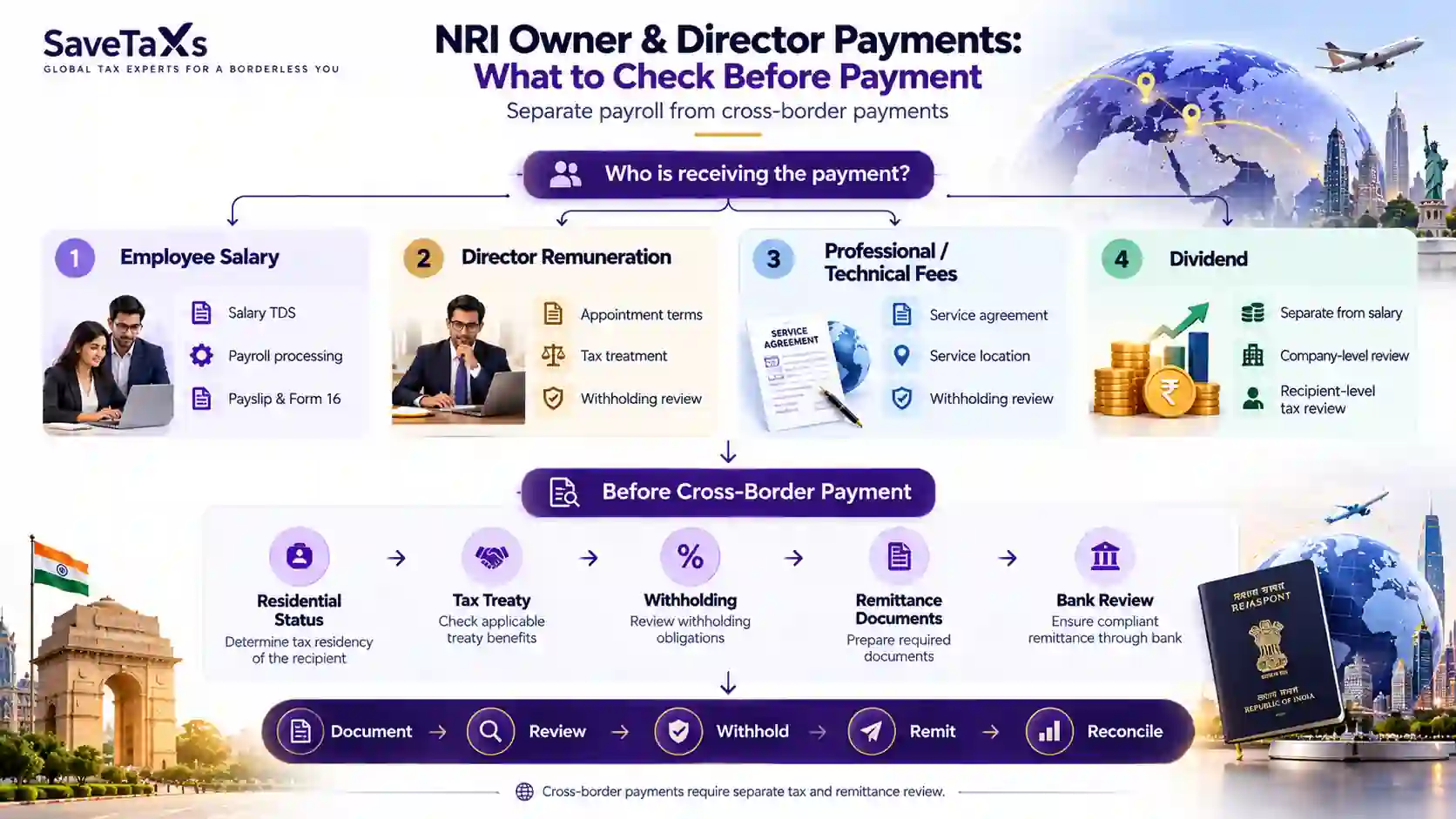
Treat payments to an NRI owner, director, or overseas service provider separately from Indian employee payroll. The correct treatment starts with the legal role, contract, service location, payment description, and whether the amount is salary, director remuneration, professional fees, reimbursement, dividend, or another payment.
If an NRI director receives remuneration, classify and process the payment according to the appointment terms and applicable tax rules. If the payment is for independent professional or technical services, review the non-salary withholding rules instead. The company must not choose the category only because the recipient is an owner or director.
Before payment, document the contract, board approval where relevant, residential status, tax identification details, withholding analysis, and bank instructions. Review whether the payment is taxable in India and whether a treaty changes the result.
Dividends are not salary. They need a separate company and recipient-level tax review. Payroll records should not combine dividend payments with remuneration.
For an overseas service provider, confirm where the services are performed, who benefits from the work, the contract terms, invoice description, withholding position, and remittance documents. An overseas invoice should be reviewed under the applicable Indian withholding rules before payment.
Read about NRI director remuneration in India before approving a payment that combines ownership, directorship, and services.
Cross-border payments require a separate review of Indian withholding, foreign-exchange documentation, treaty relief, and the recipient’s home-country reporting. The result changes with the NRI’s country of residence, including the USA, UK, Canada, Australia, UAE, and other countries.
Check the recipient’s Indian residential status, tax residence certificate where relevant, treaty eligibility, beneficial ownership, payment category, and foreign tax credit position. Treaty treatment should be assessed using the recipient’s residence and the applicable treaty conditions.
When money is remitted outside India, coordinate with the authorised dealer bank and prepare the required remittance information. Form 145 and Form 146 are tax documents used in specified remittance situations; their use depends on the payment and the applicable tax position.
Read about Form 145 and Form 146, India tax treaties for NRIs, and foreign tax credit for Indian income. Receiving Indian amounts through the right NRO and NRE account rules does not replace the underlying tax and remittance review.
An NRI-owned business should use a monthly, quarterly, annual, and event-based payroll calendar. The calendar must show the prescribed deposit and filing dates rather than relying on memory.
Monthly close
Quarterly and annual work
Event-based work
Review payroll when an employee joins, exits, changes location, receives a large variable payment, changes tax information, becomes a director, or moves between employee and contractor arrangements.
Payroll records should connect the employment contract, payroll register, payslip, bank payment, accounting entry, statutory deposit, and filed return. A mismatch between any two records is a warning that the payroll process needs correction.
Retain employee master data, attendance and leave records, salary approvals, declarations, supporting documents, payslips, payment proof, challans, Form 24Q data, Form 16 records, PF and ESI records, professional-tax filings, and full-and-final statements.
At each month-end, reconcile payroll totals to the bank, general ledger, TDS records, PF and ESI records, and employee-level data. Investigate rejected payments, duplicate employees, inactive workers, negative deductions, and unexplained salary changes.
Before the first payroll, confirm:
During each monthly close, confirm:
Review the setup when headcount, location, salary structure, tax regime, director role, or remittance arrangement changes.
Start by identifying the Indian employing entity, worker categories, locations, registrations, and state rules. Keep employee payroll separate from NRI owner or director payments, and place every cross-border payment through a documented withholding and remittance review. Have the employment contracts, salary structure, declarations, statutory records, bank data, and reconciliation reports in front of you. The fact most likely to change the answer is whether the person is an employee, director, contractor, or overseas service provider.
This article is for general informational purposes only and does not constitute tax, legal, financial, or investment advice. Laws, regulations, rates, and procedures may change over time and may vary based on individual circumstances.
While SaveTaxs makes reasonable efforts to keep the information accurate and up to date, readers should verify applicable rules with official authorities or consult a qualified professional before making decisions based on this information.
Shubham Jain is the Founder of SaveTaxs and has extensive experience in Indian and NRI taxation. He advises individuals, NRIs, and businesses on tax filing, tax planning, capital gains, DTAA benefits, fund repatriation, and compliance matters. He regularly writes about taxation and related financial topics. His focus is on making complex tax concepts easy to understand. Through his articles, he helps taxpayers stay informed, avoid common mistakes, and stay compliant with Indian tax laws. See Full Bio
Want to read more? Explore Blogs