Business Setup
Difference Between a LLP and a Partnership FirmDifference Between a LLP and a Partnership Firm
Written by Vipul Jain

Section 185 of the Companies Act, 2013 regulates loans, guarantees, and security involving company directors and certain connected persons or entities. Its purpose is to prevent misuse of company funds and address conflicts of interest.
If your company plans to lend money to a director, support a director-linked business, or guarantee a loan taken by another entity, you must identify which part of Section 185 applies before proceeding. The rules differ for direct loans to specified individuals and loans to certain entities in which a director is interested.
Section 185(1) generally prohibits a company from directly or indirectly advancing a loan, including a loan represented by a book debt, or giving a guarantee or security in connection with a loan taken by:
This restriction is not limited to a direct transfer of cash. A company must also assess indirect lending arrangements and guarantees or security supporting a covered person's borrowing.
Example: If an Indian company proposes to guarantee a personal loan taken by one of its directors, it must examine Section 185 before giving that guarantee. The company cannot assume the arrangement is permitted simply because the bank, rather than the company, is advancing the money.
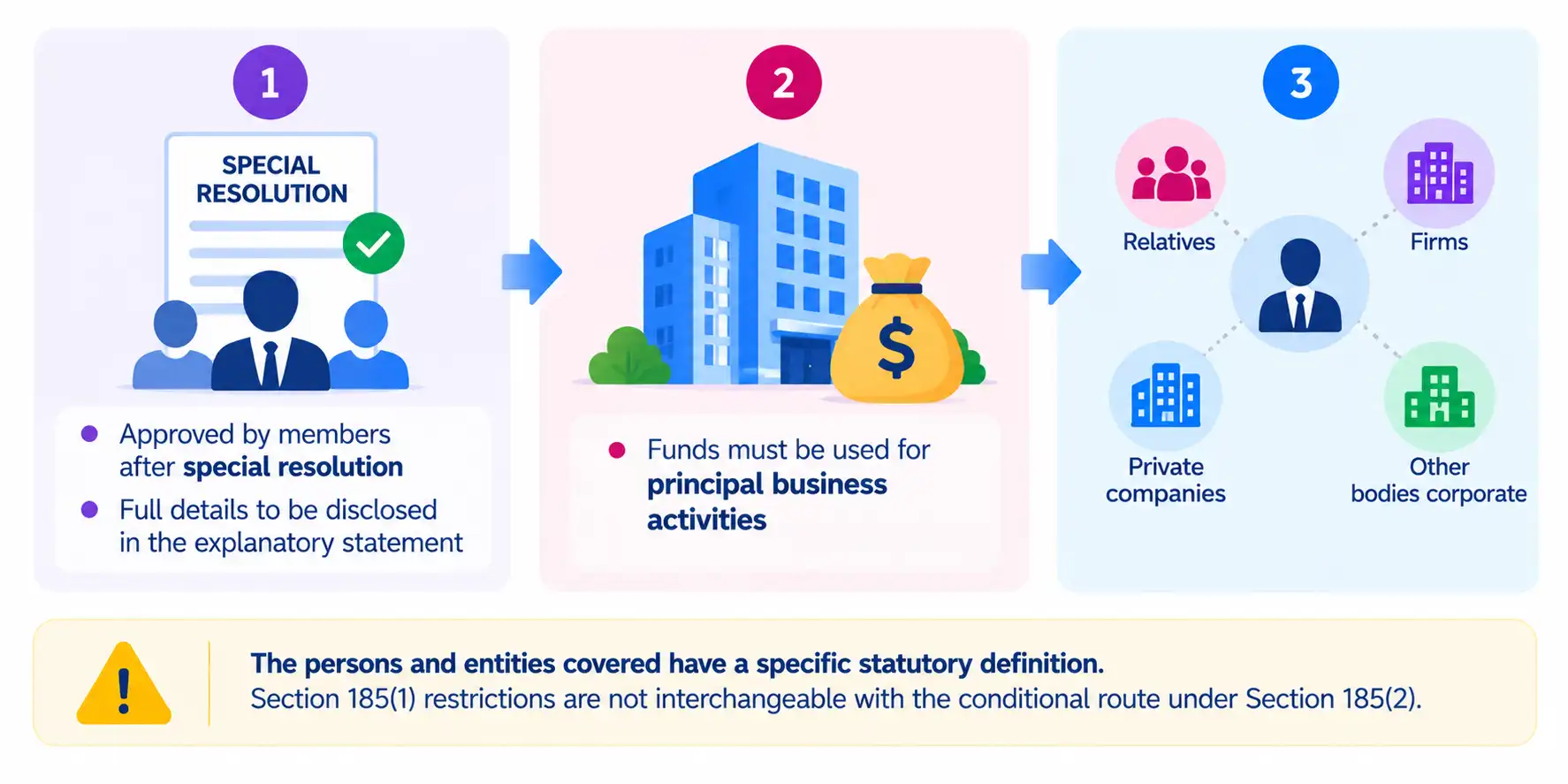
Section 185(2) provides a conditional route for loans, guarantees, and security involving a person or entity in which a director is interested, provided the recipient falls within the statutory definition. Two principal requirements must be satisfied:
The statutory explanation identifies the persons and entities covered by the expression “person in whom any director is interested,” including specified directors, partners or relatives, firms, certain private companies, and bodies corporate meeting the prescribed voting-control or management-direction tests. The applicable subsection must be identified carefully because the restrictions under Section 185(1) are not interchangeable with the conditional route under Section 185(2).
With SaveTaxs, understand Section 185 requirements, review applicable exemptions, and navigate your company's compliance obligations with greater clarity and confidence.
Section 185(3) lists specific transactions to which the restrictions in subsections (1) and (2) do not apply.
A loan may qualify if it is provided as part of the conditions of service extended by the company to all its employees, or under a scheme approved by members through a special resolution.
A company that provides loans, guarantees, or securities in the ordinary course of its business may qualify if, in respect of such loans, it charges interest at a rate not less than the bank rate declared by the Reserve Bank of India.
A holding company may lend to its wholly owned subsidiary or provide a guarantee or security in connection with a loan to that subsidiary. The subsidiary must use the funds for its principal business activities.
A holding company may provide a guarantee or security for a loan obtained by its subsidiary from a bank or financial institution, subject to the statutory requirement that the loan is used for the subsidiary's principal business activities.
An applicable MCA notification provides a separate exemption for certain private companies, subject to prescribed conditions. The conditions include restrictions concerning investment in the company's share capital by other bodies corporate, borrowing levels, and defaults on specified borrowings.
Do not assume that every private limited company qualifies. Verify the current notification, the company's ownership and borrowing position, and all conditions applicable on the transaction date before relying on this exemption.
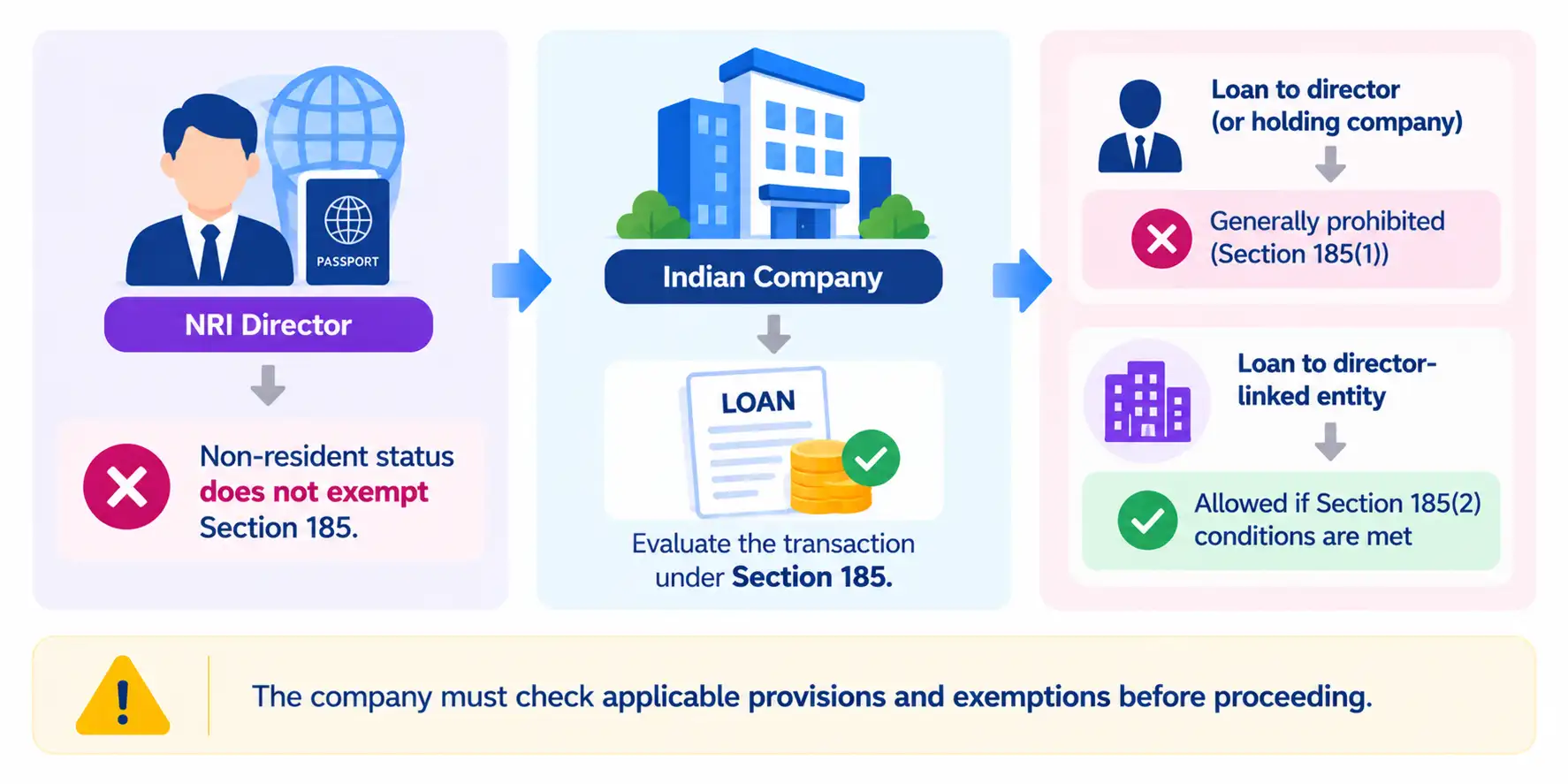
An NRI's non-resident status does not, by itself, exempt an Indian company from Section 185. The company must assess the proposed transaction under the applicable statutory provisions and exemptions.
For example, a loan to a director of an Indian company or its holding company, or a guarantee or security connected with that director's borrowing, is generally prohibited under Section 185(1) unless a specific statutory exception or applicable exemption covers the transaction. If the proposed transaction involves a director-linked entity instead, the company must determine whether the recipient meets the statutory definition under Section 185(2) and whether the applicable conditions are satisfied.
For more information about the director's wider compliance position, see our guide: Can NRIs Become Directors of an Indian Company?
Section 185(4) prescribes the following consequences for a contravention, including where a loan, guarantee, or security is utilised in contravention of the section:
The consequences make it important to check the recipient, transaction structure, statutory basis, approvals, and intended use of funds before the company advances a loan or provides a guarantee or security.
Before proceeding with a proposed transaction, the company should:
For wider corporate-law context, refer to SaveTaxs Companies Act, 2013 guide. Companies should obtain professional advice where the recipient's relationship, exemption eligibility, or transaction structure is unclear.
SaveTaxs helps you understand director-loan restrictions and compliance under the Companies Act, 2013.
Section 185 of the Companies Act, 2013 requires companies to examine director-related loans, guarantees, and security carefully. The right approach is to identify the recipient, classify the transaction, verify any exemption, and complete the required approvals before proceeding.
For transactions involving directors, group companies, or NRI stakeholders, a company secretary, chartered accountant, or qualified legal professional can help determine the applicable requirements.
This article is for general informational purposes only and does not constitute tax, legal, financial, or investment advice. Laws, regulations, rates, and procedures may change over time and may vary based on individual circumstances.
While SaveTaxs makes reasonable efforts to keep the information accurate and up to date, readers should verify applicable rules with official authorities or consult a qualified professional before making decisions based on this information.
Vipul Jain is the Co-Founder of SaveTaxs and a tax expert with experience in Indian and NRI taxation. He advises individuals, NRIs, and businesses on tax filing, tax planning, capital gains, DTAA, and compliance matters. He focuses on making complex tax concepts simple and helping taxpayers make informed, compliant decisions. See Full Bio

Want to read more? Explore Blogs