



Business Setup
Difference Between a LLP and a Partnership FirmDifference Between a LLP and a Partnership Firm
Written by Vipul Jain
Under the Companies Act, 2013, companies are categorized by listing status, members' liability, and company ownership. Understanding the categorization of businesses is important, as it directly influences the company's legal compliance, growth, operational efficiency, and tax obligations.
In this blog, we will explore the different types of companies in India. From solo entrepreneurs to large-scale collaboration businesses, each type of company in India is covered below.
In India, entrepreneurs can register for different types of companies under the Companies Act 2013. Each company type follows a different legal structure. The following are the different types of companies.
A one-person company caters to solo entrepreneurs who are seeking the benefits of limited liability. In simpler terms, in OPC, a single individual owns the company and enjoys liability protection. This person can also be the company's director. However, to start the OPC, you need one member, min 1 director and can have Max of 15 directors.
A private limited company business structure is one of the most common business structures. To establish the company, a minimum of two members are required, and there cannot be more than 200 members. Members can transfer their shares but restricted, not prohibited and this business structure is suitable for businesses that prefer to register as private entities.
In private limited companies, there can be a minimum of 2 and a maximum of 15 directors.
Key Features
A public limited company is an organization whose shares are publicly traded on a stock exchange, allowing the general public to hold its shares. For PLCs, there is no maximum number of members; however, there must be a minimum of 7 members to establish the PLC. Additionally, the company must have a maximum of 15 directors and a minimum of three.
Key Features
This type of business structure is a special form of association of persons and individuals that registers a company under Section 8 of the Companies Act 2013 for charitable purposes. Such companies are established to promote special welfare, sports, religion, science, education, commerce, art, environmental protection, charity, and other such subjects.
The company is required to apply its profits and other income generated to promote its activities, and there is a prohibition on dividend payments to the company's members.
The MSME (Micro, Small, and Medium Enterprise) Act categorizes companies by size to give the benefits provided by the central government to MSMEs.
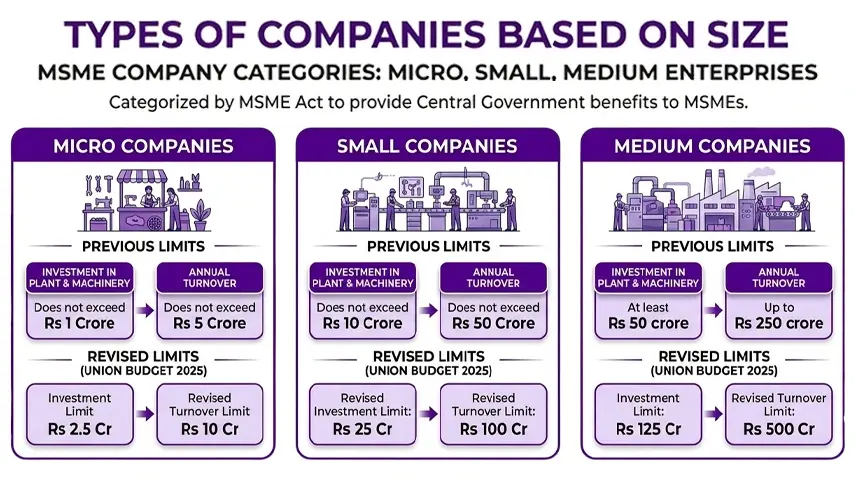
A micro company is a type of company whose total investment in plant and machinery does not exceed Rs 1 crore and whose turnover for a financial year does not exceed Rs 5 crore. However, in the Union Budget 2025, the Government of India has rolled out revised MSME investment and turnover limits for Micro Companies: Investment Limit: Rs 2.5 Cr and the revised turnover limit is Rs 10 Cr.
A small company is a company whose total investment in plant and machinery does not exceed Rs 10 crore and whose annual turnover for the financial year does not exceed Rs 50 crore. However, in the Union Budget 2025, the Government of India has rolled out the revised MSME investment and turnover limits for Small Companies: Revised Investment Limit: Rs 25 Cr and Revised Turnover Limit: 100 Cr.
Under the MSME Act, a medium company is a company with total investment in plant and machinery of at least Rs 50 crore and annual turnover of up to Rs 250 crore. However, in the Union Budget 2025, the Government of India has rolled out revised MSME investment and turnover limits for Medium Companies: Investment Limit: Rs 125 Cr; Revised Turnover Limit: Rs 500 Cr.
Company members either have unlimited liability or limited liability. The liability of the company member arises at the time of the company's loss, winding up, payment of the company's debts, or bankruptcy. Hence, a company that is established under the Companies Act 2013 can be categorized based on its shareholder liability.
For a company liability to be limited by shares means that the liability of the company members is limited by the MOA (Memorandum of Association). The members of the company are liable only for the unpaid share amount held by them respectively. The equity of a member's shares measures the shareholder's ownership in the company.
A company being limited by guarantee means that the members' liability is limited to the amount they guarantee to contribute towards the company's assets. The liability of the member is limited to the Memorandum of Association of the company. In this, the members of the MOA undertake to contribute a guaranteed amount if the company is wound up.
The percentage of the member's ownership depends on the amount they guarantee.
An unlimited company means that the members of the company have no limit imposed on their liability. In the event that any debt arises, the members' liability is unlimited and extends to their personal assets.
Generally, entrepreneurs choose not to incorporate this type of company.
Savetaxs expert assistance helps NRIs file their business taxes in India confidently.
The companies are categorized by control and ownership structure as follows.
A holding company is a company that holds the majority of the voting power of another company, i.e., the subsidiary company. The holding company is also the parent company that controls the subsidiary's policies, management decisions, and assets. However, it remains uninvolved in the subsidiary's day-to-day activities.
A subsidiary company is owned or governed either entirely or partially by the holding company. The holding company governs the subsidiary company's board of directors or holds more than 50% of the subsidiary's voting power.
The subsidiary company is also known as the Wholly Owned Subsidiary (WOS) of the holding company.
The companies are classified into listed and unlisted companies based on their access to capital. Every listed company must be a public company; however, the vice versa might not be true. Any unlisted company can be either a private or a public limited company.
A listed company is a company registered on a recognized stock exchange in India, such as the National Stock Exchange (NSE) or the Bombay Stock Exchange (BSE). The listed company shares trade freely on the stock exchange. However, such companies are required to comply with the guidelines given by the Securities Exchange Board of India (SEBI).
A company that wants to list its shares on a recognized stock exchange in India must issue a prospectus to the general public so they can subscribe for the company's shares or debentures. Initially, the company issues its shares through an Initial Public Offering (IPO), whereas an already listed company makes a FPO, which is a Further Public Offering.
An unlisted company is one that is not listed on any recognized stock exchange, and its shares are not available for trading on any stock exchange. Such companies fulfill their capital requirements by getting funds from friends, financial institutions, family members, private placements, or relatives. Unlisted companies are not required to meet the same level of regulatory security as listed companies; however, they must still comply with the Companies Act's statutory requirements.
An unlisted company converts into a public company and is required to issue a prospectus if it wishes to list its securities on the stock exchanges.
Savetaxs provides simple, expert-led business setup consultation to NRIs 24/7.
There are various types of companies in India that cater to every kind of business or entrepreneur. Each type of business entity has its own set of features, challenges, liabilities, and advantages. From the simplicity of a sole proprietorship to the strong framework of private companies and beyond, choosing the right business structure is important for making your journey smooth.
As an NRI, if you are planning to register a business in India and seeking professional assistance, Savetaxs is the name to trust. Our experts provide end-to-end consultation to NRIs, helping them navigate the complex regulatory framework, including FEMA compliance, Ministry of Corporate Affairs (MCA) procedures, and more. The experts provide consultation to NRIs, helping them choose the ideal business structure, address regulatory compliance, handle documentation, navigate incorporation procedures, set up a registered office, ensure FEMA and RBI compliance, and more.
Connect with us as we serve our clients 24/7 across all time zones.
This article is for general informational purposes only and does not constitute tax, legal, financial, or investment advice. Laws, regulations, rates, and procedures may change over time and may vary based on individual circumstances.
While SaveTaxs makes reasonable efforts to keep the information accurate and up to date, readers should verify applicable rules with official authorities or consult a qualified professional before making decisions based on this information.
Vipul Jain is the Co-Founder of SaveTaxs and a tax expert with experience in Indian and NRI taxation. He advises individuals, NRIs, and businesses on tax filing, tax planning, capital gains, DTAA, and compliance matters. He focuses on making complex tax concepts simple and helping taxpayers make informed, compliant decisions. See Full Bio
Want to read more? Explore Blogs
_1780491123033.webp&w=828&q=75)
_1778757638178.webp&w=828&q=75)