
UAE NRI Taxation
How UAE NRIs Can Build a Retirement Corpus for IndiaHow UAE NRIs Can Build a Retirement Corpus for India
Written by Shubham Jain
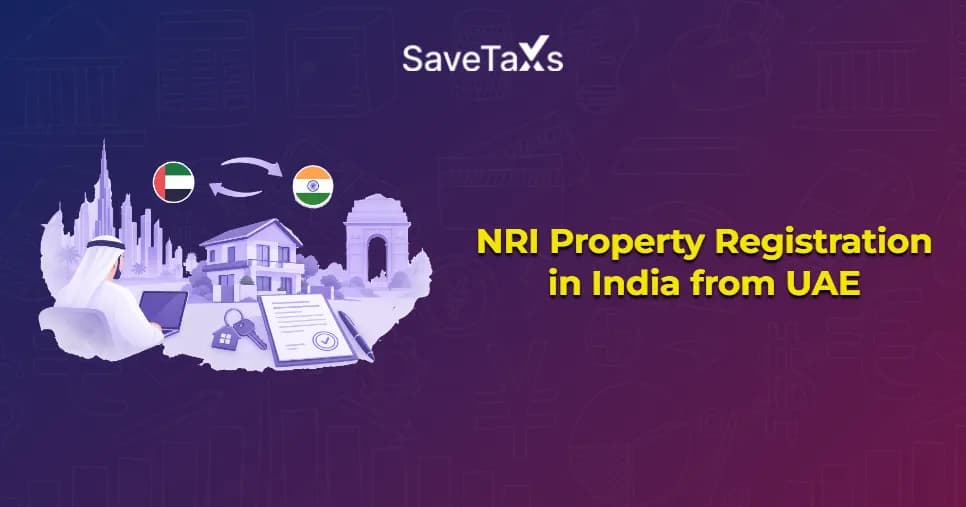
For an NRI living in the UAE, NRI property registration in India from the UAE requires careful planning because you won't be in India to sign documents, complete biometrics, or complete other verifications. Therefore, an NRI living in the UAE can register eligible property in India by traveling to India or by authorizing a Power of Attorney.
Also, for you as an NRI, the registration process is not the same across India. Document requirements, stamp duty, and Power of Attorney rules often differ from state to state.
In this blog, we will cover everything from mandatory paperwork to PoA authorization in India. We'll also cover fund transfers, completing financial registration, and more.
The Indian real estate market is growing, and so is NRIs' interest in investing in it.
Savetaxs helps NRIs file their taxes in India under expert guidance, ensuring 100% compliance.
The exact document checklist varies by state, property type, and other factors. The following is a list of common documents needed, regardless of state or property type.
| NRI Buyer's Document | Seller's Documents | Property Documents | Power of Attorney Documents |
|---|---|---|---|
| Valid Passport | PAN and identity proof | Final Sale deed | Original PoA |
| UAE Residence Visa | Previous title deed | Agreement to sell | Passport and visa copies of the NRI |
| Emirates ID | Current ownership document | Property schedule | Photographs of both the principal and the attorney |
| PAN | Encumbrance certificate | Survey or plot details | Attorney PAN and identity proof |
| OCI Card, if applicable | Property tax receipts | Floor plan | UAE attestation records |
| Recent Photographs | Mutation or revenue records | - | Indian stamp duty and the adjudication record |
| UAE Address Proof | Approved building plan | Government valuation records | PoA registration record, where required |
| Indian address details, wherever requested | Completion or occupancy certificate. | Stamp duty payment receipt | Proof that the PoA remains valid. |
| NRE/NRO account details | Society and association records | Registration fee receipt | - |
| Payment Evidence | Loan closure documents | TDS payment evidence, where applicable. | - |
| Power Of Attorney | Consent from co-owners | Builder allotment or the possession records | - |
| - | PoA, if the seller is also represented | No objection certificate, wherever required | - |
| - | Either inheritance documents or Probate, whichever is relevant | RERA documents for an applicable project | - |
It varies by state and applies to specified legal instruments, including property transfer documents. Registration charges are paid to record the documents with the registration authority.
These are two separate costs and must not be confused as one.
| Cost | Purpose. |
|---|---|
| Stamp Duty | Tax or duty on the property transfer instrument |
| Registration Fees | Charges for registering the sale deed. |
| Other local charges | May include scanning, facilitation, mutation, or administrative charges |
The following is the UAE NRI property Registration Process in India.
This is arguably the most essential step. Before you invest in any city in India, assess its growth potential and real estate market to understand how it will perform in the long term.
Factors to consider while picking an investment location are:
The next step in the property registration process in India for NRIs is-
After you finalize the location and the property you want, identify the Sub-Registrar's office with jurisdiction over the property. Many NRIs make one mistake: they assume any registration office in the city can register the property documents, which is not the case. So confirm the following:
Now, as an NRI buyer, before finalizing everything, ask a lawyer to draft an authorized power of attorney to execute the sale deed.
This document must clearly state:
As an NRI buyer, do not sign a sale deed that has any incomplete information or incomplete payment description.
Before paying the final amount, confirm the:
Knowing this beforehand is essential because the seller's residential status affects your TDS compliance as a buyer.
After cross-checking every small detail, pay the applicable amount. Keep the following safe with you.
Ensure your name as the buyer, the property details, and the amount paid are recorded accurately.
Next, if available online, upload all the required information and select the appropriate Sub-Registrar's office.
Next, the buyer and the seller, or their Power of Attorney, must execute the document per the applicable procedure. Once the sale deed is registered, get the official receipt and document reference number.
After the sale deed is executed, it needs to be registered with the Sub-Registrar of Assurances in the appropriate jurisdiction where the property is located. In the sale deed, you have to pay stamp duty and registration fees, which vary by state.
For NRIs living in the UAE who plan to buy a property in India but cannot travel here in person, Power of Attorney is a suitable option. Based on your needs, a Power of Attorney agreement drafted specifically for property purchase must authorize the representative in India to:
Be very specific while drafting the agreement; avoid broad language that would give the person in charge authority to deal with unrelated assets.
Next, choose your attorney in India carefully.
Savetaxs helps NRIs register property in India while handling all the legal formalities and documentation.
As an NRI living in the UAE and buying property in India, you must avoid the following remote property registration in India from UAE mistakes.
As an NRI living in the UAE, NRI property registration in India from the UAE is a relatively seamless process if you follow the steps and comply with requirements. However, the process varies by property type, the city the property is located in, and other factors. In the long run, this is a great investment in the Indian real estate market for an NRI.
Now, if you cannot travel to India, you must arrange a mindfully drafted, properly authenticated PoA well before the appointment. As an NRI seeking professional assistance, Savetaxs is the name to trust. Our experts help NRIs in the UAE complete the tax side of an Indian property purchase, including TDS planning and accurate documentation. Our experts also provide end-to-end assistance with the sale deed, POA, and state registration process.
Connect with us, as we serve our clients 24/7 across all time zones.
This article is for general informational purposes only and does not constitute tax, legal, financial, or investment advice. Laws, regulations, rates, and procedures may change over time and may vary based on individual circumstances.
While SaveTaxs makes reasonable efforts to keep the information accurate and up to date, readers should verify applicable rules with official authorities or consult a qualified professional before making decisions based on this information.
Shubham Jain is the Founder of SaveTaxs and has extensive experience in Indian and NRI taxation. He advises individuals, NRIs, and businesses on tax filing, tax planning, capital gains, DTAA benefits, fund repatriation, and compliance matters. He regularly writes about taxation and related financial topics. His focus is on making complex tax concepts easy to understand. Through his articles, he helps taxpayers stay informed, avoid common mistakes, and stay compliant with Indian tax laws. See Full Bio
Want to read more? Explore Blogs