
An Employer Identification Number (EIN) is a unique nine-digit number issued by the Internal Revenue Service (IRS) to identify businesses and certain other entities for federal tax purposes. It is commonly known as a federal tax ID number and is used to file business tax returns, report employment taxes, and complete other tax-related transactions.
If you are starting a business in the United States, forming an LLC, hiring employees, or opening a business bank account, you may need an EIN. However, not every business is legally required to obtain one.
Understanding what an EIN is, who needs it, and how to apply can help you meet your federal tax obligations and avoid unnecessary application errors.
- An EIN is a nine-digit federal tax identification number issued by the IRS to eligible businesses and other entities.
- Corporations, partnerships, employers, and certain other entities generally need an EIN.
- Some sole proprietors and single-member LLCs may not need one for federal income tax purposes, but exceptions apply.
- Applying directly through the IRS is free.
- Foreign business owners may qualify for an EIN but may need to apply by telephone, fax, or mail rather than online.
- Keep the EIN confirmation notice with your business records and use the correct identification number for each tax filing.
What Does an EIN Look Like?
An EIN consists of nine digits, usually displayed in this format: XX-XXXXXXX.
For example, 12-3456789 illustrates the format of an EIN; it is not a number assigned to a real business.
The IRS uses this number to identify a business or other eligible entity in its tax records. Unlike a Social Security number (SSN), which generally identifies an individual, an EIN identifies a business or other entity for applicable federal tax and reporting purposes.
An EIN may also be called a Federal Employer Identification Number (FEIN) or federal tax identification number. These terms generally refer to the same type of federal identifier.
What Is an EIN Used For?
Businesses use an EIN for several tax and administrative purposes.
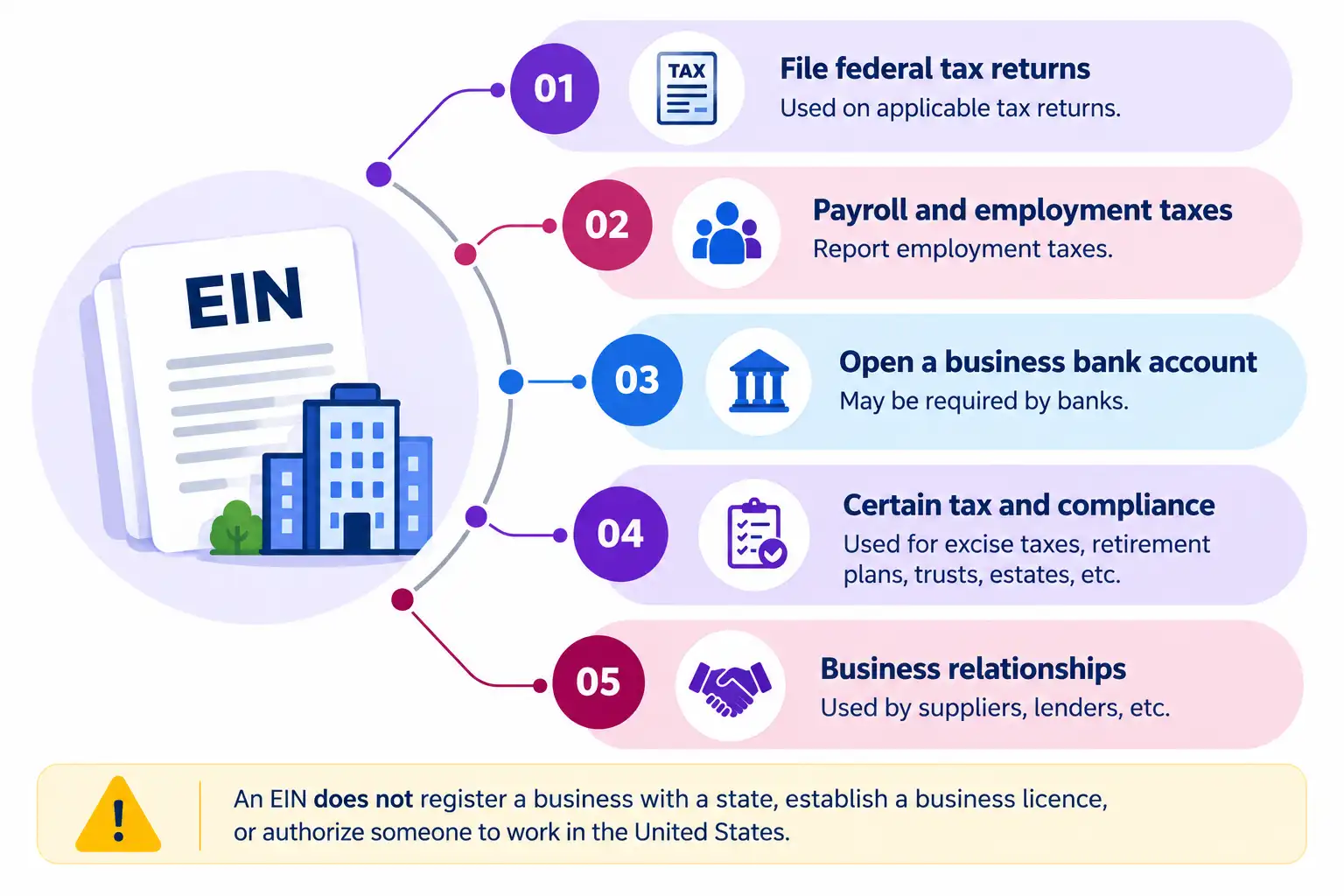
1. Filing Federal Business Tax Returns
Corporations, partnerships, and other entities use an EIN when filing applicable federal tax returns and information returns. The exact forms depend on the business structure and its tax classification.
2. Managing Payroll and Employment Taxes
Employers generally need an EIN to report employment taxes and fulfil related federal payroll obligations. The number is used on applicable employment tax returns and employee tax documents.
3. Opening a Business Bank Account
Banks may request an EIN when a business applies for a business checking account, credit facility, or other financial service. Requirements vary by financial institution and business structure.
4. Handling Certain Tax and Compliance Requirements
An EIN may be required for applicable excise tax filings, certain retirement plans, trusts, estates, and other qualifying entities.
5. Establishing Business Relationships
Suppliers, lenders, payment providers, and other organizations may request an EIN to verify business information or complete tax documentation.
An EIN does not, by itself, register a business with a state, establish a business licence, or authorize someone to work in the United States.
With SaveTaxs, understand your EIN requirements and manage your U.S. business tax obligations with confidence, accuracy, and ease.
Who Needs an EIN?
The requirement depends on the entity's legal structure, tax classification, activities, and reporting obligations.
| Business or entity type | EIN requirement |
|---|---|
| Corporation | Generally requires an EIN |
| Partnership | Generally requires an EIN |
| LLC with multiple members | Generally requires an EIN |
| Sole proprietor with employees | Generally requires an EIN |
| Sole proprietor without employees | May be able to use an SSN, depending on the circumstances |
| Single-member LLC without employees | May not need a separate EIN for federal income tax purposes if it is a disregarded entity, but exceptions apply |
| Tax-exempt organization, certain trusts, estates, or retirement plans | Requirements depend on the entity and applicable rules |
A single-member LLC is a common source of confusion. If it has no employees and no applicable excise tax obligations, it may not need a separate EIN for federal income tax purposes. However, it may need one for banking, state tax requirements, or other activities. A single-member LLC that elects corporate tax treatment may also have different requirements.
Before applying, check the IRS guidance for your specific entity type.
EIN vs. SSN vs. ITIN vs. TIN
These identification numbers serve different purposes. An EIN is not interchangeable with an individual's tax identification number in every situation.
| Identifier | What it identifies | Main purpose |
|---|---|---|
| EIN | A business or other eligible entity | Business tax and reporting obligations |
| SSN | An eligible individual | Individual identification and tax reporting |
| ITIN | An individual who needs a U.S. taxpayer identification number but is not eligible for an SSN | Federal tax purposes |
| TIN | A general category of taxpayer identification numbers | Identifying taxpayers for applicable tax purposes |
A TIN is an umbrella term that can include an EIN, SSN, or ITIN, depending on the taxpayer.
For example, a U.S. sole proprietor may use an SSN for certain federal tax reporting if an EIN is not required. A corporation generally uses its EIN for its business tax filings. The correct number depends on the form, entity, and transaction.
How to Apply for an EIN
The IRS issues EINs free of charge. You should apply directly through the official IRS website rather than paying an unofficial service solely to obtain the number.
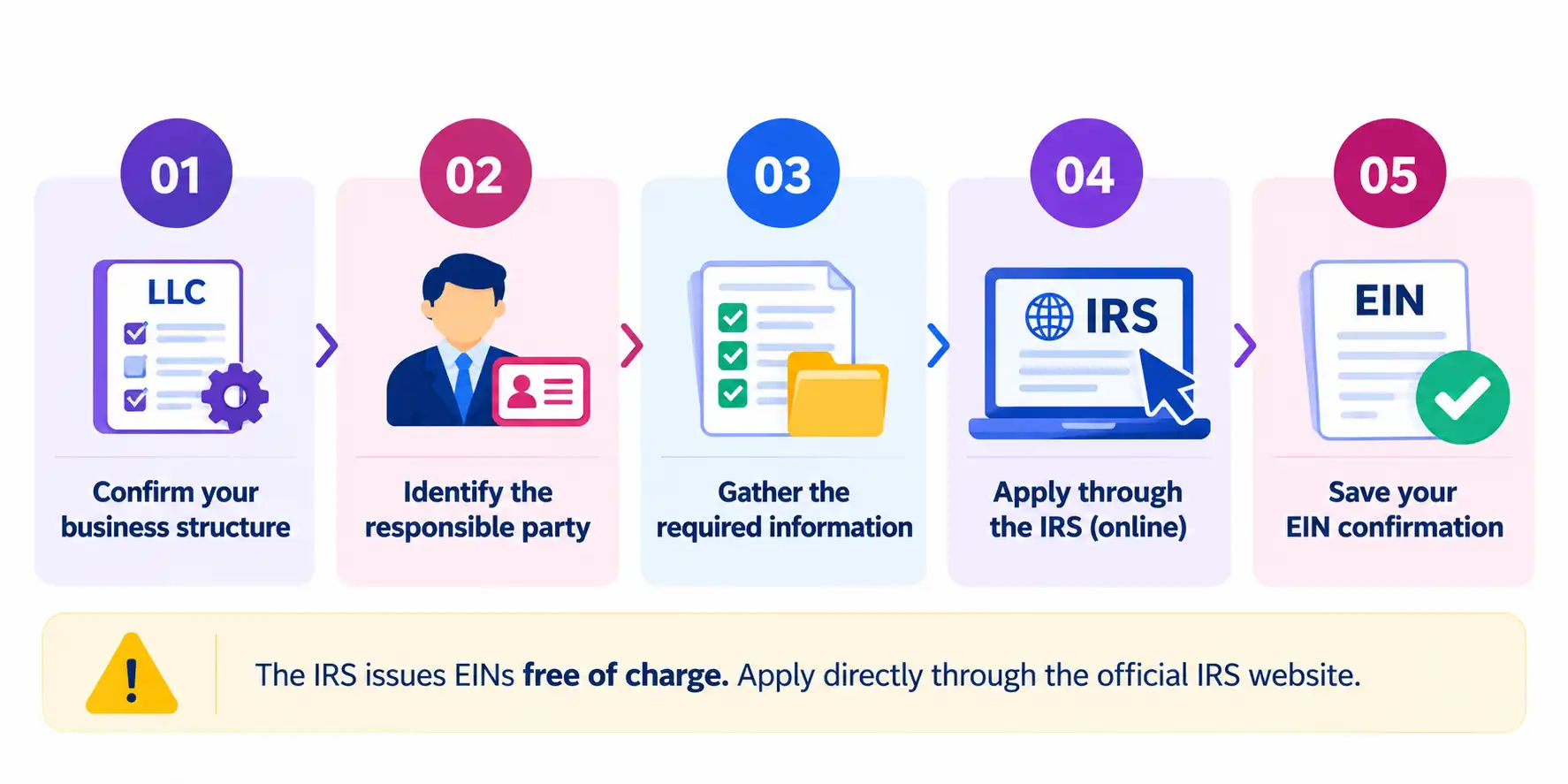
Step 1: Confirm Your Business Structure
If you are forming an LLC, partnership, or corporation, complete the applicable state formation or registration process before applying for an EIN. The IRS recommends establishing the legal entity first where required.
Step 2: Identify the Responsible Party
The application must identify the responsible party—the individual who ultimately owns or controls the entity or exercises effective control over its funds and assets, subject to IRS rules.
A nominee should not be listed in place of the actual responsible party simply because they helped form the business.
Step 3: Gather the Required Information
You may need:
- The legal name of the business or entity
- The entity's mailing and physical address, as applicable
- The business structure and reason for applying
- The responsible party's identifying information
- Details about employees and the principal business activity, where requested
Make sure the information matches your formation documents and other official records.
Step 4: Choose the Correct Application Method
Eligible applicants whose principal place of business is in the United States or U.S. territories can generally apply online through the IRS. Other applicants may need to use a different method.
The online application must be completed in one session and expires after 15 minutes of inactivity. If approved, the EIN is issued immediately online, and you should save or print the confirmation notice.
Apply here: Get an EIN directly from the IRS.
Step 5: Keep the EIN Confirmation Safe
Save the EIN assignment notice with your business records. You may need it when filing tax returns, opening a bank account, or completing business documentation.
The IRS currently limits applications to one EIN per responsible party per day.
Can a Foreign Business Owner or Non-U.S. Resident Get an EIN?
Yes. A foreign individual or business owner may be able to obtain an EIN for a qualifying U.S. business or other eligible entity. You do not automatically need to be a U.S. citizen or resident to qualify for an EIN.
However, foreign applicants generally cannot use the IRS online EIN application if their principal place of business is outside the United States or U.S. territories. The IRS provides other application methods, including telephone, fax, and mail, subject to the applicable requirements.
For international applicants, Form SS-4 is the application used to request an EIN. The IRS instructions explain how to complete the form when the responsible party does not have an SSN or ITIN and is not eligible to obtain one.
For example, a business owner living in India who forms a U.S. LLC may need to apply for an EIN for the entity. The owner should confirm the entity's tax classification, the appropriate application method, and any separate federal filing obligations.
Receiving an EIN does not automatically determine the business's tax classification, eliminate tax filing requirements, or establish immigration or work authorization.
See the IRS guidance for EIN applications for international application methods and current instructions.
How Do You Find a Lost EIN?
If you previously received an EIN but cannot locate it, you should try to recover the existing number rather than applying for another one.
You can:
- Check the original EIN confirmation notice and business tax records.
- Review prior federal business tax returns or relevant bank and business documents.
- Check whether you can obtain an eligible business tax transcript or digital EIN verification notice through the IRS Business Tax Account.
- Contact the IRS Business and Specialty Tax Line if necessary to request assistance with EIN verification.
An EIN generally remains associated with the entity after it stops operating. Closing a business does not automatically mean that the EIN can be reused for a different entity.
At SaveTaxs, we help business owners understand EIN requirements, navigate the IRS application process, and manage their U.S. tax compliance needs.
Common EIN Application Mistakes to Avoid
- Paying an unofficial website unnecessarily: The IRS does not charge a fee to issue an EIN.
- Applying before forming the entity: Complete the required state formation process first when applicable.
- Using the wrong responsible party: Provide the information required by the IRS for the actual responsible party.
- Assuming every LLC needs an EIN: Requirements differ for single-member LLCs, multi-member LLCs, and entities with employees or specific tax obligations.
- Using an EIN instead of an SSN or ITIN on individual tax documents: Use the taxpayer identification number required for the specific form or transaction.
- Submitting multiple applications for the same entity: Check whether an EIN has already been assigned before applying again.
Need Help With U.S. Business Tax Compliance?
SaveTaxs helps business owners understand U.S. tax requirements, business structures, and federal filing obligations. If you are forming a U.S. entity or are a foreign owner of a U.S. business, review your EIN requirements alongside your tax classification and ongoing filing responsibilities.

Hatim Dudhiyawala is a Certified Public Accountant (CPA) with SaveTaxs and specializes in Indian and NRI taxation. He advises individuals, NRIs, and businesses on income tax filing, capital gains taxation, DTAA benefits, fund repatriation, and tax compliance. With experience in cross-border tax matters, Hatim helps taxpayers understand complex regulations and make informed decisions. Through his articles, he shares practical insights to help readers stay compliant and manage their tax obligations with confidence. See Full Bio

Frequently Asked Questions
Generally, yes. An EIN is a federal tax identification number assigned by the IRS to eligible businesses and other entities. It is also commonly called a Federal Employer Identification Number (FEIN).
Yes. The IRS issues EINs free of charge. You can apply directly through the official IRS website if you meet the online application requirements.
No. A single-member LLC that is treated as a disregarded entity and has no employees or applicable excise tax obligations may not need a separate EIN for federal income tax purposes. Other LLCs generally have different requirements, and a bank or state authority may still require an EIN.
In some circumstances, yes. International applicants who are not eligible for an SSN or ITIN may still be able to apply for an EIN using the appropriate procedure and Form SS-4 instructions. Eligibility and application requirements should be confirmed with the IRS.
Eligible online applicants generally receive an EIN immediately once the IRS approves the application. Fax and mail applications can take longer, and processing times may vary. International applicants should check the IRS's current instructions for their chosen method.