
As a U.S. business owner, to maintain financial stability and contribute to the country's large economy, you need to understand U.S. business taxes. Knowing when and how to file reduces the time you spend on tax obligations, so you can focus more on your business.
While businesses may have tax filing and reporting obligations, not every business owes taxes. The specific taxes you owe and your obligations depend on your business structure. Want to know about it? This blog provides you with complete information about the key business taxes in the U.S. according to business structure. So scroll down and get an idea of it.
- Your business tax obligations depend on your business structure in the U.S. Your filing dates, tax obligations, reporting requirements, and additional taxes depend on it.
- Common U.S. business structures include sole proprietorships, partnerships, LLCs, S corporations, and C corporations.
- Depending on the business structure, common U.S. taxes include federal income tax, self-employment tax, state and local taxes, excise tax, payroll tax, and sales or use tax collection and remittance obligations.
- Depending on the tax year you choose to file your return, calendar or fiscal, your tax deadline differs.
- U.S. businesses may also be eligible for a variety of tax credits and deductions that reduce their tax obligations.
What Are U.S. Business Taxes?
U.S. business taxes are federal, state, and local tax obligations that may apply when you operate a business in the country. Depending on your business structure and activities, different taxes and filing requirements may apply. Considering this, U.S. business taxes depend on the following factors:
- Business structure
- Generated income
- Whether, as an owner, you work in the business
- Business location
- Having employees in it
- Services or products it offers
- Whether federal, state, or local taxes apply to its activities
The IRS states that your business structure determines your tax obligations. So, when choosing between an LLC, sole proprietorship, C corporation, and S corporation, consider tax obligations in addition to legal and administrative structure. An LLC may be treated as a disregarded entity, partnership, or corporation for federal tax purposes, depending on its ownership and elections. Eligible entities may elect S corporation treatment. State and local tax obligations may differ from federal rules.
This was all about U.S. business taxes. Now, moving ahead, let's learn about types of U.S. taxes businesses pay.
Connect with Savetaxs to file your U.S. taxes on time, without issues, and stay compliant with the country's tax laws.
What Types of Taxes Do U.S. Businesses Pay?
As mentioned earlier, U.S. business taxes depend on your business structure. Let's look at some of the common U.S. business taxes:
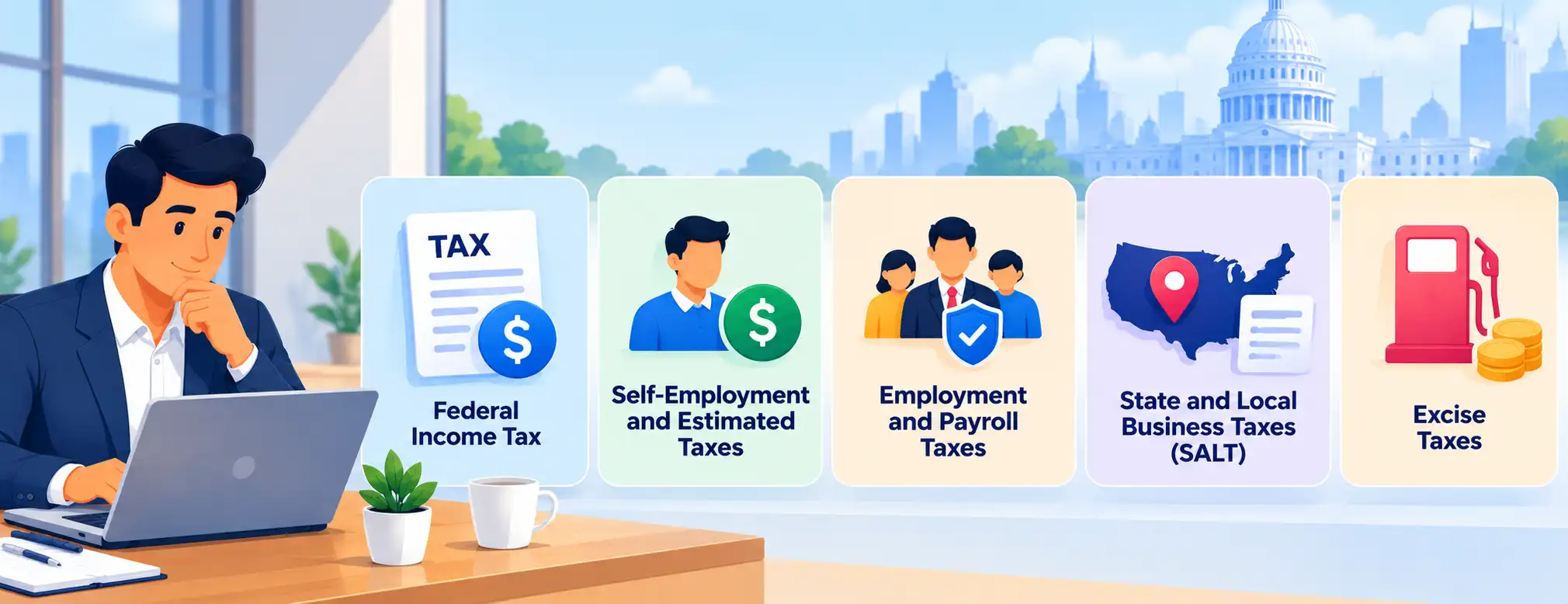
Federal Income Tax
Businesses generally must meet the federal income tax filing requirements applicable to their tax classification. Sole proprietors generally report business income on their individual tax returns, while partnerships generally file informational returns (Form 1065). Partnership income generally passes through to partners, who report their allocated tax items on their own returns. For some U.S. businesses, taxable income comes through owners and is reported on their individual returns.
However, a C corporation is a separate taxable entity under U.S. federal tax law. It generally pays corporate income tax on its taxable income. Shareholders may also owe tax on dividends they receive, potentially resulting in double taxation. Therefore, two businesses earning the same income can have different reporting and tax consequences depending on their structure.
Self-Employment and Estimated Taxes
The self-employment tax is a Social Security and Medicare tax that applies to qualifying net earnings from self-employment. Under the Social Security system, these taxes provide you with Medicare, retirement, disability, and survivor benefits. Self-employed taxpayers, such as sole proprietors, freelancers, and independent contractors, generally must file Schedule SE (Form 1040 or Form 1040-SR) when required. Generally, self-employment tax applies when net earnings from self-employment are $400 or more, subject to applicable exceptions. Special rules may apply to nonresident aliens.
Additionally, U.S. business owners may need to make estimated tax payments during the tax year. The U.S. federal income tax system works on a pay-as-you-go basis. So, if withholding doesn't cover enough tax, you may need to make estimated payments. These payments can cover both income tax and other obligations, such as self-employment tax.
Estimated taxes are especially relevant to sole proprietors, partners, and owners who receive income without withholding.
Employment and Payroll Taxes
Once a U.S. business hires employees, it faces additional tax obligations. Considering this, federal employment taxes include:
- Social Security tax
- Federal income tax withholding
- Medicare tax
- Federal Unemployment Tax Act (FUTA) tax
Generally, employers are responsible for withholding, depositing, reporting, and paying employment taxes. This compliance process also includes filing Form 941 and Form 940 when required. However, employers pay FUTA tax and do not withhold any amount from employees' wages for this tax.
Also, pay close attention to payroll compliance, as depositing and filing employment tax returns are two separate things. So don't assume that automatically applying payroll meets IRS tax filing requirements.
State and Local Business Taxes (SALT)
Federal income taxes are one part of business taxes. Depending on your business activity and jurisdiction where the business is located, you may also be liable for:
- State income tax
- Sales and use tax
- Local business taxes
- Franchise tax
- State unemployment tax
- Other state and municipal charges
Rules for state and local business taxes vary by U.S. state. Additionally, a U.S. business operating in more than one U.S. state needs to determine whether its business activity creates sufficient nexus or connection to produce a tax or registration obligation in another state. This matters because state tax filings are state-specific. So you need to review state income tax, sales tax, franchise tax, and nexus issues separately, state-wise.
Excise Taxes
Excise tax is a tax type that applies to the sale or use of specific goods and services, such as fuel, alcohol, cigarettes, and other items. The tax amount may be based on the item's value or quantity. These taxes are imposed under specific excise tax rules. If a taxpayer believes an excise tax assessment is incorrect, the taxpayer may be able to challenge it through the applicable IRS administrative procedures or other available remedies, depending on the circumstances. These taxes fall under two categories:
- Ad valorem taxes: These taxes are based on the item's value.
- Specific taxes: These taxes are based on the quantity of the item.
These are the different types of U.S. business taxes that U.S. businesses may pay. Now, moving further, let's know how business taxes differ by business structure.
How Do Business Taxes Differ by Business Structure?
Depending on your business structure, how you file your tax return and how business profits reach the owners also get affected. Confused? Look at the table below to know how business structure affects your tax obligations:
| Business Structure | General Federal Tax Treatment | Main Federal Tax Return | Key Owner-Level Issue |
|---|---|---|---|
| Sole Proprietorship | Business reported by owner | Generally Form 1040 + Schedule C, or Form 1040-NR where applicable | Pay income and self-employment tax, when applicable |
| Single-Member LLC | Disregarded by default | Applicable tax return of the owner | Tax obligation depends on tax election |
| Multi-Member LLC | Partnership by default | Form 1065 | Income allocated to members |
| Partnership | Pass-through | Form 1065 | Partners get Schedule K-1 |
| S Corporation | Pass-through | Form 1120-S | Income passes through; shareholder employees have compensation rules |
| C Corporation | Separate taxable entity | Form 1120 | Liable to pay corporate tax and shareholders may owe tax on dividends |
This was a quick overview of the business structure and associated tax obligations. Now, let's go into detail.
Sole Proprietorship
Like its name states, a sole proprietorship is an unincorporated business owned by a single individual. If you are a sole proprietor, you generally need to file Schedule C (Profit or Loss from Business) along with your Form 1040 to report the net profit or loss of your business. Additionally, you need to file Schedule SE (Self-Employment Tax) with your Form 1040 when required. For calendar-year filers, the tax filing deadline is generally April 15. However, fiscal-year taxpayers should generally file their tax return no later than the 15th day of the fourth month after the end of the tax year.
Additionally, you generally must pay estimated taxes if you expect to owe at least $1,000 in tax after subtracting withholding and refundable credits, and you do not meet an applicable exception. Generally, estimated tax payments are required if your withholding and refundable credits are less than the smaller of:
- 90% of the tax shown on your current-year tax return; or
- 100% of the tax shown on your previous year's return, subject to special rules. The required percentage is generally 110% for certain higher-income taxpayers.
Partnerships and Limited Liability Companies (LLCs)
U.S. businesses taxed as partnerships, including domestic multi-member LLCs that have not elected corporate treatment, generally need to file Form 1065 (U.S. Return of Partnership Income), which reports income and loss to the IRS. The partnership should also fill out Schedule K-1 (Partner's Share of Income, Deductions, Credits, etc.) for each partner. This is part of Form 1065. Further, the filing date for Form 1065 for a calendar-year partnership is generally March 15, subject to weekend and holiday adjustments. For example, the 2025 calendar-year partnership return was due March 16, 2026.
Corporations
If you structured your business as a regular corporation, you need to fill out Form 1120 (U.S. Corporation Income Tax Return). For calendar-year C corporations, the Form 1120 filing date is generally April 15. For a fiscal-year corporation, the tax return filing date is generally the 15th day of the fourth month after the end of the tax year of your corporation, subject to special rules.
S Corporations
These company owners need to file Form 1120-S (U.S. Income Tax Return for an S Corporation). Like a partnership in this business structure, shareholders should also receive a copy of Schedule K-1. It is part of Form 1120-S. The filing date of an S corporation is generally the 15th day of the third month after the end of its tax year. For calendar-year S corporations, the deadline is generally March 15, subject to weekend and holiday adjustments. For example, the 2025 calendar-year return was due March 16, 2026. S corporation treatment is available only to eligible entities that meet the applicable requirements. A nonresident alien cannot be an S corporation shareholder.
This is how U.S. business taxes are imposed, depending on the business structure. Moving forward, let's know which tax form U.S. businesses should file.
Which Tax Forms Do U.S. Businesses File?
The tax form you choose for your federal tax return depends on your business structure. Considering this, some of the common forms filed by U.S. businesses include:
| IRS Form | Purpose |
|---|---|
| Schedule C (Form 1040) | Used to report profit or loss generated from a sole proprietorship |
| Schedule SE | Used to calculate self-employment tax |
| Form 1040-ES | Used for estimated tax payments by individual business owners |
| Form 1065 | Partnership information return |
| Schedule K-1 | Depending on the entity type, reports a share of an owner's or beneficiary's specified tax items |
| Form 1120-S | S corporation income tax return |
| Form 1120 | Regular corporation income tax return |
| Form 941 | Quarterly federal employment tax return of employer |
| Form 940 | Annual FUTA tax return |
| Form 7004 | Extension application available for certain business income tax and other returns |
Further, the business tax forms depend on the entity structure and involved tax obligations.
For instance, a sole proprietor filing U.S. business taxes may need to complete Schedule C, Schedule SE, and Form 1040-ES, while an employer must complete Forms 941 and 940 when required, issue W-2s, and meet other reporting obligations.
Hence, U.S. businesses should first determine their tax obligation rather than first choosing the federal tax return form. Moving ahead, let's know about business tax deductions and credits.
Business Tax Deductions and Credits
Like U.S. individual taxpayers, small businesses may qualify for several business tax deductions and credits. Some of them are as follows:
Business Expenses
The cost of operating a business may be deductible from the company's profit, which further reduces taxable income. Eligible business taxes may also be deductible when calculating federal taxable income, subject to applicable rules and limitations. Common deductible business expenses include:
- Rent
- Wages
- Travel expenses
- Utilities
- Advertising
- Wireless services
- Office supplies
- Equipment, which may need to be capitalized and depreciated unless an applicable deduction or election permits faster recovery
- Internet and so forth.
Home Office Deduction
This is especially beneficial for sole proprietors who use a home office regularly and exclusively to run their business, subject to applicable exceptions and qualifying-use requirements. Generally, the space must be the principal place of business or meet another qualifying-use test, such as being a place where the taxpayer regularly meets clients. Considering this, they may use the simplified method or calculate eligible expenses based on the percentage of their home used for business. Under the actual-expense method, eligible costs may include a business portion of insurance, repairs, mortgage interest, and utilities. Additionally, depreciation may be deductible for the business-use portion of the home, subject to applicable rules.
Tax Credits
Unlike tax deductions that reduce your taxable business income, tax credits reduce your tax obligation on a dollar-for-dollar basis. Further, the tax credits available to eligible small businesses include the following:
- The Work Opportunity Tax Credit (WOTC): This federal tax credit was authorized for eligible employers that hire individuals from certain targeted groups, including qualified veterans and certain recipients of public assistance. The U.S. Department of Labor currently lists its authorization as ending December 31, 2025. Employers should not assume that employees who begin work after that date qualify unless a subsequent extension or other applicable authority is confirmed.
- The Employer-Provided Childcare Credit: This helps eligible employers with the cost of providing or funding childcare for employees. For amounts paid or incurred after December 31, 2025, the credit generally equals 40% of qualified childcare expenditures, increasing to 50% for eligible small businesses, plus 10% of qualified resource-and-referral expenditures. The maximum credit generally increases to $500,000, or $600,000 for eligible small businesses, subject to applicable inflation adjustments and eligibility requirements.
- The Small Business Health Care Tax Credit: Eligible small employers may qualify for a tax credit for a portion of the premiums they pay for qualifying employee health insurance coverage. Specific eligibility conditions apply, so this is not a general reimbursement available to every employer.
- The Qualified Small Business Payroll Tax Credit: This credit allows eligible small businesses to apply a portion of their research credit against certain payroll tax liabilities, subject to applicable requirements and limits.
This covers U.S. business deductions and credits. Moving forward, let us know when U.S. business taxes are due.
When Are U.S. Business Taxes Due?
The U.S. business tax deadline depends on your business structure and whether you use a calendar or fiscal year. For calendar-year businesses filing 2026 tax returns in 2027, the general federal income tax return deadlines are:
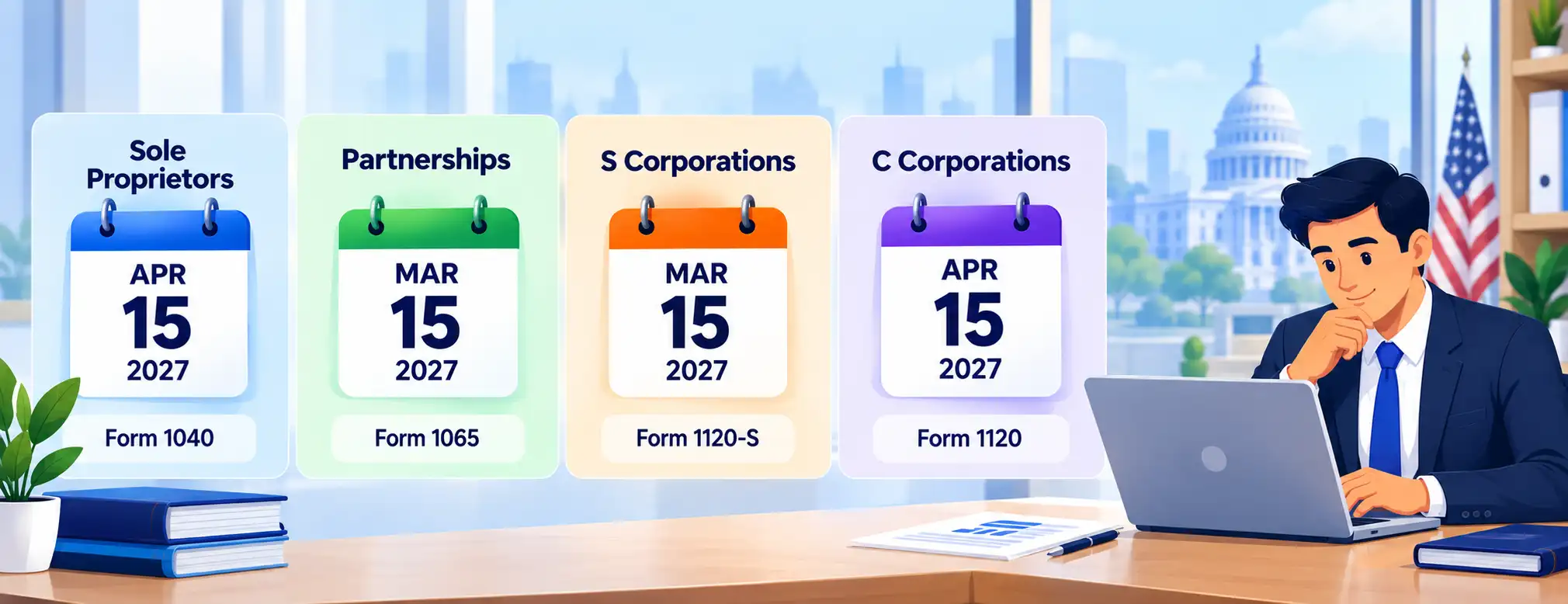
- Sole proprietors, including default single-member LLCs: April 15, 2027 (Form 1040)
- Partnerships, including partnership-taxed multi-member LLCs: March 15, 2027 (Form 1065)
- S corporations: March 15, 2027 (Form 1120-S)
- C corporations: April 15, 2027 (Form 1120)
If you need additional time to file your business tax return, you can generally request an extension from the IRS. For partnerships, S corporations, and C corporations, use Form 7004; for sole proprietors filing individual returns, use Form 4868. Request the extension on or before the original due date. An extension generally provides additional time to file, not additional time to pay taxes owed.
Moreover, if you use a fiscal year for filing taxes, the due date according to business type is generally as follows:
- Sole proprietorships and default single-member LLCs owned by individuals: 15th day of the fourth month after the fiscal year ends.
- Partnerships and S corporations: 15th day of the third month after the fiscal year ends.
- C corporations: Generally, the 15th day of the fourth month after the fiscal year ends. Special transition rules apply to certain June 30 fiscal-year returns, including certain short tax years that began before January 1, 2026. For tax years beginning after December 31, 2025, check the current IRS instructions rather than assuming the historical September 15 deadline applies.
Further, if any of these dates falls on a weekend or applicable legal holiday, the deadline shifts to the next business day. Now, moving forward, let's learn how to stay compliant with U.S. business taxes.
How to Stay Compliant With U.S. Business Taxes?
Here are some tips that will help you stay compliant with U.S. business taxes:
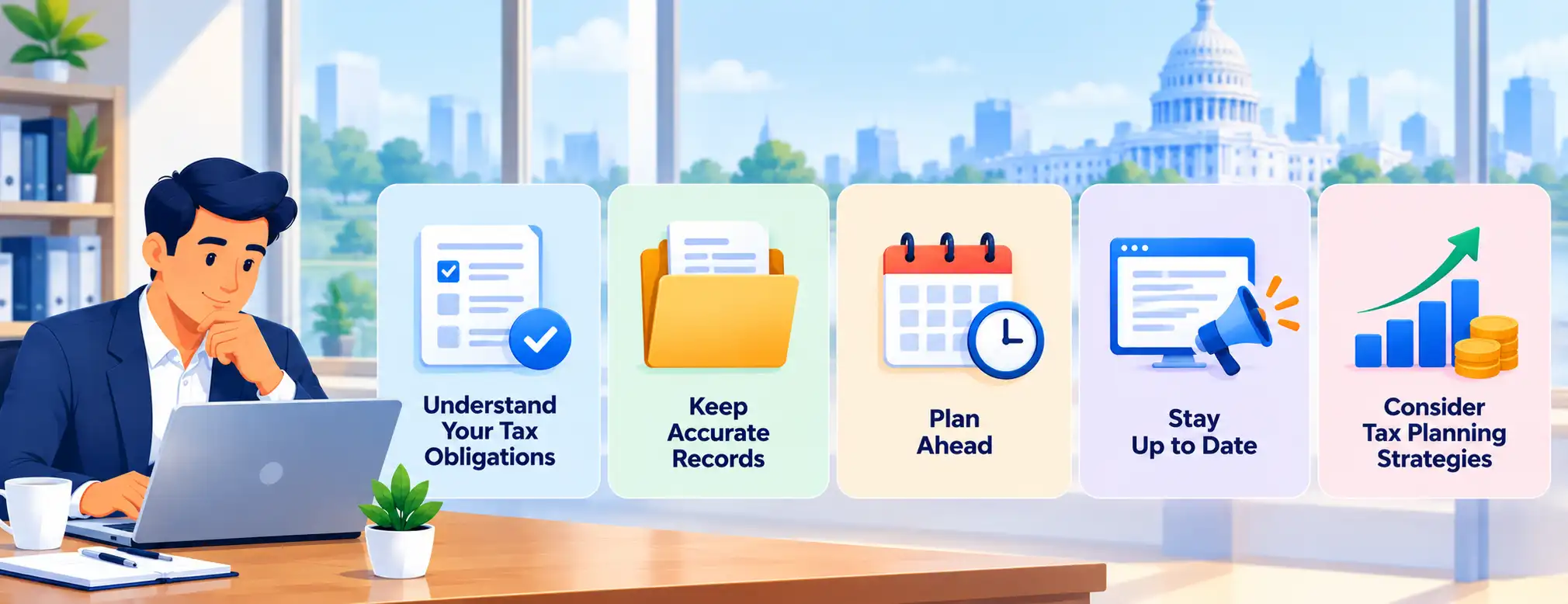
Understand Your Tax Obligations
One of the key mistakes businesses make is not understanding their tax obligations and unknowingly withholding money owed to the IRS. Based on your business structure, determine your tax obligations, when they are due, and the penalties for incomplete or late payments. Also remember that U.S. tax laws can change, so stay up to date.
Keep Accurate Records
For any venture, proper record-keeping is vital. It helps you monitor your business income and expenses, manage payroll taxes, identify tax deductions, and prepare for filing deadlines.
Plan Ahead
When it comes to paying business taxes, plan ahead. Determine your business earnings and expenses for the year to plan your budget accordingly. Also maintain proper records of all your financial transactions; it can help you in case of an audit.
Stay Up to Date
U.S. tax laws change frequently, so staying up to date on the latest tax regulations and policies is important. Check the IRS website periodically for changes or updates. Additionally, consult a tax professional to stay compliant with U.S. tax laws.
Consider Tax Planning Strategies
Tax planning is an essential part of any successful business venture. By optimizing your cash flow, you can simplify the tax process and minimize your tax obligations. For instance, you can utilize eligible tax credits and deductions, invest in research and development, or take advantage of deferral opportunities where permitted.
These are key tips to help you stay compliant with U.S. business tax laws.
At Savetaxs, we provide U.S. businesses with personalized guidance according to their business structure and help them pay taxes on time.
Final Thoughts
Lastly, to understand U.S. business taxes, you first need to understand your business structure. This is because your tax obligations, filing requirements, deadlines, and reporting requirements depend on your business structure. Beyond the federal income tax return, there are several other taxes that may be payable by U.S. businesses. These include self-employment taxes, state and local taxes (SALT), payroll taxes, excise taxes, and sales taxes.
If you are facing issues in understanding your business taxes or managing them, connect with SaveTaxs. Our team of tax experts will provide you with personalized guidance and help you pay your business taxes on time.
Below is a List of Such Common Taxation Forms That a Business is Required to File, Depending on the Type of Business You Own:
Annual Return of Income (Partnerships)
Income Tax
- 1040, US Individual Income Tax Return
- Schedule C (Form 1040), Profit or Loss From Business
- Schedule E ( Form 1040), Supplemental Income and Loss (partnerships)
- 1120, US Corporation Income Tax Return (C Corporations)
- 1120-S, US Income Tax Return for an S corporation
- Schedule K-1 (Form 1120-S) (S corporations)
Estimated Tax
Employment Tax
- 941, Employer's Quarterly Federal Tax Return
- 943, Employee's Annual Federal Tax Return for Agricultural Employees.
- 944, Employer's ANNUAL Federal Tax Return
Social Security, Medicare taxes, and income tax withholding
- W-2, Wage and Tax statements (to employee)
- W-3, Transmittal of Wage and Tax Statements (to the Social Security Administration)
Federal Unemployment (FUTA) Tax
There is a list of all the business tax forms. Either consult a business tax expert or visit the IRS's tax forms and instructions page for clear instructions on which and how to file.

Hatim Dudhiyawala is a Certified Public Accountant (CPA) with SaveTaxs and specializes in Indian and NRI taxation. He advises individuals, NRIs, and businesses on income tax filing, capital gains taxation, DTAA benefits, fund repatriation, and tax compliance. With experience in cross-border tax matters, Hatim helps taxpayers understand complex regulations and make informed decisions. Through his articles, he shares practical insights to help readers stay compliant and manage their tax obligations with confidence. See Full Bio

Frequently Asked Questions
Most businesses, such as partnerships, corporations, and those with employees, need an EIN to file taxes. However, in the case of sole proprietors without employees, they can use their social security number instead.
The Internal Revenue Service (IRS) recognizes various categories such as income taxes, estimated taxes, self-employment taxes, excise taxes, and employment taxes. The business structures determine which one to apply.
C-corporation file form 1120 (US Corporation Income Tax Return). This form reports losses, deductions, gains, and tax credits and calculates the tax liability of the entity at the corporate tax rate.
An S-Corporation files Form 1120-S, which passes deductions, tax credits, and income to the shareholders of the corporation. The business entity does not directly pay income tax; instead, the shareholders report their income on their personal tax returns.
Partnerships file their U.S. taxes through Form 1065 (U.S. Return of Partnership Income). Although the partnership itself does not pay federal income taxes, it does provide a Schedule K-1 to each of its partners, who then use it to report their share of income on their personal tax return.