_1785238921480.webp&w=828&q=75)
Income Tax Latest Updates
ITR filing 2026: Income tax refund in 24 hours? Taxpayer gets money in just a dayITR filing 2026: Income tax refund in 24 hours? Taxpayer gets money in just a day
Written by Shubham Jain

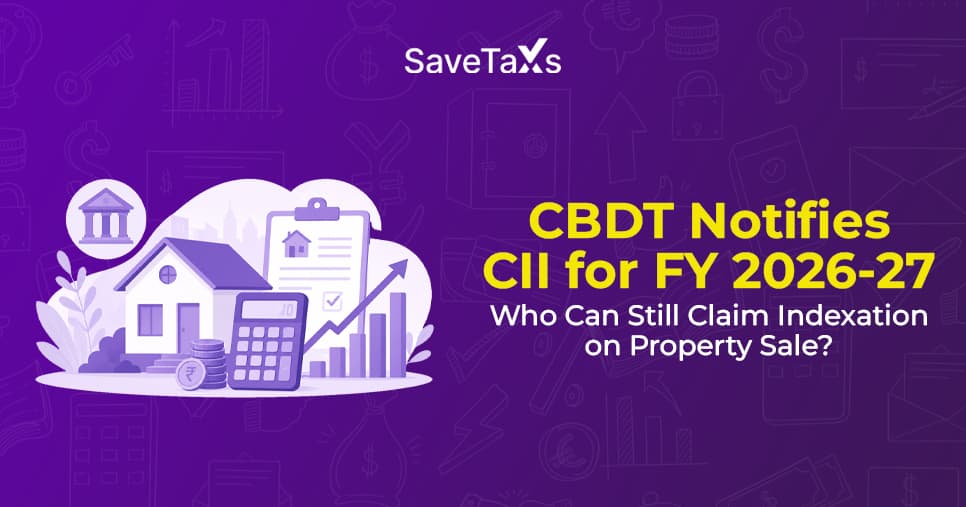
For FY 2026-27, the Central Board of Direct Taxes (CBDT) has announced the Cost Inflation Index (CII) as 384. This number is essential to calculate indexed cost applicable to eligible long-term capital gains.
Despite the changes introduced in Budget 2024 that removed indexation for long-term capital assets in general, a specific group of taxpayers selling certain immovable properties still has the option to choose the old tax regime with indexation if it leads to a lower tax liability. Hence, the annual CII notification remains important for taxpayers planning to sell qualifying properties in FY 2026-27.
The choice between the old and new capital gains tax regimes is limited to certain situations.
According to CA Chandni Anandan, "After Budget 2024, resident individuals and HUFs who sold land or buildings acquired before the stipulated cut-off and transferred on or after 23 July 2024 can benefit from comparing indexation and the lower 12.5% rate, subject to transitional rules."
Taxpayers meeting these transitional provisions can assess their tax obligations under both methods and select the one that minimizes their tax burden. For most other long-term capital assets, the new framework post-Budget applies without the benefit of indexation.
The Cost Inflation Index adjusts the purchase price of an asset to account for inflation, and a higher indexed cost can reduce the taxable capital gain. This will potentially lower the tax owed under the old tax regime.
The decision between the two tax regimes must not be based only on the tax rate.
Anandan said that "It should involve a direct tax calculation, rather than just considering rate differences. If the asset has been held for an extended period and inflation has significantly increased the cost base, indexation may reduce taxable gains enough to compensate for the higher rate. In contrast, for shorter holding periods or limited indexed cost increases, the lower 12.5% rate without indexation could be preferable. "She also said that taxpayers should calculate their tax liability under both methods prior to filing their income tax return.
Indexation typically tends to benefit properties that were purchased many years ago. As inflation increases the indexed acquisition cost over time, the taxable capital gain can be reduced considerably.
She explained that "For instance, if a property was purchased several decades ago and sold today, the indexed cost might be much higher than the original purchase price, which significantly lowers the taxable gain. This is why indexation is usually most beneficial for assets held over extended periods and where the initial purchase price is much less than the current value."
Savetaxs experts can help clear up all the confusion and handle ITR filing for you.
Taxpayers planning to claim indexation must keep all documentation related to the property's purchase and sale. This includes the purchase deed, sale deed, payment receipts, allotment letters, brokerage records, and proof of capital improvements or renovation costs.
For inherited or gifted properties, it's crucial to have documents that verify the previous owner's acquisition date and cost. Property sellers should first confirm if their transaction falls under the transitional rules that still allow for a choice between the two tax regimes before submitting their income tax return.
Anandan advised, "Taxpayers should calculate their tax under both methods and select the more beneficial option. The capital gains must be reported in the appropriate schedule of the ITR while accurately including the sale consideration, acquisition cost, holding details, and any exemption claims. Having all supporting documents organized and ready before filing minimizes the risk of discrepancies or future notices."
This article is for general informational purposes only and does not constitute tax, legal, financial, or investment advice. Laws, regulations, rates, and procedures may change over time and may vary based on individual circumstances.
While SaveTaxs makes reasonable efforts to keep the information accurate and up to date, readers should verify applicable rules with official authorities or consult a qualified professional before making decisions based on this information.
Shubham Jain is the Founder of SaveTaxs and has extensive experience in Indian and NRI taxation. He advises individuals, NRIs, and businesses on tax filing, tax planning, capital gains, DTAA benefits, fund repatriation, and compliance matters. He regularly writes about taxation and related financial topics. His focus is on making complex tax concepts easy to understand. Through his articles, he helps taxpayers stay informed, avoid common mistakes, and stay compliant with Indian tax laws. See Full Bio
Want to read more? Explore Blogs