
NRI Income Tax Compliance
NRI Property Sale Checklist: Documents, TDS & Tax ComplianceNRI Property Sale Checklist: Documents, TDS & Tax Compliance
Written by Shubham Jain

_1767604193.webp&w=3840&q=75)
Cost inflation index (CII) is a number notified by the Income Tax Department of India to estimate inflation. In simpler terms, the CII measures the year-over-year price increases of assets and goods due to inflation. The cost inflation index for FY 2025-26 is estimated at 376.
In this blog, we will discuss everything related to the cost inflation index (CII), including a CII table from FY 20001=01 to 2025-26, how CII is used in income tax, and more.
A Cost Inflation Index table is used to estimate the long-term capital gain from the sale or transfer of capital assets. Capital gain is the profit earned from transferring or selling any capital assets such as stock, property, land, patents, trademarks, or others.
In the accounting books, long-term assets are recorded at their cost. Hence, despite growing asset prices, these capital assets cannot be revalued.
When capital assets are sold, the gain generated is generally higher than the acquisition price. This enables the assessee to pay higher income tax on the profits from the sale of these assets.
The cost inflation index application for capital gains ends up adjusting the asset's purchase price based on the price at which it is sold. This results in lower earnings and a much lower tax burden.
The following table shows the cost inflation index (CII) from 2001-02 to 2025-26.
| The Financial Year | Cost Inflation Index (CII) |
|---|---|
| 2001-02 ( Base year) | 100 |
| 2002-03 | 105 |
| 2003-04 | 109 |
| 2004-05 | 113 |
| 2005-06 | 117 |
| 2006-07 | 122 |
| 2007-08 | 129 |
| 2008-09 | 137 |
| 2009-10 | 148 |
| 2010-11 | 167 |
| 2011-12 | 184 |
| 2012-13 | 200 |
| 2013-14 | 220 |
| 2014-15 | 240 |
| 2015-16 | 254 |
| 2016-17 | 264 |
| 2017-18 | 272 |
| 2018-19 | 280 |
| 2019-20 | 289 |
| 2020-21 | 301 |
| 2021-22 | 317 |
| 2022-23 | 331 |
| 2023-24 | 348 |
| 2024-25 | 363 |
| 2025-26 | 376 |
As aforementioned that the long-term capital assets are documented in the accounting books at cost price. Meaning, despite the rising inflation, they are existing at a cost price and cannot be revised. Now, when these capital assets are sold, the gain, or profit, is high because the sale prices are higher than the purchase prices. This results in the assessee paying higher income tax.
The CII is applied to long-term capital assets, thereby increasing their purchase cost, which results in lesser profits, ultimately lowering taxes and benefiting taxpayers.
The first year in the cost inflation index table is known as the base year and has a CII value of 100. The index for all other fiscal years is compared to the base year to estimate the increase in the inflation rate.
For any capital assets purchased before the base year of the CII, the taxpayer may use whichever is higher for the purchase price, the "fair market value," or the "actual cost," as of the first day of the base year. Ensure that the indexation benefit is applied to the purchase price, so that the calculated fair market value is based on the valuation report for a registered value.
Savetaxs offer end-to-end expert assistance with filing NRI income tax returns.
The cost inflation index is calculated to compare the prices to the inflation rate. In a nutshell, a percentage increase in the inflation rate over the year will lead to prices rising.
The central government of India evaluates the cost inflation index by notifying it in the official gazette.
CII 71% of the average rise in the consumer price index * ( urban ) for the immediately preceding year.
Please note that the consumer price index compares the current prices of goods and services (which reflect the economy) with the cost of the same basket of goods and services in the last year to calculate the percentage change in prices.
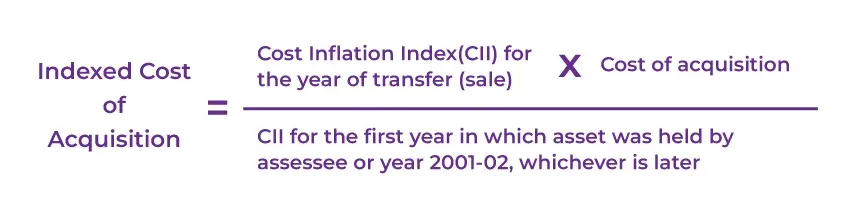
When the indexation benefits are applied to the purchase prices or the cost of acquisition of the capital assets, it becomes an "Indexed Cost Of Acquisition".
Indexed Cost Of Acquisition = Cost inflation index for the year of transaction (sale) * Cost of acquisition / CII for the year in which the assets were held by the assessee or year 2001-02, whichever is later.
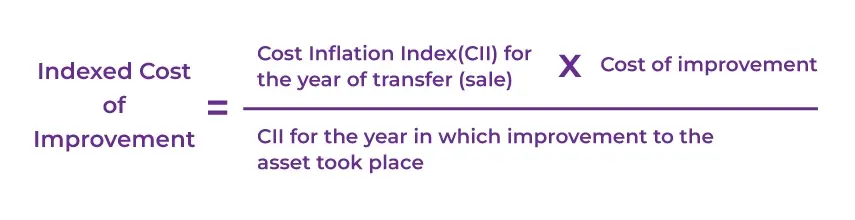
Indexed Cost of improvement = cost inflation index ( CII) for he year of transfer (sale) * Cost of improvement / CII for the year in which the improvement to the assets took place.
Case 1: Mr. Rahul purchased a flat in FY 2001-02 for Rs 10,00,000. He sells the flat in FY 2017-18. What will be the calculated indexed cost of acquisition?
In this case, the CII for the years 2001-02 and 2017-18 is 100 and 272. Hence, the indexed acquisition will be 10,00,000 * 272/100 = Rs 27,20,000.
Case 2: Mrs. Apeksha has purchased the capital assets in FY 1995-1996 for Rs 2,00,000. The fair market value of the capital asset on April 1st, 2001, was Rs 3,20,000. Then, she sells the assets in the FY 2016-17. What will be the estimated cost of acquisitions?
In this case, the capital asset is purchased before the base year.
The cost of acquisition = the higher of the actual cost or FMV on 1st April 2001, i.e., cost of acquisition = Rs 3,20,000.
The CII for the years 2001-02 and 2016-17 is 100 and 264, respectively. Here, the indexed cost of acquisition is 3,20,000 * 264/100 = Rs 8,44,800.
Case 3: Miss Sharmila has purchased equity shares for Rs 1,00,000 on 1st March 2015 and then sells the shares on 1st April 2020. What will be the indexed cost of acquisition?
Here, the CII for the year of purchase, FY 2014-15, is 240, and for the year of sale, 2020-21, is 301.
Hence, the indexed cost of acquisition for the purchased equity shares will be Rs 1,00,000 * 301/240 = Rs 1,25,416.
Manage cross-border taxes easily with Savetaxs’ expert support.
The cost inflation index CII lets the taxpayer adjust the purchase price of the assets for inflation, resulting in a more accurate capital gains tax calculation. The CII helps change the acquisition prices of long-term assets to account for inflation and ensure taxation is fair.
Hence, you will be taxed on the real gain and not on the inflated amount. This is why understanding the use case for cost indexation is essential, as it can lower your taxable income from asset sales, especially when you have held the assets for many years.
As an NRI, if you need any professional assistance with cost indexation and capital assest management in India, Savetaxs is the name to trust. We have been helping NRIs for 90+ years, managing their capital assets in India and filing their taxes.
Connect with us as we serve our clients 24/7 across all time zones.
This article is for general informational purposes only and does not constitute tax, legal, financial, or investment advice. Laws, regulations, rates, and procedures may change over time and may vary based on individual circumstances.
While SaveTaxs makes reasonable efforts to keep the information accurate and up to date, readers should verify applicable rules with official authorities or consult a qualified professional before making decisions based on this information.
Vipul Jain is the Co-Founder of SaveTaxs and a tax expert with experience in Indian and NRI taxation. He advises individuals, NRIs, and businesses on tax filing, tax planning, capital gains, DTAA, and compliance matters. He focuses on making complex tax concepts simple and helping taxpayers make informed, compliant decisions. See Full Bio
Want to read more? Explore Blogs