_1785238921480.webp&w=828&q=75)
Income Tax Latest Updates
ITR filing 2026: Income tax refund in 24 hours? Taxpayer gets money in just a dayITR filing 2026: Income tax refund in 24 hours? Taxpayer gets money in just a day
Written by Shubham Jain

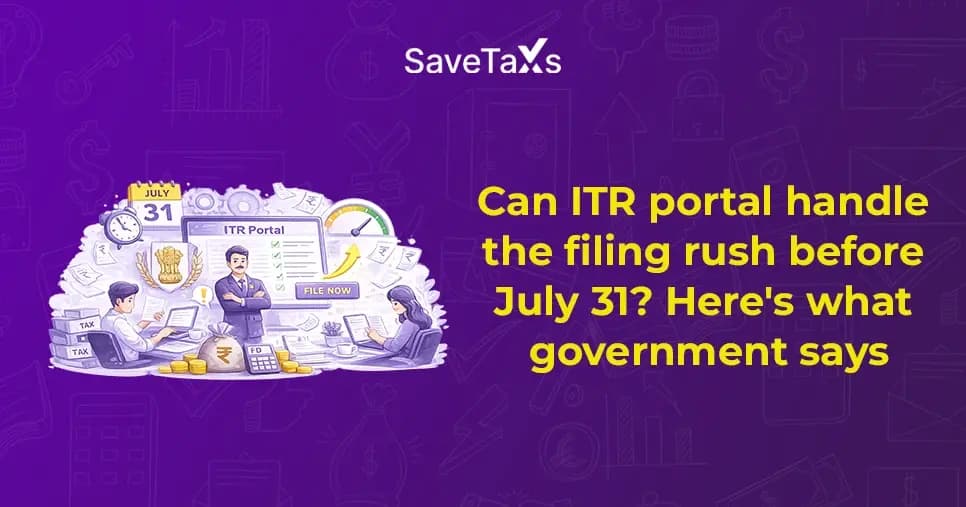
As the July 31 income tax return (ITR) filing deadline approaches, many taxpayers have expressed concerns about slow logins and delayed responses on the Income Tax Department's e-filing portal. With a large number of individuals hurrying to file their returns, the government has explained its efforts to maintain the system's smooth functionality.
In a written response presented in Parliament, the government said that while some users might experience occasional delays during peak traffic times, the portal has generally remained stable despite a notable rise in the number of taxpayers using the service this year.
According to Minister of State for Finance Pankaj Chaudhary, activity on the e-filing portal has significantly increased during the current filing season. Between the 8th and 14th of July, daily ITR filings more than doubled compared to the same timeframe last year on several occasions.
On July 14 alone, approximately 12.22 lakh income tax returns were submitted, and the portal recorded nearly 99 lakh logins in one day, as reported by the Economic Times. The government also said that this surge reflects both improved compliance and a growing total of taxpayers using the online filing system.
The Central Board of Direct Taxes (CBDT) has enhanced the infrastructure of the e-filing portal to avoid disruptions during this busy filing period.
The portal has been performance-tested, and now it can process nearly one crore income tax returns in a single day, according to the government. During this high-traffic season, the CBDT has also raised the calculating capacity, storage, memory, network bandwidth, and overall system resources to ensure a smooth process.
To enhance the portal's reliability and user experience, multiple measures have been enacted, as informed by the Minister to Parliament. These improvements include increasing computing power, network capacity and storage, upgrading the portal to support significantly higher filing volumes, and also addressing major technical issues that created difficulties for taxpayers in previous filing seasons.
To quickly identify and resolve technical issues, the CBDT has also introduced continuous infrastructure monitoring and launched a dedicated War Room.
Additionally, cybersecurity measures have been strengthened with updated firewalls, better defense against cyber and bot attacks, and increased monitoring during peak filing periods. The government stated that it has collaborated closely with organizations such as UIDAI, RBI, banks, ICAI, NSDL, and e-return intermediaries to ensure consistent services without any interruption throughout the filing season.
The Minister also disclosed to Parliament that the managed service provider (MSP) responsible for developing and maintaining the Income Tax Department's e-filing portal has been subject to financial penalties under its contract.
The government noted that penalties were imposed due to delays in delivering the Income Tax Business Application (IEC 2.0) project, instances where the ITR filing deadlines had to be extended because of the issues linked to the service provider, failing to meet agreed-upon service level standards during multiple assessment periods, and application outages during the FY 2025-26 peak filing season.
Experts continue to advise against waiting until the final days to file tax returns despite the government assuring that the portal is now better equipped to handle increased traffic. Filing early will not only help avoid the risk of last-minute technical difficulties but also allow time to rectify errors, handle any notices, and receive refunds more quickly.
Taxpayers who have yet to file their returns may find it safer to complete the process well ahead of the final surge, as only a few days remain before the July 31 deadline.
The majority of people using the e-filing portal are NRIs (Non-Resident Indians), and a lot of them face different problems apart from the usual slow-portal issue.
Many NRIs face login and password issues because the OTP is sent to an old, inactive Indian mobile number linked to their Aadhaar. To fix this, the tax department allows NRIs without an active Indian number to receive verification OTPs via their registered email address, or they can register manually by emailing their PAN, mobile number, and scanned copies of their passport and employment letter to [email protected]. Additionally, NRIs do not need an Aadhaar card to register on the e-filing portal; they only need to provide their PAN, name, date of birth, mobile number, and email.
Some NRIs receive an 'Access Denied' error when verifying Indian bank accounts via net banking, despite the bank confirming the PAN link. To fix this, taxpayers can file their return offline using the Excel utility, which processes bank details through an alternative verification method.
Alternatively, choosing the electronic verification code (EVC) method allows the required code to be sent directly to the mobile number and email linked to the bank account instead of the portal credentials.
NRIs cannot use the simplest form, ITR-1, regardless of how basic their income is, because it is strictly reserved for Indian residents. Instead, NRIs must file using ITR-2 or ITR-3 if they earn business or freelance income from India. Once filed, the return must be verified within 30 days to be considered valid.
This can be done via Aadhaar OTP, net banking EVC, or by physically mailing a signed ITR-V form to the central tax office in Bengaluru.
Extra Help Before the Deadline: The department has announced that from July 25 to July 31 this year, their helpline will work 24 hours a day to help with any last-minute queries.
According to the experts, NRIs should file even earlier than other taxpayers as sorting out a login or verification problem can itself take a few days and they may have to deal with additional issues like time-zone differences, OTP delays, and bank verification issues.
This article is for general informational purposes only and does not constitute tax, legal, financial, or investment advice. Laws, regulations, rates, and procedures may change over time and may vary based on individual circumstances.
While SaveTaxs makes reasonable efforts to keep the information accurate and up to date, readers should verify applicable rules with official authorities or consult a qualified professional before making decisions based on this information.
Shubham Jain is the Founder of SaveTaxs and has extensive experience in Indian and NRI taxation. He advises individuals, NRIs, and businesses on tax filing, tax planning, capital gains, DTAA benefits, fund repatriation, and compliance matters. He regularly writes about taxation and related financial topics. His focus is on making complex tax concepts easy to understand. Through his articles, he helps taxpayers stay informed, avoid common mistakes, and stay compliant with Indian tax laws. See Full Bio
Want to read more? Explore Blogs