


Business Setup
Difference Between a LLP and a Partnership FirmDifference Between a LLP and a Partnership Firm
Written by Vipul Jain
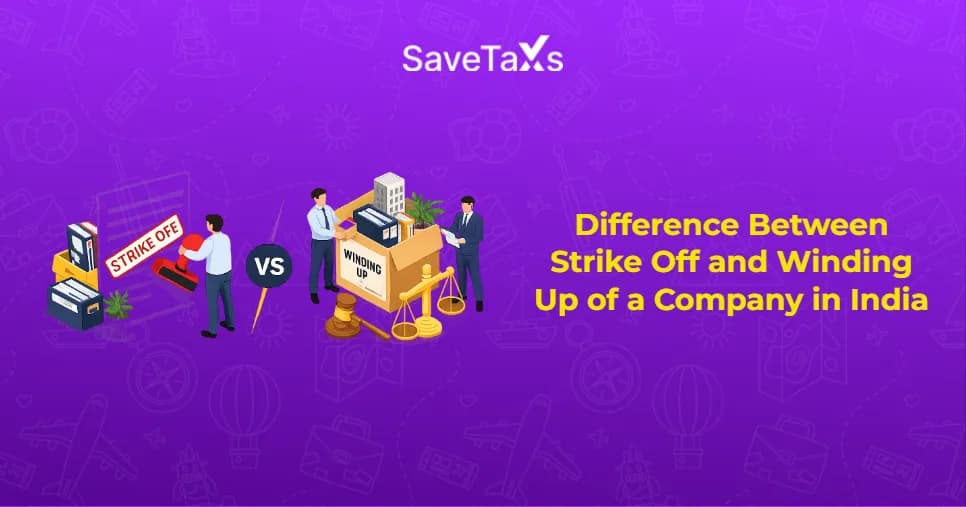
When a company decides to close down its operations, it needs to follow a legal procedure. It can be carried out through strike off and winding up. While both result in closing up, the key difference between strike off and winding up of a company is their procedure, intention, consequences, cost, and timeline.
Before closing down the business, directors, business owners, legal advisors, and accountants need to understand the key difference between the two methods. It helps in selecting the right closing process.
To help you out in this, the blog provides complete information about both the methods, key differences, and how to choose the right one as per your situation. So read the blog and gather all the information.
Strike off refers to a legal process of removing the name of the company from the Registrar of Companies (ROC) register. It generally applies to inactive companies with no assets, liabilities, or business activity. It is a simple, less costly, and quicker closure method used mainly for non-operational or dormant companies. Further, the process can be initiated:
For an NRI company founder in India, it is often a preferred route when:
With Savetaxs, fulfill your tax obligations on time without any hassle.
Key features of striking off a company include:
A company can apply for voluntary strike off if it fulfills the following requirements:
This was a complete overview of the strike off of a company. Moving ahead, let's now know about the winding up of a company.
Winding up is also known as company liquidation. It is the process of closing a company by selling its assets and settling its liabilities. Considering this, it applies to companies that have assets, ongoing operations, or debts. In India, the winding up of a company is primarily governed by the Insolvency and Bankruptcy Code, 2016 (IBC).
Under the current legal framework, winding up broadly takes place either through voluntary liquidation under the Insolvency and Bankruptcy Code, 2016, or winding up by the National Company Law Tribunal (NCLT) under the Companies Act, 2013.
Under section 59 of the IBC, solvent companies can opt for voluntary liquidation. Additionally, in certain circumstances, the winding up of a company may be governed by the National Company Law Tribunal (NCLT).
Under the Companies Act 2013, there are two ways for winding up a company, i.e.,
Here are the key features of winding up a company:
This was all about the winding up of a company. Moving further, let's see how both methods are different from each other.
The table below showcases the key differences between strike off and winding up of a company:
| Criteria | Strike Off of a Company | Winding Up of a Company |
|---|---|---|
| Meaning | Removal of the name of a company from the ROC register. | Legal liquidation, including the sale of assets and debt settlement. |
| Legal Provision | Section 248 of the Companies Act 2013. | Section 59 of the IBC 2016 & Section 271 of the Companies Act 2013. |
| Applies to | Inactive companies with zero liabilities and obligations. | Companies with operations, assets, or debts. |
| Initiated by | By the company itself or by the ROC. |
Initiated by shareholders/ directors (voluntary) or NCLT (compulsory)
|
| Authority | Registrar of Companies (ROC) | NCLT and licensed liquidator. |
| Involvement of Creditors | Not required. | Required in insolvent cases. |
| Debt Settlement | Not required. | Mandatory before company dissolution. |
| Appointment of Liquidator | Not needed. | Required during the winding-up process. |
| Asset Distribution | Not applicable. | Assets sold and profits distributed to shareholders and creditors. |
| Status of the Company During Process | Exists on record but is inactive. | Until dissolution, it exists only for liquidation purposes. |
| Public Notice | Notice by the ROC in the MCA portal and the Gazette. | Gazette Notification and stakeholder communication. |
| Procedure | Application in Form STK-2 to ROC. | Lengthy process including tribunal, liquidator, and creditors. |
| Timeline | 3 to 6 months. | Depending on complexity, 6 months to 2 years or more. |
| Costs | Low (minimal government and professional fees). | High (legal, liquidation, and professional fees). |
| Restoration | Under section 252, a company can be revived from a struck-off process within 20 years. | After dissolution, revival of a winding-up company is not possible. |
The comparison table above clearly states that the practical strike off vs winding up depends on the business operations, assets, and debts of a company. Now, moving forward, let's know winding up vs strike off, which closing up option is better.
The right option between striking off and winding up completely depends on the financial position and activity level of the company.
Choose the method that perfectly aligns with the financial status, operations, and legal obligations of the company. Further, consider taking the help of professionals to close your company legally, without any penalties and hassle.
Now, moving ahead, let's know if a company can be restored after winding up or striking off.
Yes, a struck-off company can be restored, but not a wind-up company. To restore a struck-off company, directors, shareholders, or creditors need to file a legal application with the NCLT. Under section 252 of the Companies Act 2013, a company can be restored if, during the strike off, it was conducting fair business or held assets.
Considering this, the NCLT may approve the restoration application. However, for this, the company has to prove that it was carrying on business, had proper operational reasons to continue, or owned assets.
In many cases, within three years from the strike-off date, the company, its shareholders, or creditors need to file a restoration application. Further, the tribunal may permit other aggrieved individuals to apply for restoration within 20 years from the strike-off date.
Once the company has done the winding-up process and the final dissolution order has been issued by the tribunal, you cannot restore a company. Then, under the corporate law, the company ceases to exist permanently.
So, from the above information, it is clear that a struck-off company can be restored, but not a wind-up company. Moving further, let's know the common mistakes to avoid before winding up or striking off a company.
Connect with Savetaxs and let our experts help you in choosing between winding up and the strike off method.
Many directors unknowingly make avoidable mistakes that further complicate or delay the process. To help you out, the most common mistakes and their solutions are as follows:
Further, consider the above-mentioned points and try to avoid all these mistakes. For accurate results and an easy company closure process, consider taking help from professionals.
Lastly, closing a company needs correct documentation, proper legal procedures, and updated compliance filings. In this understanding, the difference between strike off and winding up helps in choosing the right closure method. The wind-up compared to strike off is a little complex, as it involves settling debts. In contrast strike process is quite easy as it only includes the removal of the name of the company from the list of Registrar of Companies.
Further, even small errors in indemnity bonds or affidavits can lead to rejection, but with Savetaxs, you do not need to worry about this. We provide end-to-end assistance to our clients and ensure you close your company without any hassle. From choosing the right closure method as per the company's situation to coordinating with licensed professionals, we handle all.
This article is for general informational purposes only and does not constitute tax, legal, financial, or investment advice. Laws, regulations, rates, and procedures may change over time and may vary based on individual circumstances.
While SaveTaxs makes reasonable efforts to keep the information accurate and up to date, readers should verify applicable rules with official authorities or consult a qualified professional before making decisions based on this information.
Vipul Jain is the Co-Founder of SaveTaxs and a tax expert with experience in Indian and NRI taxation. He advises individuals, NRIs, and businesses on tax filing, tax planning, capital gains, DTAA, and compliance matters. He focuses on making complex tax concepts simple and helping taxpayers make informed, compliant decisions. See Full Bio

Want to read more? Explore Blogs
_1780491123033.webp&w=828&q=75)
_1778757638178.webp&w=828&q=75)