Operating a company in India is both exciting and challenging. However, when challenges are not managed effectively, they result in revenue losses, operational issues, and the need to shut down the company. To close a company in India, there are two ways: striking off or winding up. These two ways are unique and significantly different, which often confuses business owners.
In this guide, we will cover how to close a company in India as an NRI, the documentation required, the step-by-step process, the methods to close a in India and more.
Key Takeaways
- The voluntary strike-off method of closure is best for inactive dormant companies having no assets or liabilities.
- Voluntary liquidation under IBC Section 59 is necessary for solvent companies that have assets and liabilities, are active, and require a formal settlement, and are capable of paying their debts in full, supported by a declaration of solvency, audited financial statements, and required approvals from shareholders and creditors (if any).
- Compulsory winding up or striking off is initiated by the ROC for non-compliance, while compulsory winding up is handled by the NCLT, ultimately leading to the director's disqualification, which may arise separately due to prolonged non-filing of returns under the Companies Act.
- A voluntary strike-off takes around 3-6 months, whereas a voluntary liquidation takes around 6-12 months.
- Some of the major reasons for closing a company involve strategic restructuring, financial reconciliation, finalizing the adjustments, asset assessment, data backup and archiving, resetting the strategy, and final review and compliance.
Understanding Company Closure In India
When it comes to closing a company in India as an NRI, there are two legal processes for dissolving a company, namely winding up and striking off. We will understand both processes in the latter part of the blog. However, once the company has completed the closure process, it will cease to exist as a legal entity. Meaning the company can't carry out any business operation, and its name will be removed from the Registrar of Companies (ROC).
Furthermore, for NRIs, the intent to close a company in India shall align with their regulatory provisions. NRIs must ensure that, before the company's dissolution, liabilities are settled, and all compliance requirements are fulfilled.
Modes To Close A Company In India as an NRI
As mentioned in the blog, there are two primary methods for closing a company in India.
The following table demonstrates it:
| Method |
Ideal For |
Time Taken |
Cost |
Governing Law |
| Strike Off |
It is ideal for small companies with little to no assets and liabilities. |
3-6 Months |
Low Cost |
Section 248, Companies Act 2013. |
| Winding Up / Liquidation Of The Company |
It is ideal for large companies with assets, liabilities, or disputes. |
6-24 months. |
High Cost |
Insolvency and Bankruptcy Code, 2016 or Companies Act, 2013 (through NCLT), depending on the nature of closure. |
File Your NRI Business Taxes
Savetaxs helps NRIs file their NRI business taxes hassle-free with expert guidance.
Step-by-Step Process To Close A Company In India As An NRI
Both the strike-off and winding-up process in India requires a legal and formal procedure to be followed.
The following is a detailed overview of the winding-up process and strike process. However, NRIs are strongly advised to seek assistance from a CA to ensure seamless execution of the process and 100% cross-border compliance.
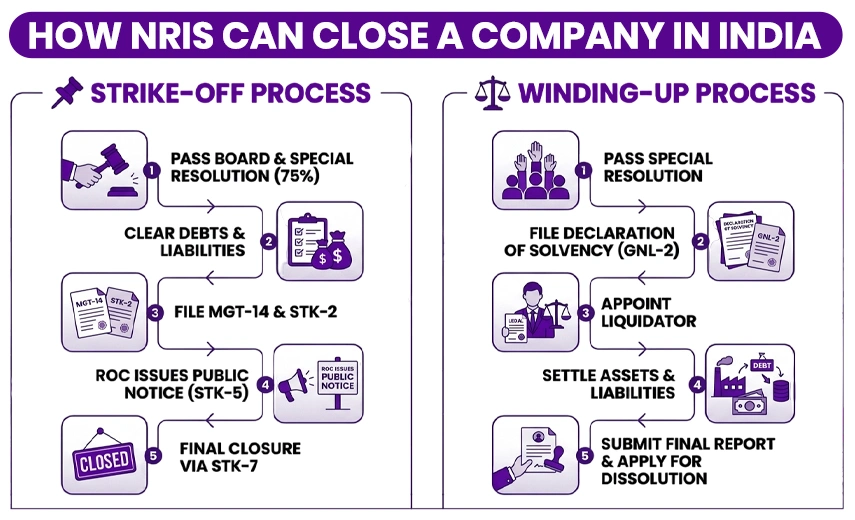
Steps On How To Close A Registered Company By Strike Off
- Board Resolution: First, the company's director needs to pass a board resolution approving the company's strike-off.
- Clear Debts & Liabilities: Up next, the company shall settle all debts and liabilities to acknowledge that it has no liabilities due and is financially free from all obligations.
- Special Resolution: Once all debts and liabilities are settled, it is essential to pass a special resolution at the Extraordinary General Meeting (EGM). Here, 75% of the shareholders shall agree to pass the resolutions and proceed with the strike-off procedure.
- MGT-14: Companies are required to file MGT-14 within 30 days only if a special resolution is passed for the strike-off.
- Filing of STK-2: Companies are now required to file STK-2, an e-Form for striking off their names. The form encapsulates multiple details about the entity that must be submitted.
- STK-5: As the application proceeds, the Registrar of Companies will publish a notice in the official gazette and in two other newspapers. Furthermore, it is important for the ROC to publish its decision so that the company can raise any objections. The public is given 30 days to raise an objection, and at the end of this period, the procedures proceed.
- STK-7 (The Final Notice): If there are no public objections, the ROC will issue STK-7 the final notice. This notice will again be published in the official gazette and on the MCA website, and, lastly, the company will cease to exist on the date of publication of this notice.
Steps On How To Close A Registered Company By Winding Up
- Passing The Special Resolution: The process of winding up begins with passing a special resolution, which also includes a proposal to close the company at the General meeting. To proceed with further steps of winding up a company, the proposal must be accepted by three-fourths of the members.
- Solvency Declaration: The director will assess the company's financial health and its ability to pay its outstanding debts and liabilities. If the company is solvent, the directors must file a declaration of solvency with the ROC using Form GNL-2, confirming that the company can pay its debts in full and has not defaulted.
- Liquidator Appointment: After the declaration of solvency is made, the company's members will appoint a liquidator, who will then settle and manage the company's debts and assets and govern the winding-up procedure.
- Notice Of Liquidator Appointment: After appointing the liquidator, it is mandatory to publish the notice in the official gazette and file it with the registrar. The process shall be followed in the next 14 days of the liquidator's appointment.
- Settlement of Debts: The liquidator will then take control of the winding-up procedure, including the recording and management of assets to pay off debts. Now, if the liquidator finds that the company is unable to pay its debts, the liquidator will arrange a creditors' meeting to plan the next steps and decisions.
- Annual General Meeting (If Needed): In a winding-up situation, if the entire procedure takes more than a year to settle matters, it is the liquidator's responsibility to arrange an AGM (Annual General Meeting) of the shareholders. If the process extends beyond one year, the liquidator must continue reporting progress and ensure compliance with regulatory requirements as per IBC and IBBI regulations, without requiring court approval to extend the winding-up procedure.
- Final Report & Meetings: Once the assets and liabilities are fully settled, the liquidator must call a final meeting to present the final accounts, highlighting the distribution of assets and the liquidation procedure.
- Company Dissolution: After presenting the financial accounts, the company must apply to the ROC for dissolution. Once the ROC approves the application, the company will be removed from the ROC list and dissolved.
Documents Needed To Close A Company
As we know, there are two methods for closing a company: strike-off and winding-up. Now, depending on the method you have chosen, the documentation list varies.
The following is an indicative list required by NRI to close a company in India.
Documents Required For Strike Off:
- A copy of the board resolution, along with the approval of the company's strike off.
- Copy of Special Resolution passed by the shareholders and members of the company to strike it off.
- Affidavit in STK-4. The affidavit must be signed by all the directors.
- Indemnity Bond in STK-3, by all the directors of the company.
- Closure letter of the bank account.
- STK-8, the accountant's statement that is not older than 30 days from the date of application.
- PAN, AOA, and MOA of the company.
Documents Required For Winding Up
- Form 26, this form includes the special resolution as proof of the company's winding-up decision.
- A declaration of solvency filed through Form GNL-2, indicating the ability of the company to pay its debt.
- The consent of the insolvency professional acting as liquidator to proceed with the winding-up process.
- The notice about the winding up of a company in the official gazette.
- Public announcement of liquidation.
- The notice about the liquidator's appointment in the official gazette.
- The liquidator's report about the outline of the company's winding-up plan.
- Final liquidation reports and accounts submitted to the ROC and IBBI.
- MOA, AOA, & PAN of the company.
Taxation & Regulatory Compliance For NRIs
Before the company is dissolved, all the tax obligations must be filed. This includes.
- Filing of income tax returns and ensuring settlement of all tax dues.
- Clearing the GST dues (if applicable).
- Ensuring proper tax compliance through filing of income tax returns, settlement of dues, and obtaining necessary certifications such as Form 145/146 for fund repatriation.
Furthermore, NRIs must consider international tax implications, especially if they plan to repatriate funds to their country of residence.
NRIs shall ensure that end-to-end compliance with the Foreign Exchange Management Act is critical when foreign investments are involved. In a nutshell, to close a company in India, as an NRI, proper reporting and documentation are essential.
Challenges NRI Face While Closing A Company
The process for NRIs closing a company in India presents unique challenges, particularly due to cross-border considerations.
- Physical Presence Constraints: NRIs might find it difficult to be physically present in India for verification and document processes.
- Documentation Complexity: International documentation requirements add the complexity of apostille and notarization.
- Regulatory Compliance: Navigating Indian laws alongside foreign exchange regulations requires careful coordination.
- Communication Gaps: For NRIs, time zone differences and remote communication can definitely slow down the entire process. Henceforth, it is advisable to address these challenges with professional assistance to ensure smoother execution.
What Are The Consequences Of Not Closing A Company Properly
It creates a set of compounding procedures when you leave a defunct company on the register without formally closing it.
- Continuous Compliance Obligations: Generally, the annual return and the financial statement filing remain due every year. Missing these filings incurs a fee of Rs 100 per day, and there is no upper limit on the accumulation.
- Director Disqualification: In regard to section 164(2) of the Companies Act, a director of a company that hasn't filed any returns or the financial statements of the company for three consecutive years is disqualified from being a director in any company for five years. This disqualification is automatic and affects all the companies the person directs, and not just the defaulting one.
- Penalty Notices From ROC: The Registrar of Companies periodically issues the strike-off notice to non-compliant companies. Under section 248(1), if the ROC has struck off your company involuntarily, you will lose the ability to control the process and may find that the assets weren't distributed properly before the strike off. This may create personal liability for the directors in cases involving fraud, misconduct, or improper handling of company assets prior to strike-off
- Difficulty in Obtaining New Registrations: Government portals, banks, and compliance filings generally verify the director's DIN status. A disqualified DIN has many channels for a director to incorporate a new company and take up directorships.
The Bottom Line
Closing a company in India as an NRI requires following either a structured process of strike-off or winding-up. Let us take a summarised look at the process.
| Method |
Key Steps |
Purpose |
| Strike Off |
Board resolutions - Clear the debts - Special Resolution - MGT-14 - STK -2 - STK-5 - STK-7 |
It removes the company's name from the ROC register, which is ideal for small, debt-free companie |
| Winding Up |
Special resolution - Solvency declaration - Appointment of the liquidator - Settle Debts - Final Report & Meetings - ROC dissolution. |
Clear the company's assets and liabilities, ideal for large companies or those with complex debt. |
Both of these methods will legally cease business operations; however, the winding-up procedure provides a more detailed closure. This is because winding up addresses all the company's financial obligations, whereas striking off is a fast and simple process for smaller companies.
As an NRI, if you are planning to strike off or wind up your company in India and are seeking professional assistance, Savetaxs is the name to trust. Our CA experts provide end-to-end consultation on the entire procedure of closing down a company. From guidance on passing the special resolution to clearing liabilities and debts, filing form MGT-14, STK-2, STK-5, and STK, respectively, for the strike-off process.
Furthermore, the experts provide consultation on the passing of special resolutions in the winding-up process, from declaring solvency to appointing liquidators, settling debts, and more. Our experts ensure you have a seamless company closing-down experience.
Connect with us as we help our clients 24/7 across all time zones.



_1780491123033.webp&w=828&q=75)
_1778757638178.webp&w=828&q=75)