


Business Setup
Difference Between a LLP and a Partnership FirmDifference Between a LLP and a Partnership Firm
Written by Vipul Jain
The winding up or liquidation of a company is the formal process through which it concludes its operations and dissolves. The process includes closing the company's operations and affairs, such as settling debts with the proceeds, selling assets, and distributing the remaining surplus to shareholders. Once the winding up of a company or corporation is complete, it is dissolved and ceases to exist. Hereon, the company ceases to exist, marking the end of its existence in the market through a legal procedure.
The Companies Act 2013 provides a detailed framework for the winding up of a company. In this blog, we will understand the winding-up process of a company in India for residents and NRIs, including the required documentation, legal considerations for NRIs, the process timeline, and more.
As stated in the Companies Act 2013, Section 2(94A), the term "winding up" means winding up under this Act or liquidation under the Insolvency and Bankruptcy Code, 2016. Another way to close a company in India is to undergo liquidation under the Insolvency and Bankruptcy Code, 2016. In this process, the business must cease its regular operations, liquidate assets, and settle debts, ultimately leading to the company's dissolution.
However, during the winding-up process until the company is completely dissolved, its legal entity is maintained, allowing it to participate in legal proceedings before a Tribunal.
In a nutshell, the objective of winding up a process is to ensure the systematic closure and distribution of the company's assets.
With respect to the Companies Act 2013, as amended by the Companies Amendment Act 2017 and the Insolvency and Bankruptcy Code 2016, there are two primary methods for winding up a company. These methods replace the early classification of multiple types.
Here, the National Company Law Tribunal (NCLT) initiates this mode. This generally happens when the company cannot pay its debts, violates legal requirements, or when it is considered just and equitable to close down. In this type of winding-up process, the Tribunal appoints a liquidator who manages the entire process, including paying creditors, distributing any surplus to shareholders, or selling assets.
This type generally occurs when the company's members voluntarily decide to wind up the company's operations. It is a self-initiated process that begins with the company passing a special resolution at the general meeting and is governed by the Insolvency and Bankruptcy Code, 2016, without direct Tribunal intervention except for final dissolution.
Note: Under the current legal framework, earlier forms, such as members' voluntary winding up, creditors' voluntary winding up, and court-supervised winding up, are no longer applicable.
Now that we have understood the updated types of winding-up processes, let us go into the details and understand the procedures for each.
Savetaxs provides end-to-end assistance in NRI ITR Filing.
As noted above, the process of voluntary winding up a company is initiated by the company's members and does not require the court's direct intervention. The Voluntary winding process commences under two primary conditions.
Under India's Insolvency and Bankruptcy Code, 2016 (IBC), voluntary liquidation enables solvent companies to wind up their operations in an orderly manner by distributing their assets to stakeholders. The following are the steps for a structure and a compliance process.
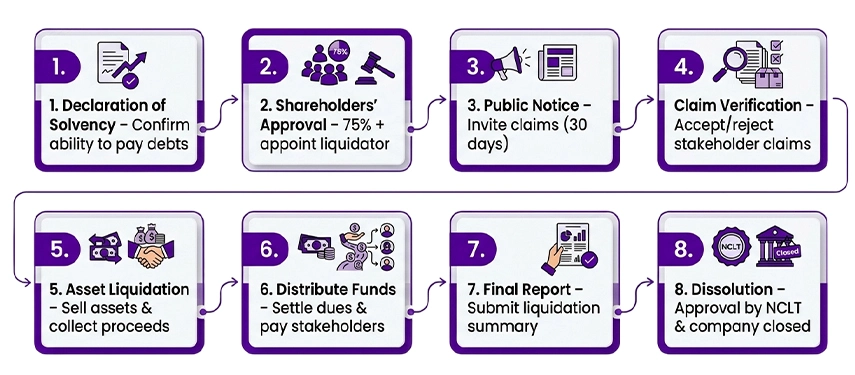
The company's director assesses its financial position and issues a formal declaration, which is verified by an affidavit confirming that there are no defaults and that it has the ability to settle all debts from the sale of assets. The declaration is backed up by the recent financial statements and an audit report to ensure overall transparency.
The shareholders of the company convene a general meeting to pass the special resolution (typically a 75% majority) to approve the liquidation and appoint the liquidators, an IP registered with the Insolvency and Bankruptcy Board of India (IBBI). This step is necessary to transfer control from the director to the liquidator.
The appointed liquidator broadcasts a notice in the newspaper and online, inviting claims from stakeholders, workers, and creditors within a 30-day period. This just ensures that every party is notified about the dissolution and can submit proof if they make any claims.
If there are any claims from the associated parties, the appointed liquidator either admits or rejects them based on evidence. This compiles a list of verified stakeholders. The list determines the distribution priorities, excluding the directors' powers over the assets subsequently.
The company's assets are valued either through a private sale or by auction and liquidated efficiently, with the sale proceeds deposited into the bank account for the process. Any unclaimed capital from the shareholder might also be recovered.
Once all the liabilities are settled, the remaining sale proceeds are distributed to the stakeholder. The proceeds distributions are made in accordance with the applicable provisions of the Insolvency and Bankruptcy Code.
The liquidator prepares a conclusive, detailed report covering payments, asset sales, receipts, and compliance, which is shared with stakeholders for transparency.
The report and the application, for example, Form H, are filed with the ROC (Registrar of Companies), IBBI, and National Company Law Tribunal (NCLT). Upon satisfaction, the NCLT issues a dissolution order within 60 days, filed with the ROC to strike off the company.
The process of compulsory winding up of a company is overseen and managed by the Tribunal. A company is compulsorily wound up for the following reason.
The following is a step-by-step approach to the compulsory winding-up process.
The process of compulsory winding up a company begins by filing a petition with the tribunal, along with a detailed statement of the company's affairs, requesting the company's winding up.
The tribunal then reviews the filed petition. If the petition is filed by a person other than the company, the tribunal asks the company to submit its objection and the statement of affairs within 30 days.
The tribunal appoints a liquidator to oversee the winding-up process. The liquidator will ensure that the company's assets are distributed fairly among the company's shareholders and creditors.
The liquidator will then draft a preliminary report, which, upon approval, is finalized and then submitted to the tribunal. The report is submitted to the tribunal in order to sanction the winding-up order.
The liquidator must submit a copy of the winding-up order to the Registrar of Companies within 30 days. Non-compliance in this situation will result in penalties.
Upon approval, the NCLT orders the dissolution of the company, and the Registrar of Companies updates its records by removing the company’s name from the register.
The Registrar of Companies publishes the notice in India to formally announce the company's dissolution.
If the company decides to wind up, either voluntarily or compulsorily, the courts can step in to supervise the entire process. This generally happens when the shareholders, creditors, or other parties require court intervention.
For instance, if a company is winding up its affairs voluntarily, it is essential that the process be conducted under the court's supervision. This further ensures that the liquidation process is transparent, providing an additional layer of protection for the parties involved in the winding-up.
Note: This concept was applicable under earlier company law frameworks and is no longer part of the current legal structure under the Companies Act, 2013.
The following documentation is required for voluntary liquidation under the Insolvency and Bankruptcy Code, 2016.
However, please ensure that, when preparing and filing the required documentation, professional assistance is taken to ensure compliance and accurate filing.
Though the process and documentation of winding up of a company is generally the same for NRIs and Indian residents. However, for NRIs, an additional complication due to cross-border factors is involved. Please keep the following points in mind.
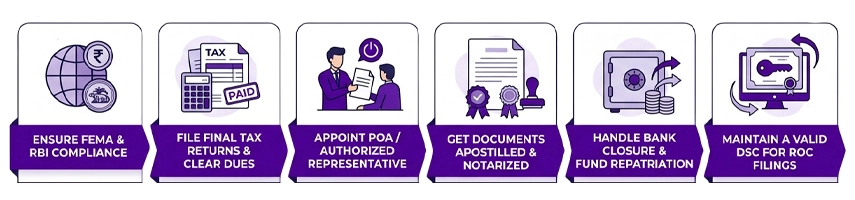
In a nutshell, for winding up a company as an NRI, proper compliance and documentation are essential to avoid delays or legal issues.
Generally, the duration of a company's winding-up varies depending on several factors. The process starts by preparing for the liquidation, which includes settling debts, notifying creditors, and completing the necessary legal formalities, and can take around 2 to 3 months; however, this also depends on the business's size and complexity.
Next up, we have the commencement of the liquidation phase, which involves distributing the proceeds to creditors, liquidating assets, and completing the final legal requirements, which can take from a few months to a year.
Savetaxs experts specialize in simplifying complicated NRI tax situations.
Definitely, the winding-up of a company can sound complicated, but it is inevitable; hence, understanding the key phases of the process is important. Regardless of the winding-up procedure you opt for as a company, whether compulsory or voluntary, the aforementioned steps will ensure everything is executed seamlessly.
As an NRI, if you are planning to wind up your company and seeking a professional to apply for the winding up of the Company, Savetaxs is the name to trust. Our experts provide end-to-end consultation on the entire winding-up process, ensuring hassle-free liquidation and compliance. Our team of experts offers support tailored to your needs, guiding you on everything from debt settlement to ROC filing, asset liquidation, creditors' and shareholders' management, and more. Savetax's expert consultation makes the company winding process stress-free for NRIs.
Connect with us as we serve our clients 24/7 across all time zones.
This article is for general informational purposes only and does not constitute tax, legal, financial, or investment advice. Laws, regulations, rates, and procedures may change over time and may vary based on individual circumstances.
While SaveTaxs makes reasonable efforts to keep the information accurate and up to date, readers should verify applicable rules with official authorities or consult a qualified professional before making decisions based on this information.
Vipul Jain is the Co-Founder of SaveTaxs and a tax expert with experience in Indian and NRI taxation. He advises individuals, NRIs, and businesses on tax filing, tax planning, capital gains, DTAA, and compliance matters. He focuses on making complex tax concepts simple and helping taxpayers make informed, compliant decisions. See Full Bio

Want to read more? Explore Blogs
_1780491123033.webp&w=828&q=75)
_1778757638178.webp&w=828&q=75)