
Business Setup
Difference Between a LLP and a Partnership FirmDifference Between a LLP and a Partnership Firm
Written by Vipul Jain


NRIs can repatriate eligible income from an Indian business to an overseas bank account, subject to applicable tax laws, FEMA requirements and banking procedures. However, the correct process depends on the business structure and the nature of the payment. A dividend from a private limited company, a partner's share of LLP profits and a sole proprietor's business income do not necessarily follow the same rules.
Before transferring funds, establish your legal entitlement to the money, determine the applicable tax treatment, verify whether the funds are eligible for repatriation, and prepare the required documentation.
This guide explains the main repatriation routes, Indian tax considerations, current remittance forms and practical steps for transferring business-related funds abroad.
An NRI may be able to transfer eligible business-related income abroad through an authorised dealer bank after satisfying the applicable tax, foreign exchange and documentation requirements.
The route depends on the legal entity, the payment being made and the terms under which the underlying investment was made.
| Business structure or transaction | Key consideration |
|---|---|
| Private limited company | Establish whether a dividend or another lawful payment is due to the NRI shareholder |
| LLP or partnership firm | Distinguish a partner's profit share from remuneration, interest or other payments |
| Sole proprietorship | Determine the nature of the business funds and the applicable FEMA conditions |
| Sale of shares or a business interest | Verify the investment terms, tax treatment and permitted repatriation route |
| Return of invested capital | Establish whether the investment was made on a repatriation or non-repatriation basis |
Receiving business profits and being permitted to transfer them abroad are separate questions. A person may be entitled to receive money from an Indian business, but the outward remittance must still satisfy the relevant legal and banking requirements.
An NRI shareholder may receive dividends when an Indian company lawfully declares a distribution from its profits.
The company's money does not automatically become the shareholder's personal money simply because the shareholder owns the business. The company must comply with applicable corporate requirements and establish the shareholder's entitlement before making the payment.
Before repatriating a dividend, consider:
Corporate requirements: Confirm that the dividend has been validly declared and is payable to the shareholder.
Tax treatment: Assess the company's tax obligations separately from the shareholder's tax liability on the dividend.
Tax withholding: Determine the applicable withholding requirements, taking account of the shareholder's status and any eligible treaty relief.
Remittance documentation: Prepare evidence of the dividend, its source, the shareholder's entitlement and the relevant tax compliance.
Once the dividend is lawfully payable, the bank can assess the appropriate outward remittance route and supporting documents.
An NRI who is a partner in an Indian LLP or partnership firm may receive a share of profits, remuneration, interest or other payments, depending on the arrangement and applicable law.
These amounts should not automatically be treated as one category for tax purposes.
A partner's share of profits may have different tax treatment from remuneration or interest. The relevant income-tax provisions, withholding obligations, partnership or LLP records and FEMA conditions must therefore be assessed separately.
Before transferring the money, establish:
The partner's entitlement to the payment.
Whether the amount represents a profit share, remuneration, interest or another category.
The applicable Indian tax treatment and withholding requirements.
Whether the investment and payment comply with the relevant foreign exchange rules.
Which supporting documents the authorised dealer bank requires.
Favourable tax treatment does not, by itself, establish that every foreign exchange or banking requirement has been satisfied.
A sole proprietorship is not a separate legal person in the same way as a company. However, an NRI cannot assume that every amount held in an Indian business account can be transferred abroad without further checks.
The applicable treatment depends on the nature of the business, the individual's status under the relevant laws, the source of funds and any restrictions applicable to the transaction.
An NRI operating an Indian proprietorship should verify the applicable FEMA position and bank requirements before transferring funds. A business withdrawal may require a different analysis from a company dividend or proceeds from selling an investment.
Returning invested capital is different from transferring recurring business income.
An NRI selling shares, disposing of an LLP interest or withdrawing investment capital may need to establish the original investment route, the terms under which it was made, the nature of the proceeds and the applicable repatriation conditions.
This distinction is particularly important for investments made on a non-repatriation basis.
Under the relevant RBI investment regulations, certain equity instruments and LLP investments made by NRIs or OCIs on a non-repatriation basis are subject to restrictions on repatriating the invested amount and capital appreciation. The applicable rules also prescribe how relevant disinvestment proceeds must be handled.
Refer to the RBI's FEMA investment regulations for the relevant conditions.
Practical rule: Identify whether the money represents business income, a distribution, a return of capital or proceeds from a disposal before choosing the remittance procedure.
The tax treatment depends on the payment type, the applicable tax law, the recipient's tax status and any relevant tax treaty. Transferring money abroad does not, by itself, determine whether the underlying income is taxable.
An Indian company may pay tax on its business profits before distributing a dividend. The NRI shareholder's tax liability on that dividend is a separate consideration.
The company's tax rate should therefore not be treated as the shareholder's final tax rate. The dividend's tax treatment, applicable withholding and any eligible treaty relief must be assessed separately.
| Payment type | Tax consideration |
|---|---|
| Company dividend | Assess the shareholder's tax treatment and applicable withholding obligations |
| LLP or partnership profit share | Verify the provisions governing a partner's share of profits |
| Partner remuneration | Determine the applicable tax treatment and withholding requirements |
| Interest paid to a partner or shareholder | Examine the nature of the payment and the relevant tax provisions |
| Sole-proprietor business income | Assess taxable business income and the relevant residential-status rules |
This comparison is a starting point, not a substitute for transaction-specific tax analysis. Verify the provisions applicable to the relevant tax year before calculating the final liability.
Tax deducted at source (TDS) is the amount withheld under the applicable rules. It is not necessarily the same as the recipient's final tax liability.
An NRI may be eligible for relief under a Double Taxation Avoidance Agreement (DTAA), depending on the income category, treaty conditions, documentation and domestic law. Treaty benefits should not be assumed merely because the recipient lives outside India.
For further guidance, consult the relevant country-specific DTAA resource and NRI income-tax services available through Savetaxs.
Possibly. Your country of residence may require you to report income received from an Indian business, even if the income has already been taxed in India or transferred to a foreign bank account.
The treatment depends on the destination country's tax residency rules, domestic law, the income category and any applicable treaty. Foreign tax credit relief may be available in some circumstances, but eligibility and the calculation depend on the relevant rules.
Consider both Indian tax compliance and your overseas reporting obligations before distributing or transferring the funds.
The documentation depends on the payment, its taxability, the amount involved and the bank processing the transfer. The forms must also match the law applicable on the remittance date.
For remittances made on or after 1 April 2026, the Income-tax Act, 2025 and Income-tax Rules, 2026 prescribe Forms 145 and 146 in place of the corresponding forms under the previous framework.
Form 145: Information to be furnished for payments to a nonresident who is not a company, or to a foreign company. It replaces Form 15CA under the previous framework.
Form 146: An accountant's certificate for relevant payments to nonresidents. It corresponds to Form 15CB under the previous framework.
According to the Income Tax Department's Form 145 guidance, Form 145 must be submitted before the relevant remittance. Form 146 is required in specified cases.
Under Rule 220 of the Income-tax Rules, 2026, the applicable part of Form 145 depends on the payment's taxability, the aggregate amount during the tax year and the certification obtained.
For taxable remittances, the rules distinguish amounts up to ₹5 lakh from amounts exceeding ₹5 lakh during the tax year. Where the amount exceeds ₹5 lakh, the applicable route depends on whether an Assessing Officer's certificate or an accountant's certificate has been obtained. Certain non-taxable remittances follow a separate reporting route, subject to the prescribed exclusions.
The ₹5 lakh threshold does not mean every remittance above that amount automatically requires Form 146. The nature of the payment, taxability and applicable certification requirements must also be considered.
The official Income Tax Department forms guidance explains the transition from Forms 15CA and 15CB to Forms 145 and 146.
If income arose under an earlier tax regime but the remittance occurs after 1 April 2026, the substantive tax treatment and the procedural requirements for remitting the money may need to be assessed under different statutory frameworks.
Prepare the following records as applicable:
Identity and nonresident-status documentation.
Details of the overseas beneficiary account.
Evidence of business ownership and entitlement to the funds.
Company resolutions, dividend records or LLP distribution records, where relevant.
Financial statements, accounting records or other evidence establishing the source of funds.
Tax calculations, TDS evidence and applicable remittance forms or certificates.
Investment records, purchase documents and disposal agreements if the funds represent investment proceeds.
Additional declarations or supporting records requested by the authorised dealer bank.
This is a preparation checklist, not a universal statutory list. The final requirements depend on the transaction and the bank's compliance review.
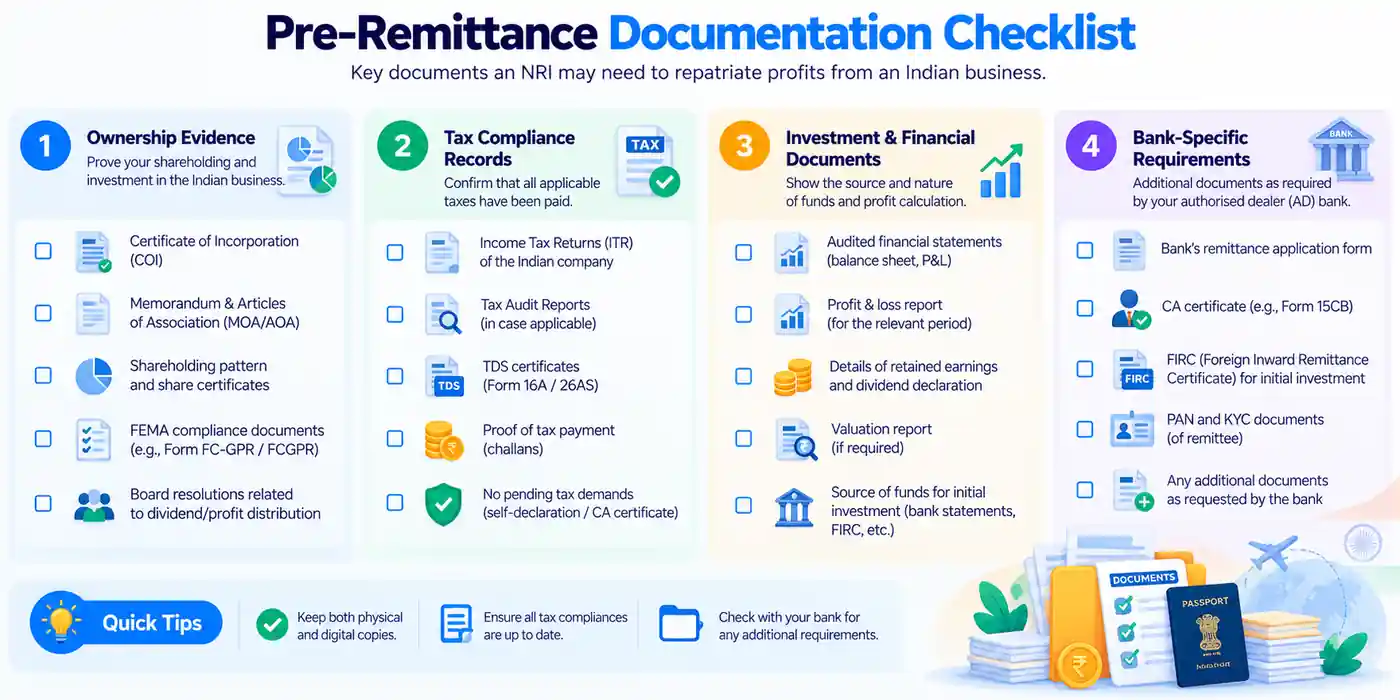
Once you have established the correct legal route, use this workflow to prepare the transfer.
Identify the payment. Determine whether the funds represent a dividend, partner profit share, remuneration, interest, sole-proprietor income or investment proceeds.
Confirm eligibility. Check the applicable FEMA provisions, the original investment terms and any restrictions affecting the payment. Do not rely solely on rules for current income when transferring capital or selling a business interest.
Establish the tax treatment. Determine whether the payment is taxable in India, whether withholding is required and whether a treaty provision may apply.
Complete the business formalities. Obtain relevant approvals and establish the recipient's legal entitlement. Keep the underlying accounting and transaction records.
Prepare the tax documentation. Determine which remittance declaration or accountant's certificate is required under the rules applicable to the transfer date.
Submit the remittance request. Approach the authorised dealer bank with the supporting documents, beneficiary details and required declarations. Follow its instructions for compliance checks and transfer processing.
Retain the records. Keep the remittance confirmation, tax documents, source-of-funds evidence and business distribution records for future reporting or verification.
Processing times, charges and additional documentation vary by bank and transaction. Confirm these details before initiating the transfer rather than assuming a universal timeline.
The appropriate account route depends on the nature of the funds and the applicable RBI rules.
An NRO account is commonly used for legitimate income and funds received in India. An NRE account holds eligible repatriable funds. However, account type alone does not determine whether a particular payment is eligible for repatriation.
RBI guidance permits specified current income, including dividends and interest, to be remitted abroad subject to applicable conditions. Eligible current income may also be credited to an NRE account when the authorised dealer bank is satisfied that the funds qualify and applicable taxes have been deducted or provided for.
See the RBI's guidance on nonresident accounts for the relevant current-income remittance framework.
Investment proceeds may follow different rules. In particular, certain investments made on a non-repatriation basis are subject to restrictions on transferring the invested amount and capital appreciation abroad, and relevant disinvestment proceeds may need to be credited to an NRO account.
The practical distinction is:
Eligible current income: Check whether it can be remitted directly or credited to an eligible account.
Eligible investment proceeds: Verify the original investment terms and permitted account route.
Restricted capital or disposal proceeds: Do not assume that routing the funds through an NRO or NRE account removes the underlying restriction.
For related guidance, consult the relevant NRE/NRO account resources through Savetaxs.
Treating company funds as personal funds. A shareholder cannot automatically withdraw the company's entire bank balance. Establish a lawful payment and the shareholder's entitlement first.
Confusing profit with investment capital. A dividend or other current-income payment may follow different rules from proceeds arising from the disposal of an investment.
Using outdated tax forms. For remittances made from 1 April 2026, check the applicable Forms 145 and 146 framework instead of automatically relying on older Form 15CA/15CB instructions.
Assuming all business structures receive identical tax treatment. A company dividend, LLP profit share, remuneration and proprietor's income must be assessed according to their respective legal and tax characteristics.
Assuming TDS completes every compliance requirement. Tax withholding does not independently establish that all FEMA, corporate-law, documentation and foreign reporting obligations have been satisfied.
Approaching the bank without supporting records. Verify the documentation required for your transaction before submitting the remittance request.
Before instructing your bank to transfer the funds, confirm that you have:
Identified the business structure and exact type of payment.
Established your legal entitlement to receive the funds.
Verified the applicable FEMA and investment-repatriation conditions.
Determined the Indian tax and withholding treatment.
Checked the current remittance forms and certification requirements.
Prepared the source-of-funds and bank documentation.
Considered any tax reporting obligations in your country of residence.
If your situation involves an LLP or proprietorship, a non-repatriation-basis investment, a business sale or uncertainty about tax withholding, obtain a transaction-specific review before transferring the funds.
Savetaxs can help you assess the Indian tax and remittance documentation relevant to your circumstances. The appropriate route should be established from the underlying transaction and applicable law - not simply from the fact that the account holder is an NRI.
This article is for general informational purposes only and does not constitute tax, legal, financial, or investment advice. Laws, regulations, rates, and procedures may change over time and may vary based on individual circumstances.
While SaveTaxs makes reasonable efforts to keep the information accurate and up to date, readers should verify applicable rules with official authorities or consult a qualified professional before making decisions based on this information.
Vipul Jain is the Co-Founder of SaveTaxs and a tax expert with experience in Indian and NRI taxation. He advises individuals, NRIs, and businesses on tax filing, tax planning, capital gains, DTAA, and compliance matters. He focuses on making complex tax concepts simple and helping taxpayers make informed, compliant decisions. See Full Bio

Want to read more? Explore Blogs