NRI Income Tax Compliance
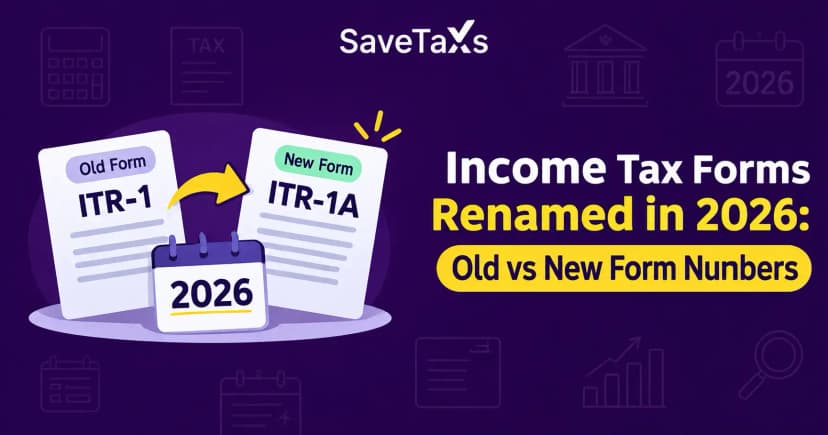
Income Tax Forms Renamed in 2026: Old vs New Form NumbersIncome Tax Forms Renamed in 2026: Old vs New Form Numbers
Written by Vipul Jain

_1766129179.png&w=3840&q=75)
The Income Tax Act 2025 will come into effect from April 1, 2026, replacing the existing Income Tax Act 1961. This new tax legislation aims to eliminate redundant provisions, simplify the language, and align tax practices with the growing economic and technological domains.
The main objective of the new act is to make the tax provisions easier for everyone to understand and follow. In this blog, we will discuss the key changes, objectives, and everything related to the new act, so you don't miss anything important.
The new Income Tax Act 2025 covers all the aspects of direct taxation in India, explained in 600 pages with 546 sections, 23 chapters, and 16 schedules to be precise. After the Indian parliament approved the new income tax bill 2025, the new act came into effect on 21 August 2025.
It serves as a revised legal framework through which the government of India will ensure fair tax administration and management nationwide.
You can download the updated version of the Income Tax Act, which came into effect on August 21, 2025.
The following are the key objectives of the new Income Tax Act, which make this act different and better.
Unlike the existing Income Tax Act, 1961, which has complex tax codes, the new act aims to provide a simpler tax code that makes its provisions easier to interpret, read, and apply. Meaning by just simplifying the legal wording of the tax provisions, the taxpayer can now understand their correct tax obligations without confusion.
An easy tax code also helps NRIs understand their income tax implications and provides better provisions.
Another key objective of the new act is to lower tax rates, thereby giving taxpayers in India more disposable income. With more disposable income in hand, individuals can either save or spend more, which, in turn, boosts demand for goods and services in India, supporting overall economic growth.
By eliminating broad, unclear tax provisions, streamlining the entire tax administration, and introducing modern tools and mechanisms for compliance, the New Income Tax Act is set to reduce legal disputes and provide individuals with an easier system for redressal.
The new act has a revised structure that is clearer and contains less content, making compliance more straightforward and efficient. Easier compliance will also encourage individuals to file their taxes and reduce tax evasion overall.
In the new act, the definition of virtual assets has been broadened to include other digital assets, including cryptocurrencies. This has been done to make the taxation process for virtual digital assets easier.
Filing your NRI ITR in minutes with expert guidance from Savetaxs.
Key features of the new Income Tax Act 2025 are as follows:
Let's look at the most awaited aspect: the differences between the Income Tax Act 2025 and the Income Tax Act 1961.
| Aspect | Income Tax Act, 1961 | Changes Made In the New Income Tax Act 2025 |
|---|---|---|
| Effective Date | Came into effect on April 1, 1962. | To be effective from April 1, 2026. |
| The Overall Structure | Has too many details, complex tax codes, and is quite lengthy. | Adapts a more streamlined overall structure with simplified language in tax forms by segmenting content into sections and reorganizing it, making everything easier to read, interact with, and understand. |
| Concept Of Year | In the existing act, the concept of year is based on the previous year (income earned) and the assessment year (income taxed). |
The new act introduces the concept of a tax year (1 April-31 March), replacing the dual reference dates with the succeeding tax year. |
| Default Regime | New regime 115ABC is the default. | The new regime (202) is the best one. |
| TDS Provisions | In the existing income tax, the TDS provisions span Sections 192 - 194T. | Consolidated rules under section 393, the rates and limits are unchanged. |
| Level of complexity | Highly complex, as it uses outdated terms and multiple cross-references. | Less complexity with a reduced and simple structure that has precise drafting. |
There are 23 chapters in the new income tax act, and a few of these chapters have subparts. They are as follows.
| The Chapter | Overview Of The Chapter |
|---|---|
| Chapter I | Prrelimianuery |
| Chapter II | Basis of the charge. |
| Chapter III | Incomes that do not form part of the total income |
| Chapter IV | Computation of total income |
| Chapter V | Income of other persons, included in the total income of the assessee |
| Chapter VI | Aggregation Of Income |
| Chapter VII | Set off, or carry forward and set off losses. |
| Chapter VII | Tax deductions to be made in computing total income. |
| Chapter IX | Tax Rebates & Tax Reliefs |
| Chapter X | Special provisions relating to avoidance of tax |
| Chapter XI | General Anti-Avoidance Rule |
| Chapter XII | Mode of payment in some instances. |
| Chapter XIII | Tax determination in exceptional cases |
| Chapter XIV | Tax administration |
| Chapter XV | Return of Income |
| Chapter XVI | Procedure for assessment |
| Chapter XVII | Special taxation provisions for certain people. |
| Chapter XVIII | Appeals, Revision, and Alternate Dispute Resolution |
| Chapter XIX | Collection of tax and recovery of tax |
| Chapter XX | Refunds |
| Chapter XXI | Penalties |
| Chapter XXII | Offences and Prosecution |
| Chapter XXIII | Miscellaneous. |
The scope of how the taxes will be implemented under the Income Tax Act 2025 depends entirely on the taxpayer's residency status.
| The Income Type | Resident and ordinarily resident (ROR) Residential Status | Resident but not ordinarily resident (RNOR) Residential Status | Non-Resident ( NR) Residential Status |
|---|---|---|---|
| Income received or deemed to be received in India. | Taxable | Taxable | Taxable |
| Accrued income in India | Taxable | Taxable | Taxable |
| Income accrues from outside India, but the profession or business is either controlled from India or has a setup in India. | Taxable | Taxable | Non-taxable |
| Income acquired from outside India, however, the business or profession was either set up in or controlled from outside India. | Taxable | Non-taxable | Non-taxable |
| The un-taxed past type of income that was brought back to India | Non-taxable | Non-taxable | Non-taxable |
In the new Income Tax Act 2025, the capital gains structure and essence are retained; however, the language has been simplified and made easier to understand. The capital gains tax provisions are now covered by Clauses 67, 196, and 198 of the Income Tax Act 2025.
| Income Tax Act Clause | The Description Clause |
|---|---|
| Clause 67 | This clause defines capital gains. |
| Clause 196 | This clause shares the description of short-term capital gains for business trust units, equity shares, and equity-oriented funds. |
| Clause 197 | Long-term capital gains for non-equity long-term assets. |
| Clause 198 | The long-term capital gains for equity shares, business trust units, and equity mutual funds. |
Additionally, please ensure that Section 47 of the Income Tax Act, 1961, has now been revised, and the clauses related to stock exchange demutualisation and the transfer of land of an industrially sick company have been eliminated from the "exceptions to transfer".
Furthermore, the new act now includes cryptocurrencies as a taxable capital class. With this inclusive move, the tax act also removes ambiguity by allowing virtual digital assets and cryptocurrencies to be treated as a taxable source of income.
The tax slab rate is the rate at which a taxpayer's income is taxed. The government of India follows a progressive tax rate system, which means that as the income rises, so does the tax rate. This ensures that taxpayers with higher incomes pay higher taxes.
The Income Tax Department provides the two tax regimes in India.
Let us understand the old vs the new tax regime slab rates
Under the Income Tax Act 2025, the new tax regime slab rates are set out in section 202. The tax rates are as follows.
| The Income Tax Slabs | The Tax Rate |
|---|---|
| Up to Rs 4 lakh | NIL |
| Rs 4 lakh to Rs 8 lakh | 5% |
| Rs 8 lakh to Rs 12 lakh | 10% |
| Rs 12 lakh to Rs 16 lakh | 15% |
| Rs 16 lakh to Rs 20 lakh | 20% |
| Rs 20 lakh to Rs 24 lakh | 25% |
| Above Rs 24 lakh | 30% |
The old tax regime slab rates under the new Income Tax Act 2025 are as follows.
| Slab rate | Age < 60 years & NRI ( Non-Resident Indian) | Age 60 years to 80 years (Resident Individuals) | Above the age of 80 years (Resident individuals) |
|---|---|---|---|
| Up to Rs 2,50,000 | NIL | NIL | NIL |
| Rs 2,50,001 - Rs 3 lakh | 5% | NIL | NIL |
| Rs 3 lakh to Rs 5 lakh | 5% | 5% | NIL |
| Rs 5 lakh to Rs 10 Lakh | 20% | 20%; | 20% |
| Above Rs 10 lakhs | 30% | 30% | 30% |
The tax rate limit for the new Income Tax Act 2025 is as follows.
New Tax Regime: Any taxpayer filing their tax return as per the regulation of the latest income tax regime can claim a tax rebate, provided their income is not more than Rs 12 lakh; that is, you can get a tax rebate of up to Rs 60,000.
Old Tax Regime: Any taxpayer filing the tax return under the old tax regime can claim tax rebates provided their income is not more than 5 lakh, which means they can get a tax rebate of up to 12,500.
From deductions to exemptions, tax obligations, and ensuing compliance, Savetaxs consultants help you with all.
That's it. These were the key changes and highlights you, as an Indian taxpayer, must know about the new Income Tax Act 2025. Apart from the tax, you can also look at the different sections of the Income Tax Act and know about all the available deductions. This will help you make smarter investments throughout.
When we talk about the income tax act, we can't ignore income tax filing. As an NRI, if you are looking for NRI ITR filing, Savetaxs is the name to trust.
We have been helping NRIs in 20+ countries file their NRI ITR in India. Our experts bring in 30+ years of experience in cross-border taxation and NRI tax implications. Our experts will provide end-to-end assistance from filing the ITR form to claiming tax deductions, exemptions, and more.
Connect with us as we serve our clients 24/7 across all time zones.
This article is for general informational purposes only and does not constitute tax, legal, financial, or investment advice. Laws, regulations, rates, and procedures may change over time and may vary based on individual circumstances.
While SaveTaxs makes reasonable efforts to keep the information accurate and up to date, readers should verify applicable rules with official authorities or consult a qualified professional before making decisions based on this information.
Shubham Jain is the Founder of SaveTaxs and has extensive experience in Indian and NRI taxation. He advises individuals, NRIs, and businesses on tax filing, tax planning, capital gains, DTAA benefits, fund repatriation, and compliance matters. He regularly writes about taxation and related financial topics. His focus is on making complex tax concepts easy to understand. Through his articles, he helps taxpayers stay informed, avoid common mistakes, and stay compliant with Indian tax laws. See Full Bio

Want to read more? Explore Blogs