NRI Income Tax Compliance
Income Tax Forms Renamed in 2026: Old vs New Form NumbersIncome Tax Forms Renamed in 2026: Old vs New Form Numbers
Written by Vipul Jain

If you are an NRI who owns or earns from a business in India, choosing the correct Income Tax Return (ITR) form can be confusing. You may own a private limited company, run a proprietorship, work as a freelancer, or be a partner in an Indian firm.
The important point is that simply owning a business does not automatically decide your ITR form.
Your correct return depends mainly on whether you personally earn income taxable under “Profits and Gains of Business or Profession” (PGBP) and the legal structure through which the business operates.
For Assessment Year (AY) 2026-27, an NRI individual with business or professional income will generally need ITR-3, while an NRI without business or professional income may use ITR-2, subject to its eligibility conditions. The Income Tax Department confirms that ITR-3 applies to non-resident individuals having business or professional income.
For AY 2026-27, ITR-3 is the primary return applicable to an individual, including a non-resident individual, who has income chargeable under the head “Profits and Gains of Business or Profession.”
It can also accommodate other income such as salary or pension, house property income, capital gains, and income from other sources.
For example, suppose you live in the US but operate a sole proprietorship in India and the profits are taxable in India as business income.
In this situation, you would generally file ITR-3.
The same principle can apply to an NRI earning professional or freelance income that is taxable in India under the head PGBP.
Therefore, when deciding the ITR form for NRI business owner, first ask:
Do I personally have income taxable in India under the head “Profits and Gains of Business or Profession”?
If yes, ITR-3 will generally be the relevant individual return.
An NRI should generally consider ITR-3 when their taxable Indian income includes business or professional income.
Common situations can include:
The Income Tax Department describes ITR-3 as the return for individuals and HUFs having income from profits and gains of business or profession.
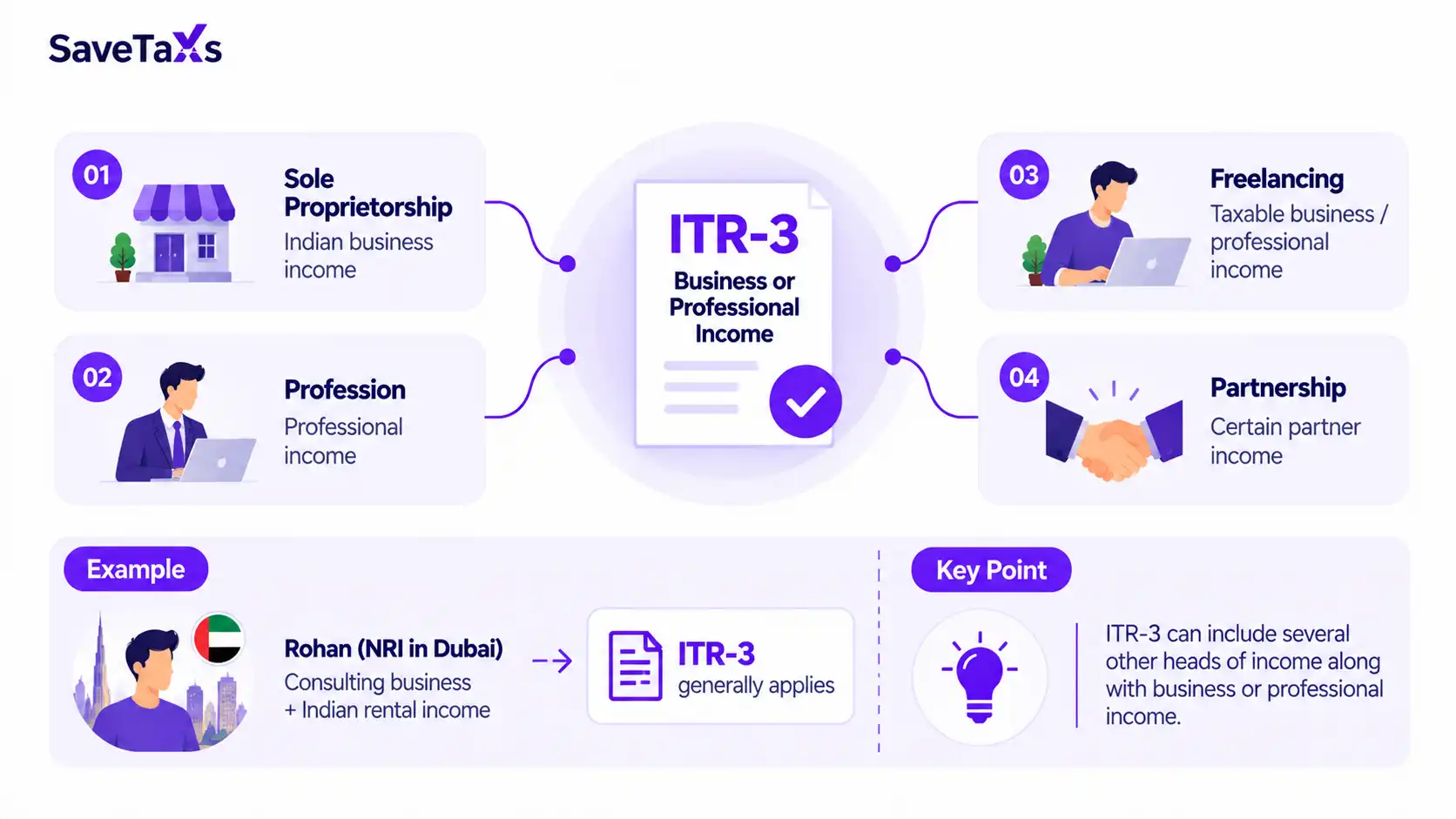
Rohan lives in Dubai and qualifies as a non-resident for Indian income-tax purposes. He operates a consulting business in India as a sole proprietor and also receives rental income from an apartment in India.
Because Rohan has business income, ITR-3 would generally be the appropriate form. The fact that he also has rental income does not require him to file a separate return for that income.
This is an important distinction: ITR-3 is not restricted only to business income. It can accommodate several other heads of income along with business or professional income.
Find the right ITR based on your NRI status and business income.
An NRI business owner should not select an ITR merely because the form appears simpler.
ITR-2 is available to resident and non-resident individuals who do not have income chargeable under the head “Profits and Gains of Business or Profession.”
Therefore, being a “business owner” does not by itself prevent an NRI from using ITR-2.
For example, suppose Priya lives in Canada and owns shares in an Indian private limited company. She does not personally carry on a proprietorship or profession. During the year, she receives dividend income and earns capital gains from investments.
Merely being a shareholder does not convert those receipts into her personal business income.
If she has no income chargeable under PGBP and otherwise satisfies the requirements, ITR-2 may be the appropriate personal return.
An NRI who is a director in a company but does not have business/professional income can also use ITR-2, subject to the other applicable conditions. The AY 2026-27 ITR-2 instructions specifically accommodate company directors and holders of unlisted equity shares.
Generally, no.
ITR-4 (Sugam) is available only to specified resident taxpayers meeting its eligibility conditions. The Income Tax Department expressly states that a non-resident individual cannot file ITR-4 for AY 2026-27.
Therefore, an NRI should not choose ITR-4 simply because their business might otherwise qualify for presumptive taxation provisions.
For an NRI individual with business/professional income, ITR-3 is generally the relevant form.
This is where many NRI business owners become confused.
You must distinguish between:
the return filed by you personally
and
the return filed by the business entity.
They are not necessarily the same.
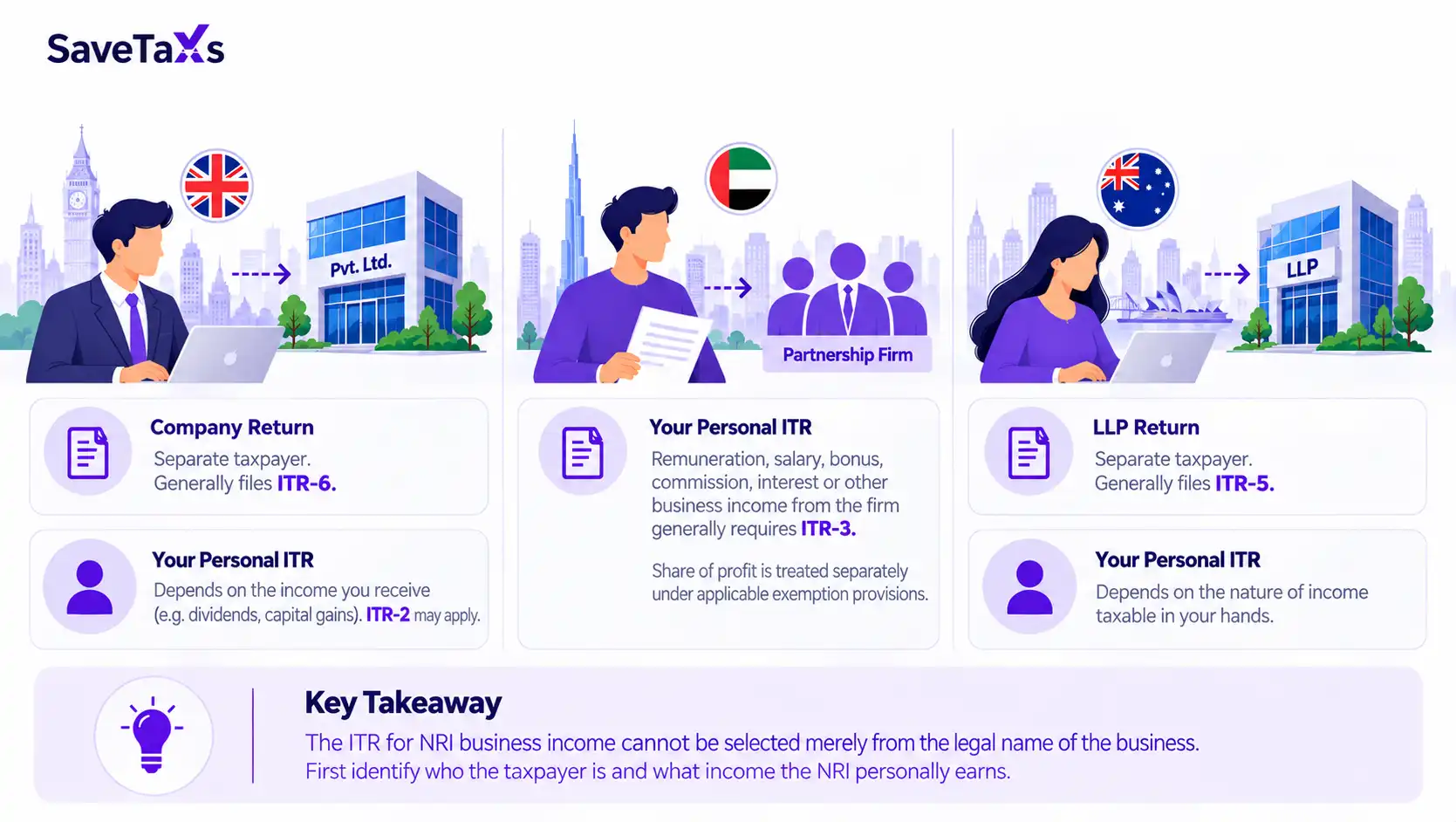
Suppose you live in the UK and own 60% of an Indian private limited company.
The company is a separate taxpayer. The fact that the company carries on a business does not automatically mean that its business profits are your personal business income.
The company generally files its own applicable corporate return, typically ITR-6.
Your personal ITR depends on the income you personally receive and how that income is taxed.
For example, if you only receive dividend income and have capital gains but no personal business/professional income, ITR-2 may apply.
You do not personally file ITR-6 simply because you own the company.
The NRI partner separately files an individual return. Taxable remuneration, salary, bonus, commission, interest or other income from the firm that is chargeable under the head ‘Profits and Gains of Business or Profession’ generally requires ITR-3. A partner’s eligible share of profit from the firm is treated separately under the applicable exemption provisions.
An LLP is also a separate taxpayer and generally files ITR-5.
The NRI member must separately determine their personal ITR based on the nature of income taxable in their hands.
Therefore, ITR for NRI business income cannot be selected merely from the legal name of the business. You first need to identify who the taxpayer is and what income the NRI personally earns.
| Your situation | ITR generally applicable |
|---|---|
| NRI running a sole proprietorship with business income | ITR-3 |
| NRI earning professional/freelance income taxable under PGBP | ITR-3 |
| NRI with no business/professional income but with eligible capital gains, rent, dividend, etc. | ITR-2 |
| NRI who is a company director but has no PGBP income | ITR-2 may apply |
| NRI shareholder with no personal PGBP income | ITR-2 may apply |
| NRI partner receiving income taxable under PGBP | Generally ITR-3 |
| Partnership firm or LLP itself | ITR-5 |
| Indian company itself | Generally ITR-6 |
| Non-resident individual trying to use ITR-4 | Not eligible |
The table is a starting point. Your complete income profile and the applicable ITR eligibility conditions should still be checked before filing.
ITR-2 or ITR-3? Get expert help based on how you own or earn from your business.
If you are asking, “Which ITR form should I file as an NRI business owner?”, start by determining whether you personally have business or professional income taxable in India.
If you do, ITR-3 generally applies.
If you merely own shares in an Indian company and have no business/professional income personally, you do not automatically need ITR-3. ITR-2 may apply, depending on your other income and eligibility.
NRIs should also remember that ITR-4 is not available to non-resident individuals.
Finally, keep your personal tax return separate from the return of the business entity. A company, LLP, or partnership can have its own filing obligation even though you separately file an individual ITR as an NRI.
This article is for general informational purposes only and does not constitute tax, legal, financial, or investment advice. Laws, regulations, rates, and procedures may change over time and may vary based on individual circumstances.
While SaveTaxs makes reasonable efforts to keep the information accurate and up to date, readers should verify applicable rules with official authorities or consult a qualified professional before making decisions based on this information.
Vipul Jain is the Co-Founder of SaveTaxs and a tax expert with experience in Indian and NRI taxation. He advises individuals, NRIs, and businesses on tax filing, tax planning, capital gains, DTAA, and compliance matters. He focuses on making complex tax concepts simple and helping taxpayers make informed, compliant decisions. See Full Bio
Want to read more? Explore Blogs