For NRIs who support their families in India or maintain financial ties back home, managing finances across borders can be challenging. An NRI joint account is an important financial tool designed to address such needs efficiently.
Joint accounts allow NRIs to hold accounts jointly with other NRIs, OCIs, PIOs, and resident Indians — subject to the regulatory framework of the Foreign Exchange Management Act (FEMA) and Reserve Bank of India (RBI) guidelines.
In this blog, we will discuss NRI joint accounts, their types, eligibility rules, documentation requirements, operational conditions, taxation aspects, and how to open one correctly.
Key Takeaways
- NRIs can maintain all three types of NRI accounts simultaneously — NRE, NRO, and FCNR.
- Joint holding rules differ depending on account type and residency status of the joint holder.
- When a resident Indian is added to an NRE or FCNR account, it must generally be on a “Former or Survivor” basis.
- NRO accounts allow broader joint holding flexibility.
- Interest on NRE and FCNR accounts is tax-free in India (subject to conditions).
- NRO account interest is taxable in India and subject to TDS.
- NRI joint accounts can be opened online or offline, depending on the bank.
Types of NRI Joint Accounts
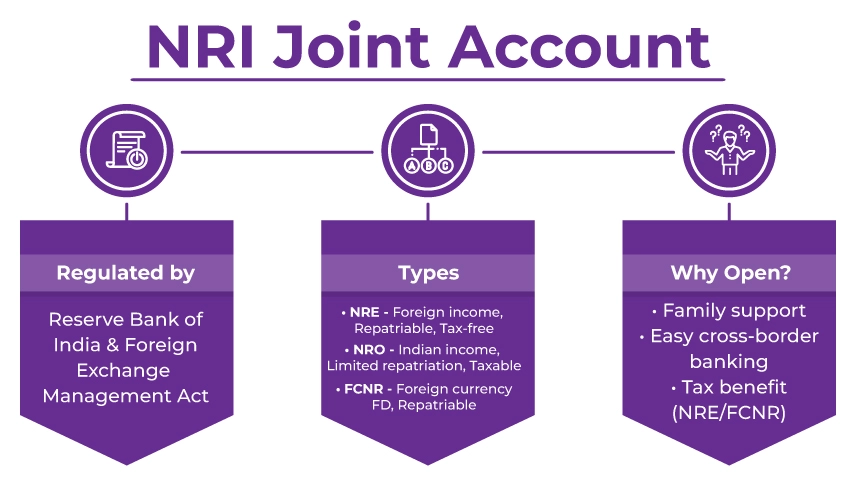
NRIs can open three primary types of accounts depending on their income source and financial objective.
Non-Resident External (NRE) Account
- Designed for income earned outside India.
- Fully repatriable (principal and interest).
- Interest earned is tax-free in India (as long as the account holder qualifies as NRI under FEMA).
Joint Holding Rules:
- Can be held jointly with another NRI/OCI/PIO (with “Either or Survivor” or “Joint” mode).
- Can be held with a resident close relative, but only on a “Former or Survivor” basis.
- The resident joint holder cannot operate the account during the lifetime of the NRI (unless specifically permitted by bank mandate within RBI guidelines).
Non-Resident Ordinary (NRO) Account
- Used to manage income earned in India (rent, dividends, pension, capital gains, etc.).
- Repatriation allowed up to USD 1 million per financial year, subject to taxes and submission of Form 145/146.
- Interest is taxable in India.
- TDS generally applicable at 30% + applicable surcharge and cess (effective rate around 31.2%, subject to DTAA relief).
Joint Holding Rules:
- Can be held jointly with another NRI/OCI/PIO.
- Can be held with a resident Indian (usually on a “Former or Survivor” basis when NRI is primary holder).
- Tax liability on interest depends on the primary holder.
Foreign Currency Non-Resident (FCNR) Account
- Term deposit account maintained in designated foreign currencies.
- Protects against currency fluctuation risk.
- Fully repatriable.
- Interest is tax-free in India (subject to NRI status).
Joint Holding Rules:
- Can be held jointly with another NRI/PIO/OCI.
- A resident close relative may be added only on a “Former or Survivor” basis.
Who Qualifies as a “Close Relative”?
Under RBI guidelines (aligned with Companies Act definition), close relatives include:
- Father (including step-father)
- Mother (including step-mother)
- Son (including step-son)
- Son’s wife
- Daughter
- Daughter’s husband
- Brother (including step-brother)
- Sister (including step-sister)
- Spouse
- Members of HUF (where applicable)
Friends, cousins, business partners, and distant relatives are not considered close relatives for NRE/FCNR joint holding purposes.
Required Documents For NRI Joint Accounts
Documentation may vary by bank, but generally includes:
For NRI Primary Holder
- Valid passport (with visa/work permit)
- Proof of overseas address
- PAN card
- Proof of NRI status (visa, residence permit, employment letter)
- Passport-size photographs
- Relationship proof (if adding resident relative)
- Form 10F & Tax Residency Certificate (if claiming DTAA benefits for NRO account)
For Resident Joint Holder
- Aadhaar card
- PAN card
- Address proof (Aadhaar/utility bill/bank statement)
- Relationship proof (birth certificate/marriage certificate, as applicable)
- Passport-size photographs
- Duly filled account opening form
Note: Banks may request additional KYC documentation depending on compliance requirements.
How To Open an NRI Joint Account
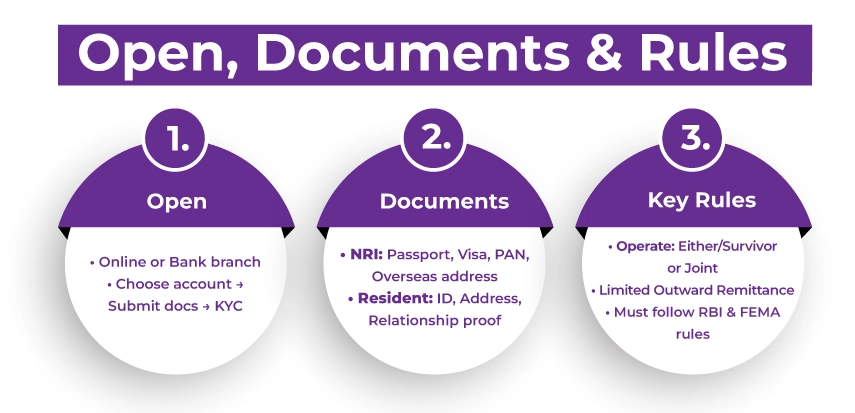
Opening an NRI joint account can be done either online or offline.
Online Process
- Choose an authorized bank offering NRI services.
- Select the appropriate account type (NRE/NRO/FCNR).
- Fill out the online application form.
- Upload scanned copies of required documents.
- Complete video KYC or verification process.
- Courier physical documents if required.
Offline Process
- Visit the designated bank branch.
- Collect and complete the joint account application form.
- Submit physical copies of required documents.
- Complete in-person verification.
- Fund the account as per minimum balance requirements.
Processing timelines typically range between 7–15 working days, depending on documentation completeness.
Operational Conditions for NRI Joint Accounts
The mode of operation determines how the account functions:
- Former or Survivor – Primary holder operates during lifetime; secondary holder gains control after death of primary holder.
- Either or Survivor – Both holders can operate independently (generally allowed when both are NRIs).
- Jointly – All holders must sign/authorize transactions.
Important Operational Restrictions:
- A resident joint holder in an NRE/FCNR account generally cannot operate the account during the NRI’s lifetime.
- Funds from an NRO account cannot be freely transferred to an NRE account without compliance procedures.
- Repatriation from NRO accounts is subject to annual limits and tax compliance.
- Accounts must comply with FEMA regulations at all times.
The following conditions ensure that the NRI joint account complies with FEMA guidelines and meets the financial objectives of both NRIs and resident joint holders.
Taxation of NRI Joint Accounts
NRE & FCNR Accounts
- Interest: Tax-free in India.
- No TDS deduction (as long as holder qualifies as NRI under tax law).
NRO Accounts
- Interest: Taxable in India.
- TDS applicable at 30% + surcharge + cess (subject to DTAA benefit).
- DTAA can reduce TDS to 10–15% in many treaty countries, subject to documentation.
Tax liability typically follows the primary holder status unless income attribution rules apply.
Professional tax advice is recommended for correct reporting in India and abroad.
What are the benefits of an NRI Joint Account?
NRI joint accounts offer an array of advantages that make them a preferred choice for cross-border financial management.
- The Financial Security: NRI Joint account provides a credible avenue for NRIs to support their family members in India.
- Convenience: These joint accounts simplify the income management for NRIs, whether the income is earned in India or abroad.
- Flexibility: NRE and NRO accounts allow NRIs to deposit their foreign income in India and access the funds in INR.
- Tax Advantage: NRE and FCNR accounts are tax-free, whereas NRO accounts are taxable.
Important Compliance Points
- Joint accounts must strictly follow RBI and FEMA rules.
- Mode of operation cannot override regulatory restrictions.
- Resident joint holders cannot create beneficial interest for themselves in NRE accounts.
- Change in residential status must be updated immediately with the bank.
- Periodic KYC updates are mandatory.
The following benefits of NRI joint accounts make them an essential financial tool for NRIs seeking to maintain financial stability and convenience in India.
Trusted NRI Banking Support
Expert help from Savetaxs NRI banking experts for hassle-free compliance.
The Bottom Line
NRI joint accounts are a structured financial solution for managing cross-border responsibilities while remaining compliant with Indian regulations. When set up correctly, they offer security, operational convenience, and tax efficiency.
However, the rules differ significantly based on:
- Account type (NRE/NRO/FCNR)
- Residency status of joint holder
- Mode of operation
- Tax residency and DTAA eligibility
Understanding these distinctions before opening the account can prevent operational restrictions, tax complications, and regulatory issues later.
As an NRI, if you are seeking professional guidance to open a joint accout account in India that is right for your financial goals, Savetaxs is the name to trust. Our banking experts provide end-to-end assistance in onboarding procedures for NRIs, handling KYC compliance, key documentation, and product guidance for NRE NRO accounts.
We have been helping NRIs across 20+ countries open their NRI-designated bank accounts. Connect with us as we serve our clients 24/7 across all time zones.
Sources: Income Tax Department, ICICI Bank, Reserve Bank of India, HDFC Bank, Axis Bank, State Bank of India, The Economic Times, Times of India, ClearTax


_1785327342628.webp&w=828&q=75)

_1771851103775.webp&w=3840&q=75)



_1784120197435.webp&w=828&q=75)