

_1785327342628.webp&w=828&q=75)
NRI Banking Services
What Should NRIs Know Before Choosing an NRI Account?What Should NRIs Know Before Choosing an NRI Account?
Written by Shubham Jain


Once an NRI's residential status changes to an Indian resident, their NRE account loses its tax-free status in India. Under the provisions of FEMA (Foreign Exchange Management Act), a person is considered an Indian resident when they move back to India with the intent to reside permanently.
Upon this change in your residency, you immediately need to inform your bank and convert your NRE account into a resident rupee account or a resident foreign currency (RFC) account. In this blog, we will discuss whether the NRE account interest is tax-free and when it loses its tax-free status.
An NRE (Non-Resident External) account is a bank account specifically for NRIs that permits them to manage their foreign earnings in Indian Rupees. An NRE account is ideal if you wish to send money earned abroad to India.
The primary benefit of an NRE account is that both the principal and interest amount can be sent back abroad without any restrictions. It means that there are no limits on repatriation in an NRE account.
An NRE account can be opened as savings, current, recurring, or fixed deposits. NRE Fixed Deposits (NRE FD) accounts are fixed deposits that are funded by an NRI through their NRE accounts using foreign income. Unlike standard savings accounts, NRE accounts offer higher returns, making them the most popular investment choices for NRIs.
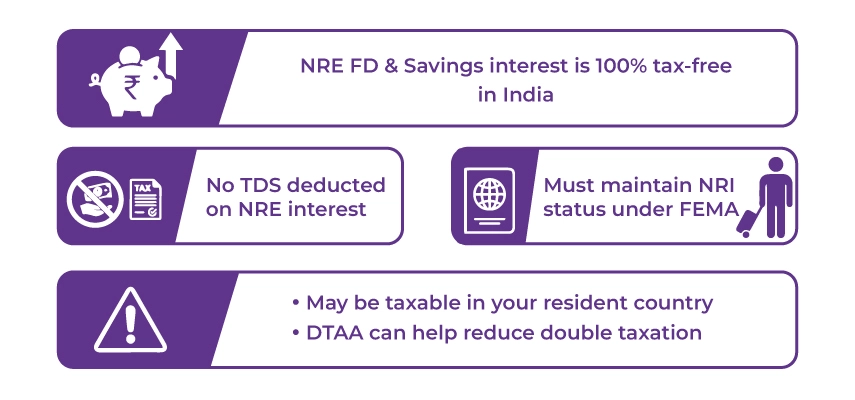
According to the Indian tax laws, NRIs are taxed only on income earned in India. This means that the funds in your NRE (Non-Resident External) account, which are foreign earnings, are not taxable in India.
The interest earned from both NRE fixed deposits and NRE savings accounts is entirely exempt from taxes in India, and no tax is deducted at the source for this interest.
To take advantage of these tax benefits, it's important to be recognized as a Non-Resident Indian (NRI) under the Foreign Exchange Management Act (FEMA). Keeping your NRI status active is important to enjoy the tax-free perks associated with NRE accounts.
While the interest from NRE FDs and savings accounts is tax-exempt in India, it may be subject to taxation in your current country of residence. India has established Double Taxation Avoidance Agreements (DTAA) with several nations, aiming to prevent double taxation. If such an agreement is in place between India and the country where you live, you may be eligible for tax exemptions or reduced tax rates on the interest earned from your NRE deposits.
Interest earned on an NRE account is tax-exempt as long as you remain an NRI. However, upon your permanent return to India, you are classified as a resident under FEMA from the moment you arrive, making it non-compliant to keep your NRE account active.
You will need to either convert your NRE account into a resident account or transfer the funds to a Resident Foreign Currency (RFC) account. Interest on these accounts remains tax-free only while you maintain the RNOR status (Resident but Not Ordinarily Resident), which is valid for up to three years after your return. After the RNOR period ends and you become a regular resident, all income, including interest, will be subject to full taxation in India.
Avoid errors and enjoy fast and accurate tax filing assistance by experts.
The banks will frequently review your residency by checking your:
If they find any mismatch in the documents, like your PAN shows "resident". Then, the banks may:
When you move back to India to reside permanently, or your residential status changes from Non-resident Indian (NRI) to resident. Then, you are not allowed to legally operate your NRE account in its original form because, as per the rules of FEMA, NRE accounts are specifically meant for NRIs. Upon becoming a resident, you should:
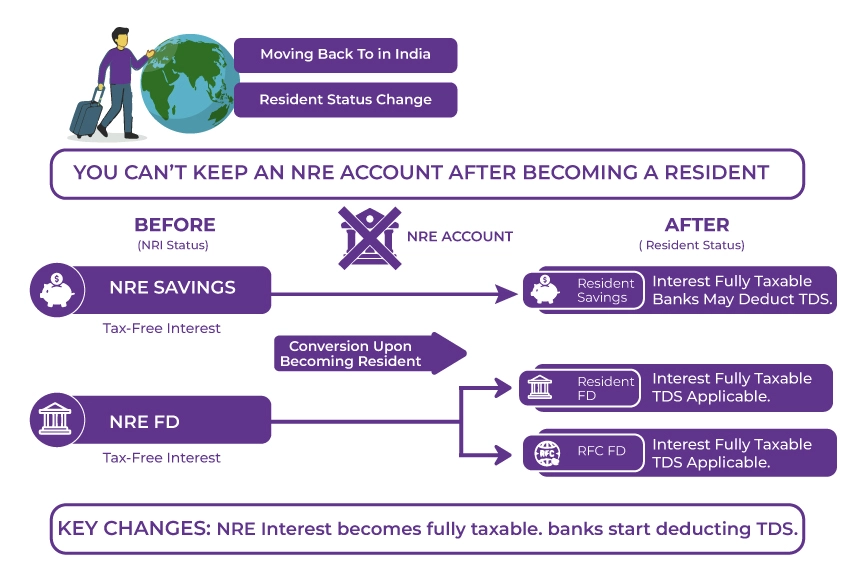
Banks are legally required to re-designate your NRE savings account into a regular resident savings account as:
If you hold NRE fixed deposits (FDs), you are not allowed to continue in NRE status. Your bank will convert them into:
Once your status changes to a resident Indian:
Get complete NRI tax solutions under one platform
An NRE account offers a tax-efficient way for NRIs to manage their foreign income in India. The interest earned on both NRE savings and fixed deposits is exempt from taxation, making them an attractive choice. It is essential to understand the taxation and compliance requirements for an NRE account.
To handle this transition smoothly, it's advised to consult an expert from the Savetaxs team. We have a team of experts who can help you understand the complexities of this status transition, as well as your associated tax obligations. Contact us anytime, as we are available 24*7 across all time zones.
This article is for general informational purposes only and does not constitute tax, legal, financial, or investment advice. Laws, regulations, rates, and procedures may change over time and may vary based on individual circumstances.
While SaveTaxs makes reasonable efforts to keep the information accurate and up to date, readers should verify applicable rules with official authorities or consult a qualified professional before making decisions based on this information.
Shubham Jain is the Founder of SaveTaxs and has extensive experience in Indian and NRI taxation. He advises individuals, NRIs, and businesses on tax filing, tax planning, capital gains, DTAA benefits, fund repatriation, and compliance matters. He regularly writes about taxation and related financial topics. His focus is on making complex tax concepts easy to understand. Through his articles, he helps taxpayers stay informed, avoid common mistakes, and stay compliant with Indian tax laws. See Full Bio

Want to read more? Explore Blogs


_1784120197435.webp&w=828&q=75)