Bookkeeping
The Ultimate QuickBooks Bookkeeping Guide for Small BusinessesThe Ultimate QuickBooks Bookkeeping Guide for Small Businesses
Written by Hatim Dudhiyawala

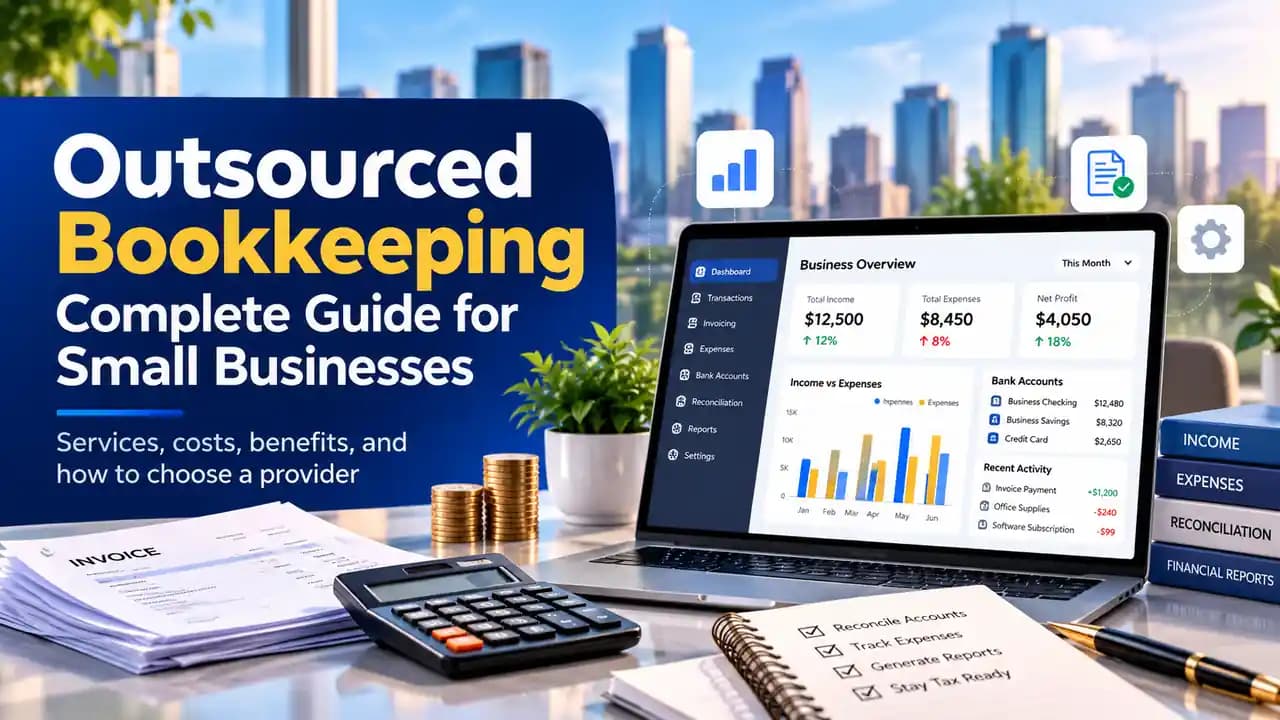
You've probably already realized that keeping your books current takes more time as transactions, invoices, expenses, and accounts increase. Outsourced bookkeeping services give businesses a practical way to delegate recurring financial recordkeeping to an external professional without immediately hiring a full-time bookkeeper. In this guide, you'll learn what outsourced bookkeeping includes, how the process works, what affects pricing, and how to decide whether outsourcing is right for your business.
Outsourced bookkeeping is the practice of hiring an external professional or bookkeeping firm to maintain a business's financial records instead of handling the bookkeeping function entirely in-house. An outsourced bookkeeper manages agreed financial-recordkeeping tasks on behalf of a business while the owner or internal team retains access to its accounting information.
Moreover, outsourced bookkeeping can include recording transactions, categorizing income and expenses, reconciling bank accounts, managing accounts receivable and payable, closing monthly books, and preparing financial reports. For example, a consulting company can provide its bookkeeping provider with secure access to its accounting software while the owner focuses on clients, sales, and operations.
At the same time, bookkeeping outsourcing is different from hiring an in-house bookkeeper. An in-house bookkeeper is an employee within the company's internal structure, while an outsourced bookkeeper operates as an external service provider under an agreed scope of work.
For more foundational information, see our guide to bookkeeping basics.
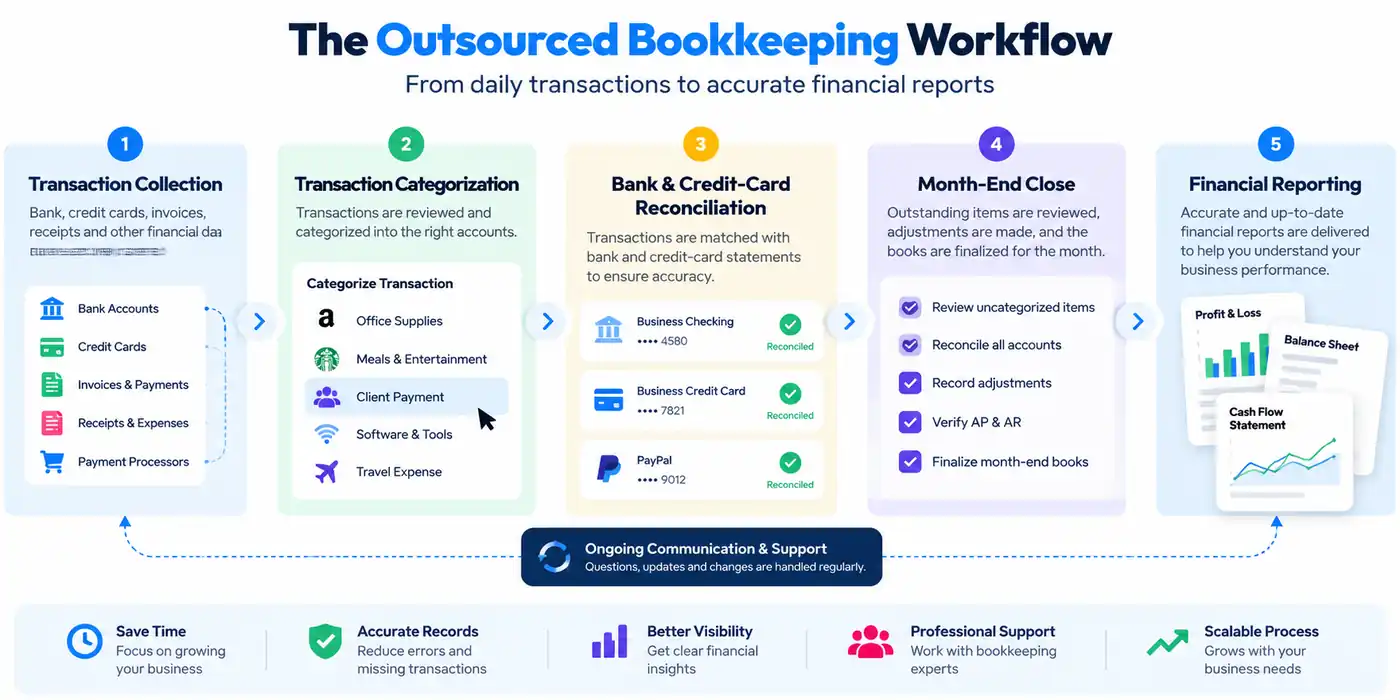
An outsourced bookkeeper maintains and organizes the financial records needed to monitor a company's financial activity. Common outsourced bookkeeping tasks include transaction categorization, bank and credit-card reconciliation, accounts payable, accounts receivable, month-end close, and financial reporting.
For example, an outsourced bookkeeper may review imported bank transactions, categorize business expenses, match customer payments with invoices, reconcile accounts, and prepare monthly financial statements.
In addition, some professional bookkeeping services include catch-up or cleanup bookkeeping when financial records are incomplete or behind schedule. Payroll, tax preparation, financial planning, and CFO advisory may be offered separately, so businesses should never assume that these services are automatically included.
Outsourced bookkeeping matters because accurate financial records help businesses understand their financial position, monitor performance, track expenses, and maintain organized records for financial and tax-related work. A reliable bookkeeping process gives business owners cleaner financial information for day-to-day decisions and longer-term planning.
For example, a business that regularly reconciles its bank accounts can identify missing transactions, duplicate entries, unexpected fees, and other discrepancies before they become larger problems.
Furthermore, outsourcing can move recurring bookkeeping work away from business owners and employees. Instead of spending several hours each week maintaining transactions and reconciliations, an owner can use that time for customers, sales, employees, or strategic decisions.
That being said, outsourcing bookkeeping does not automatically reduce costs or improve financial performance. The value depends on the business's transaction volume, complexity, internal expertise, service requirements, and provider quality.
Outsourced bookkeeping services typically include the recurring financial-recordkeeping activities required to keep business accounts organized, reconciled, and up to date. The core purpose of outsourced bookkeeping is to turn day-to-day financial transactions into organized accounting records and useful financial reports.
For example, a monthly bookkeeping engagement might include transaction categorization, bank reconciliation, credit-card reconciliation, accounts payable and receivable support, month-end close, and financial reporting.
Transaction recording involves entering or importing business income and expenses into the accounting system and assigning them to appropriate accounts. For example, a software subscription can be categorized as a software expense rather than remaining as an uncategorized transaction.
Bank reconciliation compares accounting records with bank statements to identify missing, duplicated, or incorrectly recorded transactions. For example, a bookkeeper may discover that a bank fee appears on a statement but was never recorded in the accounting system.
Accounts payable tracks money a business owes, while accounts receivable tracks money customers owe the business. For example, an outsourced bookkeeping provider may record vendor bills, monitor unpaid invoices, and prepare receivables reports.
Month-end bookkeeping involves reviewing financial activity for a completed accounting period and finalizing the books. For example, a monthly reporting package may include a profit and loss statement, balance sheet, cash-flow information, and account reconciliations.
Bookkeeping cleanup corrects historical errors, missing transactions, unreconciled accounts, or other problems in existing records. For example, a business that has not reconciled its books for several months may need a one-time cleanup project before starting regular monthly bookkeeping.
Payroll processing, payroll tax filings, income tax preparation, audits, financial planning, and CFO advisory are not automatically included in every bookkeeping engagement. Businesses should confirm the provider's exact service scope before signing an agreement.
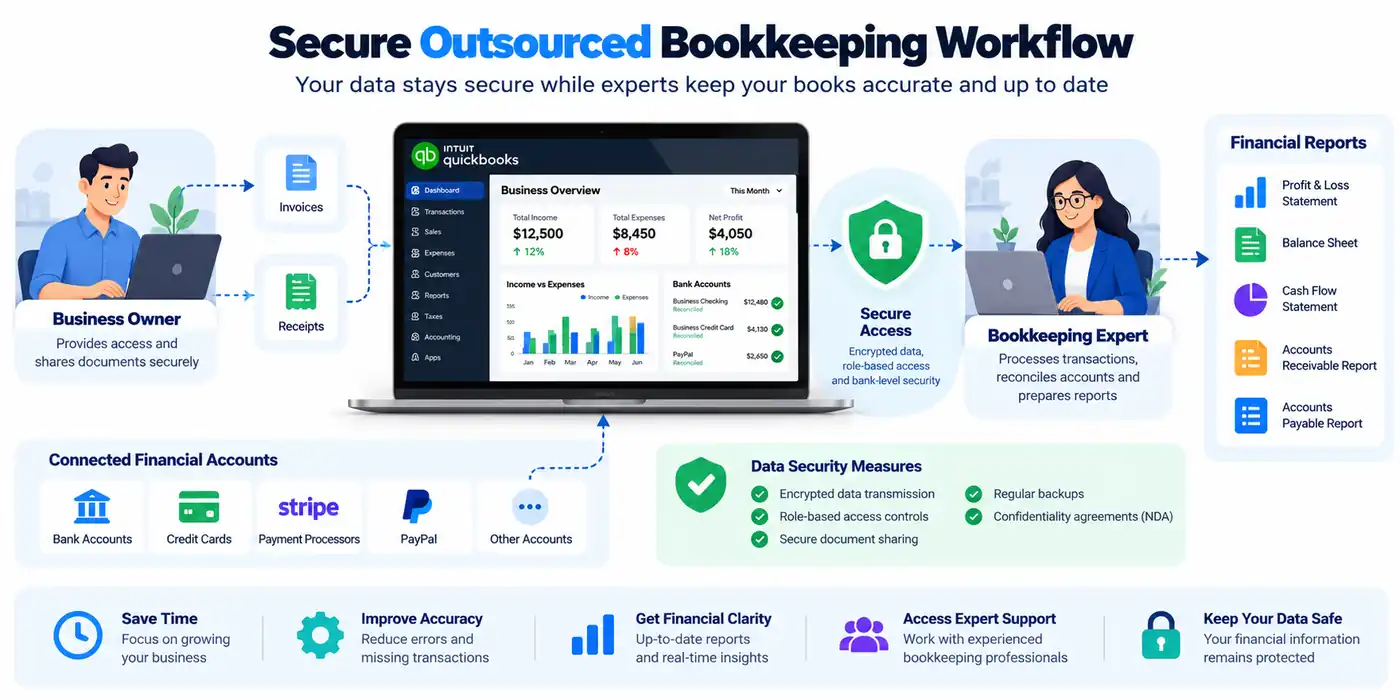
Bookkeeping outsourcing generally follows a structured workflow that moves from assessment and setup to transaction processing, reconciliation, reporting, and ongoing review. A defined outsourcing process gives the business and bookkeeping provider clear responsibilities from the beginning.
For example, a company switching to an outsourced bookkeeping service may first provide previous financial statements, accounting-system access, bank information, and details about its existing bookkeeping process.
A typical outsourced bookkeeping process includes:
As such, a good bookkeeping outsourcing workflow is more than simply handing financial transactions to another company. It establishes a repeatable process for collecting information, maintaining records, reviewing accounts, and communicating financial results.
Outsourced bookkeeping costs vary according to the amount and complexity of work rather than following one universal price. Outsourced bookkeeping pricing is commonly influenced by transaction volume, number of accounts, business complexity, service frequency, cleanup requirements, reporting needs, and additional services.
For example, a small consulting business with a few bank accounts and relatively low transaction volume may need a simpler bookkeeping package than an e-commerce business managing inventory, payment processors, refunds, multiple sales channels, and large transaction volumes.
| Pricing Factor | Why It Matters |
|---|---|
| Transaction volume | More transactions generally require more processing and review |
| Number of accounts | Additional bank and credit-card accounts increase reconciliation work |
| Business complexity | Multiple entities, locations, or revenue streams can increase bookkeeping requirements |
| Service frequency | Weekly, biweekly, and monthly bookkeeping require different workloads |
| Accounts payable | Bill recording and payment-related workflows add work |
| Accounts receivable | Invoice tracking and collections support can expand the scope |
| Cleanup work | Historical errors and backlogs may require one-time additional work |
| Inventory | Inventory businesses may require more complex accounting workflows |
| Reporting | Customized reports can require additional preparation and review |
| Support | Frequent meetings and financial questions can increase service requirements |
Moreover, ongoing bookkeeping and bookkeeping cleanup should be priced separately when their scopes are substantially different. A business with several months of unreconciled transactions may need a one-time catch-up project before recurring bookkeeping begins.
Outsourced and in-house bookkeeping are different staffing models, and neither is automatically better for every company. The right bookkeeping model depends on workload, business complexity, budget, internal expertise, desired control, and required financial support.
| Factor | Outsourced Bookkeeping | In-House Bookkeeping |
|---|---|---|
| Staffing | External bookkeeping provider | Internal employee |
| Hiring | Provider handles its own staffing | Business manages recruitment |
| Expertise | May provide access to multiple specialists | Depends on internal employee expertise |
| Capacity | Can often scale with service scope | Limited by employee capacity |
| Management | Managed through a service relationship | Direct employee management |
| Continuity | Provider may have backup personnel | Can depend heavily on one employee |
| Cost structure | Service or engagement fee | Salary and employment overhead |
| Control | Governed through access permissions | Direct internal access |
| Best fit | Flexible or specialized support | Dedicated internal finance capacity |
For example, a growing professional-services business may choose an outsourced bookkeeping service for small businesses when it needs reliable monthly bookkeeping but does not require a full-time employee.
Conversely, a larger organization with complex internal financial operations may prefer an in-house bookkeeping team because daily financial activities require close coordination with other departments.
Outsourcing bookkeeping can provide access to professional expertise and flexible capacity, but it also creates responsibilities around communication, financial-data access, and provider oversight. The best outsourcing decision considers both the benefits and limitations instead of assuming that external bookkeeping is always the better option.
First, outsourcing can reduce the amount of recurring bookkeeping administration handled by business owners and internal employees. For example, an owner can delegate transaction categorization and reconciliation instead of spending several hours each week maintaining the books.
Second, outsourced bookkeeping can provide access to specialized expertise without requiring a business to recruit a dedicated full-time employee. For example, a small company can work with a provider experienced in reconciliations, accounts receivable, accounts payable, and monthly reporting.
Third, outsourcing can provide flexible capacity as bookkeeping requirements change. For example, a business may need extensive cleanup initially and then move to a simpler monthly bookkeeping engagement after its records are brought up to date.
Fourth, consistent bookkeeping can improve financial visibility. Accurate and timely financial reports give business owners a clearer view of income, expenses, assets, liabilities, and overall business performance.
At the same time, outsourced bookkeeping requires effective communication and oversight. A bookkeeping provider cannot produce reliable records when the business provides incomplete information or does not resolve outstanding questions.
For example, if employees fail to submit receipts or explain unusual transactions, the provider may have to leave some items unresolved until the required information becomes available.
Moreover, businesses must consider financial-data security when selecting a provider. Access permissions, document handling, account security, and communication procedures should be reviewed before sensitive financial information is shared.
A small business should consider outsourcing bookkeeping when maintaining accurate financial records becomes a recurring burden or exceeds its available internal expertise. The strongest signal is a mismatch between the bookkeeping workload and the resources available to manage it accurately and consistently.
For example, outsourcing may be worth considering when:
However, outsourcing is not necessary for every small business. A company with simple finances, low transaction volume, current books, and sufficient internal expertise may reasonably continue handling bookkeeping internally.
Small businesses can outsource bookkeeping by first assessing their current records, defining the required services, comparing qualified providers, and establishing a secure workflow. The most effective approach is to outsource a clearly defined workload rather than simply transferring every financial task to an external provider.
For example, a small service business might initially outsource monthly transaction categorization, bank reconciliation, accounts receivable tracking, and financial reporting while keeping payment approvals and strategic financial decisions internally.
Before outsourcing, document:
By documenting these requirements first, you can compare bookkeeping providers more accurately and avoid paying for services your business does not need.
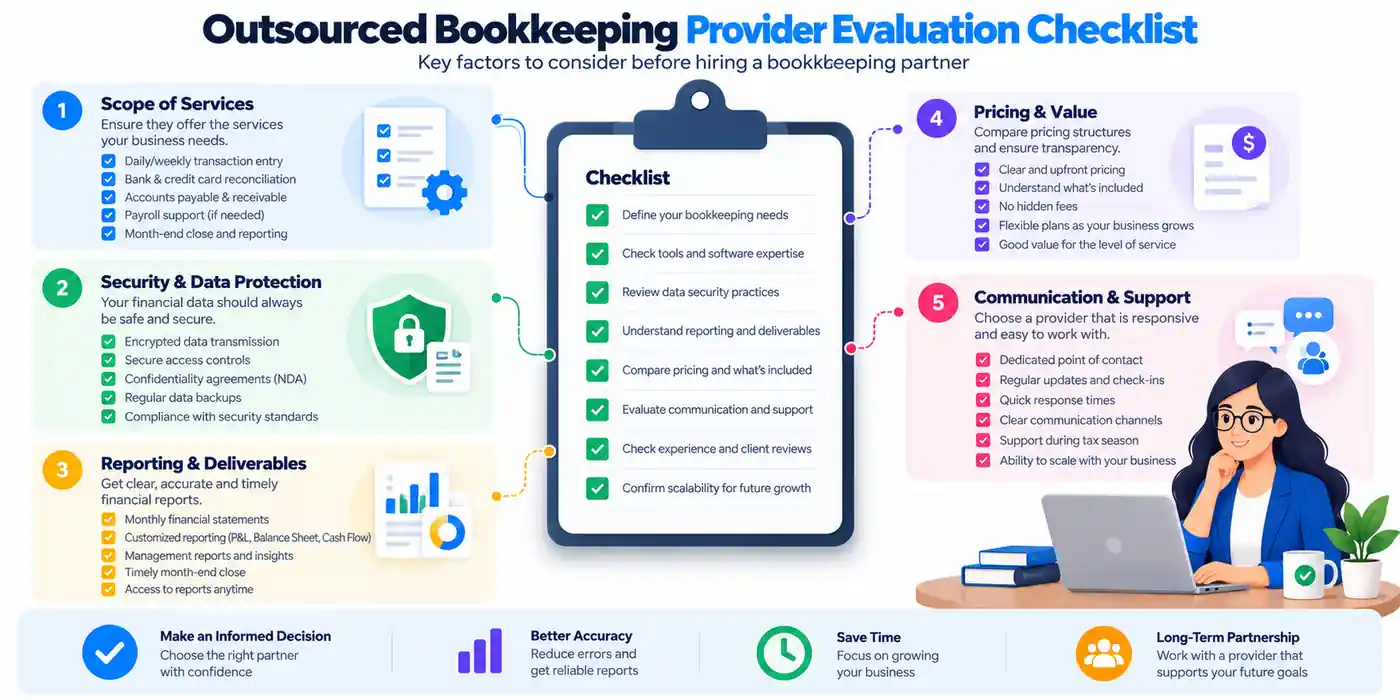
Choosing an outsourced bookkeeping service requires evaluating experience, scope, software expertise, security, communication, reporting, pricing, and continuity. A low monthly price does not necessarily represent the best value if important bookkeeping tasks, reviews, or reports are excluded.
First, look for a provider that understands businesses with similar financial workflows. For example, an e-commerce business may need experience with payment processors, refunds, inventory, sales channels, and high transaction volumes.
Second, ask exactly what the bookkeeping package includes. Confirm whether bank reconciliation, accounts payable, accounts receivable, cleanup, reporting, payroll, and tax-related support are included or billed separately.
Third, verify that the provider understands the accounting software your business uses. QuickBooks Online and Xero are common cloud accounting platforms, but software familiarity should be combined with sound bookkeeping processes.
Fourth, ask how the provider manages user permissions, financial documents, credentials, backups, and sensitive information. Use individual user accounts and appropriate access permissions instead of sharing personal passwords whenever the software supports separate users.
Finally, ask when reports are delivered, who reviews the books, how questions are handled, and how unusual transactions are escalated.
For businesses using QuickBooks Online, see our QuickBooks bookkeeping service to understand how bookkeeping, reconciliation, and financial reporting can be handled as an ongoing workflow.
Before hiring a bookkeeping service provider, businesses should verify the scope of work, pricing, workflow, security practices, communication process, software expertise, and transition plan. A written scope of work helps establish what the provider is responsible for delivering and what remains the client's responsibility.
For example, ask the provider:
Furthermore, businesses should continue maintaining supporting financial documentation even when bookkeeping is outsourced. Receipts, invoices, deposit records, and other transaction documentation help support accounting records and tax-related reporting.
Cloud accounting software is the primary technology used by many outsourced bookkeeping providers to record, reconcile, and report financial transactions. Accounting software supports the bookkeeping workflow, but software alone does not replace professional review and financial-recordkeeping processes.
For example, QuickBooks Online can connect financial accounts and provide a shared accounting environment for business owners and bookkeeping professionals.
Similarly, Xero and other cloud accounting platforms can support remote bookkeeping workflows. The best accounting platform depends on the business's requirements, integrations, transaction volume, reporting needs, and existing systems.
Additionally, businesses should evaluate tools based on workflow requirements rather than choosing software solely because it is inexpensive. A suitable platform should support the provider's reconciliation, reporting, document-management, and collaboration processes.
The right next step depends on the condition of your books, the amount of internal bookkeeping capacity available, and the complexity of your financial operations. Businesses should assess their actual bookkeeping workload before choosing between DIY bookkeeping, an employee, or an outsourced bookkeeping service.
For example, use this decision framework:
If your books are already behind, bookkeeping cleanup and catch-up services can help establish an organized starting point before recurring monthly bookkeeping begins.
Outsourced bookkeeping is a practical way for businesses to delegate recurring financial recordkeeping to an external professional or firm. The right outsourced bookkeeping service can provide consistent financial-recordkeeping support without requiring a business to immediately hire a full-time internal bookkeeper.
Ultimately, outsourcing is not automatically better than in-house bookkeeping. The right choice depends on your transaction volume, financial complexity, internal expertise, budget, reporting requirements, and desired level of control.
If your bookkeeping is becoming difficult to keep current, start by documenting your workload and identifying exactly what you need help with. Then compare bookkeeping providers based on service scope, expertise, security, communication, reporting, and total value—not price alone.
For businesses that need ongoing bookkeeping support, provide monthly bookkeeping, transaction categorization, bank and credit-card reconciliation, accounts payable and receivable, month-end close, financial reporting, and bookkeeping cleanup or catch-up support.
This article is for general informational purposes only and does not constitute tax, legal, financial, or investment advice. Laws, regulations, rates, and procedures may change over time and may vary based on individual circumstances.
While SaveTaxs makes reasonable efforts to keep the information accurate and up to date, readers should verify applicable rules with official authorities or consult a qualified professional before making decisions based on this information.
Hatim Dudhiyawala is a Certified Public Accountant (CPA) with SaveTaxs and specializes in Indian and NRI taxation. He advises individuals, NRIs, and businesses on income tax filing, capital gains taxation, DTAA benefits, fund repatriation, and tax compliance. With experience in cross-border tax matters, Hatim helps taxpayers understand complex regulations and make informed decisions. Through his articles, he shares practical insights to help readers stay compliant and manage their tax obligations with confidence. See Full Bio
Want to read more? Explore Blogs