Payroll Planning
Payroll Outsourcing vs In-House Payroll for NRI-Owned BusinessesPayroll Outsourcing vs In-House Payroll for NRI-Owned Businesses
Written by Shubham Jain


Operating a business in India from another country creates an accounting challenge that goes beyond recording sales and expenses. The Indian entity may have to maintain books under Indian law while simultaneously providing financial information to its foreign parent for management reporting and group consolidation.
Foreign investment, intercompany payments, GST, TDS, payroll, foreign-currency transactions, and related-party dealings can all affect the accounting process.
For this reason, accounting for foreign-owned businesses in India should be designed around both Indian compliance requirements and the reporting expectations of the overseas parent.
This guide explains how foreign-owned businesses can establish and manage an effective accounting and bookkeeping system in India.
The accounting requirements depend partly on how the foreign business operates in India.
Common structures include:
An Indian incorporated company is a separate legal entity from its overseas parent. Its accounting records should therefore clearly reflect the Indian entity's own assets, liabilities, revenue, expenses, capital, and transactions.
For an Indian incorporated company, Section 128 of the Companies Act, 2013 requires the company to prepare and keep books of account and relevant records that give a true and fair view of its affairs. The books are maintained on an accrual basis and according to the double-entry system. Electronic books are permitted subject to the prescribed requirements.
This distinction is particularly important when a multinational group uses centralized finance systems. The Indian entity cannot simply treat the foreign parent's consolidated records as a substitute for its own compliant accounting records.
Businesses still deciding their legal presence in India should first understand setting up a business in India and the applicable Foreign Company Registration in India requirements.
Good bookkeeping for foreign companies in India starts with a complete transaction trail.
Depending on the entity and its activities, records will generally include:
| Accounting area | Typical records |
|---|---|
| Sales | Customer invoices, credit notes, receipts |
| Purchases | Vendor invoices, purchase records, debit notes |
| Banking | Bank statements and reconciliations |
| Expenses | Bills, receipts and employee claims |
| Fixed assets | Asset register, additions and disposals |
| Payroll | Salary records and payroll liabilities |
| Taxes | GST, TDS and other applicable tax records |
| Foreign investment | Bank advice, share-capital and supporting corporate records |
| Intercompany transactions | Agreements, invoices, debit/credit notes |
| Receivables/payables | Customer and vendor ageing |
| Foreign currency | Currency-wise balances and exchange differences |
GST-registered businesses also have specific record-keeping requirements. CBIC rules require relevant businesses to maintain supporting documents such as invoices, bills of supply, delivery challans, credit/debit notes and other prescribed records. Electronic records require appropriate backups, and electronic changes should maintain an edit/delete log where applicable.
The objective should be simple: every material number in the financial statements should be traceable back to an appropriate supporting document.
Get expert accounting and bookkeeping support for your foreign-owned business in India.
A multinational should avoid simply copying its global accounting setup into India without considering Indian reporting requirements.
The better approach is to design a system that supports local compliance while remaining compatible with the group's reporting framework.
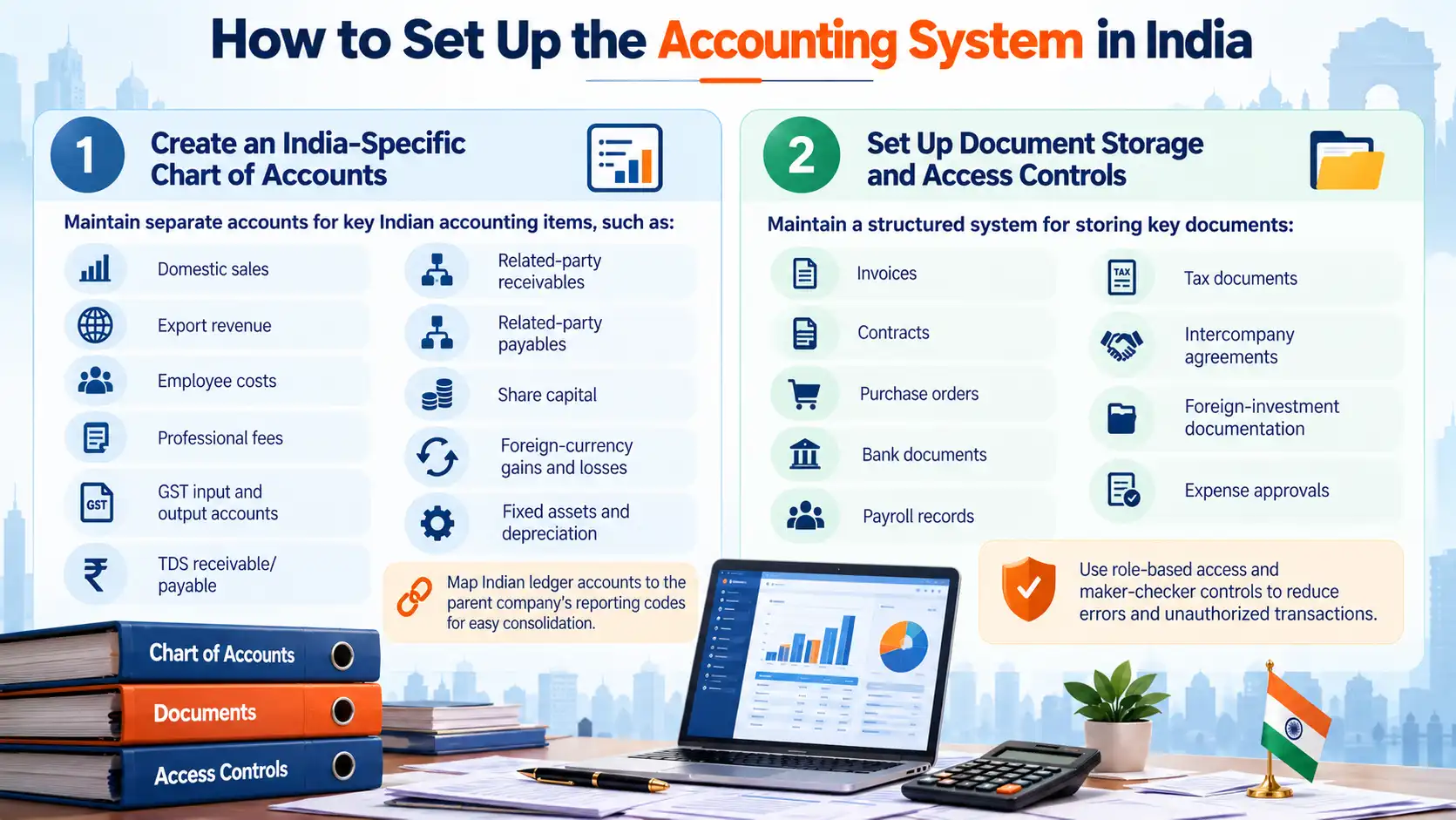
The chart of accounts [the structured list of accounts used to classify transactions] should separately capture items relevant to the Indian operation.
For example:
For effective Indian subsidiary accounting, the chart should also map to the foreign parent's reporting structure.
Suppose the parent uses one global account for "tax liabilities." The Indian company may still need separate ledger accounts for GST, TDS and other Indian tax liabilities so that reconciliations and filings can be prepared correctly.
A mapping table can then connect those Indian ledger accounts to the parent company's consolidated reporting codes.
Accounting is not only about entries in software. Supporting documentation and internal controls matter equally.
Businesses should establish a structured system for storing:
Access should be role-based.
For example, the employee creating a vendor may not be the same person approving the payment. Similarly, the person preparing a bank payment should ideally not have unrestricted authority to approve it.
This maker-checker approach reduces errors and unauthorized transactions.
Foreign groups using centralized ERP systems should also confirm that Indian records remain accessible and capable of meeting local statutory requirements. Under the Companies Act, books may be maintained electronically, while records maintained outside India can trigger requirements relating to copies and accessibility in India.
One major difference between an ordinary domestic business and foreign-owned business accounting in India is the volume of cross-border transactions.
Common transactions include:
Each transaction should be recorded according to its actual legal and commercial nature.
For example, money received from the parent as share capital should not be casually recorded as an ordinary loan simply because both represent incoming funds.
The accounting entry should reconcile with the company's banking documents, corporate records, and applicable foreign-investment documentation.
Foreign investment into India is governed through the FEMA framework and applicable Foreign Exchange Management (Non-Debt Instruments) Rules. RBI's foreign-investment directions also prescribe reporting requirements for relevant transactions.
RBI's FIRMS system is used for several foreign-investment reporting forms, including FC-GPR and FC-TRS.
The accounting team therefore needs to coordinate with the company's legal, secretarial, banking, and tax advisers instead of treating foreign investment as merely another journal entry.
Foreign-currency transactions also require careful accounting because exchange rates can change between the invoice date and settlement date, potentially creating foreign-exchange gains or losses.
Foreign-owned Indian businesses frequently transact with their parent company or other overseas group entities.
Examples include:
These transactions should be separately identifiable in the general ledger.
That is important because cross-border transactions between associated enterprises may fall within India's transfer-pricing framework.
The accounting records should therefore capture details such as the counterparty, transaction type, amount, currency, agreement, invoice, and supporting documentation.
Indian transfer-pricing rules require prescribed information and documentation for applicable international transactions, including details of the multinational group, associated enterprises, transaction terms and pricing.
The Income Tax Department also identifies Form 3CEB as the accountant's report relating to applicable international transactions and specified domestic transactions.
This guide does not cover benchmarking, arm's-length price determination or detailed Form 3CEB filing. Those issues should be handled separately in a dedicated transfer-pricing analysis.
The bookkeeping objective is narrower: make sure the underlying related-party transactions are accurately identified and supported.
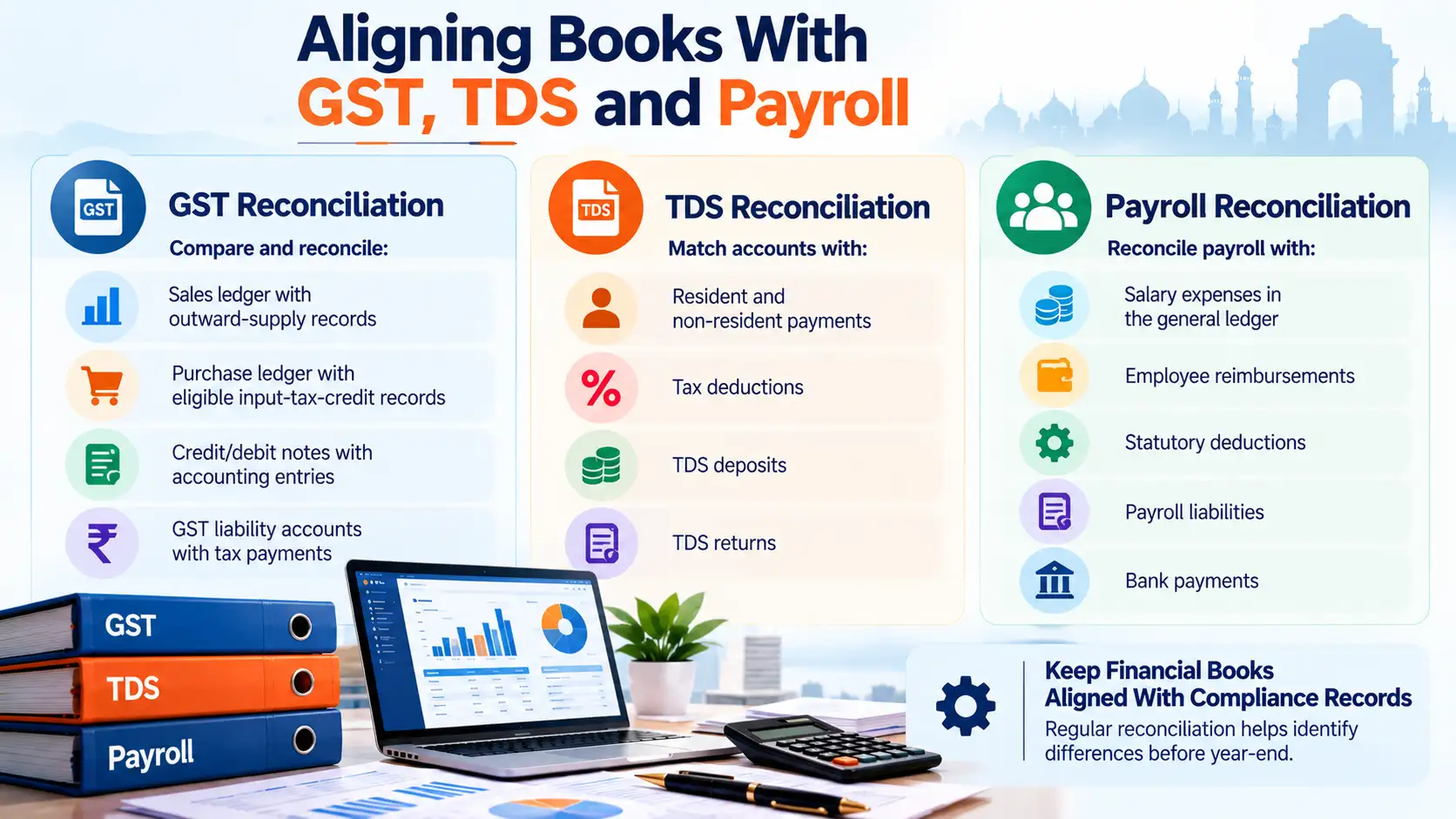
One of the most common problems in accounting compliance for foreign companies is that different teams maintain different numbers.
The accounting ledger may show one amount while the GST return, TDS records or payroll system shows another.
Regular reconciliation helps identify these differences before year-end.
Where GST applies, businesses should compare:
The CGST framework requires registered persons to maintain true and correct accounts covering relevant inward/outward supplies, input tax credit and tax payable/paid.
TDS [Tax Deducted at Source] accounts should be matched with applicable resident and non-resident payments, tax deductions, deposits and returns.
Unreconciled TDS can create differences between expenses recorded in the books and tax-compliance records.
Payroll should be reconciled with:
The accounting team does not necessarily need to run every compliance process itself. But the financial books should ultimately agree with the underlying compliance records.
A foreign-owned Indian company may have two reporting audiences.
The first is India, where it must prepare financial information according to applicable Indian legal and accounting requirements.
The second is the overseas parent, which may need the Indian entity's results for management reporting and group consolidation.
Under Section 129 of the Companies Act, financial statements must give a true and fair view and comply with applicable accounting standards and prescribed presentation requirements.
Indian companies are also subject to the statutory-auditor framework under Section 139 of the Companies Act.
The parent reporting package may include:
Differences can arise between Indian reporting requirements and the accounting framework used by the foreign parent.
The finance team should therefore maintain a clear mapping and reconciliation process rather than changing Indian books solely to match the parent's reporting format.
A disciplined monthly close makes year-end reporting significantly easier.
A typical monthly accounting process for a foreign-owned company may follow this sequence:
This process turns bookkeeping into a financial-control system rather than a year-end compliance exercise.
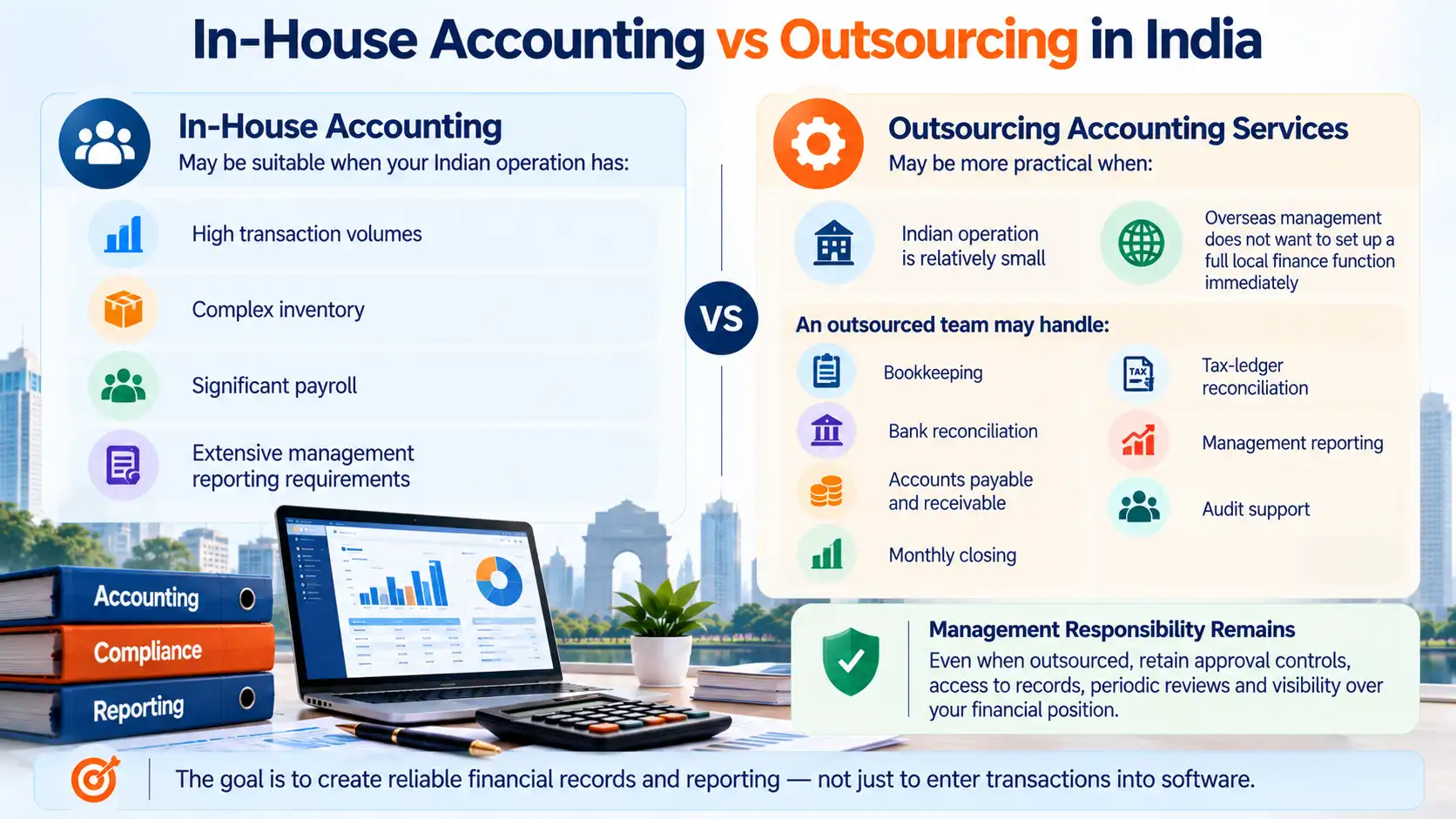
Foreign-owned businesses can build an internal finance department or use outsourced accounting services in India.
An in-house team can make sense where the Indian operation has high transaction volumes, complex inventory, significant payroll or extensive management-reporting requirements.
Accounting services for foreign companies in India may be more practical when the Indian operation is relatively small or the overseas management team does not want to establish a full local finance function immediately.
An outsourced team may handle:
However, outsourcing does not eliminate management responsibility.
The company should retain appropriate approval controls, access to records, periodic reviews, and visibility over its financial position.
The goal of bookkeeping services in India for foreign companies should be to create reliable records and reporting—not simply to enter transactions into software.
Foreign-owned businesses should particularly watch for these problems:
These issues can affect financial statements, tax filings, audits, transfer-pricing documentation and parent-company reporting simultaneously.
A strong cross-border accounting India process addresses them throughout the year.
Savetaxs helps foreign-owned businesses maintain accurate books and manage their Indian accounting requirements.
Managing accounting for foreign-owned businesses in India requires coordination between local bookkeeping and the wider cross-border compliance environment.
Savetaxs can assist foreign-owned businesses with accounting and finance processes such as bookkeeping, account reconciliations, management reporting, tax-ledger coordination and preparation of records required for professional review.
The appropriate setup depends on the Indian entity's structure, transaction volume, foreign-parent reporting requirements and the nature of its cross-border transactions.
Businesses should establish these processes early rather than trying to reconstruct their accounting records immediately before an audit, tax filing or group reporting deadline.
For a foreign-owned business, accounting in India is more than maintaining a ledger.
The accounting system needs to connect the Indian entity's day-to-day transactions with statutory records, tax accounts, foreign investment, related-party dealings, financial statements and the overseas parent's reporting requirements.
A properly designed accounting for Indian subsidiary process creates that connection from the beginning.
When the chart of accounts, supporting documentation, reconciliations, internal controls and monthly reporting processes are established correctly, the Indian entity is better positioned for financial reporting, audit, tax compliance and group consolidation.
This article is for general informational purposes only and does not constitute tax, legal, financial, or investment advice. Laws, regulations, rates, and procedures may change over time and may vary based on individual circumstances.
While SaveTaxs makes reasonable efforts to keep the information accurate and up to date, readers should verify applicable rules with official authorities or consult a qualified professional before making decisions based on this information.
Hatim Dudhiyawala is a Certified Public Accountant (CPA) with SaveTaxs and specializes in Indian and NRI taxation. He advises individuals, NRIs, and businesses on income tax filing, capital gains taxation, DTAA benefits, fund repatriation, and tax compliance. With experience in cross-border tax matters, Hatim helps taxpayers understand complex regulations and make informed decisions. Through his articles, he shares practical insights to help readers stay compliant and manage their tax obligations with confidence. See Full Bio
Want to read more? Explore Blogs