Bookkeeping
Outsourced Bookkeeping: The Complete Guide to Services, Costs, Benefits & Choosing a ProviderOutsourced Bookkeeping: The Complete Guide to Services, Costs, Benefits & Choosing a Provider
Written by Hatim Dudhiyawala

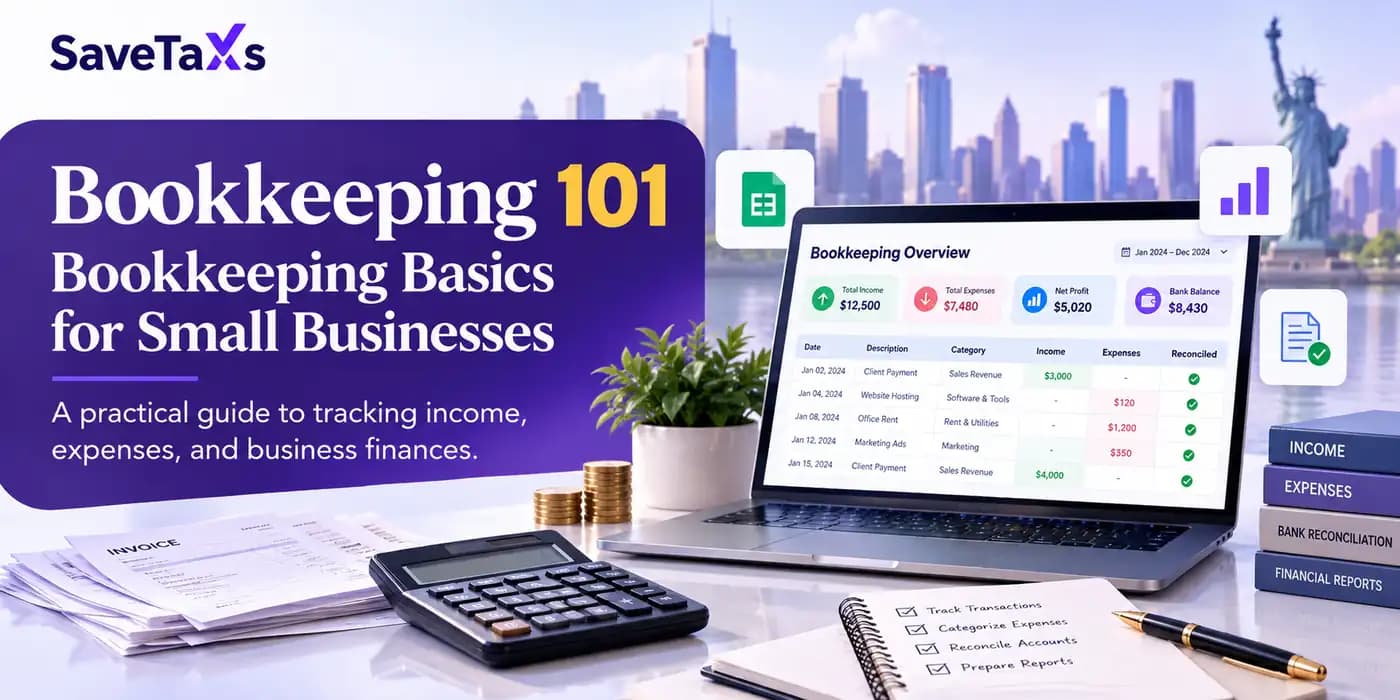
You've probably already been tracking sales, paying bills, sending invoices, and saving receipts as your business grows. However, keeping those transactions organized—and turning them into reliable financial records—can be confusing when you're new to bookkeeping. In this guide, we'll explain small-business bookkeeping from the ground up, including what to record, how the process works, which reports matter, and when professional help makes sense.
Bookkeeping is the process of recording, categorizing, and maintaining a business's financial transactions and supporting records. It creates an organized financial record of what your business earns, spends, owns, and owes.
For example, if a consulting business receives $3,000 from a client and spends $600 on business software, those transactions need to be recorded and categorized correctly. The resulting records can then be used to reconcile the business's accounts and prepare financial reports.
At its simplest, bookkeeping answers questions such as:
Moreover, bookkeeping is different from accounting. Bookkeeping focuses primarily on recording and organizing financial transactions, while accounting uses financial information to analyze, report, and interpret the business's finances.
For example, a bookkeeper may record a $1,500 software expense, while an accountant may later use the completed records to prepare financial statements or address tax-related accounting questions.
Bookkeeping is important because accurate financial records help a business monitor performance, prepare financial statements, track expenses, and support information reported on tax returns. The IRS specifically identifies these purposes as reasons businesses should maintain good records. IRS
First, organized bookkeeping gives you a clearer picture of financial health. For example, a business may have $20,000 in monthly sales but still experience cash-flow problems if customers pay slowly while expenses are due immediately.
Second, bookkeeping makes tax preparation more manageable. The IRS states that business records should support income, expenses, and other amounts reported on a tax return. IRS
Third, good records can help you identify problems earlier. For example, a monthly reconciliation may reveal a duplicate payment, missing deposit, unexpected bank charge, or incorrectly categorized transaction.
Finally, organized records can make it easier to work with accountants, lenders, investors, and other financial professionals.
Important: Bookkeeping records do not automatically make an expense tax-deductible. Whether an expense qualifies for a deduction depends on applicable tax rules and the facts of the transaction.
A small business bookkeeping system tracks financial transactions that affect the business's income, expenses, assets, liabilities, and equity.
At a practical level, this usually includes:
| Category | What it represents | Example |
|---|---|---|
| Income | Money earned by the business | Client payment |
| Expenses | Costs incurred by the business | Software subscription |
| Accounts receivable | Money customers owe | Unpaid invoice |
| Accounts payable | Money the business owes | Unpaid vendor bill |
| Assets | Resources owned by the business | Computer or equipment |
| Liabilities | Amounts the business owes | Business loan |
| Equity | Owner's financial interest | Owner contribution |
| Bank/credit-card activity | Movement of business funds | Deposit or card purchase |
First, source documents support these records. The IRS identifies documents such as invoices, receipts, deposit slips, canceled checks, and paid bills as examples of supporting documentation. IRS
For example, if you purchase a $2,000 computer for business use, the bookkeeping record should be supported by documentation showing the transaction and amount paid.
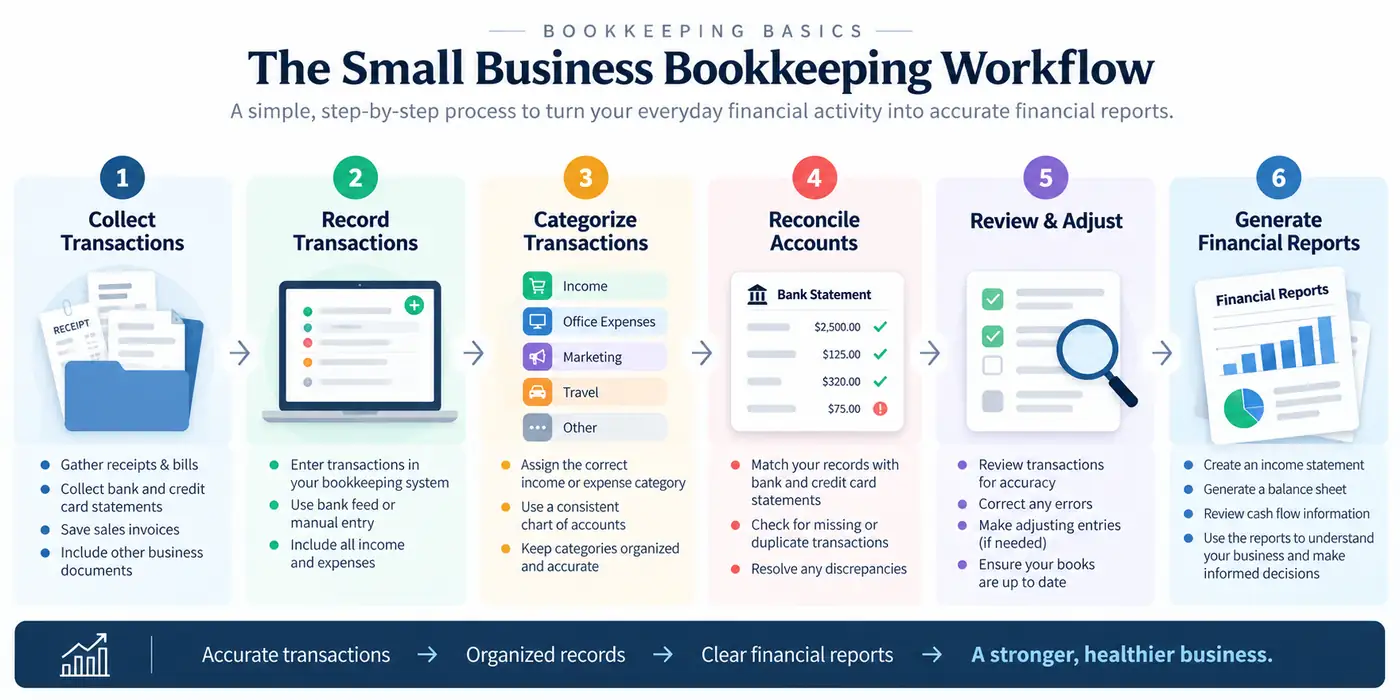
The basic bookkeeping process involves recording transactions, categorizing them correctly, reconciling financial accounts, and reviewing financial reports.
First, gather the documents that support your business transactions. These can include sales invoices, receipts, bills, bank statements, credit-card statements, deposit records, and other relevant documents.
For example, a marketing agency might collect client invoices, software receipts, advertising bills, bank statements, and credit-card statements during the month.
Second, enter your transactions into your bookkeeping system. Depending on the business and accounting system, transactions may be entered manually or imported through bank and financial-account connections.
The IRS notes that business transactions are ordinarily summarized in books such as journals and ledgers, and electronic systems can also be used when they maintain complete and accurate records. IRS
For example, a $500 payment from a client should be recorded as business income rather than simply appearing as an unexplained bank deposit.
Third, assign each transaction to the appropriate account or category. Correct categorization helps your financial reports accurately reflect the business.
For example, a $200 payment for business software should not be categorized the same way as a $200 owner withdrawal.
Accurate categorization is one of the foundations of useful bookkeeping because financial reports depend on how transactions are classified.
Fourth, reconcile your bookkeeping records with your bank and credit-card statements. Reconciliation helps identify transactions that are missing, duplicated, incorrectly recorded, or otherwise inconsistent.
For example, your bookkeeping system might show a $750 payment while the bank statement shows $570. Reconciliation gives you an opportunity to investigate the discrepancy before relying on the financial reports.
Finally, review the reports generated from your bookkeeping records. The income statement, balance sheet, and cash-flow information can show different aspects of the business.
For example, a profitable business can still have limited cash if significant amounts of revenue are tied up in unpaid customer invoices.
Cash-basis bookkeeping generally recognizes income and expenses when money is received or paid, while accrual-basis accounting generally recognizes income when earned and expenses when incurred, subject to applicable rules. IRS
Cash-basis accounting generally records income when you receive payment and expenses when you pay them.
For example, if you send a $2,000 invoice in December but receive payment in January, the timing of the income under the cash method generally follows when the payment is received.
The IRS notes that many individuals and sole proprietors without inventory use the cash method, although specific tax rules and eligibility requirements can apply. IRS
Accrual-basis accounting generally records income when it is earned and expenses when they are incurred, rather than waiting for the related cash movement.
For example, if your business provides $2,000 of services in December and invoices the customer, accrual accounting may recognize the revenue before the customer pays.
The choice of accounting method can have tax implications, and businesses generally need to use a method that clearly reflects income and follow applicable IRS requirements. IRS
Do not choose an accounting method solely because it appears simpler. Your business structure, inventory, revenue, transactions, and tax situation can affect which method is appropriate.
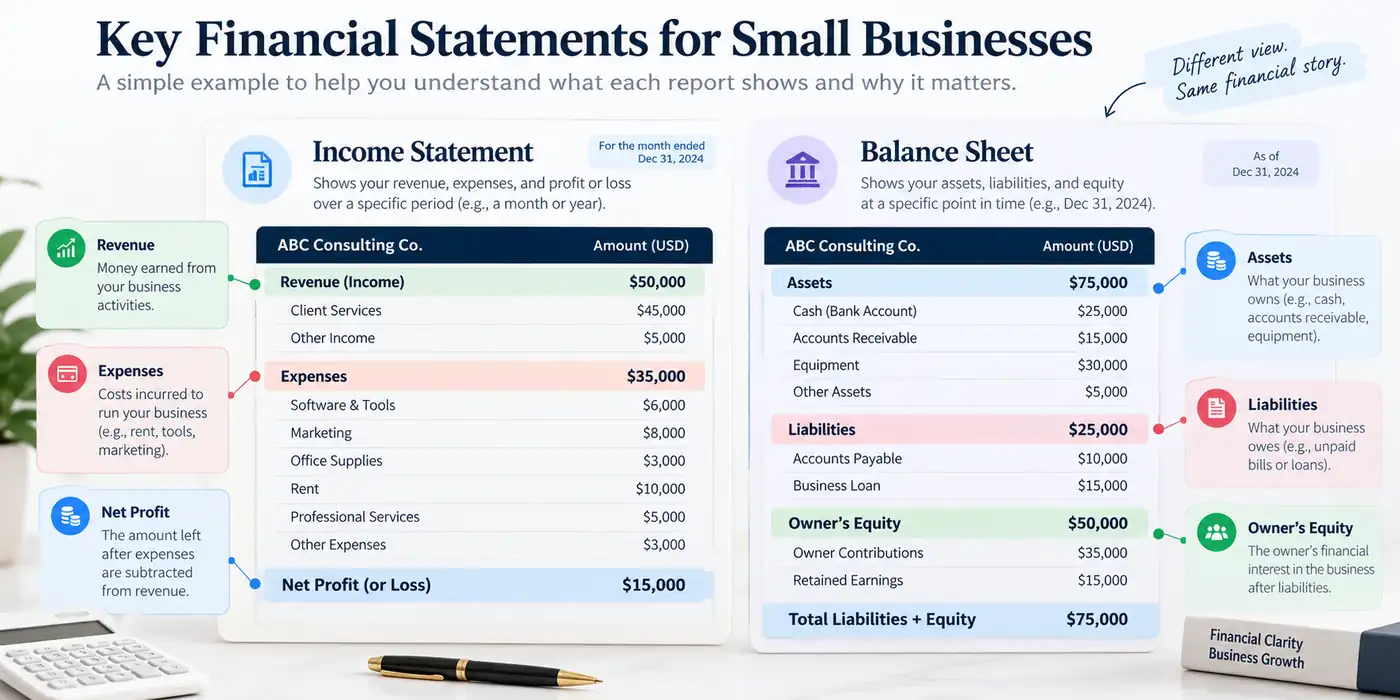
The most important financial reports for a small-business owner are the income statement, balance sheet, and cash-flow information because each provides a different view of the business.
An income statement shows the business's income and expenses for a specific period. IRS
For example, if your business generated $50,000 of revenue and had $35,000 of expenses during a month, the income statement helps show the resulting profit or loss.
A balance sheet shows the business's assets, liabilities, and equity at a specific point in time. IRS
For example, the balance sheet can show how much the business owns in cash and equipment compared with its outstanding obligations.
Cash-flow information helps you understand how money moves into and out of the business.
For example, a business can report strong sales while experiencing cash pressure because customers have not yet paid their invoices.
Small-business bookkeeping should generally be updated frequently enough that transactions remain current and errors can be identified before they accumulate.
First, recording transactions regularly reduces the chance of forgetting expenses or losing supporting documentation. The IRS states that it is generally best to record transactions daily. IRS
Second, many small businesses can use a weekly routine to review transactions, invoices, and outstanding bills.
Third, monthly bookkeeping should generally include reconciliation of relevant bank and credit-card accounts and a review of financial reports.
A practical schedule might look like this:
Common bookkeeping mistakes include mixing personal and business transactions, failing to reconcile accounts, misclassifying transactions, and waiting too long to update records.
First, separating business and personal finances makes bookkeeping easier to maintain. The IRS recommends keeping a business checking account separate from a personal checking account. IRS
For example, paying personal shopping expenses from a business account can make it harder to identify legitimate business transactions.
Second, failing to reconcile accounts can allow errors to remain hidden.
For example, a duplicated expense may continue appearing in your books even though the bank account contains only one payment.
Third, incorrect categories can distort financial reports.
For example, recording an owner withdrawal as an operating expense can make business expenses appear higher than they actually are.
Finally, postponing bookkeeping until tax season can turn a manageable monthly task into a large cleanup project.
Consistent bookkeeping is usually easier to maintain than reconstructing months of financial activity after records have fallen behind.
Small-business bookkeeping tools include accounting software, spreadsheets, bank feeds, receipt-management systems, and reconciliation features.
First, accounting software can centralize transactions, financial accounts, invoices, and reports. It is generally more scalable than manually maintaining multiple spreadsheets.
Second, a spreadsheet can be sufficient for a very simple business with limited transactions, provided the records remain accurate and complete.
Third, digital receipt and document storage can help connect supporting documentation to bookkeeping records.
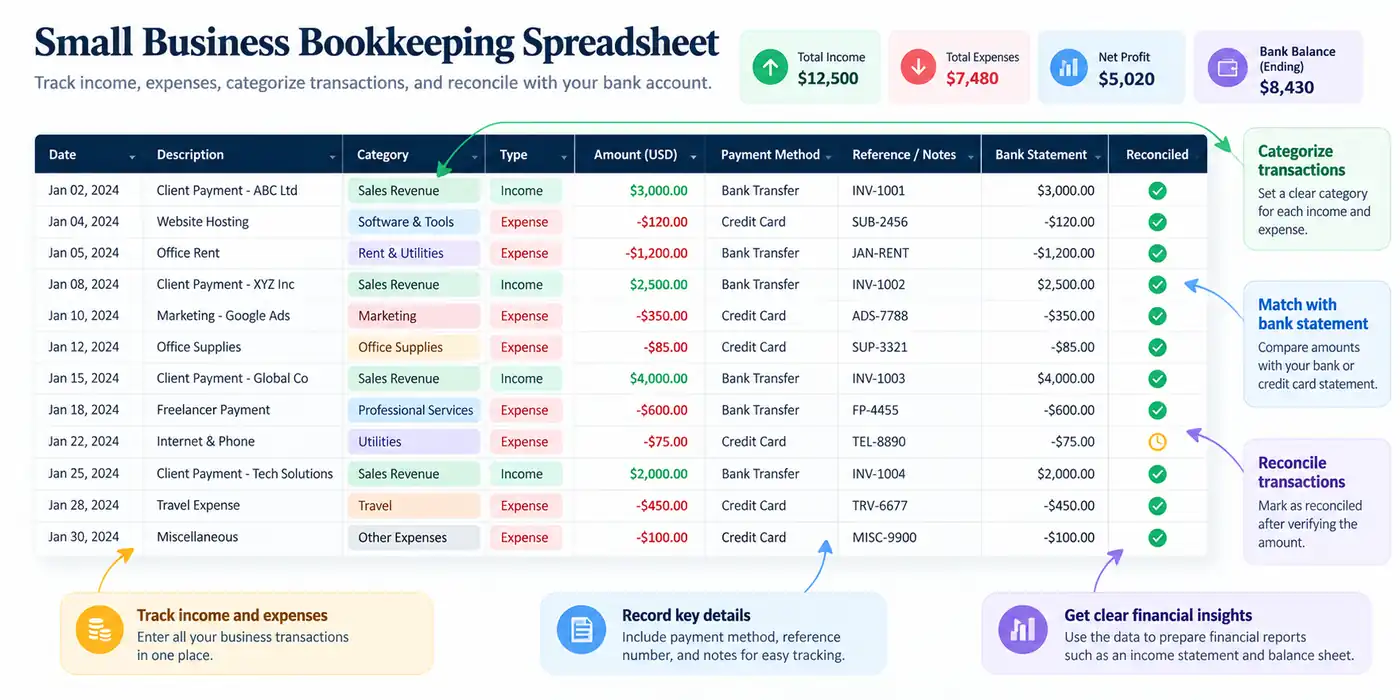
Moreover, the best tool depends on the complexity of the business. A freelancer with a handful of monthly transactions may have different needs from a growing company with employees, inventory, multiple bank accounts, credit cards, and significant accounts receivable.
DIY bookkeeping can work when the business has relatively simple transactions, the owner understands the system, and the owner can consistently maintain accurate records.
For example, a solo consultant with one business bank account, limited expenses, no employees, and straightforward customer payments may be able to manage basic bookkeeping with appropriate software.
However, professional bookkeeping becomes more valuable as complexity increases. Consider getting help when you have:
Furthermore, a bookkeeper and an accountant can have different roles. A bookkeeper primarily maintains financial records, while an accountant may analyze those records, prepare financial statements, address accounting matters, or provide tax-related services depending on their qualifications and engagement.
If you are considering outsourcing, bookkeeping services can be a relevant next step for understanding what professional bookkeeping support can include.
A practical bookkeeping setup starts with separating financial activity, selecting an appropriate system, recording transactions consistently, and reconciling accounts regularly.
Use this beginner checklist:
The IRS states that businesses can generally choose a recordkeeping system suited to their needs as long as it clearly shows income and expenses. IRS
For example, a new consultant could start with separate business banking, accounting software, a simple chart of accounts, digital receipt storage, and a monthly reconciliation routine.
Record-retention periods also vary by the type of document and circumstances. The IRS states that records should generally be kept as long as needed to substantiate income or deductions, rather than applying one universal retention period to every business document. IRS
For employment tax records specifically, the IRS states that businesses should keep them for at least four years. — Source: IRS, 2025 recordkeeping guidance. IRS
Bookkeeping is the foundation for organized, useful small-business financial records. By recording transactions consistently, categorizing them correctly, reconciling accounts, and reviewing financial reports, you can build a clearer picture of how your business is performing.
Moreover, you do not need to become an accountant to establish good bookkeeping habits. Start with separate business finances, an appropriate bookkeeping system, organized supporting documents, and a regular review schedule.
As your business grows, your bookkeeping needs may grow with it. When transactions become more complex or maintaining accurate books takes time away from running the business, professional bookkeeping support can help keep your financial records current and organized.
This article is for general informational purposes only and does not constitute tax, legal, financial, or investment advice. Laws, regulations, rates, and procedures may change over time and may vary based on individual circumstances.
While SaveTaxs makes reasonable efforts to keep the information accurate and up to date, readers should verify applicable rules with official authorities or consult a qualified professional before making decisions based on this information.
Shubham Jain is the Founder of SaveTaxs and has extensive experience in Indian and NRI taxation. He advises individuals, NRIs, and businesses on tax filing, tax planning, capital gains, DTAA benefits, fund repatriation, and compliance matters. He regularly writes about taxation and related financial topics. His focus is on making complex tax concepts easy to understand. Through his articles, he helps taxpayers stay informed, avoid common mistakes, and stay compliant with Indian tax laws. See Full Bio
Want to read more? Explore Blogs