


Investment & Financial Planning
NRI Property Sale: How to Calculate Capital Gains TaxNRI Property Sale: How to Calculate Capital Gains Tax
Written by Shubham Jain

_1767333184.png&w=3840&q=75)
Alternative Investment Funds (AIFs) for NRIs are privately pooled investment vehicles in India that collect money from sophisticated investors. The funds are invested in non-traditional assets like private equity, venture capital, real estate, etc., potentially offering higher returns.
These funds are governed by the Securities and Exchange Board of India (SEBI). AIFs have longer lock-in periods, typically ranging from 3-10 years, and have a minimum investment requirement of Rs. 1 crore. A Non-Resident Indian (NRI) can invest in an AIF through NRE/NRO accounts with an authorized Indian bank.
An NRI must complete KYC and comply with FEMA regulations to be eligible to invest in an AIF. The process to invest in AIFs requires specific documents, adhering to minimum investment thresholds, and routing funds via specified bank accounts. In this blog, we will discuss how an NRI can invest in an AIF in India.
According to the Securities and Exchange Board of India (SEBI), an AIF (Alternative Investment Fund) is a privately pooled investment vehicle established or registered in India. These funds raise funds from sophisticated investors, both Indian and foreign, to invest based on a defined investment policy for the benefit of its investors.
AIF offers numerous strategic benefits for Non-Resident Indian (NRI) investors. Unlike mutual funds, AIFs focus on assets that are typically absent from traditional financial markets. These funds provide access to unique investment opportunities, including startups, private equity, and venture capital.
Generally, they are structured as closed-ended funds with investment tenures ranging from 3 to 10 years, allowing fund managers the necessary time to implement their strategies and generate returns.
Alternative investment funds are open to investments from all Indian residents, including Non-Resident Indians (NRIs), Persons of Indian Origin (PIOs), and Overseas Citizens of India (OCIs), with units being issued to investors. However, the fund manager's compliance policies may impose some restrictions on investments originating from certain geographical locations. Moreover, to invest in an AIF, you need to fulfill some eligibility criteria.
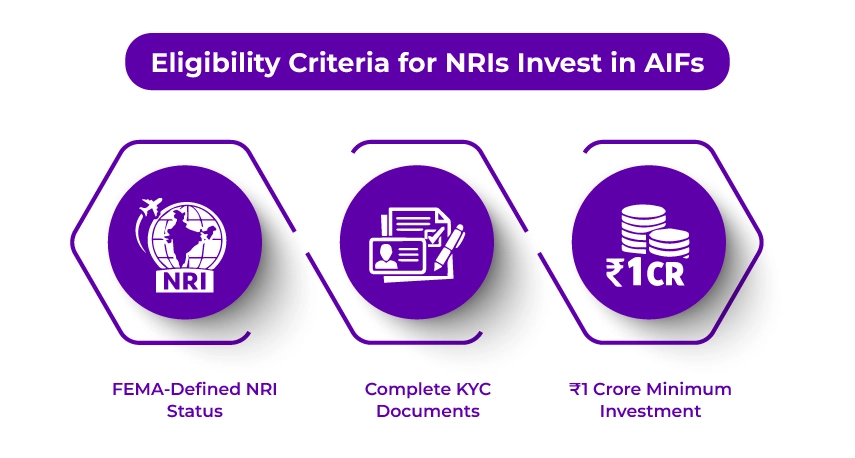
NRIs must meet the following eligibility requirements to invest in an AIF:
Alternative Investment Funds (AIFs) offer several benefits for the NRIs, some of which are as follows:
Avoid tax filing stress and ensure accuracy by letting experts handle your return.
Follow the steps below if you are an NRI looking to invest in Alternative Investment Funds in India:
First, you must ensure that you meet the required eligibility criteria. According to the Foreign Exchange Management Act (FEMA), NRIs can invest in all categories of AIFs by purchasing units.
For KYC compliance, you will need to provide documents such as your PAN card, passport, proof of overseas address, and a recent photograph.
You will need to open either an NRE (Non-Resident External) or an NRO (Non-Resident Ordinary) account with a registered Indian bank. Additionally, a Portfolio Investment Scheme (PIS) account is necessary as per the Reserve Bank of India (RBI) guidelines. Keep in mind that you can only maintain one PIS account at a time.
Most AIFs require a minimum investment of Rs. 1 crore. However, employees or directors of the AIF or its manager can invest a lower amount of Rs. 25 lakh. Typically, these funds also impose a 3-year lock-in period.
A FEMA declaration is essential for AIF investors. Make sure all the documents are notarized or banker-attested when they are sent from abroad.
Once your documents are verified, you can transfer your funds from your NRE/NRO account to the specified AIF document. An NRE account is preferable for overseas earnings, as it offers complete repatriation benefits (both principal and interest) and remains tax-exempt in India.
NRI families can also access the Indian capital markets through GIFT City by setting up a non-retail AIF or Fund of Funds. This option requires:
Tax considerations are crucial when making informed decisions regarding your investments in AIFs. The taxation framework for AIFs in India is defined by specific regulations that significantly impact your return as an NRI investor.
In India, different categories of AIFs are subject to different tax regimes. Category I and II AIFs benefit from a favorable "pass-through" status, meaning the income generated (not including business income) is directly passed to you as the investor. This avoids taxation at the fund level. Conversely, Category III AIFs are subject to taxation at the fund level under applicable tax rates.
As an NRI investor, you will face specific tax deducted at source (TDS) rates for your AIF investments, which can range from 10% to 30%. You may also take advantage of the Double Taxation Avoidance Agreement (DTAA) between India and your country of residence, which could reduce your tax burden or allow you to claim credits for the taxes paid in India when filing ITR in your home country.
To access these benefits, obtaining a Tax Residency Certificate from your country is essential.
Additionally, the Reserve Bank of India (RBI) regulates the repatriation of returns from your AIF investments. Income from Category I and II AIFs can be repatriated freely after tax obligations are met, while Category III AIFs may require you to fulfill additional criteria for repatriation.
Enjoy stress-free tax filing and maximize your refund with a dedicated expert.
An NRI can grow their investment portfolio in India's growing economy by investing in AIFs. Unlike traditional markets, it gives access to various investment opportunities under SEBI. A minimum investment of Rs. 1 crore in an AIF is mandatory, as it indicates a focus on high-net-worth and institutional investors. Additionally, these funds have a more extended lock-in period, typically ranging from 3-10 years. So, these are ideal for NRIs seeking long-term financial planning.
Moreover, to navigate the complex regulations of investing in an AIF, seek expert assistance from Savetaxs. We have a team of experts who can assist you in selecting the most suitable AIF category for your financial goals and help you stay compliant with the rules. You can remain confident that you are availing of all the benefits and managing all the tax implications. Reach out to us now and broaden your portfolio by investing in AIF.
This article is for general informational purposes only and does not constitute tax, legal, financial, or investment advice. Laws, regulations, rates, and procedures may change over time and may vary based on individual circumstances.
While SaveTaxs makes reasonable efforts to keep the information accurate and up to date, readers should verify applicable rules with official authorities or consult a qualified professional before making decisions based on this information.
Vipul Jain is the Co-Founder of SaveTaxs and a tax expert with experience in Indian and NRI taxation. He advises individuals, NRIs, and businesses on tax filing, tax planning, capital gains, DTAA, and compliance matters. He focuses on making complex tax concepts simple and helping taxpayers make informed, compliant decisions. See Full Bio

Want to read more? Explore Blogs

_1781845771869.webp&w=828&q=75)
_1778936280179.webp&w=828&q=75)