-for-401(k)_1790057066765.webp&w=828&q=75)
US Tax Filing and Compliance
Net Unrealized Appreciation (NUA) for 401(k): A Guide for NRIs Moving to IndiaNet Unrealized Appreciation (NUA) for 401(k): A Guide for NRIs Moving to India
Written by Vipul Jain
_1786712557156.webp&w=3840&q=75)
Imagine, just like on other days from New Jersey, you are trying to send money back home to your parents in India, but suddenly you get a notification of an unexpected deduction. This is a situation some people sending money from the United States may encounter in 2026, depending on how they fund the transfer. It is because of the new 1% remittance transfer tax under Section 4475 of the Internal Revenue Code, enacted by the One, Big, Beautiful Bill Act (OBBBA).
With the introduction of the "One Big Beautiful Bill Act," transferring money from the US to India is not only about selecting the fastest delivery method. It is also about While the remittance tax was initially proposed at 5% and later reduced to 3.5% in the House version, the final law enacted a 1% tax on qualifying remittance transfers.
Confused? This blog simplifies everything. It breaks down what changes actually, what impact the US Tax Bill 2025 has on NRI remittances, and how you can avoid it. So read on and gather all the information.
The "US Tax Bill 2025," which has become a significant topic of discussion among the NRI community in the US and their family WhatsApp group, is known as the One Big Beautiful Bill Act (OBBBA). This is a large tax and spending law signed on July 4, 2025, by the US President, Mr. Trump.
Although the new act impacts several US tax codes, it has become a matter of concern among NRIs, as it imposes a remittance tax on money they send outside the US, including India. From January 1, 2026, the tax started to apply to certain money transfers made overseas from the US that used physical methods such as cash, cashier's checks, and more.
This was all about the US Tax Bill 2025. Moving ahead, let's know the remittance tax rate imposed on money transfers overseas.
Did you know you didn't get the remittance tax rate in one go? It has changed several times. This further led to confusion within the NRI community. Considering this, it is worth knowing the remittance tax rate journey, as it explains the anxiety among NRIs about it.
So now don't be confused if you are reading a 5% remittance tax rate; the actual tax rate is one-fifth of the original proposed rate, i.e., 1%. Moving further, let's know what the final law actually says about the remittance tax rate.
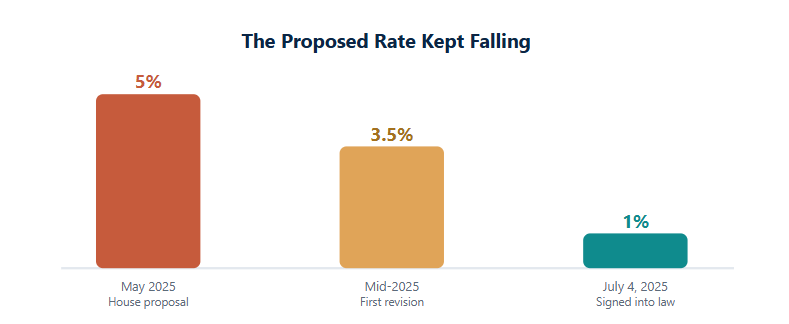
As mentioned earlier, the official and final federal excise tax is 1%, which came into effect for any money transfers made overseas from the US on or after January 1, 2026.
So, the actual remittance tax rate that applies to money transfers from the U.S. to other countries, including India, is 1% for physical methods. Moving forward, let's know who is liable to pay this tax.
In April 2026, the Treasury Department and IRS issued proposed regulations providing additional guidance on Section 4475. The proposed rules would treat traveler's checks as taxable physical instruments. They also clarify that certain other payment methods, including personal or business checks, debit cards, credit cards, and general-use prepaid cards, generally do not trigger the tax, subject to the proposed anti-avoidance rules.
The proposed regulations also clarify that the tax base is generally the amount ultimately transferred to the designated recipient, rather than separate service fees or other amounts that are not transferred to the recipient.
Because these are proposed regulations, not final regulations, this section should be updated if Treasury and the IRS subsequently issue final rules.
Connect with Savetaxs, get a clear idea of your US tax obligations, and pay them on time.
When the remittance tax was first introduced, it did not include US citizens transferring money from the US to overseas. Well, it did not proceed further to the final law. Considering this, the tax applies to the method you use to transfer the money overseas rather than your residential status in the US.
So, whether you are an NRI or a US citizen, if you use cash to transfer money overseas, you will face a 1% remittance tax under the US Tax Bill 2025.
This was all about who actually pays the US remittance tax. Moving ahead, let's know what this means in real rupees.
To understand what the 1% tax on remittance actually means in real rupees, you need to zoom out. According to Reserve Bank of India (RBI) data, the United States was India's largest source of inward remittances in FY 2023-24, accounting for about 27.7% of India's total remittance inflows. This highlights the enormous scale of the remittance corridor between the United States and India.
However, for any individual transferring money from the US to India, the tax is too small and avoidable also. For example, if the taxable remittance transfer amount is equivalent to ₹1,00,000, a 1% tax would be equivalent to ₹1,000. The actual tax is imposed in U.S. dollars based on the applicable transfer amount and exchange rate. Additionally, if you send the same amount to India using your US debit/credit card, you do not need to pay an extra INR 1,000.
So the real story here is not about the tax rate but the payment method you opt for. Moving further, let's know the impact of the tax rate in India.
Globally, India is considered the biggest recipient of remittances, as it receives more than $130 billion annually. Given this large remittance amount, even a small change in money transfer can impact its economy.
Considering this, even when the 5% remittance tax was under discussion, some economists warned it could reduce the inflow of dollars in the country. Additionally, this will also create pressure on India's currency as large remittance amounts will become more expensive to transfer.
The final 1% rate is significantly lower than the original 5% proposal. Because qualifying transfers funded through certain bank accounts and cards are outside the tax, the impact may be smaller for people who already use these payment methods. However, the overall effect on remittance volumes, informal channels, and India's foreign-exchange inflows will depend on how consumers and remittance providers respond to the new rules.
This was all about the impact of the US Tax Bill 2025 on NRI remittances. Moving forward, let's see how to avoid this tax.
Here is how you can avoid paying the remittance tax under the new US Tax Bill 2025:
Let's understand this better with an example.
For instance, Suresh is a green card holder living in New Jersey, US. Every month from the US, he sends INR 80,000 to his parents living in India. Before the remittance tax was introduced, he always made cash payments to his parents using a nearby exchange counter. For him, that method of transferring money was simple and familiar.
However, when he sent money in January 2026 to his parents, this habit cost him an extra INR 800, i.e., INR 9600 annually. This happens not because of any change in the amount, but because of the method he opted to transfer the money. When he learned about this through one of his relatives, he immediately changed the method of transferring money from cash to a wireless transfer, and the tax automatically disappeared.
So, from the above example, it is clear that the US Tax Bill 2025 impacts NRI remittances only when they use the physical method to transfer money overseas. Now, moving ahead, let's get an overview of transferring money overseas through a quick checklist.
Here is a quick checklist you should consider when remitting money from the US to overseas:
So next time you transfer money from the US to India or any other foreign country, do consider this checklist.
Get clear guidance on them and avoid paying unnecessary taxes on your money transfer.
The 1% remittance transfer tax created by the One, Big, Beautiful Bill Act (OBBBA) is now applicable to certain qualifying transfers made from the United States after December 31, 2025. The tax is not an NRI-specific tax and does not apply simply because you are sending money to India.
Instead, the key issue is whether your transaction is a qualifying remittance transfer and how the transfer is funded. Cash, money orders, cashier's checks, and similar taxable physical instruments can trigger the 1% tax, while qualifying transfers funded through certain financial institution accounts or debit and credit cards generally fall outside it.
For NRIs, Indian students, green-card holders, and U.S. citizens regularly sending money to India, understanding the funding method can help avoid unnecessary tax costs. Because the Treasury and the IRS issued additional proposed regulations in April 2026, payment methods and provider practices should be reviewed against the latest guidance before making a transfer.
If you regularly send money from the United States to India and are unsure whether the 1% remittance tax applies to your transfer, Savetaxs can help you understand the relevant U.S.-India tax and remittance rules and maintain appropriate cross-border compliance.
This article is for general informational purposes only and does not constitute tax, legal, financial, or investment advice. Laws, regulations, rates, and procedures may change over time and may vary based on individual circumstances.
While SaveTaxs makes reasonable efforts to keep the information accurate and up to date, readers should verify applicable rules with official authorities or consult a qualified professional before making decisions based on this information.
Vipul Jain is the Co-Founder of SaveTaxs and a tax expert with experience in Indian and NRI taxation. He advises individuals, NRIs, and businesses on tax filing, tax planning, capital gains, DTAA, and compliance matters. He focuses on making complex tax concepts simple and helping taxpayers make informed, compliant decisions. See Full Bio

Want to read more? Explore Blogs