-for-401(k)_1790057066765.webp&w=828&q=75)
US Tax Filing and Compliance
Net Unrealized Appreciation (NUA) for 401(k): A Guide for NRIs Moving to IndiaNet Unrealized Appreciation (NUA) for 401(k): A Guide for NRIs Moving to India
Written by Vipul Jain

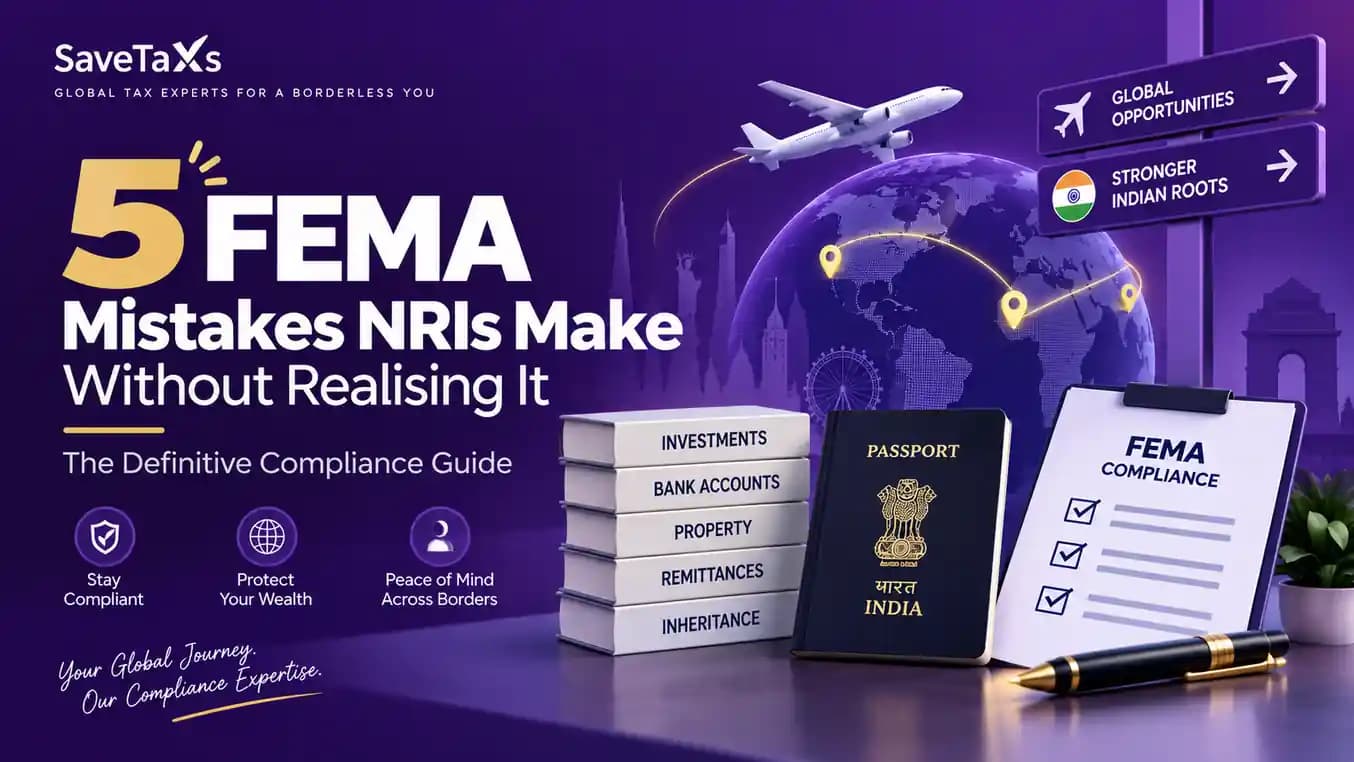
If you have recently become an NRI, you have probably already thought about taxes, overseas income, and your Indian investments. However, FEMA rules can also affect your existing bank accounts, investments, property transactions, and movement of money, and this guide explains five common mistakes NRIs can make without realising it.
Residential status can affect how your existing Indian bank accounts and financial arrangements should be maintained under FEMA and RBI rules.
Resident savings accounts generally need to be redesignated as NRO accounts when a resident becomes a person resident outside India, subject to the applicable rules.
Cross-border transfers should be supported by appropriate banking channels, documentation, and compliance with applicable repatriation conditions.
Indian property transactions can involve FEMA restrictions in addition to income-tax and property-law requirements.
FEMA compliance and income-tax compliance are separate obligations, so completing your tax filing does not automatically establish FEMA compliance.
Potential FEMA mistakes should be reviewed promptly with the relevant authorised dealer bank or a qualified professional rather than being ignored.
The correct FEMA treatment is fact-dependent, particularly where residential status, source of funds, account type, or the nature of a transaction differs.
FEMA, or the Foreign Exchange Management Act, 1999, is India's principal law governing foreign exchange and specified cross-border transactions. For NRIs, FEMA can influence how Indian bank accounts, investments, property transactions, and transfers of funds are structured and carried out.
First, FEMA uses the concept of "person resident in India" rather than simply relying on whether someone calls themselves an NRI. Residential status under FEMA depends on the statutory framework and circumstances such as leaving India for employment, business, vocation, or an intention to stay outside India for an uncertain period.
For example, an Indian professional who moves to the UAE for employment may need to review their existing Indian financial arrangements after becoming a person resident outside India.
Moreover, FEMA compliance and income-tax compliance are separate: meeting an NRI's tax obligations does not automatically mean that every foreign-exchange transaction complies with FEMA.
The Reserve Bank of India (RBI) provides specific rules for non-resident accounts, remittances, and property transactions. The exact treatment can depend on the individual's status and the nature and source of the transaction.
FEMA mistakes matter because a financial arrangement that was appropriate while you were resident in India may require different treatment after your residential status changes.
First, the most common problem is not necessarily a deliberate violation. It can be a failure to update an account, document a transfer correctly, or check whether a transaction has additional restrictions after becoming non-resident.
For example, an NRI may continue receiving salary, rent, investment income, or other funds into an account without reviewing whether the account remains appropriately designated.
In addition, FEMA provides for penalties where a person contravenes the Act, rules, regulations, notifications, directions, or orders. Under Section 13 of FEMA, a quantifiable contravention can attract a penalty of up to three times the amount involved, subject to the statutory framework.
The practical lesson is simple: NRIs should review their Indian financial arrangements when their residential status changes instead of assuming that existing arrangements automatically remain appropriate.
The five common FEMA mistakes below involve resident bank accounts, financial arrangements, remittances, property transactions, and the assumption that tax compliance covers FEMA compliance.
First, continuing to operate a resident savings account without redesignating it can create a FEMA compliance issue after a person becomes non-resident. RBI guidance states that when a resident Indian becomes a person resident outside India in the relevant circumstances, the existing resident account should be designated as an NRO account.
For example, Rahul moves from India to Canada for a long-term job but continues using his old resident savings account for rent receipts and personal transfers. His first step should be to inform the bank about his changed residential status and determine the appropriate account designation.
Moreover, redesignation does not necessarily mean that the money disappears or that the account must simply be closed. An NRO account is specifically designed to hold permitted Indian rupee income and funds for non-residents, subject to applicable rules.
Therefore, if you have recently become an NRI, ask your bank to review your account status rather than continuing to use the account exactly as before.
Second, a change in residential status should trigger a broader review of existing financial arrangements, not just your primary bank account.
For example, an NRI may have fixed deposits, investment accounts, recurring deposits, securities, or other Indian financial relationships that were established while they were resident. The appropriate treatment can depend on the specific investment, the account through which it is held, and the applicable regulations.
At the same time, not every investment automatically becomes invalid simply because the investor becomes an NRI. The correct response is usually to check the applicable rules and update the relevant institution's records, rather than assuming that all existing holdings must be sold.
For example, someone who moves to the United States may continue holding an Indian investment but may need to update their residential-status details with the relevant bank, broker, fund house, or financial institution.
As such, create a post-NRI-status review covering:
Indian bank and deposit accounts
Demat and investment accounts
Mutual funds and securities
Insurance and other financial products
Existing loans or financial obligations
Sources of income credited to India
Third, moving money between India and your country of residence without checking the applicable FEMA route, documentation, and repatriation conditions can create avoidable compliance problems.
For example, an NRI selling an Indian asset may assume that the entire sale proceeds can simply be transferred overseas whenever they choose. In practice, repatriation can depend on how the asset was acquired, the account holding the proceeds, applicable limits, taxes, and supporting documentation.
Moreover, RBI rules provide specific facilities for remittances from NRO accounts and certain asset sale proceeds. For eligible NRI/PIO cases, the commonly referenced remittance framework permits up to USD 1 million per financial year from specified NRO balances or eligible asset sale proceeds, subject to applicable conditions and documentation.
Therefore, the amount received in India and the amount that can be repatriated are not necessarily the same thing.
In addition, maintain documents showing the source of funds, transaction details, and relevant tax or professional certificates where required. Your authorised dealer bank can determine what documentation is required for the particular remittance.
Fourth, Indian property transactions involving NRIs can be subject to FEMA rules in addition to tax and property-law requirements.
For example, an NRI may assume that because they are an Indian citizen, they can purchase or transfer every type of Indian property without restriction. FEMA rules distinguish between property categories and circumstances; for example, NRI/OCI purchase permissions generally do not extend to agricultural land, plantation property, or farmhouses under the general permission framework.
Similarly, selling a property and repatriating the proceeds can involve additional conditions. RBI guidance states that repatriation of eligible sale proceeds can depend on how the property was acquired and how the acquisition was funded.
At the same time, tax compliance and FEMA compliance remain separate checks. Paying capital-gains tax on a property sale does not by itself establish that the related foreign-exchange transaction satisfies FEMA requirements.
Therefore, before buying, selling, gifting, or repatriating proceeds from Indian property, review the transaction structure with the authorised dealer bank and, where necessary, a qualified professional.
Fifth, FEMA compliance is separate from income-tax compliance, even when the same transaction has both tax and foreign-exchange implications.
For example, an NRI may correctly report rental income in an Indian income-tax return and pay the applicable tax. That tax compliance does not by itself answer whether the associated bank account, remittance, repatriation, or foreign-exchange transaction has been handled under FEMA.
Moreover, the two frameworks answer different questions. Income-tax rules primarily determine matters such as taxable income, deductions, reporting, and tax liability, while FEMA regulates specified foreign-exchange transactions and dealings involving persons resident outside India.
As a result, an NRI can be tax-compliant while still needing to correct a FEMA-related account or transaction issue.
Therefore, treat tax review and FEMA review as two related but separate compliance exercises.
| Area | Tax compliance asks | FEMA compliance may ask |
|---|---|---|
| Bank account | Is income correctly reported? | Is the account appropriately designated? |
| Property sale | What tax is payable? | Can proceeds be transferred or repatriated, and under what conditions? |
| Remittance | Are tax obligations satisfied? | Is the transfer permitted and properly documented? |
| Investment | What income or gains are taxable? | Does the investment and account structure comply with applicable rules? |
A FEMA compliance review is a structured check of your residential status, Indian accounts, investments, property transactions, remittances, and supporting documents.
First, start with your residential-status date and bank accounts. List every Indian account and identify whether it is resident, NRO, NRE, FCNR(B), or another permitted category.
Next, review your financial relationships:
Identify accounts opened while you were resident.
Check whether residential-status details were updated.
Review investments and securities accounts.
List significant transfers between India and overseas accounts.
Review recent property purchases, sales, gifts, or inheritances.
Collect remittance and transaction documentation.
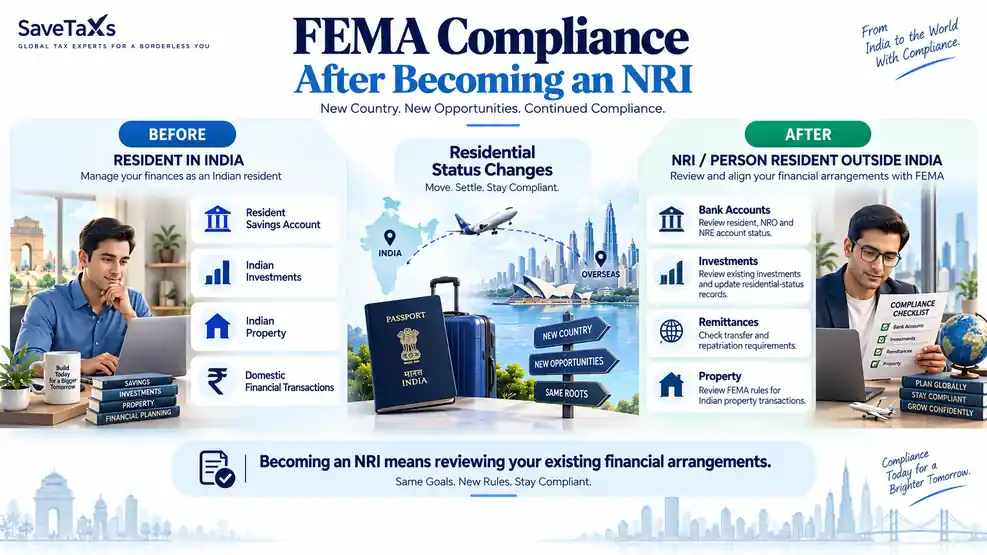
Furthermore, keep transaction documents together rather than relying only on bank statements. Source-of-funds records, property documents, inheritance records, remittance paperwork, and bank correspondence can become important when an authorised dealer evaluates a transaction.
The safest next step after identifying a potential FEMA issue is to review the transaction with the relevant authorised dealer bank or a qualified FEMA professional before taking corrective action.
First, do not assume that every irregularity is automatically a FEMA violation. The legal treatment can depend on residential status, dates, account type, source of funds, transaction structure, and applicable regulations.
For example, if you discover that you continued using a resident savings account after becoming non-resident, contact your bank and explain the circumstances. The bank can review the account and advise on the appropriate redesignation and documentation.
In addition, avoid trying to "fix" a historical transaction by making a new transfer without understanding the original issue. Correcting the underlying documentation and transaction trail is generally more useful than creating another unexplained transaction.
FEMA compliance for NRIs is primarily about aligning Indian financial arrangements with your current residential status and the rules applicable to each transaction.
First, review resident bank accounts, investments, remittances, and property transactions after becoming non-resident. Second, remember that FEMA compliance and income-tax compliance are separate obligations, even when both apply to the same transaction.
Finally, if you identify a potential issue, do not ignore it or assume the worst. Gather your documents, speak with your authorised dealer bank, and obtain professional advice where the transaction is significant or fact-dependent.
This article is for general informational purposes only and does not constitute tax, legal, financial, or investment advice. Laws, regulations, rates, and procedures may change over time and may vary based on individual circumstances.
While SaveTaxs makes reasonable efforts to keep the information accurate and up to date, readers should verify applicable rules with official authorities or consult a qualified professional before making decisions based on this information.
Shubham Jain is the Founder of SaveTaxs and has extensive experience in Indian and NRI taxation. He advises individuals, NRIs, and businesses on tax filing, tax planning, capital gains, DTAA benefits, fund repatriation, and compliance matters. He regularly writes about taxation and related financial topics. His focus is on making complex tax concepts easy to understand. Through his articles, he helps taxpayers stay informed, avoid common mistakes, and stay compliant with Indian tax laws. See Full Bio
Want to read more? Explore Blogs