

NRI Income Tax Compliance
How to Claim Excess TDS Refund After Selling Property in India as an NRIHow to Claim Excess TDS Refund After Selling Property in India as an NRI
Written by Shubham Jain

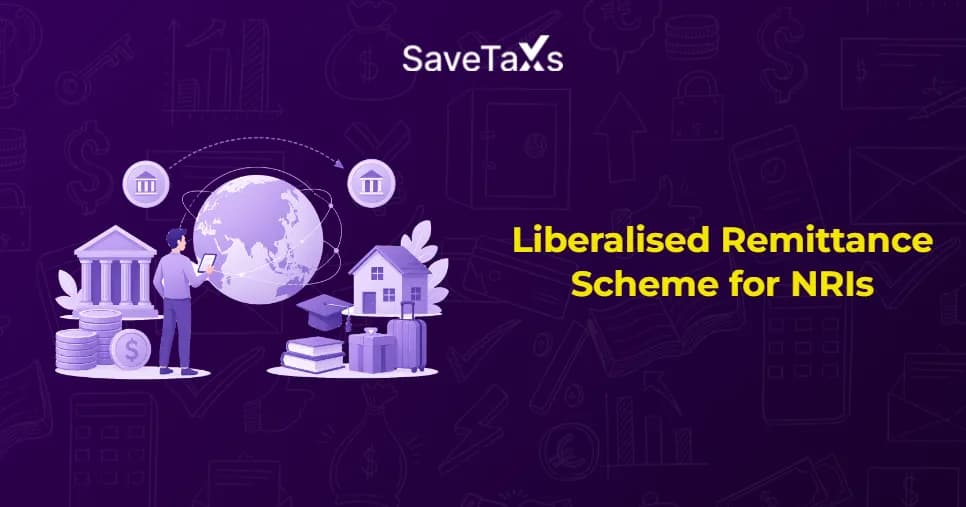
The Liberalised Remittance Scheme (LRS) is exclusively designed for resident individuals as defined under FEMA. This means NRIs cannot use the LRS scheme. However, NRIs have their own designated accounts in India — NRE, NRO, and FCNR accounts — which allow them to repatriate funds abroad under FEMA rules without needing LRS. To manage cross-border transactions, NRIs have their designated accounts in India, such as NRE, NRO, and FCNR accounts.
When it comes to foreign exchange and NRI banking, LRS is indeed one of the most talked-about and also the most misunderstood ones. NRIs often tend to believe that they can use the LRS to transfer money from India to another country, but that is not actually how the Liberalised Remittance Scheme works.
In this guide, we will explain in clear terms who is really allowed to use it, what NRIs can use instead, a checklist, and more.
The Reserve Bank of India (RBI) has rolled out the LRS, the Liberalized Remittance Scheme, which allows resident individuals to send money abroad up to a set annual threshold without needing any special permission every time.
Before the existence of LRS, sending money out of India for things like child tuition fees, foreign holidays, property buying, and more needed a case-by-case approval from the designated authorities. The RBI replaced those time-consuming processes with a general threshold limit under FEMA (Foreign Exchange Management Act). Meaning you send whatever money you like or the approved legitimate reasons under the yearly thresholds, and your bank will simply process it.
The Liberalized Remittance Scheme is applicable to resident individuals based on their residential status under FEMA rather than citizenship. And an NRI, by definition, is not a resident of India, so this scheme is not applicable to them and is designed primarily for residents. Do not think of it as a loophole for NRIs or a restriction for NRIs; this is not a scheme that was meant for them in the first place.
Savetaxs helps NRIs file their taxes under expert guidance and with 100% accuracy.
As an individual who is eligible to reap the benefit of the LRS scheme, the following are a range of everyday reasons LRS is used to send money abroad.
The present yearly threshold to send money under LRS abroad is $250,000 per person per financial year (April 1 to March 31). This limit applies to each resident individual, including minors (where the LRS declaration is countersigned by a natural guardian). Ensure that the unused amount for the previous year does not roll over to the next year; it lapses. Additionally, TCS (Tax Collected at Source) is applicable on LRS remittances at varying rates depending on the purpose of the remittance.
NRIs are generally associated with the LRS because it somehow touches an NRI's life indirectly, even though it does not directly apply to NRIs. The following are some of the common situations.
A parent from India sent money to their child studying abroad. The transfer made happened under the parents' LRS allowance, and the NRI child who received it isn't subject to their own LRS limit because, in the first place, they do not have one under the scheme.
An individual who attained the residential status of an NRI recently and is still getting used to the change. If you were using the LRS last year as a resident and have moved abroad this year, your privileges to use the LRS end when your residential status shifts, even if it was a mid-year change.
An NRI planning to return to India needs to research the LRS in advance before they actually become a resident again.
Myth vs Fact: "NRIs are allocated their own $250,000 allowance for LRS to send money out of India."
Fact: This $250,000 allowance belongs only to resident individuals. The NRIs do not get a personal LRS at all.
Generally speaking, for NRIs, there is no need for the LRS because they already have their NRI bank account with them, which is far more generous and has no thresholds as the LRS does.
While the USD 1 million threshold is higher than the LRS threshold of $250,000, the NRO route comes with additional documentation and tax compliance requirements.
Deepa is an NRI living in London; her mother, who lives in Chennai, wants to send her a Rs 15 lakh gift as it is Deepa's 30th birthday.
Under her own LRS allowance, Deepa's mother sends her the money since she is a resident of India. This transfer counts against her mother's yearly USD 250,000 limit, and not Deepa's, because Deepa does not have an LRS limit of her own to start with.
That aside, Deepa owns a flat in Chennai that she rents out. The rental income sits in her NRO account, and if she wants to send some of those savings to London, she can do that using the NRO route, which already has the USD limit of 1 million in a year, so she does not need the LRS anyway.
The following are some of the quick points that you must keep in mind:
Savetaxs helps NRIs with expert-backed guidance on remittance and cross-border tax preparation.
The liberalised remittance scheme and the NRI altogether are often misunderstood; it all boils down to one thing: the LRS is only for residents of India and not NRIs. As an NRI, your cross-border transactions are generally covered under the FEMA (Foreign Exchange Management Act) rules that apply to your NRI-designated bank accounts, such as NRE, NRO, and FCNR accounts. Once you understand this difference, it can help you choose the appropriate remittance route, avoid any unnecessary delays or consequences, and stay compliant with FEMA regulations. Once you understand this difference, it can help you choose the appropriate remittance route, avoid any unnecessary delays or consequences, and stay compliant with FEMA regulations.
So, if you are getting a monthly money flow from your family in India, repatriating earned rental income, or planning to move back to India, understanding which rules apply to your residency status is essential. The best approach here can ensure your overseas money transfers are compliant and smooth, and prevent unnecessary delays.
As an NRI, if you are seeking professional assistance on managing your cross-border money flow, or have a clear idea of whether the LRS, NRO repatriation, or the NRE/FCNR rules apply to your situation or not, Savetaxs is the name to trust.
At Savetaxs, our FEMA or NRI tax experts will provide you with all-inclusive end-to-end NRI-specific guidance on FEMA compliance, Form 145/146, Tax planning, and cross-border fund transfer, remittances, and well beyond this.
Connect with us as we serve our clients 24/7 across all time zones and let our NRI tax experts help you manage your money legally, safely, and with complete peace of mind.
This article is for general informational purposes only and does not constitute tax, legal, financial, or investment advice. Laws, regulations, rates, and procedures may change over time and may vary based on individual circumstances.
While SaveTaxs makes reasonable efforts to keep the information accurate and up to date, readers should verify applicable rules with official authorities or consult a qualified professional before making decisions based on this information.
Shubham Jain is the Founder of SaveTaxs and has extensive experience in Indian and NRI taxation. He advises individuals, NRIs, and businesses on tax filing, tax planning, capital gains, DTAA benefits, fund repatriation, and compliance matters. He regularly writes about taxation and related financial topics. His focus is on making complex tax concepts easy to understand. Through his articles, he helps taxpayers stay informed, avoid common mistakes, and stay compliant with Indian tax laws. See Full Bio

Want to read more? Explore Blogs
The money sending limit for NRIs depends on the account type:
As your residential status changes, your LRS eligibility changes as well. Under FEMA rules:
It is always recommended to check your exact FEMA residential status for the specific date of your transfer, as this can change mid-year.