NRI Income Tax Compliance
How to Claim Excess TDS Refund After Selling Property in India as an NRIHow to Claim Excess TDS Refund After Selling Property in India as an NRI
Written by Shubham Jain

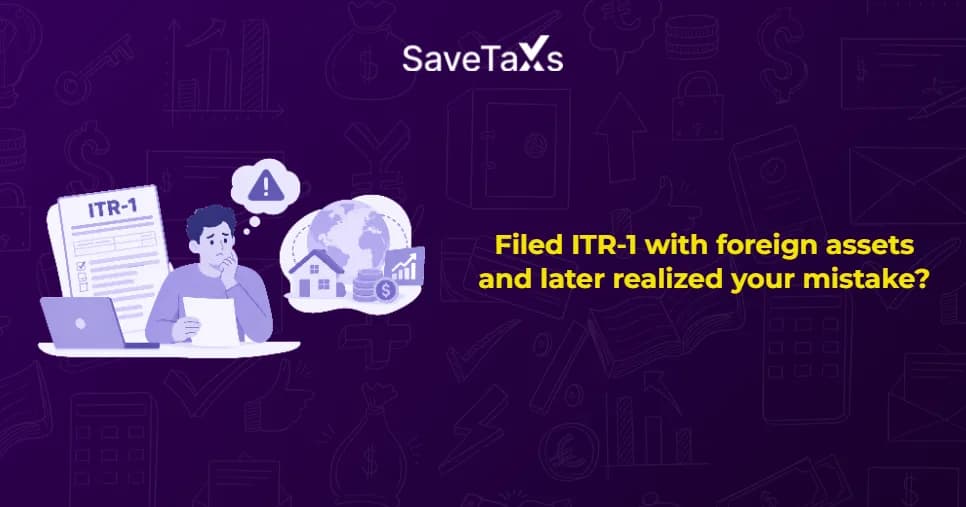
This is the most common mistake NRIs make when filing an ITR. They fill out a form they are not eligible to use. The ITR-1 form is only for eligible Indian residents with simple income. This form isn't even available to NRORs and RNORs or residents with income from any source outside India.
So, how do you rectify your mistake and choose the correct form for filing your tax returns in India? Well, this depends on your residential status, income source, filing rules, and foreign assets. Want to know about all this in detail? Read the blog and get your answers.
No, a Non-Resident Indian (NRI) is not eligible to file ITR-1. Only Indian residents other than RNORs who meet the conditions set by the Income Tax Department can use this form. Considering this, depending on the income source, NRIs can opt for ITR-2 or ITR-3.
If you unknowingly file ITR-1 as an NRI, the return may be treated as defective if the prescribed eligibility conditions are not satisfied. For AY 2026-27, defective-return proceedings are governed by Section 139(9) of the Income-tax Act, 1961.
So, as an NRI, even if you have Indian income such as salary, interest, rental, or other straightforward income, you are not eligible to file ITR-1.
Further, ITR-1 eligibility depends not only on income source but also on an individual's residential status in India. Now, moving ahead, let's find out who can file ITR-1 for AY 2026-27.
ITR-1, also known as Sahaj, is for Resident (other than Not Ordinarily Resident) individuals who have income up to INR 50,00,000 from specified income sources such as:
This form is not available for individuals in the following conditions:
Additionally, the ITR-1 form does not include mandatory reporting sections like Schedule FA (Foreign asset), Schedule FSI (Foreign Source of Income), and Schedule TR (Tax Relief). So, you cannot report foreign assets and income in ITR-1.
This was all about who can file ITR-1 for AY 2026-27. Moving further, let's know what the difference is between Schedule FA, FSI, and TR.
At Savetaxs, we help NRIs meet their Indian tax obligations on time, without hassle, and maximize their refunds.
All three schedules, i.e., FA, FSI, and TR, serve different reporting requirements under the Indian income tax return. Here is how they are different from each other:
| Schedule FA (Foreign Asset) | Schedule FSI (Foreign Source of Income) | Schedule TR (Tax Relief) |
|---|---|---|
| Used to report specified foreign assets and related information. | This schedule reports the income accruing or arising from sources outside India. | Schedule TR summarizes foreign tax relief claimed in India for taxes already paid outside the country. |
You cannot interchange these schedules with each other. The reporting requirements depend on an individual's residential status, foreign assets, income, and foreign taxes paid.
Now, moving forward, let's learn how to choose the correct ITR form when filing a tax return as an NRI in India.
The table below provides an overview of how to choose the correct ITR form based on your residential status and income type.
| Basis | ITR-1 | ITR-2 | ITR-3 |
|---|---|---|---|
| Who can file | Only available for resident individuals (not applicable for NRIs/ RNORs) | ITR-2 is suitable for individuals (NRIs, RNORs, and Indian residents) and Hindu Undivided Families (HUFs) with no professional or business income. | Individuals (residents, NRIs and RNORs) and HUFs with income from profession or business. |
| Income Type | Includes the following income up to INR 50,00,000 earned in India:
|
Includes the following income types:
|
Includes all the income types stated in the ITR-2 form along with:
|
There is also ITR-4 (Sugam), but like ITR-1, this form is not available for NRIs and RNORs.
So, this is how based on your residential status and income type, you can choose the correct ITR form. Moving ahead, let us know if you have already filed the ITR-1 form.
If you unknowingly filed ITR-1 and later find out you weren't eligible, first figure out why you cannot file ITR-1. In this scenario, the two most common situations under it are as follows:
If you held NRI or RNOR status in the relevant previous year, then know that you are not eligible for this form. This is available only to resident Indians with sources of income only in India. Based on this, review your income types and choose ITR-2 or ITR-3 to correct your mistake.
You are an Indian resident, but hold foreign assets, financial interests, or have signing authority in a foreign bank account. In this scenario, you also cannot file ITR-1. This ITR form applies only to income up to INR 50,00,000 from the following:
According to your income type, choose ITR-2 or ITR-3.
So, even if you unknowingly fill out ITR-1, correct your mistake by choosing the right form for your income type. Want to know how? Read the next section and get your answer.
Here is how you can rectify your mistake of filling the ITR-1 unknowingly:
Determine your residential status in India under the applicable residential-status rules, including your physical presence, citizenship or PIO status, and any applicable special conditions:
Prepare a list of your income types to determine whether you need to file ITR-2 or ITR-3. This includes:
If you are a resident Indian during the financial year and hold foreign assets and accounts, report them in your ITR-2 or ITR-3 as per your income type. This includes:
If you are an NRI or RNOR, then you do not need to report your foreign assets in Schedule FA when filing ITR in India.
Choose your ITR form according to your residential status and income profile in India. Do not select the ITR-2 or ITR-3 form only because you hold foreign assets. With this in mind, confirm your eligibility before filing your ITR in India.
After choosing the correct ITR form, confirm whether there is a revised return or another correction tool available for the relevant tax year, or whether the deadline has passed. The NUDGE guidance of the Income Tax Department helps taxpayers rectify their filed ITR by correctly reporting foreign assets in the revised return where the applicable time limit permits.
If the deadline for the revised return has not passed, correct your return by choosing the correct form and including all missing information.
While filing your revised ITR, keep the following documents by your side:
This is how you can correct an incorrect ITR-1 mistake. Moving further, let's better understand how to choose the correct ITR form through some examples.
Here are two examples to help you choose the correct ITR form based on your residential status and income profile in India.
Suppose you are living in the US, and in India you qualify as an NRI. Additionally, you have the following sources of income in India:
You cannot choose ITR-1 to file your tax return in India because you are an NRI, and this form does not apply to you. Also, you do not have any business or professional income in India. Based on this information, choose ITR-2 to file your tax return in India. Further, being an NRI, you do not need to file Schedule FA in your ITR for assets you held outside India.
Suppose you are a resident taxpayer in India with salary income. Additionally, you also hold shares in the US. In this scenario, being a resident with salary income, you cannot file ITR-1 as you also hold shares in the US. However, you can file ITR-2 and report the US shares in Schedule FA.
Given this, since you have salary income in India, you should file ITR-2 and report the US shares in Schedule FA.
This is how you can choose the correct ITR form as per your residential status and income profile in India. Additionally, as an NRI or RNOR, you are not eligible to file ITR-1 even if you have salary income in India and zero foreign assets and income.
Now, let's see what happens if you don't correct your ITR-1 mistake.
If you do not correct your filed ITR-1 but have foreign assets mistake, you face compliance issues. Additionally, the return you filed may be treated as defective if the prescribed eligibility conditions are not satisfied. The consequences you face depend on the following factors:
In case you are an NRI or RNOR, although you do not need to report your foreign assets in your ITR, you should review and correct your filed return through the applicable revised-return or defective-return procedure. This is because the ITR-1 form is only available for eligible Indian residents other than RNORs with a simple income profile (up to INR 50,00,000).
Also, don't assume that not correcting your mistake of choosing the wrong ITR form will always result in a penalty or the same consequences. This can vary depending on your circumstances, so take the right action.
Moving forward, let us know what tools can help you file a revised return.
With Savetaxs, choose the correct ITR form based on your residential status and income profile in India, and stay compliant with tax laws.
You can correct mistakes in your filed ITR using the Income Tax e-filing portal and applicable ITR utilities. Currently, the Income Tax Department allows AY 2026-27 ITR-1, ITR-2, and ITR-3 utilities for taxpayers. Additionally, before making corrections, consider the following:
In simple terms, you can correct your ITR mistake using the Income Tax e-filing portal and the applicable ITR utilities.
Lastly, if you filed ITR-1 but have foreign assets or hold NRI or RNOR status and later realized it, you need to rectify your mistake. ITR-1 form is specifically available only for eligible Indian residents other than RNORs whose income does not exceed INR 50,00,000 and who satisfy the prescribed conditions. Even this form is not applicable when residents have business or professional income or hold foreign assets and income. Additionally, foreign asset reporting is separate and does not apply to NRIs and RNORs. So, the ITR forms available for NRIs and RNORs in India are ITR-2 (no business or professional income) and ITR-3 (have business or professional income).
If you are still confused about the ITR forms and having trouble choosing the right one based on your income profile and residential status in India, contact Savetaxs. Our team of cross-border tax experts helps you choose the correct form based on your income and residential status. Additionally, we can also assist you with ITR filing on time without any hassle.
This article is for general informational purposes only and does not constitute tax, legal, financial, or investment advice. Laws, regulations, rates, and procedures may change over time and may vary based on individual circumstances.
While SaveTaxs makes reasonable efforts to keep the information accurate and up to date, readers should verify applicable rules with official authorities or consult a qualified professional before making decisions based on this information.
Shubham Jain is the Founder of SaveTaxs and has extensive experience in Indian and NRI taxation. He advises individuals, NRIs, and businesses on tax filing, tax planning, capital gains, DTAA benefits, fund repatriation, and compliance matters. He regularly writes about taxation and related financial topics. His focus is on making complex tax concepts easy to understand. Through his articles, he helps taxpayers stay informed, avoid common mistakes, and stay compliant with Indian tax laws. See Full Bio
Want to read more? Explore Blogs