NRI Income Tax Compliance
How to Claim Excess TDS Refund After Selling Property in India as an NRIHow to Claim Excess TDS Refund After Selling Property in India as an NRI
Written by Shubham Jain
_1785741343696.webp&w=3840&q=75)
If you are a Non-Resident Indian (NRI) who owns a flat, house, or a plot back home, you must have questioned yourself: Do I still need to pay property tax in India? Well, the answer to this question is yes, and there's often a lot of confusion about what is covered under property tax.
To clear this confusion, in this blog, we will walk you through exactly what NRIs owe, how to pay property tax, and how it links to your income tax obligations.
A lot of NRIs often end up mixing two entirely different taxes, which are municipal property tax and income tax on property. Here is the key difference between these two taxes:
However, we mainly focus on municipal property tax in this blog. Moving further, we will discuss the main question: Do NRIs need to pay municipal property tax?
Yes, NRIs have to pay municipal property tax without any exceptions. Instead of your residency status, municipal property tax is charged only on ownership of an immovable property. You are legally required to pay this annual tax to the local municipal body, irrespective of whether you live in Dubai, London, or Toronto, or if you own a flat, house, shop, or even vacant land in India. Also, it applies regardless of whether the property is self-occupied, rented out, or lying vacant.
Don't think that ignoring it will make your liability disappear. Municipal corporations can charge monthly interest at a rate of 1-2% on overdue amounts, issue notices for penalties, and place legal holds on the property (in serious cases) that can block its sale or transfer.
You must now be thinking, how is this tax calculated? Let's see that.
Property tax for NRIs is calculated by municipal corporations based on various factors such as:
Remember that every city has its own valuation method. For example, Mumbai's BMC, Bengaluru's BBMP, Delhi's MCD, Chennai Corporation, and Hyderabad's GHMC all have separate portals and formulas.
To have a rough benchmark, remember that a typical two-bedroom flat might attract anywhere from ₹3,000 to ₹15,000 every year in Bengaluru and Hyderabad, and ₹10,000 to ₹50,000 in Mumbai, based on the size and location. Now that we know how it is calculated, let's discuss how you can pay it from abroad.
Most major cities in India now allow you to make fully online payments through their municipal portals. This makes the tax-paying process easier for NRIs even from overseas. Here is how you can pay property tax online:
In case you have lost your old tax records or PID number, contact the municipal citizen helpline, or appoint a trusted local representative or family member to visit the ward office on your behalf. Moreover, try avoiding cheque payments wherever possible because they are slow and harder to track from overseas. Do you know many municipal bodies also offer rebates?
Several municipal bodies offer a rebate of 2-10% for paying your full amount of property tax before a specified deadline (often early in the financial year). To save money and avoid last-minute issues with the portal, the simple way is to pay early.
If you are thinking you will just ignore it and skip paying the tax, well, consequences are waiting for you. Let's discuss the consequences of not paying property tax.
Skipping municipal property tax might seem normal, but it carries various risks, such as:
Instead of clearing years of accumulated liability later, keeping payments current each year is much cheaper. Now, it's common to have doubts about how property tax is connected to your ITR. Let's clear this confusion.
Property tax is not just a municipal formality, but it has a direct income tax benefit. So, if your property is rented out, you can actually deduct the property tax you paid during the year from the gross annual value while calculating "Income from House Property" in your ITR. Ensure you keep your receipts safely as they reduce your taxable rental income.
Additionally, apart from municipal property tax, there are other property-related taxes that NRIs must also know. We will now discuss these taxes.
Although municipal property tax applies purely for owning a property, NRIs must also stay aware of some related central taxes linked to property transactions:
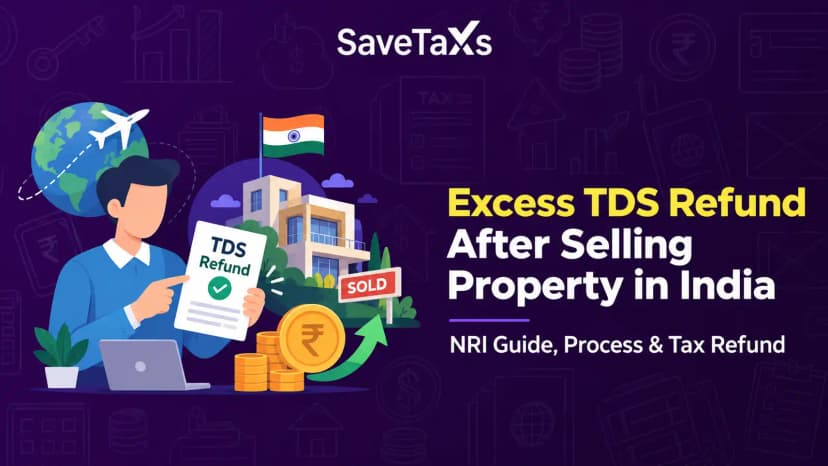
NRIs must file an ITR even when TDS has already been deducted because TDS on both rent and sale is typically higher than the actual tax owed. Filing an ITR is often the only way to claim the refund for the excess TDS deducted. At last, we will look at a quick checklist for NRIs owning a property.
Here is a checklist for NRIs owning a property and confused about municipal property taxes:
Let the professionals at Savetaxs manage your Indian tax returns.
Municipal property tax is a small tax, but it is non-negotiable for every NRI who owns a property in India. It means there are no exemptions based on your residency. To ensure your Indian property is fully compliant and prevent legal complications, it is important to pair timely property tax payments with correct TDS management and file ITR annually.
Further, to get expert guidance with ITR filing and ensure compliance, contact an expert at Savetaxs. We have an entire team of experts who can help ensure you file your ITR on time accurately and confidently. Our team can also help with TDS, repatriation, NRE/NRO account opening, and other NRI-related matters. Connect with us right away, as we are working 24/7 across all time zones and ensure you don't leave any refund on the table.
This article is for general informational purposes only and does not constitute tax, legal, financial, or investment advice. Laws, regulations, rates, and procedures may change over time and may vary based on individual circumstances.
While SaveTaxs makes reasonable efforts to keep the information accurate and up to date, readers should verify applicable rules with official authorities or consult a qualified professional before making decisions based on this information.
Shubham Jain is the Founder of SaveTaxs and has extensive experience in Indian and NRI taxation. He advises individuals, NRIs, and businesses on tax filing, tax planning, capital gains, DTAA benefits, fund repatriation, and compliance matters. He regularly writes about taxation and related financial topics. His focus is on making complex tax concepts easy to understand. Through his articles, he helps taxpayers stay informed, avoid common mistakes, and stay compliant with Indian tax laws. See Full Bio
Want to read more? Explore Blogs