NRI Income Tax Compliance
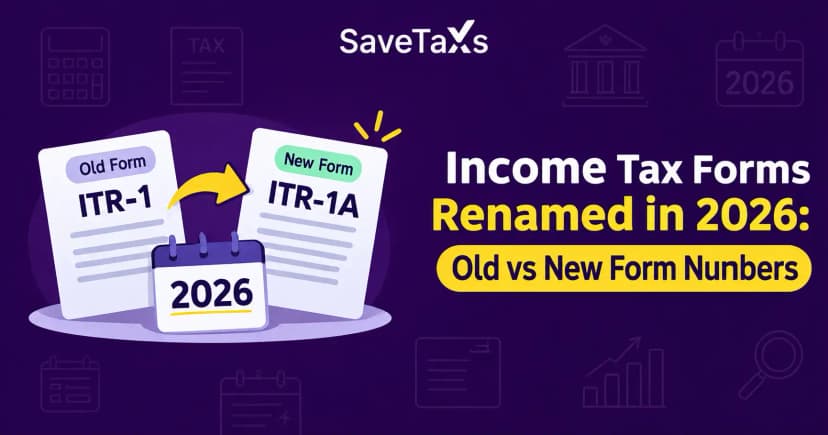
Income Tax Forms Renamed in 2026: Old vs New Form NumbersIncome Tax Forms Renamed in 2026: Old vs New Form Numbers
Written by Vipul Jain

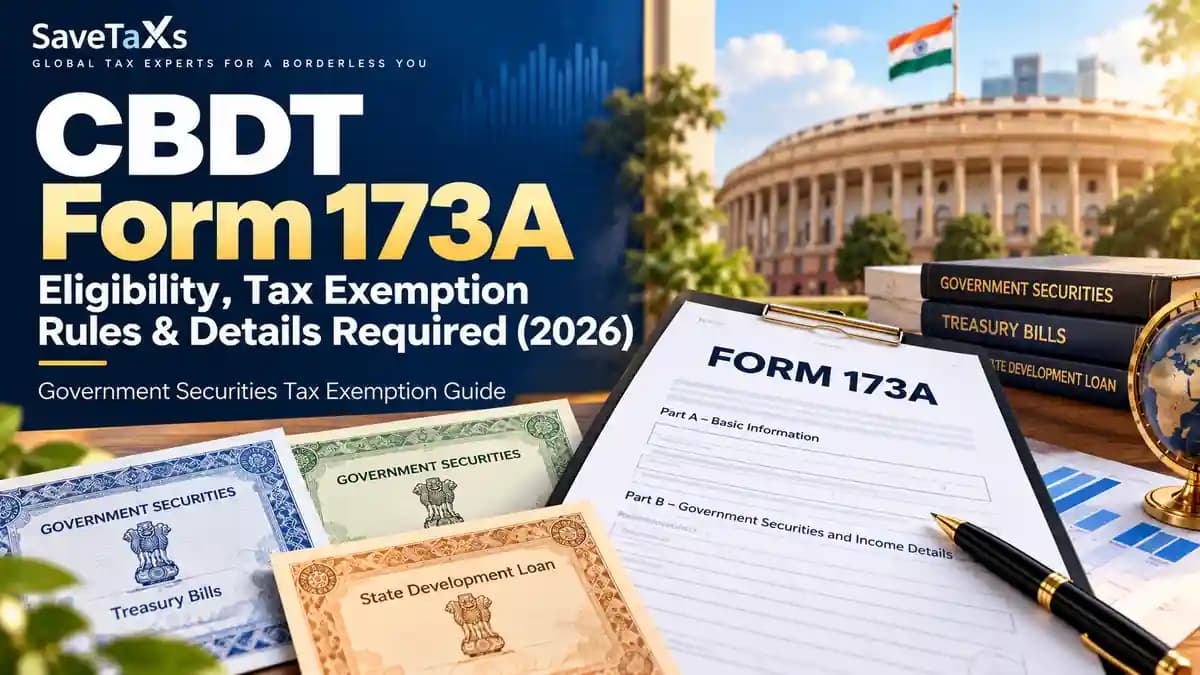
The Central Board of Direct Taxes (CBDT) has introduced Form 173A, a mandatory information-furnishing requirement for claiming specified tax exemptions on interest and capital gains from government securities. The requirement was notified on October 19, 2026, through the Income-tax (Seventh Amendment) Rules, 2026.
Under the newly inserted Rule 281A of the Income-tax Rules, 2026, eligible claimants must furnish information in Form 173A to claim exemptions under Schedule IV, Table entries 13D and 13E of the Income-tax Act, 2025. Entry 13D concerns eligible foreign institutional investors (FIIs), including qualifying foreign portfolio investors (FPIs), while entry 13E concerns the Bank for International Settlements (BIS).
Form 173A does not create a tax exemption for every investor holding government securities. It prescribes the information required to claim exemptions available under specific statutory provisions. Ordinary retail investors cannot claim this particular exemption merely because they own government bonds or Treasury Bills.
The underlying tax provisions provide specified exemptions for eligible claimants on qualifying interest income and capital gains from government securities.
According to the Ministry of Finance's policy announcement, the exemption covers qualifying interest income and capital gains arising from the sale, transfer, exchange or redemption of government securities, subject to the applicable statutory conditions. The exemption applies to qualifying income arising on or after April 1, 2026.
Two dates matter when interpreting the new requirement:
| Date | Significance |
|---|---|
| April 1, 2026 | Effective date for the specified exemption on qualifying income |
| October 19, 2026 | Date Notification G.S.R. 901(E) was issued and the Seventh Amendment Rules came into force upon publication in the Official Gazette |
These dates serve different purposes. April 1, 2026, determines the starting point for the qualifying income covered by the exemption. October 19, 2026, marks the commencement of the rules introducing Form 173A.
The underlying eligibility conditions continue to apply. Furnishing the form is a procedural requirement; it does not independently establish that an investor, security or transaction qualifies for the exemption.
For the policy background, consult the Ministry of Finance's factsheet on reforms to expand foreign participation in government securities.
Form 173A applies to claims under the two specified entries of Schedule IV.
| Claimant category | Relevant provision | What it means |
|---|---|---|
| Eligible FIIs, including qualifying FPIs covered by the provision | Entry 13D | Must satisfy the applicable eligibility conditions and furnish the prescribed information to claim the exemption |
| Bank for International Settlements (BIS) | Entry 13E | Must furnish Form 173A when claiming the specified exemption, subject to the form's express exceptions |
Other foreign investors, institutions and ordinary retail investors should not assume that the same exemption applies to them. Their eligibility must be assessed under the relevant statutory provisions.
The terminology also matters: FII and FPI should not automatically be treated as interchangeable legal categories in every context. Form 173A requests the SEBI registration number as an FPI/FII, while the applicable exemption provision determines which claimants qualify.
Form 173A has two parts. Part A collects the claimant's basic information, and Part B records the government securities and related income covered by the exemption claim.
The claimant must provide the prescribed identification and contact details.
| Field | Information required |
|---|---|
| Name | Full name of the claimant |
| Country of residence | Country or specified territory of residence |
| Address | Address in the country of residence or at the headquarters, as applicable |
| PAN | Permanent Account Number |
| TIN | Tax Identification Number in the country of residence |
| SEBI registration number | Registration as an FPI/FII, as applicable |
| Tax year | Tax year for which the exemption is claimed |
| Contact details | Email address and contact number, including country code |
BIS-specific exception: Note 4 to Form 173A expressly makes the TIN and SEBI registration number fields optional for the Bank for International Settlements. This exception applies to those two identification fields in Part A. It should not be extended to other fields or other claimants.
Part B requires security-level information and details of the related holdings, transactions and income.
| Field | What the claimant must report |
|---|---|
| ISIN | International Securities Identification Number for the security |
| Type of government security | Treasury Bills, fixed-rate bonds, floating-rate bonds, State Development Loans (SDLs) or another specified type |
| Tenor | Tenure of the security |
| Total value as of April 1 | Opening value of the securities |
| Purchases during the year | Value of securities purchased during the tax year |
| Sale consideration | Consideration for securities sold during the tax year |
| Total value as of March 31 | Closing value of the securities |
| Gross interest | Interest received or accrued during the tax year |
| Capital gains | Capital gains earned during the tax year |
The form allows Part B to be repeated where required. Amounts must be entered in Indian rupees unless otherwise provided in the form.
A distinction worth preserving is that sale consideration and capital gains are not the same amount. Sale consideration is the amount received from selling a security. Capital gains represent the gain calculated under the applicable tax rules. Both are separate disclosures in Form 173A.
For practical preparation, claimants should reconcile the reported figures against their security-level records, transaction statements, interest records and capital gains calculations.
Eligible claimants and their compliance teams can use this checklist to organize the information before completing the form.
These are practical preparation steps, not additional statutory fields. The prescribed form remains the authority for what must be furnished.
Three points deserve particular attention.
Eligibility comes before form completion. Form 173A supports claims under specific statutory provisions. It does not extend the exemption to investors who fall outside those provisions.
The BIS exception is limited. BIS can leave the TIN and SEBI registration number fields optional under Note 4. This does not make every identification or financial disclosure optional.
Verify the filing process rather than assuming a deadline. The notification establishes the Form 173A information-furnishing requirement. Do not infer a separate due date, online submission workflow or specific late-filing penalty without checking the applicable official rules and guidance.
The form also includes a declaration confirming that the information is true to the best of the signatory's knowledge and belief and is consistent with the relevant provisions of Schedule IV. The principal officer should therefore review the disclosures before signing.
Use primary government sources wherever possible:
Official e-Gazette of India: Search for Notification G.S.R. 901(E), dated October 19, 2026, to verify the Income-tax (Seventh Amendment) Rules, 2026, Rule 281A and Form 173A.
Ministry of Finance factsheet on government securities reforms: Provides the policy background and the effective date of the specified exemptions.
Ministry of Finance FAQs on the BIS exemption: Explains the BIS exemption's scope and relevant policy context.
For compliance decisions, rely on the applicable statutory provisions and the notified form rather than financial news summaries alone.
CBDT Form 173A establishes a specific information-furnishing requirement for eligible claimants seeking exemptions on interest and capital gains from government securities under Schedule IV entries 13D and 13E of the Income-tax Act, 2025.
The practical priorities are to confirm eligibility, understand the applicable exemption, reconcile the required securities and income disclosures, and verify the official submission instructions. BIS has a specific exception for the TIN and SEBI registration number fields, but that exception should not be generalized to other disclosures.
Because the requirement is new, eligible claimants should consult the notified rules and seek qualified tax advice if the scope of eligibility, reporting treatment or filing procedure is unclear.
This article is for general informational purposes only and does not constitute tax, legal, financial, or investment advice. Laws, regulations, rates, and procedures may change over time and may vary based on individual circumstances.
While SaveTaxs makes reasonable efforts to keep the information accurate and up to date, readers should verify applicable rules with official authorities or consult a qualified professional before making decisions based on this information.
Shubham Jain is the Founder of SaveTaxs and has extensive experience in Indian and NRI taxation. He advises individuals, NRIs, and businesses on tax filing, tax planning, capital gains, DTAA benefits, fund repatriation, and compliance matters. He regularly writes about taxation and related financial topics. His focus is on making complex tax concepts easy to understand. Through his articles, he helps taxpayers stay informed, avoid common mistakes, and stay compliant with Indian tax laws. See Full Bio

Want to read more? Explore Blogs