NRI Income Tax Compliance
NRI Divorce and Cross-Border Asset Division: Indian Tax and Legal ConsiderationsNRI Divorce and Cross-Border Asset Division: Indian Tax and Legal Considerations
Written by Hatim Dudhiyawala
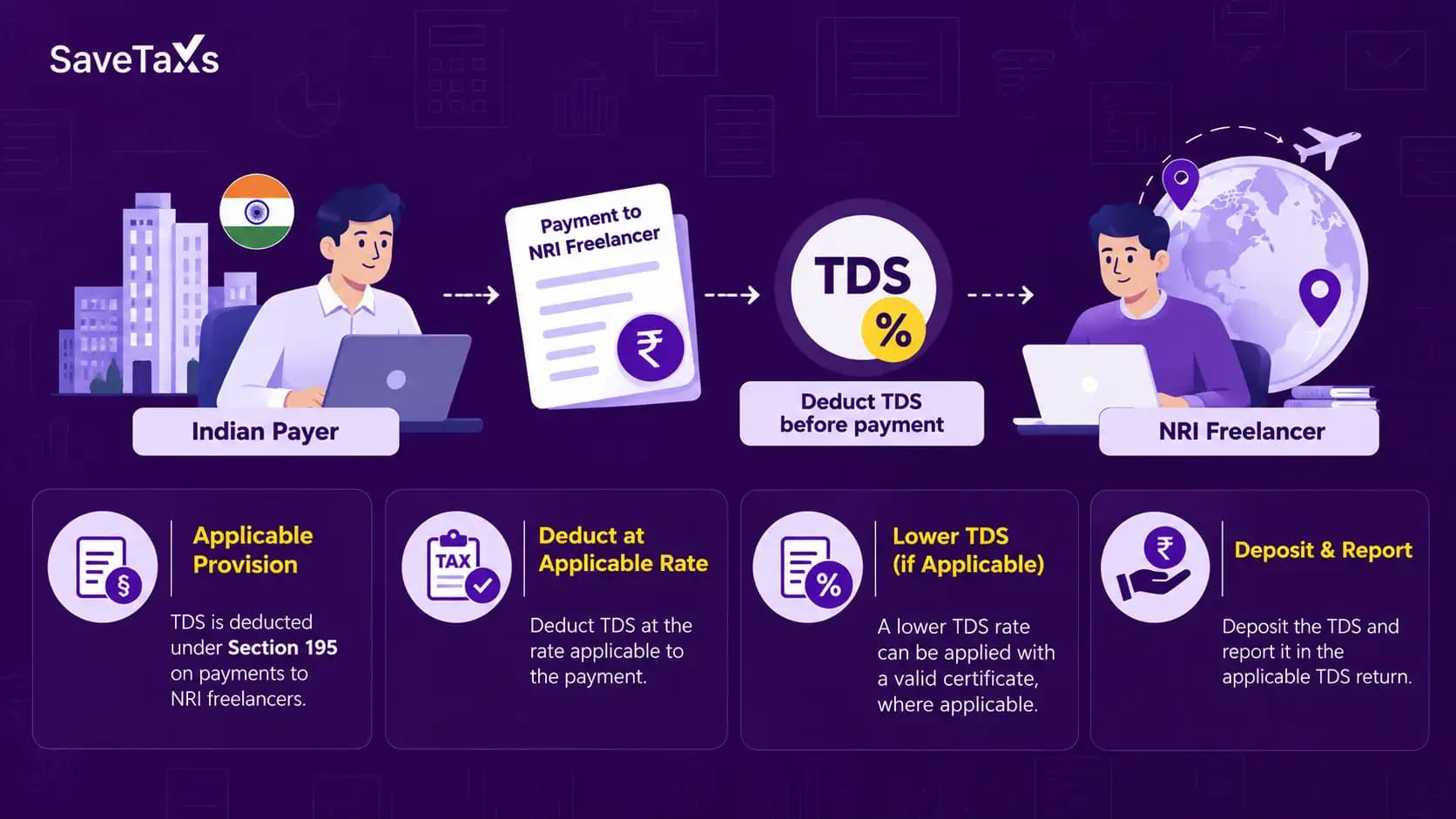
Indian businesses increasingly hire NRI freelancers for software development, design, consulting, marketing and other professional services. However, paying an NRI freelancer is not the same as paying a resident freelancer.
The Indian client must first determine whether the payment is taxable in India. If it is chargeable to Indian tax, the payer may have to deduct Tax Deducted at Source (TDS), deposit it with the government and report it through the prescribed forms.
There is no single TDS rate that applies to every NRI freelancer. The correct treatment depends on the service, where it is performed, the freelancer’s country of residence and the relevant Double Taxation Avoidance Agreement (DTAA).
TDS applies when the amount paid or credited to the NRI is chargeable to tax in India.
Under the Income-tax Act, 2025, payments to non-residents are covered by the non-resident withholding provisions in Section 393. The provision includes interest and other sums chargeable under the Act, excluding salary, and generally requires deduction at the applicable rates in force.
The Indian client should ask four questions:
The answer cannot be determined from the invoice description alone. A payment described as “consulting fees” may represent ordinary business services, technical services or even royalty if intellectual-property rights are transferred.
Get expert guidance on TDS, DTAA and non-resident payments.
Depositing the amount into an NRO account does not convert an NRI freelancer into a resident payee. Similarly, paying the invoice to a foreign bank account does not automatically make the income non-taxable in India.
The payer must examine the freelancer’s residential status and the nature of the income—not merely the destination bank account.
A UAE-based NRI designs marketing material for an Indian company. All work is completed from Dubai. The freelancer does not visit India, maintain an Indian office or allow the client to use any separately owned intellectual property.
This may be treated as business or professional income rather than taxable technical fees. Depending on the India–UAE DTAA and the complete facts, India may not have the right to tax the payment if the applicable treaty does not create an Indian taxing right through a Permanent Establishment, fixed base or other relevant treaty provision.
The Indian company should not automatically deduct a standard professional-fee rate. It should review the contract, service location and treaty documents before deciding whether withholding is required.
There is no universal TDS rate for an NRI freelancer.
The applicable rate depends on how the income is classified.
| Possible Classification | Factors to Examine | Possible Withholding Treatment |
|---|---|---|
| Business or professional income | Nature of work, service location and Indian business presence | May not be taxable in India if the applicable treaty protects business profits or professional income and the freelancer has no Indian PE, fixed base or other treaty-based Indian taxing right |
| Fees for technical services | Technical, managerial or consultancy character of the service | Domestic rate or lower treaty rate may apply |
| Royalty | Transfer or use of copyright, software rights, patent, process or know-how | Royalty withholding provisions and treaty limits may apply |
| Salary | Genuine employer–employee relationship | Salary withholding rules apply instead of freelancer-payment rules |
The term “rates in force” can require consideration of:
The payer should generally use a beneficial DTAA rate only after collecting adequate treaty documents.
The rates applicable to professional or technical fees paid to residents should not automatically be used for an NRI freelancer.
The Income-tax Act, 2025 separates resident professional-fee payments from payments made to non-residents. Resident professional-fee provisions and thresholds therefore cannot be applied without first confirming the payee’s residential status.
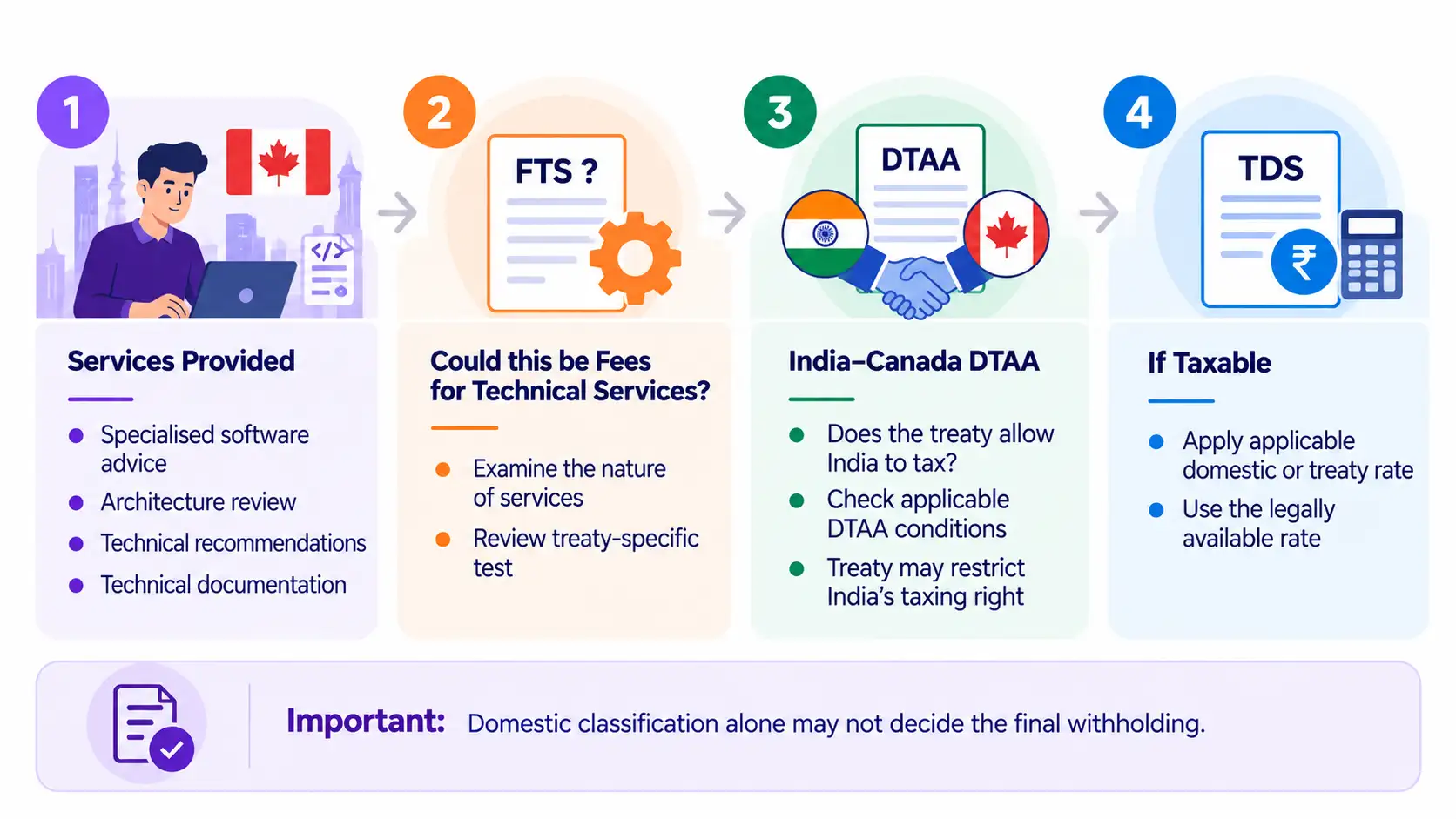
An Indian technology company hires a Canadian tax resident to review its software architecture. The consultant provides specialised recommendations and shares technical documentation.
The payment requires closer examination because it may constitute fees for technical services. The India–Canada DTAA conditions must be reviewed, including whether the services satisfy any treaty-specific technical-service test.
If the treaty restricts India’s right to tax and the conditions are not satisfied, the domestic classification alone may not determine the final withholding. If the payment is taxable, the Indian client should apply the appropriate domestic or treaty rate, whichever is legally available and more beneficial.
A DTAA can restrict the amount of tax India may impose on certain payments. Depending on the treaty and the service, relief may arise under provisions dealing with:
DTAA relief is not automatic. The NRI freelancer must establish that they are a tax resident of the treaty country and satisfy the relevant conditions.
A Golden Visa, residence permit or foreign address may not, by itself, establish treaty residence.
An NRI consultant lives in Singapore but visits Bengaluru for 25 days to conduct workshops at the client’s office. The remaining work is performed from Singapore.
The outcome may differ from a project completed entirely outside India. The Indian visit can affect:
The payer should not assume that the entire invoice is tax-free merely because the consultant normally lives in Singapore. At the same time, the entire invoice should not automatically be treated as Indian income without examining whether a reasonable allocation is required.
For a broader explanation of treaty problems, see DTAA relief for cross-border freelancers.
Before releasing the payment, the Indian client should ordinarily collect documents relevant to the transaction.
These may include:
The documents must agree with one another. For example, the contract should not state that all services are performed outside India if the freelancer regularly works from the Indian client’s office.
Once the payment is found taxable in India, the payer should complete the relevant withholding and reporting steps.
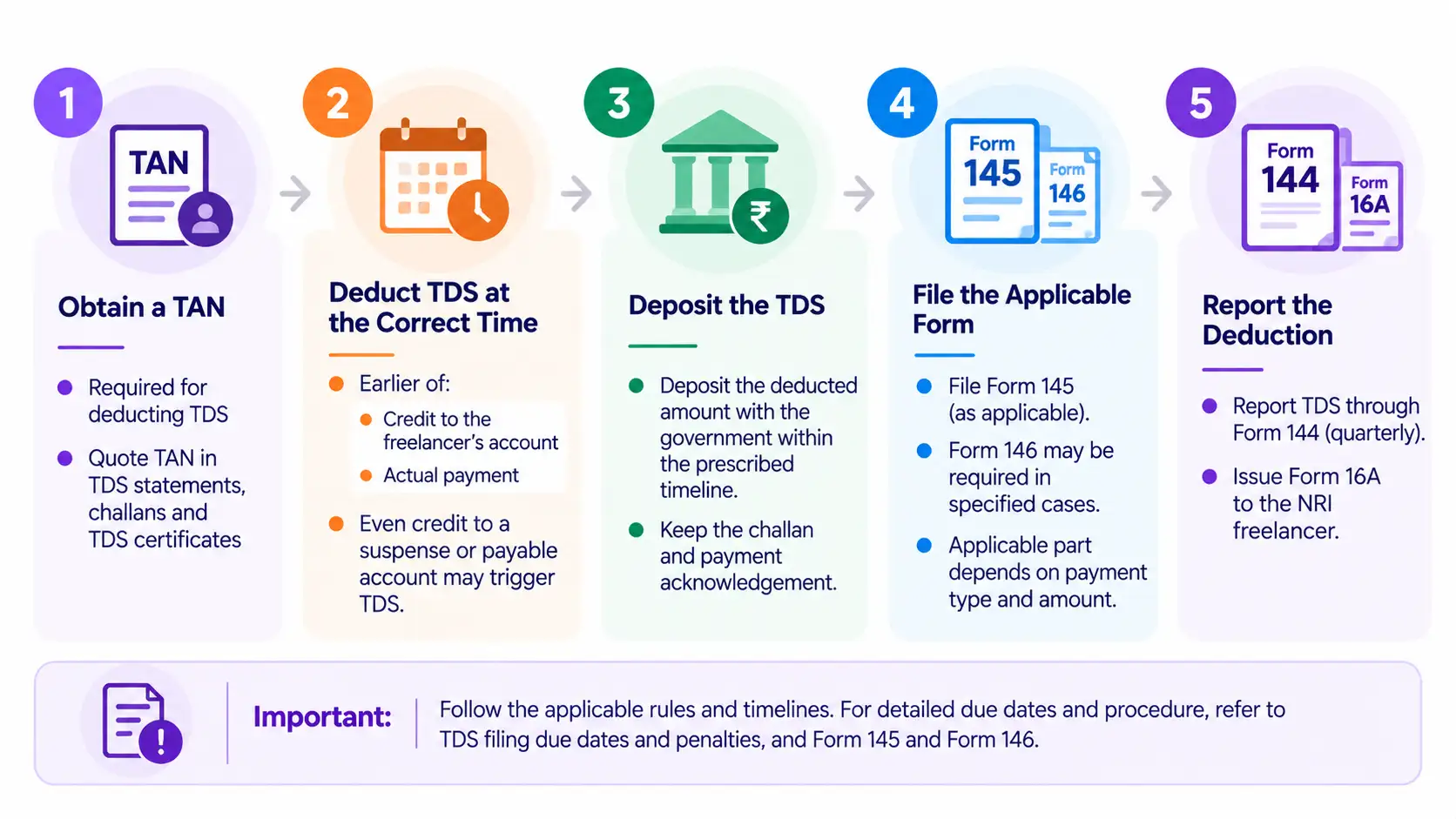
A Tax Deduction Account Number is generally required for a person responsible for deducting TDS. TAN must be quoted in TDS statements, payment challans and TDS certificates.
For non-resident payments, tax is generally deducted at the earlier of:
Crediting an amount to a suspense or payable account may still trigger the withholding obligation.
The deducted amount must be deposited with the government within the prescribed timeline. The payer should retain the challan and payment acknowledgement.
For the complete calendar, link readers to TDS filing due dates and penalties instead of repeating every deadline here.
Form 145 provides information about a payment made to a non-resident or foreign company. Form 146 is an accountant’s certificate used in specified cases.
The appropriate part of Form 145 depends on whether the payment is taxable, its amount and whether a lower-deduction certificate or accountant’s certificate has been obtained.
Official guidance states that:
Rule-based exceptions must also be checked.
For the complete procedure, internally link to Form 145 and Form 146.
TDS on non-salary payments to non-residents is generally reported through Form 144. The Income-tax Rules, 2026 prescribe Form 144 for quarterly reporting and Forms 145 and 146 for the prescribed non-resident payment reporting and accountant-certification requirements.
After reporting the deduction, the payer should issue Form 16A to the NRI freelancer.
An Indian startup pays ₹8 lakh to a UK-based NRI marketing consultant. The accounts team deducts 10% because it normally applies that rate to resident professional fees.
This approach may be incorrect because:
The correct amount could be higher, lower or nil depending on the facts. A convenient accounting rate is not a substitute for a taxability analysis.
Review taxability, treaty benefits and withholding before payment.
An NRI freelancer has two main options.
Where the expected withholding exceeds the likely Indian tax liability, an eligible payee may seek an appropriate lower or nil deduction certificate under the prescribed process. The certificate must be obtained before the relevant payment or credit.
This option can protect cash flow when payments are recurring or substantial. The certificate must be obtained before the relevant payment or credit.
If excess TDS has already been deducted, the freelancer may file an Indian income-tax return and claim credit for the tax reflected in the relevant tax records.
The refund claim should be supported by:
A refund is not automatic merely because the freelancer lives abroad. The return must show why the final Indian tax liability is lower than the amount withheld.
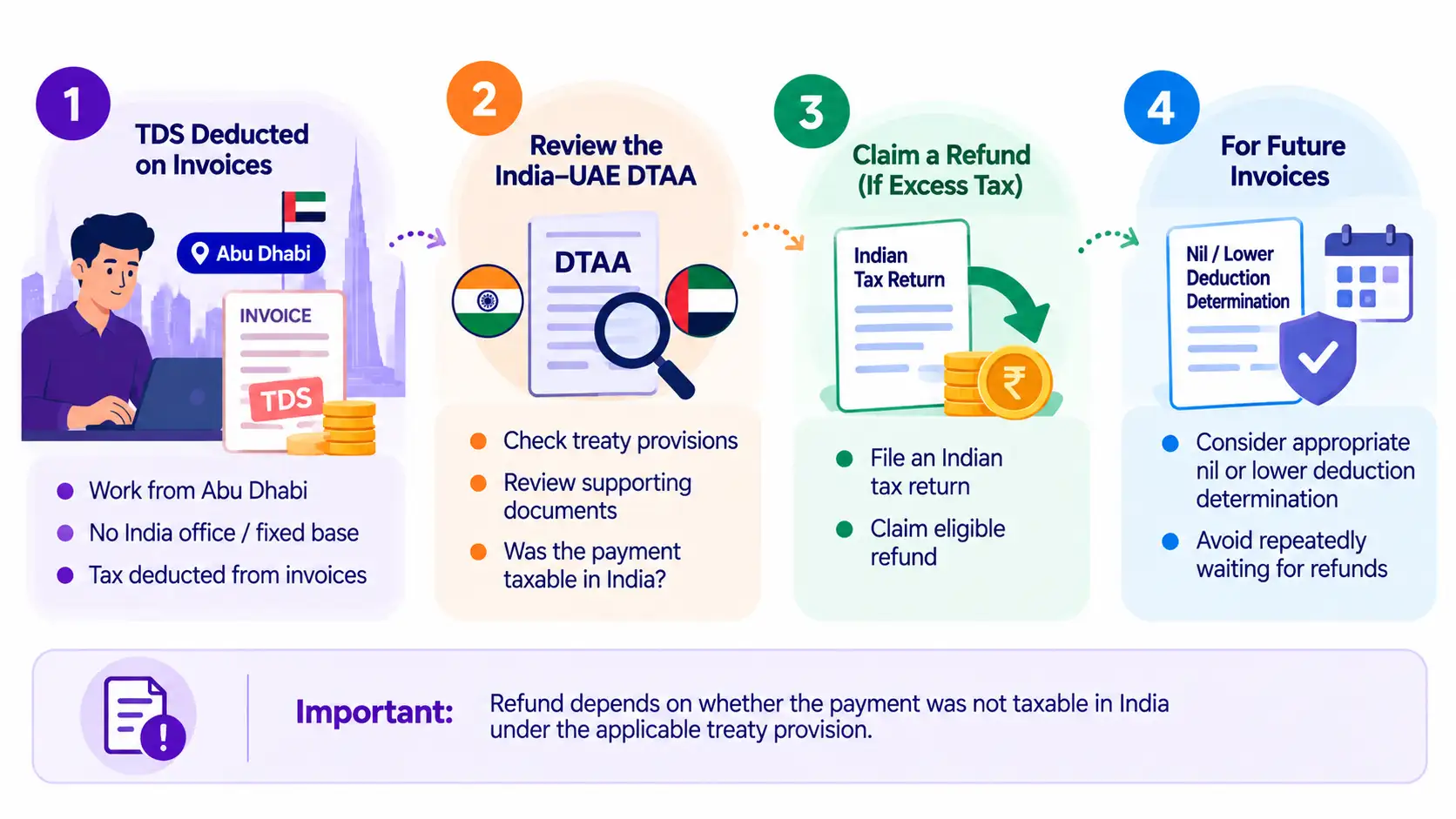
A UAE-based management consultant works entirely from Abu Dhabi and has no office or fixed base in India. The Indian client deducts tax from every invoice without considering the treaty.
After the end of the tax year, the consultant reviews the India–UAE DTAA and supporting documents. If the payment was not taxable in India under the applicable treaty provision, the consultant may file an Indian return and claim a refund.
For future invoices, obtaining an appropriate nil or lower deduction determination may be more efficient than repeatedly waiting for refunds.
TDS on payments to NRI freelancers cannot be determined using the invoice amount alone. The freelancer’s tax residence, place of work, contract, intellectual-property terms, Indian presence and applicable DTAA must be considered together.
Savetaxs can help Indian clients and NRI freelancers:
A pre-payment review is usually more effective than correcting excessive or insufficient withholding after the transaction.
This article is for general informational purposes only and does not constitute tax, legal, financial, or investment advice. Laws, regulations, rates, and procedures may change over time and may vary based on individual circumstances.
While SaveTaxs makes reasonable efforts to keep the information accurate and up to date, readers should verify applicable rules with official authorities or consult a qualified professional before making decisions based on this information.
Vipul Jain is the Co-Founder of SaveTaxs and a tax expert with experience in Indian and NRI taxation. He advises individuals, NRIs, and businesses on tax filing, tax planning, capital gains, DTAA, and compliance matters. He focuses on making complex tax concepts simple and helping taxpayers make informed, compliant decisions. See Full Bio
Want to read more? Explore Blogs