



Investment & Financial Planning
FCNR Deposit Interest Rates in 2026FCNR Deposit Interest Rates in 2026
Written by Vipul Jain

_1777957219922.webp&w=3840&q=75)
One of the most common dilemmas for NRIs looking to grow their savings is choosing between FD and debt mutual funds. NRI fixed deposits allow NRIs to deposit their earnings in an Indian bank account. On the other hand, debt funds pool investors' money to invest in fixed-income securities.
Both investment instruments offer steady returns. However, this decision became complex due to the tax treatment, currency risk, and post-2023 rule changes. To make the right choice, it's important to understand how each instrument is taxed in both India and your country of residence. Keep reading to learn more about debt funds vs. NRE fixed deposits.
An NRI Fixed Deposit (FD) is an investment option that allows NRIs to deposit their earnings in an Indian bank account. It offers higher interest rates and may offer several tax benefits, like tax-free returns based on the investment type. NRI FD can be in the form of NRE (Non-Resident External) FD, NRO (Non-Resident Ordinary) FD, or FCNR FD. Each type has its own features and offers unique benefits.
Not all NRI fixed deposits are created equally. The type of account you choose will determine your tax treatment, currency exposure, and the freedom to repatriate. Here are the four NRI FD options available to NRIs:
| Basis | NRE Fixed Deposits | NRO Fixed Deposits | FCNR (B) Fixed Deposits | Gift City FD |
|---|---|---|---|---|
| Best for | Tax-free FD in INR | Indian income deposits | Currency hedging | Offshore FX deposits |
| Currency | Indian Rupee (INR) | Indian Rupee (INR) | USD, GBP, EUR, JPY, etc. | USD, EUR, GBP, and 14+ currencies |
| Source | Foreign income only | Indian or foreign income | Foreign income | Foreign income |
| Tax in India | Nil and fully exempt | Taxable at applicable slab rates | Nil and fully exempt | Nil - offshore SEZ |
| TDS | None | 30% + 4% cess (reducible under DTAA) | None | None |
| Repatriation | Fully repatriable (principal + interest) | Up to 1 million USD per year (after tax) | Fully repatriable | Freely repatriable |
| Tenure | 1-10 years (minimum 1 year for interest) | 7 days to 10 years | 1-5 years | Flexible: no premature penalty |
| Rates | 6.5 - 7.5% per annum | 6.5 -7.5% per annum | 4.5 - 5.5% per annum | 4.5 - 6% per annum |
Debt mutual funds collect money from investors to invest in fixed-income securities. It includes government bonds, treasury bills, corporate bonds, commercial papers, certificates of deposits, and other similar instruments. It offers professional portfolio management within the specific income space. These mutual funds are managed by SEBI-regulated Asset Management Companies (AMCs).
Debt fund returns are not guaranteed like FDs. It might fluctuate based on the interest rate movements and the credit quality of the underlying instruments. However, they usually return 0.5-1.5% higher than comparable FD rates. There are various types of debt funds that NRIs can invest in. Let's understand the available options.
Here are the main types of debt funds available to NRIs, as per the SEBI's classification:
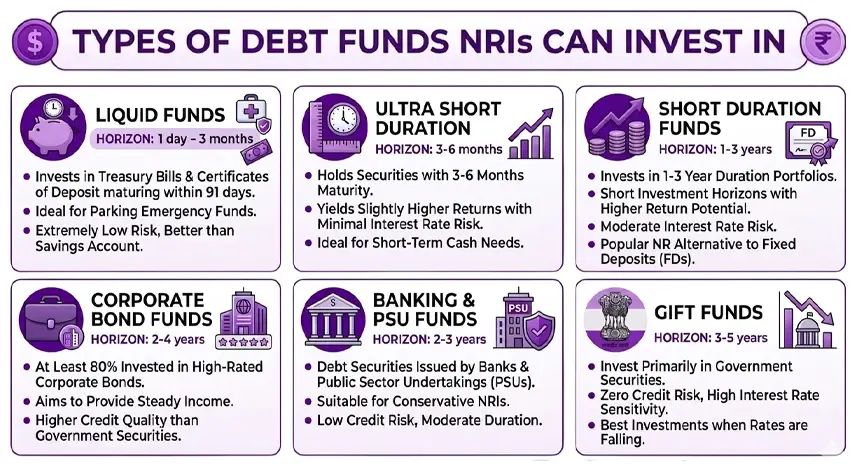
Liquid Funds (Horizon: 1 day - 3 months): Invest in treasury bills and certificates of deposit maturing within 91 days. It is ideal for parking emergency funds. These carry extremely low risk and are better than a savings account.
Ultra Short Duration (Horizon: 3-6 months): Hold securities with 3-6 months maturity. Compared to liquid funds, these yield slightly higher returns with minimal interest rate risk.
Short Duration Funds (Horizon; 1-3 years): Invest in 1-3-year-duration portfolios, ideal for investors with short investment horizons. It has the potential to yield higher returns and has moderate interest rate risk. These are most popular for NRIs as an alternative to FDs.
Corporate Bond Funds (Horizon: 2-4 years): Invest at least 80% in high-rated corporate bonds. It aims to provide a steady income and has higher credit quality than government securities.
Banking & PSU Funds (Horizon: 2-3 years): Invest in debt securities issued by banks and public sector undertakings (PSUs). It's suitable for conservative NRIs. It has low credit risk and moderate duration.
Gift Funds (Horizon: 3-5 years): Invest primarily in government securities. It has zero credit risk and high interest rate sensitivity. These investments are best when the rates are falling.
On paper, debt funds often target returns of 0.5 - 1.5% higher than those of equivalent-tenure FDs. However, the actual after-tax return depends significantly on your tax situation. The table below lists the indicative current returns for FY 2025-26:
| Instrument | Indicative Return | Currency | Type of Return |
|---|---|---|---|
| NRE FD (1-3 years) | 6.5% - 7.5% per annum | INR | Fixed, guaranteed |
| NRO FD (1-3 years) | 6.5% - 7.5% per annum | INR | Fixed, taxable at 30% TDS |
| FCNR FD (USD, 1-2 years) | 4.5% - 5.5% per annum | Foreign currency | Fixed, no currency risk |
| GIFT City FD (USD) | 4.5% - 6% per annum | Foreign currency | Fixed, offset tax-free |
| Liquid/ Ultra-short debt fund | 6.5% - 7.5% per annum | INR | Variable, market-linked |
| Short Duration Debt Fund | 75 - 8.5% per annum | INR | Variable, market-linked |
| Corporate Bond Fund | 7.5% - 9% per annum | INR | Variable: credit, along with rate risk |
The tax treatment of NRI FDs is one of the clearest in the Indian tax code. The taxation rules are determined by the type of account and not the tenure or rate. The table below lists how NRI fixed deposits are taxed in both India and their resident country:
| FD Type | Indian Tax on Interest | TDS Rate | DTAA Reducible | Tax in Resident Country |
|---|---|---|---|---|
| NRE FD | Nil- fully exempt under the Indian Income Tax Act, 2025 (Schedule IV) | None | Not available | Varies by country, so ensure to check the local law. For example, in the UAE, Nil, and in the USA/UK, it is taxable as ordinary income |
| NRO FD | Taxable at applicable slab rate |
30% + 4% cess = 31.2% |
|
Foreign tax credit available for taxes paid in India |
| FCNR (B) FD | Nil- fully exempt in India | None | Not available | Same as NRE- Check local law |
| GFIT City FD | Nil- offshore SEZ (FEMA treats as outside India) | None | Not available | Varies: often exempt (UAE) or taxable with FTC available |
An NRI must provide their Indian bank account to claim DTAA benefits on NRO FD interest. You must also provide a valid tax residency certificate (TRC) from your country of residence and a completed Form 10F. The bank will deduct TDS at a rate of 31.2% without these documents.
Under the Finance Act 2023, debt mutual fund taxation in India was restructured. The key tax benefit of debt funds was eliminated for all units purchased on or after 1st April, 2023. The benefit was long-term capital gains with indexation benefit after 3 years. This is the significant change that any NRI investor must understand before comparing debt funds with FDs. Here is how NRI debt funds will be taxed based on the purchase date:
| Purchase Date | Tax Treatment | Holding Period Impact |
|---|---|---|
| Before 1st of April, 2023 |
|
The Holding period of 24 months matters. |
| On or after the 1st of April, 2023 | All gains are taxed at the applicable slab rates, regardless of the holding period under Section 50AA | Holding period is irrelevant. The slab rates apply, regardless of whether held for 1 month or 10 years |
For NRIs, the fund house or platform deducts the TDS before the money reaches your bank account at the time of redemption. The table below lists the applicable rates for units purchased on or after 1st of April, 2023:
| Scenario | TDS Rate (before surcharge & cess) | Effective Rate (with 4% cess) |
|---|---|---|
| Debt fund gains purchased post April 2023 are treated as STCG | 30% (at the highest slab) | 31.2% (at 30% slab + 4% cess) |
| Debt fund gains pre-April 2023 purchases are treated as LTCG if held for more than 24 months | 12.5% | 13% (approx) |
| Debt fund dividend (IDCW) | 20% | 20.8% (approx) |
Yes, NRIs can claim DTAA treaty rates on capital gains from mutual funds in India. However, capital gains on Indian securities are taxed in India at Indian rates for most DTAA countries. The key benefit of the DTAA treaty is to avoid double taxation through the foreign tax credit in the resident country. Remember that it doesn't reduce the Indian tax rate.
To claim any DTAA-based relief, NRIs must submit their tax residency certificate (TRC) and Form 10F to the AMC/platform. Let's now look at some examples of how NRE FD and debt funds are taxed.
Suppose an NRI has Rs. 25 lakh, which he wishes to invest for 3 years. Let's compare an NRE FD and a debt fund investment. We will consider two tax scenarios. UAE NRI (no foreign income tax) and a USA NRI (subject to US income tax)
| NRE FD / 25,00,000 / 3 Years / 7.25% p.a. (compounded quarterly) | |
| Principal invested | Rs. 25,00,00 |
| Maturity value (3 years quarterly compounding) | Rs. 31,14,450 (approx) |
| Total interest earned | Rs. 6,14,450 |
| Indian income tax on interest | Nil (NRE- fully exempt) |
| TDS deducted in India | Nil |
| Taxation in the UAE (no personal income tax) | Nil |
| Net after-tax return (UAE NRI) | Rs. 6,14,450 - effective 7.25% per annum |
| Debt Fund / 25,00,000 / 3 years / 8% per annum (estimated return)/ Purchased April 2024 | |
| Principal invested | Rs. 25,00,000 |
| Estimated NAV gain over 3 years | Rs. 6,49,000 (approx) |
| Tax treatment (post-April 2023 purchase) | Section 50AA - STCG at slab rate |
| TDS at redemption (30% slab + 4% cess) | Rs. 2,02,488 deducted upfront |
| Net after Indian TDS (UAE, NRI, no further tax) | Rs. 4,46, 512 |
| Effective after-tax return (UAE, NRI, 30% slab) | ~5.52% per annum - significantly lower than NRE FD |
These examples will help you understand how you will be taxed based on the investment made in NRE FDE or a debt fund.
Get CA-approved investment strategies tailored to your financial goals
For NRIs with medium to long-term stable income, the NRE fixed deposit remains the main choice. It's a combination of guaranteed returns (6.5 - 7.5%), complete Indian tax exemption, and full repatriation freedom. It's difficult for any debt fund to beat on an after-tax basis, given the post-2023 slab-rate taxation. Conversely, debt funds are ideal for NRIs with very low Indian income and falling in the Nil or 5% tax bracket. It retains a strategic role in short-term liquidity and interest-rate plays.
If you are confused about which investment instrument to choose, seek guidance from an expert. When it comes to experts, Savetaxs is the name to trust. At Savetaxs, we have a dedicated team of experts with years of knowledge. Our team can help you choose the right investment instrument based on your financial goals. We also offer guidance on issues related to NRI taxation, cross-border compliance, and DTAA advisory services. Contact us now, and get expert guidance at every step.
This article is for general informational purposes only and does not constitute tax, legal, financial, or investment advice. Laws, regulations, rates, and procedures may change over time and may vary based on individual circumstances.
While SaveTaxs makes reasonable efforts to keep the information accurate and up to date, readers should verify applicable rules with official authorities or consult a qualified professional before making decisions based on this information.
Vipul Jain is the Co-Founder of SaveTaxs and a tax expert with experience in Indian and NRI taxation. He advises individuals, NRIs, and businesses on tax filing, tax planning, capital gains, DTAA, and compliance matters. He focuses on making complex tax concepts simple and helping taxpayers make informed, compliant decisions. See Full Bio
Want to read more? Explore Blogs
_1781845771869.webp&w=828&q=75)
_1778936280179.webp&w=828&q=75)
_1778936089630.webp&w=828&q=75)