


US Tax Filing and Compliance
Is an S Corporation Worth It? Costs, Tax Benefits and Decision ChecklistIs an S Corporation Worth It? Costs, Tax Benefits and Decision Checklist
Written by Shubham Jain


Do you know, as an NRI, that if you sold an apartment, house, commercial property, or any type of real estate in the U.S., you would trigger FIRPTA withholding? FIRPTA (Foreign Investment in Real Property Tax Act) applies when a non-resident alien sells property in the U.S., and the buyer withholds a certain amount from it to deposit with the IRS.
This comes as a surprise to NRIs, as FIRPTA generally requires withholding at 15% of the amount realized from the sale of a U.S. real property interest, rather than the seller's actual capital gain. The amount realized can include cash paid, the fair market value of other property transferred, and certain liabilities assumed by the buyer. The realized amount from the sale of the property may include the fair market value of the property transferred, liabilities assumed by the buyer, and cash. For instance, if you sell property valued at $500,000, then $75,000 is deposited with US tax authorities.
However, this does not mean that every non-resident alien selling property in the U.S. is subject to the 15% FIRPTA withholding rate. For example, properties valued under $300,000 that are used as a residential home by the buyer may be subject to nil withholding. Additionally, property sales between $300,000 and $1 million are subject to a 10% FIRPTA withholding rate. Having information about the FIRPTA withholding rate can help you avoid paying unnecessary taxes.
Want to know more about FIRPTA withholding and how NRIs can reduce the tax rate on it? Read the blog and get your answers.
FIRPTA, or the Foreign Investment in Real Property Tax Act, is a U.S. tax regime that generally requires withholding when a foreign person disposes of a U.S. real property interest. For an NRI who is a nonresident alien for U.S. tax purposes, this can apply when selling U.S. real estate. The withholding rate applies to the selling amount, not to profit or capital gain. The act operates under the Internal Revenue Code (IRC) Section 1445.
FIRPTA was enacted to ensure that the United States can collect tax on gains from the disposition of U.S. real property interests by foreign persons. The withholding rules generally require the buyer or other withholding agent to withhold and remit tax to the IRS. Under this act, the buyer is generally responsible for deducting the tax on the sale of the property and depositing it with the IRS.
This was all about FIRPTA. Moving ahead, let's know when this withholding rate applies to NRIs.
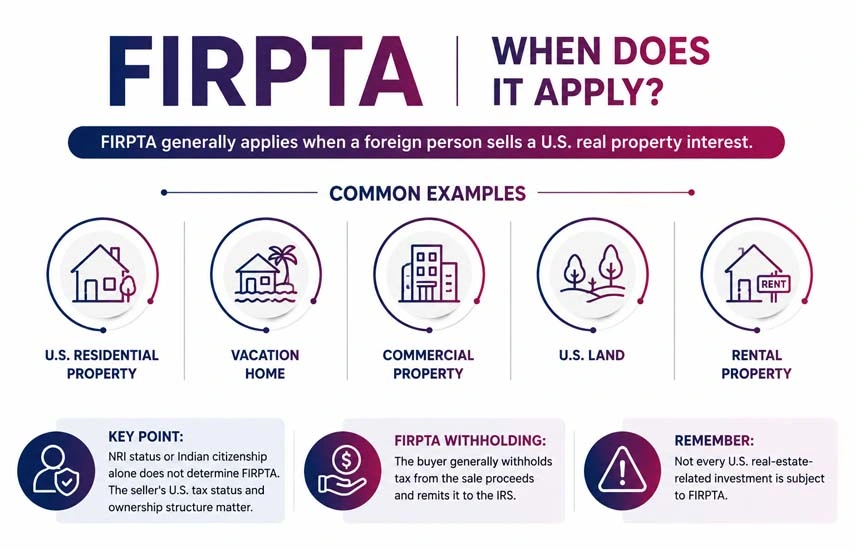
FIRPTA generally applies to an NRI when the seller is a foreign person for U.S. tax purposes, such as a nonresident alien individual, and the seller disposes of a U.S. real property interest. Indian citizenship or NRI status alone does not determine whether FIRPTA applies; the seller's U.S. tax status and ownership structure must also be considered. Additionally, selling property in the country. Considering this, visa status and citizenship are different from your tax residency status in the country. Common examples when FIRPTA applies to an NRI include:
Apart from the above-mentioned examples, you may also be liable to pay tax on certain U.S. corporations if certain FIRPTA requirements are fulfilled. Additionally, not every investment associated with U.S. real estate is subject to FIRPTA. Confused? Let's understand this with an example.
For instance, an NRI holding a property in the U.S. sold it. The buyer, while paying the NRI, will deduct a FIRPTA withholding amount. Here, the buyer is responsible for deducting the withholding amount and depositing it with the IRS within 20 days of the transaction, using the applicable forms.
So this is when FIRPTA applies to an NRI. Moving further, let's know what qualifies as a U.S. real property interest.
FIRPTA applies to direct real estate and certain interests in entities that hold US real property. To provide you with an idea, here are the asset types that qualify for U.S. Real Property Interest (USRPI):
| Asset Type | USRPI | Example | Notes |
|---|---|---|---|
| Direct real estate | Yes | Apartment, single-family home, land, condo, building | Core USRPI |
| Natural-resource rights | Yes | Mines, timber, well, gas and oil rights | Connected with U.S. land |
| Leaseholds and options | Yes | Long-term ground lease; have the choice to purchase the U.S. land | Considered as a real property interest |
| Stock in a US real property holding corporation | Yes | Under IRC § 897(c) (2), corporation shares meet the 50% USRPI threshold limit | Through the entity, ownership is still counted. |
| Personal property connected with real estate | Yes, in some scenarios | Movable asset used with a rental building | Only when connected with property |
| Personal residence held by the seller in their own name | Depends | A foreign individual sold it | USRPI, but with residence exception, withholding tax may be reduced |
| Stock in foreign corporation that has US real estate | No | Shares of a foreign company that owns US property | Different rules available |
This was all about what qualifies as a U.S. real property interest. Moving forward, let's know who is accountable for deducting FIRPTA withholding.
With expert guidance from Savetaxs, fulfill your U.S. tax obligations with full compliance on time.
As mentioned earlier, under section 1445, generally the buyer is responsible for withholding the FIRPTA rate when purchasing a property from a foreign owner. Under IRS rules, the buyer of the property is considered the withholding agent. Further, depending on the property transaction, other individuals such as a title company, settlement agent, or closing attorney may also help the buyer collect FIRPTA withholding. However, before withholding the amount, it is advisable, under the FIRPTA rule, to determine the responsible party for collecting it.
Additionally, the buyer reports the withholding amount on IRS Form 8288 and deposits both the form and the amount with the IRS within 20 days of the transaction.
So, the misconception that a foreign seller deposits the withholding amount with the IRS is not true; the buyer is responsible for deducting and depositing the amount with the IRS. Now, moving ahead, let's determine how much is withheld under FIRPTA.
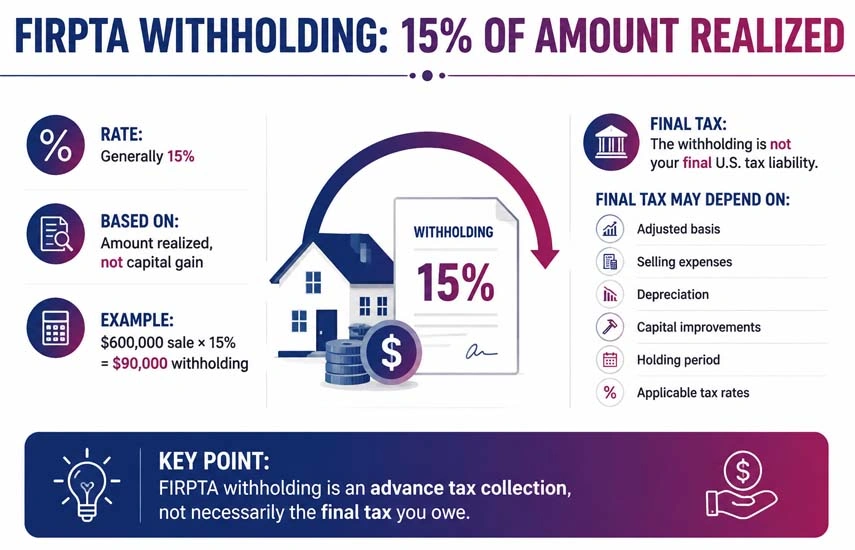
Generally, the FIRPTA withholding rate for an NRI is 15% applied to the realized selling amount. Here, it is vital for you to know that the withholding amount is applied to the selling amount, not to the capital gain or profit you received from the sold property.
The realized amount is known as the full contract price and may include other values and liabilities assumed by the buyer as part of the property deal. This includes the fair market value of the other transferred property, cash paid, and more. Confused? Let's understand this with an example.
For instance, if an NRI sells a U.S. real property interest for an amount realized of $600,000 and the 15% FIRPTA rate applies, the buyer would generally withhold $90,000 ($600,000 × 15%) regardless of your actual profit or what you originally paid. Here, this does not mean the $90,000 amount is your final U.S. income tax liability. Considering this, it depends on several factors:
It is vital to understand this, as it is one of the most essential aspects of the FIRPTA process. Moving further, let's know the difference between the FIRPTA withholding and Final U.S. taxes.
The table below showcases the key differences between the FIRPTA withholding and Final U.S. taxes.
| FIRPTA Withholding | Final U.S. Taxes |
|---|---|
| This amount is collected when a foreign individual sells U.S. real estate property. | This is determined when you report all your income and deductions on your U.S. tax return. |
| Generally applied to the realized selling amount. | Based on the applicable U.S. tax laws and rules. |
| The buyer or property transferee is responsible for FIRPTA withholding. | Attributable to the tax position of the seller. |
| The withholding rate is generally 15%. | The final U.S. taxes may be higher or lower than the FIRPTA withholding. |
| You can reduce the amount before closing. | Calculated after considering the actual property transaction. |
So this is how the two amounts- FIRPTA withholding and final U.S. taxes- are different from each other and cannot be interchangeable. Further, did you know you may reduce the 15% withholding rate? Want to know how? Read the next section.
No, FIRPTA withholding is not always 15%. As mentioned above, you can reduce the withholding rate; however, if there are the following scenarios:
Considering this, If the residence-use requirements are not met, or the amount realized exceeds $1 million, the general 15% withholding rate generally applies, subject to other applicable FIRPTA exceptions or an IRS withholding certificate. For the residence exception, the buyer or a qualifying family member generally must have definite plans to reside at the property for at least 50% of the days the property is used by any person during each of the first two 12-month periods following the transfer. Vacant days are not counted.
So, the FIRPTA withholding rate does not always remain 15%; under certain conditions, it can be reduced. Now, let's know can FIRPTA withholding can be reduced before closing.
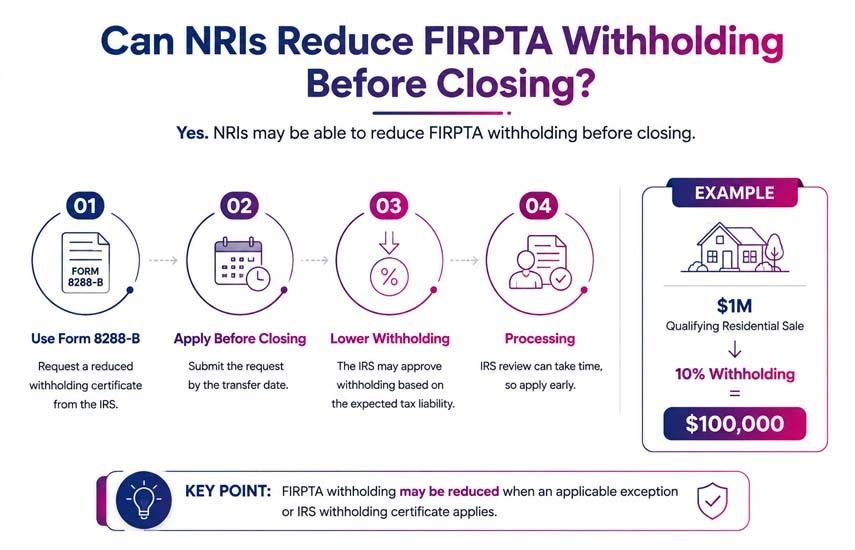
Yes, FIRPTA withholding can be reduced before closing. It can be done in circumstances where the actual tax liability of the seller in the U.S. is less than the FIRPTA withholding. Considering this, before closing the sale, you need to fill out IRS Form 8288-B with the IRS. It is a withholding certificate that you fill out to request a reduction or elimination of the FIRPTA withholding. The form shows your actual expected capital gain and your actual tax obligation, rather than a flat rate.
You need to submit the form on or before the transfer date. Generally, the IRS responds to it within 90 days. If your form receives IRS approval when closing the sale, the lower amount is withheld, so you do not need to wait several months for a refund on money you never owed. The purpose of the form differs from that of FIRPTA exemptions.
This is because the FIRPTA exemption applies when the property transaction meets specific exemption conditions, such as residency use and the realized amount limit. In contrast, the withholding certificate applies to the seller's situation and the expected tax due.
For example, if an NRI sells a U.S. property for $1,000,000 and the buyer acquires it for qualifying residential use, the transaction generally falls within the 10% withholding rule. The FIRPTA withholding would therefore generally be $100,000 rather than $150,000. Here, instead of the 15% FIRPTA withholding rate, the 10% rate will apply. So the withheld amount will be $100,000 instead of $1,50,000.
So, the FIRPTA withholding rate does not always remain at 15%; it depends on the realized amount, the buyer's use of the property, and the seller's actual tax obligation. Moving forward, let's discuss the differences between the FIRPTA exemption, the withholding certificate, and the refund.
Most NRIs, when selling property in the U.S., get confused about the FIRPTA exemption, the withholding certificate, and the refund, as they are interconnected. But as mentioned earlier, these are three different concepts. To give you an idea, the table below highlights the key differences between them.
| Option | When It Applies | Key Purpose |
|---|---|---|
| FIRPTA Exemption | Before or during closing when the statutory conditions are met. | Under the applicable exemption, reduce or eliminate the withholding rate. |
| Withholding Certificate | It is requested before or on the sale date. Approval of the IRS is required. | Based on the seller's tax obligations, reduce or eliminate the withholding amount. |
| FIRPTA Refund | After the property transfer, when part of the realized amount is withheld. | The excess amount you received after filing the U.S. tax return that was withheld during the property transaction. |
Generally, after submitting the withholding certificate, the IRS acts on it within 90 days. Here, the processing takes time; it is advisable for the seller to submit the form before closing the property transaction. The simplest way to differentiate these three terms is:
So this is how the FIRPTA exemption, withholding certificate, and refund differ from each other. Moving ahead, let's know what happens after FIRPTA withholding.
After completing the property transaction in the U.S., the FIRPT withholding process does not end; it begins. Considering this, NRIs need to complete the following forms.
Filling out Form 8288 and Form 8288-A and submitting them within 20 days of the property transaction is the responsibility of the buyer. Considering this, Form 8288 is known as "U.S. Withholding Tax Return for Certain Disposition by Foreign Persons of U.S. Real Property Interests." This form reports the FIRPTA withholding amount kept by the buyer from the property transaction.
Additionally, Form 8288-A is the statement that serves as evidence that the seller has paid the withholding amount from the sale of the property. The buyer generally files Form 8288 with the IRS and attaches Form 8288-A for each foreign transferor. The IRS stamps Copy B of Form 8288-A and sends the stamped copy to the foreign seller. The seller generally uses the stamped Form 8288-A to claim credit for FIRPTA withholding on the U.S. tax return. This form helps the seller to claim the excess withheld amount from the IRS when filing the U.S. tax return. The stamped Form 8288-A is the standard document used to claim credit for FIRPTA withholding. If the seller does not receive a stamped Form 8288-A because the transferor's TIN was missing, the IRS provides an alternative procedure using substantial evidence of withholding and the required information.
To claim the credit on the excess FIRPTA withheld amount, you need to fill out a U.S. tax return using Form 1040-NR. Under it, you need to report your actual capital gain or loss from the sale of the property and claim the FIRPTA credit for the year.
As mentioned earlier, the FIRPTA withholding amount is calculated on the realized gross amount from the sale. Most of the time, this generally results in a refund, especially during long-term holdings. Further, to prove that you have paid the FIRPTA withholding amount, attach a copy of Form 8288-A that you received from the buyer with your U.S. tax return. After filing the applicable U.S. tax return and claiming the FIRPTA withholding credit, the refund may take additional processing time. Current IRS instructions state that refunds involving Form 8288-A may take up to six months.
To claim a refund for your excess withholding and file U.S. tax returns, you need an ITIN. If you do not have one, apply for it using Form W-7 with your passport and other supporting documents. If an NRI seller does not have an SSN and needs a U.S. taxpayer identification number to meet the FIRPTA filing or reporting requirements, they may generally apply for an ITIN using Form W-7 under the applicable IRS rules. So, apply for it accordingly.
This was all about what happens after FIRPTA withholding. Moving further, let's know what happens if an NRI sells the property at a loss.
Selling a property at a loss does not exempt you from FIRPTA withholding. As mentioned earlier, the FIRPTA withholding rate applies to the realized sale proceeds, not to the capital gain or profit from the property.
Considering this, even if an NRI sells U.S. property at a loss, they may still face FIRPTA withholding on the realized amount. Further, they can receive the excess amount withheld when filing their U.S. tax return.
So, in simple terms, the FIRPTA withholding rate still applies even if an NRI sells the U.S. property at a loss. Now, moving forward, let's know whether FIRPTA applies to rental property as well.
Yes, FIRPTA withholding may apply to a rental property held by an NRI. The fact that the property is rented out does not exempt it from FIRPTA withholding. However, allowable tax deductions or claimed depreciation may affect the adjusted basis and the character of the property's capital gain.
Considering this, an NRI selling a rental property in the U.S. should first review the depreciation history and adjusted basis of the property before calculating the final tax obligation. Here, the calculation of FIRPTA withholding and the capital gain calculation are two different things.
So, in simple terms, if an NRI sells a rented property in the U.S., FIRPTA withholding applies, regardless of how the property was used. Moving ahead, let's see how FIRPTA withholding applies when the NRI receives the U.S. property by inheritance.
Inheriting U.S. property and later selling it are separate tax events. FIRPTA withholding generally becomes relevant when the foreign owner or applicable estate disposes of the U.S. real property interest. For inherited property, the U.S. tax basis is generally determined under the inherited-property basis rules, commonly using the property's fair market value at the date of death, subject to applicable exceptions.
heriting U.S. property does not itself trigger FIRPTA withholding. However, if an NRI later sells the inherited U.S. real property and is a foreign person for U.S. tax purposes, FIRPTA withholding may generally apply to the sale, subject to applicable exceptions. The property's U.S. tax basis is generally determined under the inherited-property basis rules, which can affect the seller's final gain or loss. Now, moving further, let's know what an NRI should do before selling U.S. property.
Before selling a U.S. property, an NRI should consider the following points:
These are some key things that NRIs should consider before selling U.S. property. Now, moving ahead, let's know the common FIRPTA withholding mistakes that NRIs should avoid.
Here are some common FIRPTA mistakes that NRIs should avoid
These are the common FIRPTA mistakes that NRIs should avoid when selling U.S. property. Let's better understand this with an example.
For instance, Rahul is a non-resident alien in the U.S. He sells a property there for $700,000. Now, as he is a non-resident alien, he is subject to FIRPTA withholding. Here, we assume that a 15% FIRPTA withholding rate applies to his realized amount of $105,000 ($700,000 x 15%).
Further, based on factors such as capital improvements, selling price, adjusted basis, depreciation, and the character of the gain, his final tax obligations would also be determined. If his final tax obligation is lower than the FIRPTA withholding amount, he can claim it when filing his U.S. tax return. He may also apply for the withholding certificate using Form 8288-B before closing the sale.
These are the common FIRPTA mistakes that NRIs should avoid. Moving further, let's know the things NRIs should consider during the whole U.S. property selling process.
Here is a quick checklist for NRIs selling U.S. property:
So, this was a quick checklist that NRIs should consider while selling a property in the U.S.
Connect with Savetaxs and resolve all your doubts about FIRPTA withholding.
FIRPTA withholding reduces the amount of sale proceeds paid to the foreign seller at closing, but it does not necessarily represent the seller's final U.S. tax liability. The seller's final tax is determined after reporting the transaction and calculating the actual taxable gain or loss. It is simply a tax rule that applies to NRIs who sell U.S. property. With the right strategy, you can reduce the 15% FIRPTA withholding rate to 10% or 0% through the buyer-residence exemptions. Additionally, to claim the refund on the excess withheld amount, you need to file a U.S. tax return.
Further, if you are planning to sell your U.S. property and are looking for assistance in determining your tax position in the country, connect with Savetaxs. The tax experts on our team will help you determine your tax status in the country, assessing your FIRPTA position before and after the U.S. property sale. With us, you can simply sell your U.S. property without any issues.
This article is for general informational purposes only and does not constitute tax, legal, financial, or investment advice. Laws, regulations, rates, and procedures may change over time and may vary based on individual circumstances.
While SaveTaxs makes reasonable efforts to keep the information accurate and up to date, readers should verify applicable rules with official authorities or consult a qualified professional before making decisions based on this information.
Vipul Jain is the Co-Founder of SaveTaxs and a tax expert with experience in Indian and NRI taxation. He advises individuals, NRIs, and businesses on tax filing, tax planning, capital gains, DTAA, and compliance matters. He focuses on making complex tax concepts simple and helping taxpayers make informed, compliant decisions. See Full Bio

Want to read more? Explore Blogs



Yes, FIRPTA withholding can be reduced under the following circumstances: