US Tax Filing and Compliance
S Corporation Health Insurance for 2% Shareholders: Tax Rules and DeductionsS Corporation Health Insurance for 2% Shareholders: Tax Rules and Deductions
Written by Shubham Jain

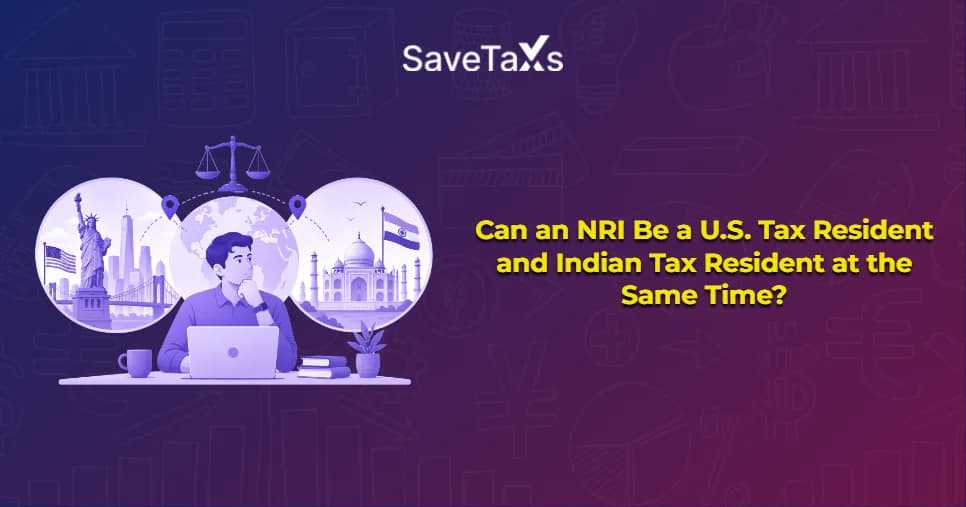
Yes, it's possible for an NRI to be a U.S. tax resident and an Indian tax resident in the same year. Tax residency is determined primarily under each country's tax rules. Citizenship, immigration status, physical presence, and other facts can all matter depending on the country and the specific rule being applied. Instead, both the U.S. and India use different rules to decide who is treated as a tax resident. So, you might meet the residency requirements of both countries during the same year even without intending to.
For U.S. citizens, green cardholders, NRIs returning to India, and individuals who spend significant time in both countries, this situation can be particularly important. One easy example of this is a green cardholder moving back to India, becoming an Indian tax resident while remaining a U.S. tax resident. It's because the individual still holds a green card; they are a US tax resident, and, based on the number of days spent in India, they also become an Indian tax resident.
Dual residency doesn't automatically make you liable to pay tax twice on the same income. However, it does increase your reporting and tax-filing requirements. Also, there are various tax rules that can help reduce the risk of double taxation, based on your situation.
In this blog, we will understand how the U.S. and India determine your tax residency, when you may face dual tax residency, what requirements you may face, and the benefits you can claim.
An individual being a tax resident of two countries in the same year is very simple in logic. So, both the US and India follow their own approaches and rules for determining who counts as a tax resident. When both countries' tests were written, the other country was not taken into account. Also, there is no specific rulebook that forces the countries to follow the same set of rules.
Therefore, it's completely normal for an individual to be a tax resident of two different countries in the same year. It means being a US resident under US rules and a resident of India under India's tax residency rules in the same year. There's nothing to be stressed about, and it's not rare.
However, another important point arises: both countries use different rules to determine your tax residency. It's important for you to understand these rules. That being said, let's now learn how both countries determine your tax residency.
If you are not a U.S. citizen, you will face two important tests to determine your eligibility for U.S. tax residency:
Let's look at both tests in detail.
Generally, a lawful permanent resident who holds green-card status at any time during the calendar year is treated as a U.S. tax resident under the Green Card Test, unless the status has been properly abandoned or otherwise terminated.
Let's look at an example to make the green card test easier to understand.
Example of Green Card Test
Rahul moved from New York to India in April and spent the rest of the year living with his parents in Jaipur. However, he still holds a U.S. green card.
In this situation, His U.S. tax residency does not automatically end simply because he moves to India. If he retains his lawful permanent resident status, he generally remains a U.S. tax resident under the Green Card Test unless the status is properly abandoned or terminated. He will continue to be treated as a U.S. resident for tax purposes until he properly abandons or terminates his green card status. Now comes the second test.
In addition to holding a green card, you can become a U.S. tax resident based on the number of days you spend in the U.S. This is known as the substantial presence test, which considers your physical presence in the U.S. over a three-year period.
To meet this test, you generally need to be present in the U.S. for:
So, it's calculated by considering all the days in the current year along with:
If, after calculating all this, your number of days is 183 days or more, you will meet the substantial presence test and be treated as a U.S. tax resident.
*Point to Note: Remember that certain types of U.S. presence may get some exceptions and special rules.
Let's now look at an example to make the substantial presence test easier to understand.
Example of Substantial Presence Test
Assume that you were physically present in the U.S. for:
Now, when calculating for 2026, the following number of days will be considered:
After the calculation, your total number of days will be 180. But since you must be present for at least 183 days to meet the test requirement, you will not pass the test. As a result, you will not be considered a U.S. tax resident for 2026.
You need to meet the requirements of either the green card test or the substantial presence test to be considered a tax resident of the U.S. Next, we will learn about how India determines your tax residency.
India primarily uses day-count rules to determine whether an individual is a resident for tax purposes. It means the country considers the number of days you spend there in a year. Also, the basic residency conditions under the Income Tax Act 2025 largely remain the same.
So, generally you will be considered an Indian tax resident if you:
Another key point is that certain Indian citizens and persons of Indian origin visiting India may be subject to additional rules. These may include special day-count rules based on factors such as income and whether the individual is responsible for paying tax in another country.
It basically means that you can't simply say that I am an Indian resident because I spend about half the year there. This is not right. You must ensure you review your specific situation and the applicable residency rules rather than assuming everything on your own.
It's pretty common for anyone to be confused about whether this situation is rare or common. Let's clear this confusion.
If you've faced this situation, don't worry; it's very common. If you hold a green card and you move back to India, you will face this situation immediately when you meet India's day count test. It basically means simply not using the green card will not end your obligation on the U.S. side.
The same rule applies to those who meaningfully split time between both countries in a single year.
In short, if you have tax residency in both countries, you don't need to worry. Instead, you must understand your obligations and ensure compliance. Next, we will understand what happens when you become a tax resident in both countries.
Firstly, if you come across this situation, don't panic. Dual tax residency is neither illegal nor a mistake. It's simply a situation that can easily be handled by understanding your obligations and requirements.
So, once you qualify as a tax resident of both the U.S. and India in the same year, you may face tax filing and reporting obligations in both countries. However, this doesn't necessarily make you liable to pay tax twice on the same income. There are various mechanisms and rules that can reduce double taxation in certain situations, such as the U.S.-India tax treaty and the foreign tax credit.
Moreover, the exact treatment will vary based on your income, residential status, citizenship, green card status, and the number of days you spend in each country. In easy words, once you become a dual tax resident, you may become liable to do the following things:
To keep it short and simple, let's use an example.
Vishal worked in the US for several years and obtained a green card. Recently, he moved back to Delhi to stay with his parents and find a new job there.
He still holds his green card and hasn't formally given it up yet. As a result, the US still considers him a tax resident. Simultaneously, since he lives in Delhi and works full-time there, he is treated as a resident of India.
Now, considering Vishal's case, we can see that he neither did anything unusual nor acted intentionally, yet he still ended up in this situation. This means being a dual tax resident might not always be your own choice, but you may still become one, and there's nothing to stress about.
Lastly, let's look at a quick checklist that will help you determine whether you are a dual tax resident.
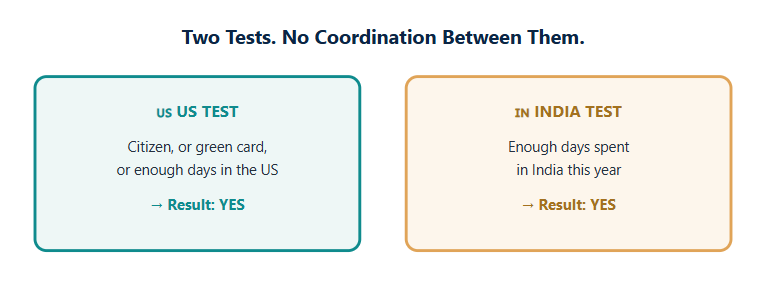
Consider the following questions and check whether your answers match to determine whether you also fall under the dual tax residency status:
After reading the questions, if you answered yes to both a US test and India test for the same period, you'll likely be treated as a dual tax resident for that year. If you are still not sure, you can confirm your status with a professional.
Let Savetaxs handle your US tax needs with expert care and utmost precision.
You must now have understood that it's very common to be a tax resident of both the US and India in the same year. It most commonly happens to green card holders, US citizens living in India, and people who spend significant time in both countries. Although it doesn't automatically make you liable for paying tax twice, it does create additional filing and reporting requirements.
You can reduce the risk of double taxation by claiming benefits under various treaties, such as the US-India tax treaty, the foreign tax credit, and other provisions. However, it's important to review your residency status every year, as your situation and the number of days spent in each country can affect it.
Moreover, if you are unsure about your residency status and need help, contact an expert at Savetaxs. We have a team of experts who can help you determine your residency status, understand treaty rules, claim a foreign tax credit, and file taxes in India and the US. Connect with us right away to stay compliant and avoid the risk of double taxation.
This article is for general informational purposes only and does not constitute tax, legal, financial, or investment advice. Laws, regulations, rates, and procedures may change over time and may vary based on individual circumstances.
While SaveTaxs makes reasonable efforts to keep the information accurate and up to date, readers should verify applicable rules with official authorities or consult a qualified professional before making decisions based on this information.
Vipul Jain is the Co-Founder of SaveTaxs and a tax expert with experience in Indian and NRI taxation. He advises individuals, NRIs, and businesses on tax filing, tax planning, capital gains, DTAA, and compliance matters. He focuses on making complex tax concepts simple and helping taxpayers make informed, compliant decisions. See Full Bio

Want to read more? Explore Blogs