
US Tax Filing and Compliance
FBAR Filing Deadline 2026: Important Dates, Automatic Extension & Filing GuideFBAR Filing Deadline 2026: Important Dates, Automatic Extension & Filing Guide
Written by Shubham Jain

As an NRI living in the United States, one of the most common questions that might wander into your mind would definitely be: "If my NRE account is tax-free in India, do I still need to file about it with the IRS?"?. The simple answer to this is yes. Yes, you almost always have to tell the IRS about it. The US tax system and the Indian tax system are completely different, and tax benefits or breaks in one do not necessarily carry over to the other.
In this blog, we will understand NRE and NRO account reporting to the IRS, among other topics.
The forms are applicable to persons living in the United States, such as green card holders and U.S. citizens, who also hold NRO and NRE accounts in India. Now this relates to a lot of people, such as NRIs who were once working in the US and attained a green card, a child of Indian parents born in the USA, or a naturalized citizen who keeps their Indian bank accounts active.
If any of the aforementioned individual categories applies to you, the IRS will treat your Indian bank account as a foreign financial account, regardless of what Indian taxes it and how.
The myth here is that many taxpayers think the NRE account interest is tax-free in India, so it does not need to be reported on their US tax return.
But the fact is, the Indian tax exemption on NRE interest applies only to India. The US tax system treats this NRE interest in its own way: it is generally fully taxable US income for a US person and must be reported every year, regardless of what India does with it.
For NRIs, it is natural to assume that tax-free means tax-free everywhere. But you should also understand that every country has its own tax rules and tax authorities. India does not set taxes for the United States. So if India decides that the NRE interest will be tax-free, it does not necessarily mean the US will also not tax this.
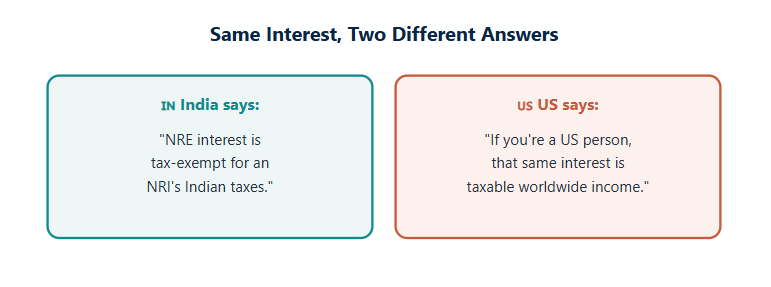
The US treats NRE and NRO accounts as original foreign bank accounts that hold taxable interest. Whereas for India these two accounts are treated differently. In the following table, we will demonstrate the tax treatment of the receiving account in the respective countries, namely India and the US.
| Account | Tax Treatment In India | Tax Treatment In The USA |
|---|---|---|
| NRE (Non-Resident External Account) | Tax-free in India. | Fully taxable US income |
| NRO (Non-Resident Ordinary Account) | Taxable in India where the tax is deducted at source. | Fully taxable US income |
The following are the applicable US tax forms:
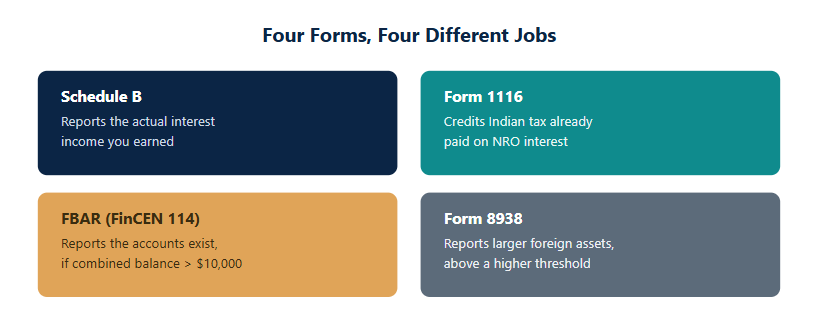
Now that Indian banks do not send the IRS a Form 1099 form as US banks do. Here, you are responsible for calculating and summing the interest yourself and reporting it on Schedule B, which is attached to your regular Form 1040. This treatment applies to both NRE and NRO accounts because the Indian tax-free label on NRE interest does not create an exemption here.
In India, the interest on NRO accounts is already taxed at the source. Now, if you file for this in the US, Form 1116 lets you claim a US tax credit for the NRO interest you have already paid in India, so you are not taxed twice. Whereas the NRE interest is not taxed in India in the first place, hence it has no US tax credit to claim. So, this form matters more for an NRO account than it matters for an NRE account.
Reporting the existence of the account is different from reporting the income. This means that you are reporting that ues the account exists. Now, across all your foreign bank accounts, the combined balance exceeds the threshold of $10,000 at any point during the year you need to file an FBAR. The FBAR is filed with the official Treasury Department and not with the IRS, as it is not attached to your tax return.
In case your total specified foreign financial assets cross a higher threshold, somewhere around $200,000 for someone living abroad. This could be higher for couples; you may also need to file Form 8938, attached to your actual tax return. Many taxpayers end up filing both the FBAR and Form 8938 in the same year for the same accounts.
The following table demonstrates the clear difference between the FBAR and Form 8938.
| Feature | FBAR | Form 8938 |
|---|---|---|
| Form | FinCEN 114 | IRS Form 8938 |
| Main purpose of the form | Report certain foreign financial accounts. | Reporting of the specified foreign financial assets. |
| General Threshold | $10,000 as the total maximum account value. | A higher threshold based on the circumstances. |
| Filed with the tax return | No | Yes, when required |
| Filed with | FinCEN | IRS |
| Can both be required? | Yes | Yes |
Here is an important update: Filing one does not automatically replace the others. As a US taxpayer with NRE, NRO, FCNR, and other foreign accounts, you may need to file both FBAR and Form 8938.
Nisha lives in Chicago and is a US green card holder. She owns bank accounts in India.
Nisha's NRE fixed deposit earns interest that is exempt from Indian tax. Whereas her NRO accounts earn interest, which is already deducted wherever applicable.
Here, what Nisha needs to consider is that she first needs to consider the interest she earned from both accounts when preparing her US tax return. The fact that she needs to know is that her NRE interest is tax-free in India does not automatically make it tax-free in the United States.
Second, if she has paid all the required income tax on the NRO income, she can claim the FTC using Form 1116, provided she proceeds in accordance with the applicable rules.
Lastly, she needs to run a check on the maximum balance of all her foreign financial accounts. This is because if her total amount exceeds the $10,000 threshold at any time during the year, she will be required to file an FBAR.
Finally, she must run a check to see whether her foreign financial assets also exceed the applicable Form 8938 threshold. If the threshold is exceeded, she must also file Form 8938.
The following is a quick checklist pointing out what you, as an NRI in the US, must take care of. Confirm any year-end United States taxes for tax purposes. This means whether you are a citizen or a green card holder.
Avoid double taxation as we help you understand the India-US DTAA.
As an NRI living in the United States, if you have an NRE or NRO account in India, it does not mean that it won't be reported in the United States. As the NRE interest is tax-free in India, but in the United States it will be treated as taxable income. The NRO interest is also taxable in the United States, although you might be able to claim the credit for the Indian taxes you have already paid on the NRO income in India.
Just remember that reporting of the income and reporting of the account in India are two different things. This is because you need to report your interest in Schedule B, disclose your foreign accounts via the FBAR, and then, if you fulfill the applicable threshold, you would also need to file Form 8938. Keep receipts for your Indian balances and interest income, as this will make your filing process much easier.
If you are a green card holder or a US citizen and NRI with an Indian bank account, it is advisable to seek professional assistance. Among those to trust is Savetaxs, as our experts will help you understand your tax obligations and avoid any sort of reporting mistakes. Our experts will assist with NRE/NRO instruments requiring FBAR, Form 8938, Form 1116, Schedule B, and US-India tax compliance.
Connect with us as we serve our clients 24/7 across all time zones.
This article is for general informational purposes only and does not constitute tax, legal, financial, or investment advice. Laws, regulations, rates, and procedures may change over time and may vary based on individual circumstances.
While SaveTaxs makes reasonable efforts to keep the information accurate and up to date, readers should verify applicable rules with official authorities or consult a qualified professional before making decisions based on this information.
Vipul Jain is the Co-Founder of SaveTaxs and a tax expert with experience in Indian and NRI taxation. He advises individuals, NRIs, and businesses on tax filing, tax planning, capital gains, DTAA, and compliance matters. He focuses on making complex tax concepts simple and helping taxpayers make informed, compliant decisions. See Full Bio

Want to read more? Explore Blogs

-for-401(k)_1790057066765.webp&w=828&q=75)