US Tax Filing and Compliance
US Salary Income Taxation for NRIsUS Salary Income Taxation for NRIs
Written by Hatim Dudhiyawala

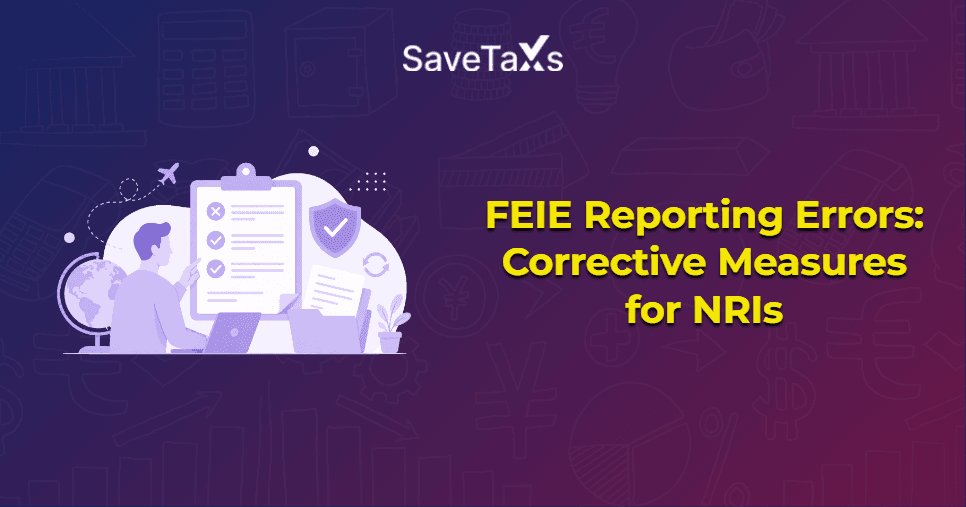
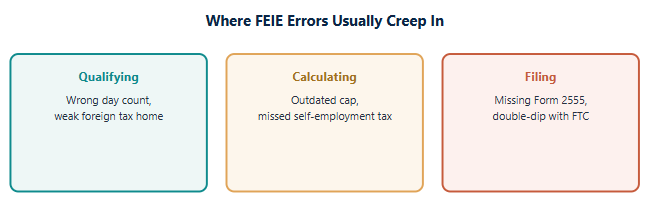
The Foreign Earned Income Exclusion (FEIE) can significantly reduce U.S. taxable income for eligible NRIs and U.S. citizens or Green Card holders living and working abroad. However, mistakes such as using the wrong exclusion limit, miscalculating qualifying days, forgetting Form 2555, or incorrectly combining FEIE with the Foreign Tax Credit can create compliance problems.
The good news is that most FEIE errors can be corrected. This guide explains the most common FEIE reporting mistakes, how to amend a return using Form 1040-X, applicable correction timelines, and when additional compliance procedures may be needed.
The FEIE isn't a simple checkbox it involves a specific qualifying test, a dollar cap that changes every year, and a strict rule against claiming it alongside the Foreign Tax Credit on the same income. Add in the fact that many NRIs prepare returns while juggling Indian financial documents that arrive late or in unfamiliar formats, and small errors creep in easily, even for careful filers.
Form 1040-X is the standard tool for correcting a previously filed return including a wrong FEIE figure, a missed Form 2555, or an improper FEIE/FTC overlap. It's specifically meant for substantive errors like these; simple arithmetic slips are usually corrected automatically by the IRS without needing an amendment at all.
Good News Either Way: if the correction increases your refund, amending simply gets that money back to you. If it increases your tax owed, filing promptly and paying what's due limits further interest and penalties acting first is always better than waiting for the IRS to find it.
To claim an additional refund through Form 1040-X, you generally must file it within 3 years of your original filing date (or the original due date, if you filed early) or 2 years from when you actually paid the tax, whichever is later. If you're only correcting an error that increases the tax you owe, there's no similar time limit stopping you from fixing it.
If FEIE errors are part of broader non-willful failures to report foreign income or financial assets, you may need to consider the IRS Streamlined Filing Compliance Procedures. However, these procedures have specific eligibility requirements and are not required simply because an FEIE mistake occurred in multiple years, since they address multiple years and form together under one coordinated process.
Often, yes. If the original error was an honest mistake or followed reasonable professional advice a reasonable cause argument can support waiving accuracy-related penalties. First-time filers with an otherwise clean compliance history may also qualify for automatic first-time penalty abatement. Filing the correction promptly, before the IRS identifies the issue on its own, meaningfully strengthens either argument.
Meet Ashwin. Filing his own return for the first time from Pune, he excluded $130,000 under FEIE and also claimed the Foreign Tax Credit for Indian tax paid on that exact same salary an overlap he didn't realize wasn't allowed. A friend later flags the issue.
Since his original return was accepted and the error is substantive, Ashwin files Form 1040-X to remove the improperly duplicated credit, keeping the FEIE exclusion and correctly applying the Foreign Tax Credit only to his remaining, non-excluded income. Because he catches and fixes it well within the 3-year window and before any IRS notice, he avoids a bigger dispute later.
Avoid the stress of US tax filing with expert help from Savetaxs.
FEIE can provide valuable tax savings, but even a small reporting mistake can affect your U.S. tax return. If you discover an incorrect FEIE claim, missed Form 2555, or an FEIE and FTC overlap, correcting it promptly is usually the best approach.
Savetaxs can help NRIs review FEIE eligibility, identify reporting errors, prepare amended returns, and manage related U.S. India tax compliance.
Contact Savetaxs today for expert cross-border tax guidance and make sure your FEIE claim is accurate and compliant.
Note: This guide is for information purposes only. The views expressed in this guide are personal and do not constitute the views of Savetaxs. Savetaxs or the author will not be responsible for any direct or indirect loss incurred by the reader for taking any decision based on the information or the contents. It is advisable to consult either a CA, CS, CPA or a professional tax expert from the Savetaxs team, as they are familiar with the current regulations and help you make accurate decisions and maintain accuracy throughout the whole process.
Hatim Dudhiyawala is a Certified Public Accountant (CPA) with SaveTaxs and specializes in Indian and NRI taxation. He advises individuals, NRIs, and businesses on income tax filing, capital gains taxation, DTAA benefits, fund repatriation, and tax compliance. With experience in cross-border tax matters, Hatim helps taxpayers understand complex regulations and make informed decisions. Through his articles, he shares practical insights to help readers stay compliant and manage their tax obligations with confidence. See Full Bio

Want to read more? Explore Blogs